
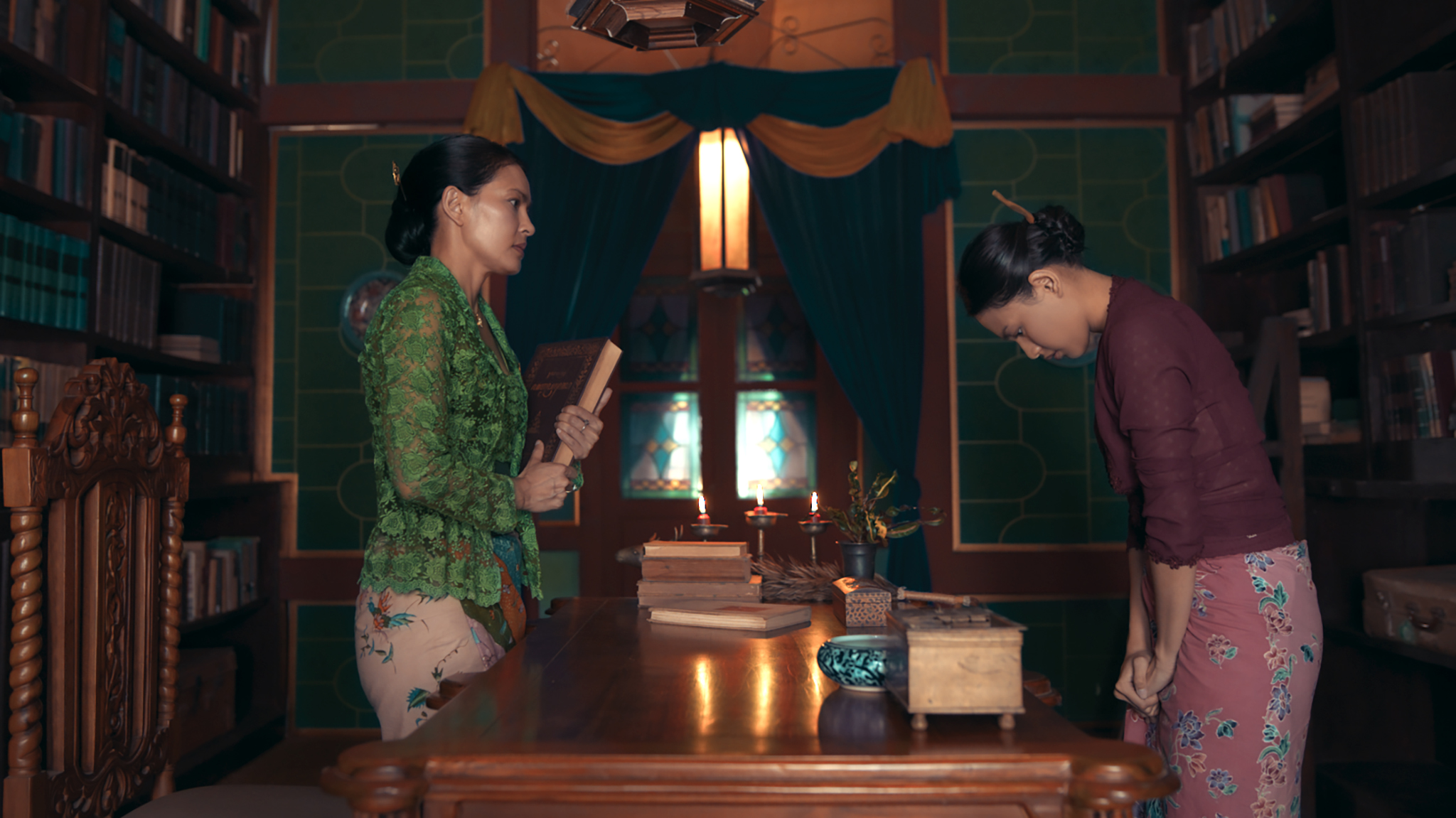
There’s an essential contradiction at the centre of Hanung Bramantyo’s spicy romantic melodrama Gowok: Javanese Kamasutra (Gowok: Kamasutra Jawa) in that, on the one hand, the gowok is said to exist so that men learn how satisfy their wives’ sexual desires. Which is to say, the sexual desires of women are recognised and approved rather than denied or taboo while men are expected to live up to satisfying them as part of what it means to be a proper man. But at the same time, women are constrained by the patriarchal institution of marriage, have few rights of their own, and are largely unable to live independently while lacking status as anything other than a man’s wife.
Indeed, the inserting of increasingly outdated notions of sex and class that stand in the way of romance and set the tragic events in motion rather than the black magic to which many attribute the looming crisis. Years before, Jaya’s mother had been in love with the soon-to-be king, but he couldn’t marry her because she wasn’t of sufficiently noble birth. She agreed to step aside and marry a mutual friend on the condition he would be given high office and her son would marry into royalty so that she would be a queen in all but name and their family would enter the royal bloodline.
Now a university student, Jaya (Devano Danendra / Reza Rahadian) is sent to a gowok to make a real man out of him, though as he explains to his father, that’s not what a real man is. Jaya is a young man of the new Indonesia who believes in things like equality of the sexes and the breaking down of the old class system even if he maintains his privilege in other ways, including submitting himself to the gowok. Nevertheless, while he’s there, he falls in love with the adopted daughter of his gowok Santi (Lola Amaria), Ratri (Alika Jantinia / Raihaanun), and makes her a lot of promises about the future while introducing her to the women’s movement in 50s Indonesia that offers her the vision of a different future in which she might become an independent woman rather than being forced to become a gowok herself. To become a gowok necessarily means that she would not be able to marry. Most gowok adopt children to succeed them. Accidentally seeing a secret ritual, Santi fears that Ratri has fallen victim to a pure love spell that threatens spiritual disaster should the man break his promise which, as an older woman, she knows he almost certainly will.
Then again, that turns out not quite to be the case and the lovers are in fact betrayed by those still clinging on to to the old class system. The destructive quality of their romance is played out against the background of the screws tightening across Indonesia as anti-communist fervour takes hold and suspicion falls on the women’s groups when military generals are abducted and murdered. Despite his progressive views, Jaya ends up married to a princess at his mother’s behest, exemplifying the ways in which women try to hold on to power by exerting matriarchal control over their sons. As for the princess, she is already pregnant by her communist boyfriend but prevented from marrying him and forced to marry Jaya instead though apparently coming fall in love with him after their marriage. Meanwhile, it turns out that there is an awkward connection between Jaya and Ratri that lends their fateful meeting a tragic quality even as his mother refuses to entertain the idea of Ratri marrying her son because her mother was a sex worker and she is not of their class.
In any case, though the gowok system may not actually be that different from other folk practices, there is something uncomfortable about it in that some of the “men” are very young and do not want to be there. Though Jaya, who is also sent there against his will, is in university and falls for Ratri who is around the same age, when his own son, Bargas, is sent to the gowok he is only around 14 and looks very childlike while ushered into “manhood” by a then 33-year-old Ratri. The system is at least potentially abusive and unethical while demonstrating how men are also ensnared by the patriarchal trap in that they too are being groomed for marriage whether they like it or not. It was in fact a man’s inability to remain faithful to the wife chosen for him that led to Ratri’s mother’s death and the activation of a black magic curse.
In any case, it turns out that human motivations can be far more damaging than any curse in the long years of anger, resentment, and misery born of misunderstandings and deliberately misdirected love. Ratri desperately tries to overcome her past and become an independent woman as a gowok but finds herself frustrated by the changing nature of society which promises so much freedom and opportunity in her youth only to immediately roll back on it while her own attempt at revenge backfires with tragic results. Poignant in its themes of tragic romance, the film quietly hints that this kind of oppression may not have really gone away even as Ratri seeks to reclaim her legacy in the 1980s-set coda by turning the gowok house into a school that educates women in a final attempt to finally free them from patriarchal control.
Gowok: Javanese Kamasutra screened as part of this year’s New York Asian Film Festival.
Trailer (English subtitles)

 Windows on Worlds