Leonor Will Never Die (Ang Pagbabalik ng Kwago, Martika Ramirez Escobar, 2022)

A grief-stricken screenwriter resolves to write her way out of self-imposed inertia while trapped in a world of her own creation in Martika Ramirez Escobar’s meta dramedy Leonor Will Never Die (Ang Pagbabalik ng Kwago). Drawing inspiration from the action exploitation films of the 1980s, the film asks some big questions about grief and agency and the role stories play in our lives while celebrating a sense of community in cinema along with the accidental immortality it may grant. 

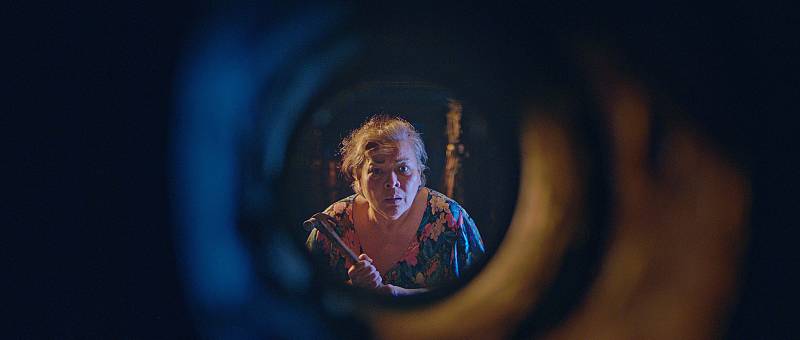
Once a successful screenwriter of action films, Leonor Reyes (Sheila Francisco) is now an elderly lady who has largely shut herself away following the tragic death of her eldest son, Ronwaldo (Anthony Falcon). Her youngest, Rudie (Bong Cabrera), still lives with her but as she later reveals there is distance between them and a sort of repellant dependency in which each resents the other and longs for freedom while simultaneously afraid to chase it. When Leonor “forgets” to pay her electricity bill and is berated by Rudie, she is handed a newspaper by the ghost of Ronwaldo containing an ad for a screenplay competition and decides to dust off the script she broke off when he died. While taking a cigarette break, she is hit on the head by a flying TV thrown out by the man next-door fed up with his wife’s addiction to soap operas and finds herself falling into the world of the film hoping she can save the hero, also named Ronwaldo (Rocky Salumbides), from his tragic fate. 

Shifting into a grainy 4:3 with mono aural sound, Escobar perfectly recreates the world of retro action drama but subtly updates it from its Marcos-era backdrop in replacing activists with drug users, her authoritarian thugs carrying out extrajudicial killings for reasons of intimidation. The movie Ronwaldo is set on revenge against a corrupt mayor and his vigilante son who shot his brother and then placed a pistol and a small packet of drugs next to the body, resisting authoritarianism in a way it may not have actually been possible to do so directly in the movies of the past. In any case, Leonor slips into her own screenplay as an awkward omnipotent force writing as she goes but struggling with her own role and agency before picking up a hammer and venturing into danger to rescue the hero and his love interest herself.  

From the other side of the screen, Rudie asks her if she’d be OK with someone else finishing her screenplay which is in a way asking her if she’s alright with her final decisions being made for her. That might be what Leonor is trying to decide for herself by rewriting in real time, searching for the right ending for her life’s story. Rudie had resented his mother, blaming her for keeping him behind when he planned to apply for an overseas work visa to join his boyfriend abroad but she wonders if he isn’t just using her as an excuse while afraid to take the risk. She by turn insists she can manage alone, but is perhaps afraid she can’t which, along with the grief she feels over Ronwaldo’s death, leads her to push him away. 

Leonor’s coma perhaps brings them both clarity that allows them to discover what it is they really want, Rudie finally handing agency back to his mother in telling her do what she has to do in a world of her own creation while she tells both her sons to be sure they write their own lives. The doctor had told Rudie that Leonor was trapped in a world between sleeping and waking and that you can’t wake someone who is not asleep, they will have to find a way to escape by themselves something which in one way or another Leonor perhaps does coming to terms with Ronwaldo’s death and breaking free of her grief through recapturing her creative spirit if writing a poetic end for herself. Then again as an authorial voice breaks through, life is never as simple as narrative and we’re rarely given the opportunity to edit our own stories or decide the way in which they end, perhaps Leonor isn’t either but even so passes into a world of joy and song in which there are no real endings only a great expanse of cinema. Charmingly surreal and filled with good humour, Leonor Will Never Die is at once the story of an old woman rediscovering herself while letting go of her grief and a celebration of escapist pleasures as paths towards self actualisation. 


Leonor Will Never Die screens in Amsterdam on 30th October as part of this year’s Imagine Fantastic Film Festival.

US release trailer (English subtitles)
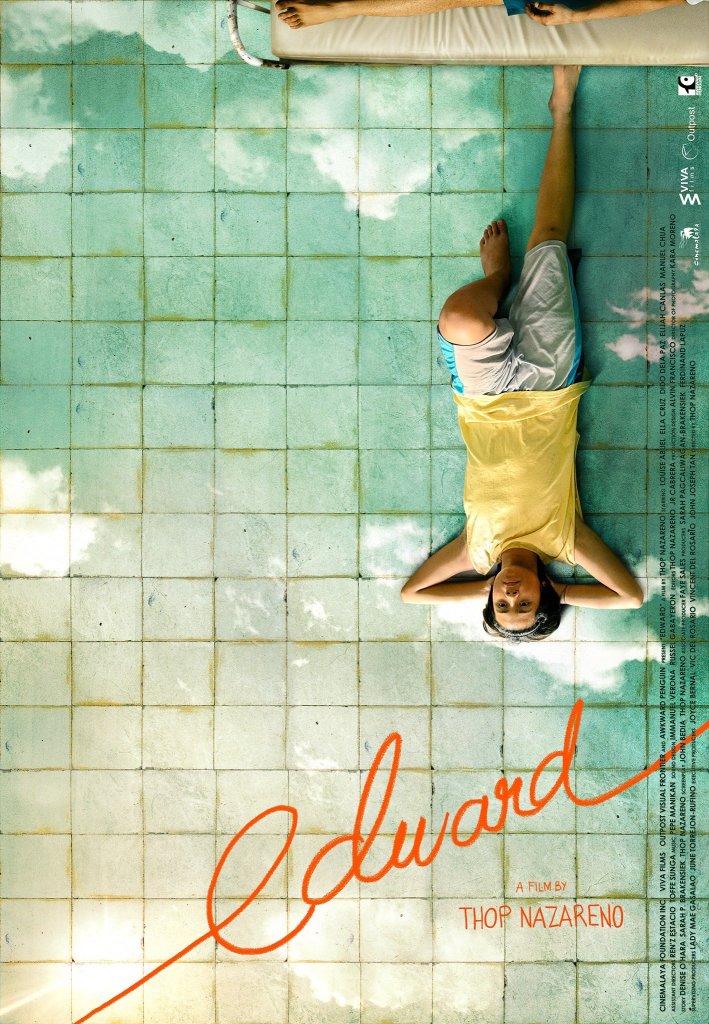
Edward (Thop Nazareno, 2019)

Maybe there’s no better place to learn about life and death than a hospital, but it’s a devastatingly cruel one in which to come of age in Thop Nazareno’s infinitely warm second feature Edward. A sharp condemnation of failing health policies with minor jabs to the political realities of the day, Edward finds its titular hero forced to grow up all too soon thanks to a confluence of personal tragedy, parental disappointment, and shattered dreams all of which are brought home to him as he begins to bond with his distant father while forced to care for him during his hospitalisation for an as yet undiagnosed respiratory complaint. 

Just a teenager, Edward (Louise Abuel) should probably be in school but he’s left his rural home to be with his father Mario (Dido de la Paz) at a hospital in Manila where he sleeps on the floor under his bed and is expected to provide care such as making sure he’s washed, changing sheets, and generally watching over him to be able to update the doctors on his condition. Technically speaking, Edward shouldn’t be taking on this responsibility, but his older half-brother Renato has had to leave and there are no other relatives available so the hospital has made an exception. As you might expect, he’s not as diligent as one might hope, especially as his relationship with his father is already strained, spending most of his time goofing off with another boy, Renz (Elijah Canlas), who is giving him a few life lessons of his own in drinking and weed while they help out running errands for the hospital staff. 

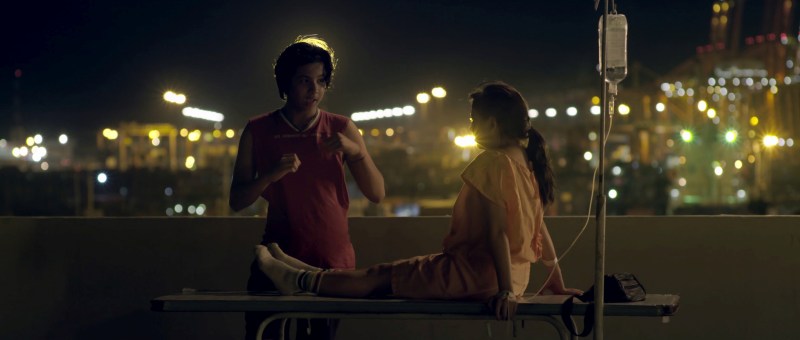
When we first meet the two boys they’re playing a grim game, taking bets on whether or not the emergency patients are going to make it. Nazareno opens with a long tracking shot following just one such casualty into the hospital, shifting chaotically from one bed to another while those in the crowded waiting area loudly call out for a doctor but are told only to wait their turn. Edward’s insensitivity bears out firstly how used he’s become to the liminal space of the hospital where death is never far away, but also his youth and impressionability, taken in as he is by Renz’ rather cool and cavalier approach to life. Later he bonds with a young woman, Agnes (Ella Cruz), herself an accident victim, who takes him to task for his callousness pointing out that she’s a real live human not the subject for a game, showing him it seems for the first time how inappropriate his behaviour has been. 

Though he knows very little about her aside from her name and that she seems to be around the same age, Edward enjoys spending time with the refreshingly direct young woman and comes to see it as something of a respite from being forced to care for his dad whom he is technically neglecting. We realise that Mario is perhaps not an easy man and the family network seems to have broken down, Renato declaring himself at the end of his tether and no longer prepared to care for a father who abandoned his family for another woman only to expect filial deference on becoming ill. Like Agnes, Edward is all alone but actively avoids looking forward, little realising that his father’s condition may be far more serious than they’d assumed, preferring to lose himself in the small absurdities of hospital life as if he were on a strange kind of holiday. 

Meanwhile, he discovers just how unequal and unfair the hospital system can be. During the chaotic opening we witness a congressman’s cook attempt to get bumped up the queue using his political clout while a boy bleeds out from gunshot wounds on a gurney behind reception. Mario’s original doctor leaves his position to move away, while the new one has his own private clinic and only works at the hospital on Tuesdays. Tests take three whole weeks to come back because they have to outsource and until then all they can do is guess and treat symptoms. While hanging out with Renz, Edward finds out about some decidedly dark and very untoward goings on at the hospital morgue which it perhaps doesn’t quite occur to him to feel disturbed by until much later.

For all that, Edward still hasn’t grasped that sometimes when they tell you you can go home, it’s not necessarily a good thing. Still, for the time that he’s there the hospital is a home. Mothered by overworked nurses and beginning to warm to his rather gruff father who only wants to talk to Renato (who doesn’t want to talk to him) while experiencing his first brush with romance, Edward comes of age staring death in the face. With its moody jazz score and wistful folk rock soundtrack, Thop Nazareno’s second feature doesn’t so much tug at the heart strings as play a merry tune with them, finding all the warmth there is in tragedy as Edward learns to navigate his hospital life towards its inevitable exit. 


Edward streamed as part of this year’s Udine Far East Film Festival.

Festival trailer (English subtitles)

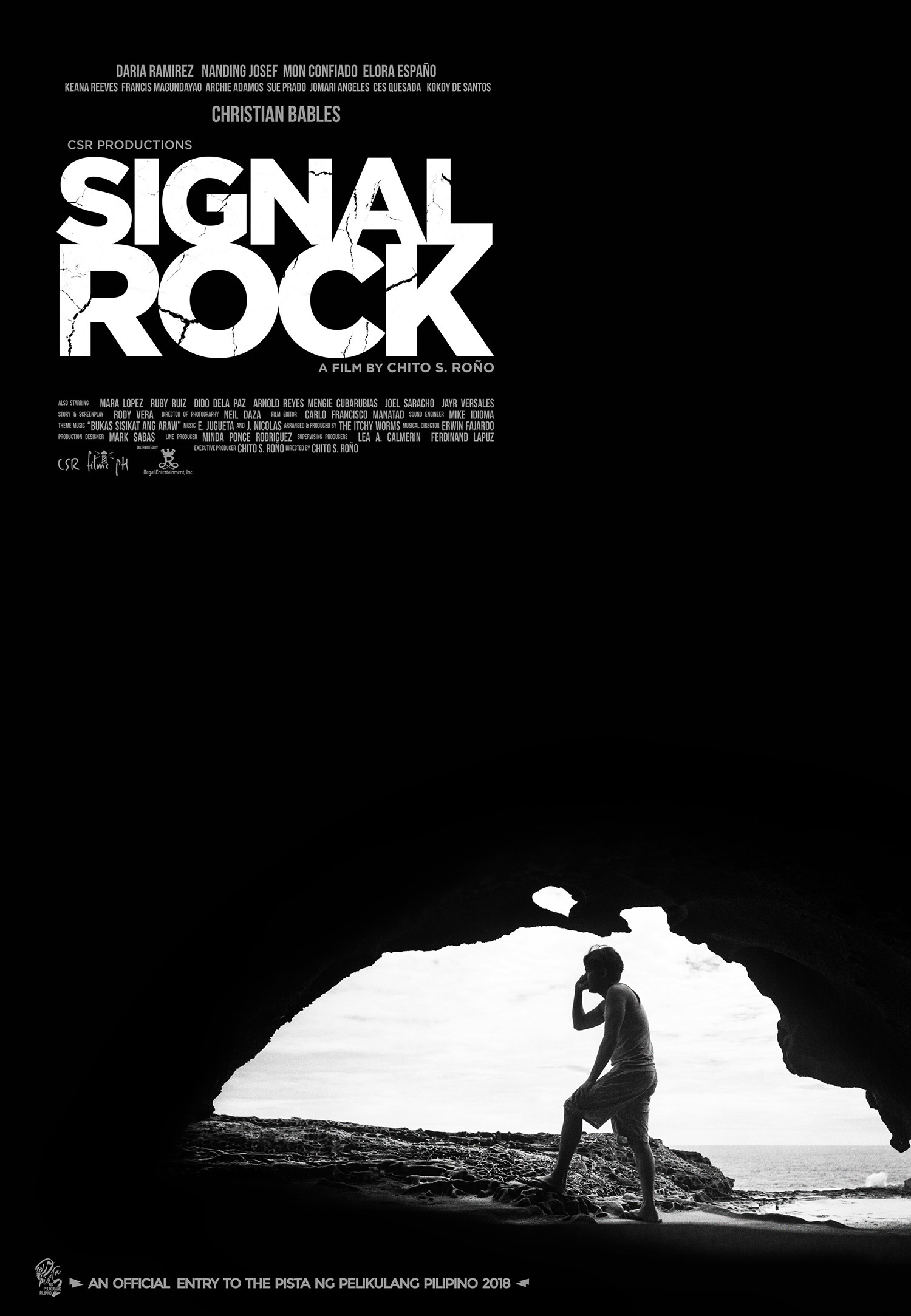
Signal Rock (Chito S. Roño, 2018)

kinopoisk.ru“Family is family, I can’t just say no” a young woman tells her boyfriend in response to his angry outburst on discovering that, like all the young women round these parts, she’s being dispatched to another part of the country to work in a bar. Inspired by true events in the ‘90s, Chito S. Roño’s Signal Rock situates itself in an idyllic fishing community left behind by the modern world like a lonely rock pool after the tide has pulled out. A microcosm of the nation itself, the island has become used to its transitory status as a conduit between two worlds, dependent on those who leave for its survival while the young men rendered incongruously obsolete have little more to do than battle their feelings of resentment and powerlessness.

Our hero, Intoy (Christian Bables), is the youngest son of the Abakan family, charged like so many young men with responsibility over technical things – in this case, maintaining the mobile phone which is the only point of contact that they have with oldest daughter Vicky who is supporting them all while working overseas in Finland. Remote as it is, the only place you can get a signal on the island is by climbing to the top of a rocky outcrop so communication has to be carefully planned in advance. This becomes a particular problem when Intoy discovers that the reason the money from Vicky hasn’t been coming through is that her relationship with a Finnish man with whom she has a small daughter is falling apart because he is both abusive and adulterous. As her daughter Sofia was born in Finland, Vicky fears that her boyfriend will try to seize custody and prevent her returning home to her family. Intoy, a fiercely protective brother, is not about to let that happen and sets about mobilising the community to hatch a plan to ensure Vicky and Sofia come home safely.

Despite Intoy’s protective instincts, the rest of the family’s relationship with Vicky is ambivalent. Oldest son Joaquin (Arnold Reyes), one of many resentful middle-aged men left on the island with not much to do, endlessly complains about the lack of ready money from his sister which he claims he needs to buy a motorbike in order to work. Joaquin also resents the shame of Vicky’s out of wedlock pregnancy, while the parents are still a little put out about the financial sacrifices they had to make in order for Vicky to achieve her “dream” of going abroad.

In order to sell the fantasy that Vicky comes from a wealthy family in the Philippines which is perfectly well equipped to support herself and her daughter, the Abakans are forced to confront their longstanding family issues. Intoy’s parents have been estranged for some time with his father technically living in a shed outside the main house, apparently loathed by his wife who claims the youngest two children are a result of marital rape. Another product of the patriarchal society, Intoy’s parents apparently eloped at a young age so that his mother could escape a marriage arranged by her father, only for the relationship to sour when Intoy’s dad lost his job at an American-run factory causing his wife to become disillusioned with his ordinariness.

Little seems to have changed in the last 30 years in that the lives of women are still largely dictated by the whims of their fathers. Vicky may have made a free choice to go abroad, but seeing as work is easier to come by for women, it is the norm for girls of the island to be sent away while the boys remain home alone. While dealing with his sister’s plight, Intoy is also facing the inevitable heartbreak of losing his girlfriend Rachel whose father has arranged for her to work in a bar in the city. As Intoy points out, from the parents’ point of view bar work is a pathway to finding a rich foreign husband – like Gina, another young woman from the village, who is returning home to celebrate her marriage to an elderly German (official now that his divorce has come through). Hardly pausing at the dockside, Gina introduces her former lover as a “cousin” before whispering in his ear that her feelings haven’t changed and she hopes to bring him to Germany for a better life after the old man snuffs it.

Intoy makes a kind of living on the island running errands for older people and acting as an MC during village celebrations, but as there is no real work round here and all the girls are gone, the young men largely spend their time playing basketball and getting into fights. They resent being forced to live off their sisters and seeing the women they love promised to other men, but have no other option than to make uneasy peace with their lack of possibilities. Intoy battles against his baser emotions, remaining kind and cheerful as he convinces his friends and neighbours to help him forge documents that imply his sister owns property while cosying up to the local mayor who hopes to hang on to power at the next election by convincing his wife to stand as a candidate.

Intoy alone is desperate to preserve the integrity of his family, even when spread across continents, standing out on Signal Rock as a kind of beacon left behind solely to convey information from one point to another. Having helped his sister, however, he discovers the depths of her resentment in her embarrassment at the idea of returning home after receiving the help of so many people. He loses his temper, unable to understand his sister’s rejection of everything he has worked so to protect at great cost to himself. Even so, Intoy manages to maintain his cheerfulness and desire to help others, sinking back into island life with his customary stoicism even if mildly troubled by a bargain he may have committed to without fully comprehending its implications. An ambivalent depiction of idyllic island life built on the back of female exploitation and entrenched patriarchy, Signal Rock nevertheless finds finds hope in community spirit and in its hero’s essential goodness.


Signal Rock screens in Chicago on Oct. 3 as part of the ninth season of Asian Pop-Up Cinema where actor Christian Bables will be present for an introduction and Q&A.

Original trailer (English subtitles)

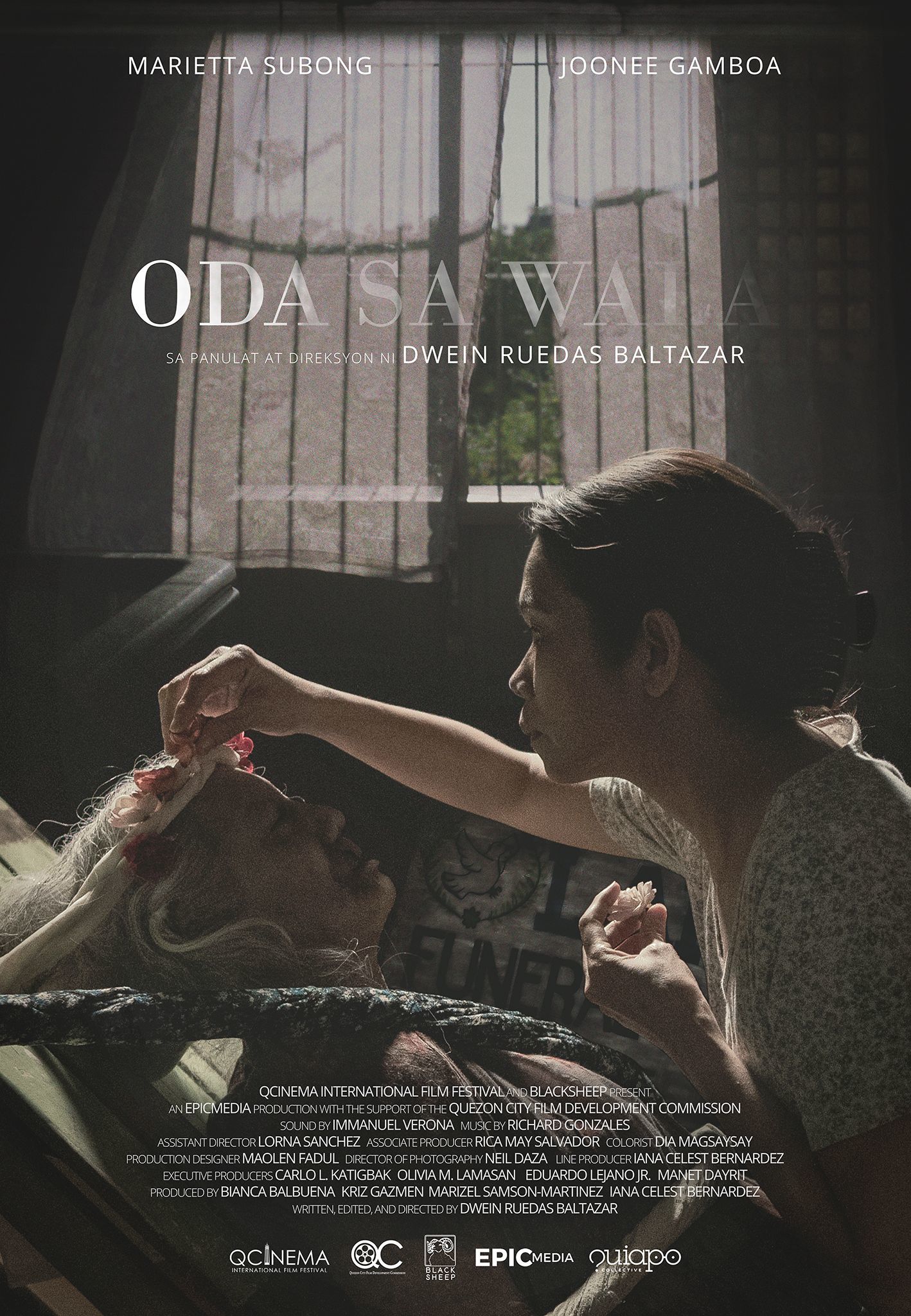
Ode to Nothing (Oda Sa Wala, Dwein Ruedas Baltazar, 2018) [Fantasia 2019]

Ode to Nothing poster 3“Maybe it would be better if I just disappeared rather than physically be here but feel invisible all the time” the lonely heroine of Dwein Ruedas Baltazar’s Ode to Nothing (Oda sa wala) sadly laments to her only source of comfort, a semi-embalmed corpse. A melancholy meditation on the living death that is existential loneliness, Ode to Nothing takes its alienated heroine on a journey of hope and disappointment as she rediscovers a sense of joy in living only through befriending death. 

43-year-old Sonya (Marietta Subong, AKA Pokwang) lives alone with her elderly father (Joonee Gamboa) to whom she barely speaks in a large Spanish-style house which doubles as a moribund funeral home. Short on custom, Sonya’s only frequent visitor is sinister loanshark Theodore (Dido de la Paz) who currently holds the deeds to the house while she struggles to make the interest payments. Meanwhile, she spends her days gazing out of open windows, waiting for the handsome young taho seller to arrive, and listening to an ancient cassette tape of Chinese folksong Mo Li Hua.

The stillness of her life is ruptured late one night when a couple of men arrive with the fresh corpse of an old woman, seemingly having run her over and not wanting the bother of taking her to a hospital seeing as she is already dead. Sonya is dubious. She doesn’t want any trouble either, but needs the money and the custom and so she agrees to take the woman in and see if anyone claims her. No one does, and soon enough the corpse has become a new presence in Sonya’s life and home. She begins to confide in it, dresses it in her mother’s old clothes, and sits it at the dinner table where her father too indulges the illusion, finally talking to her once again as if the family had really been restored.

In an odd way, the corpse guides Sonya back to life. No longer so sullen, her funeral parlour finally attracts some customers while she begins to dress more cheerfully, even dancing and skipping along to Mo Li Hua with girlish enthusiasm. “As you get older, you have more reason to do the things you were too afraid to do when you were younger” she explains to the corpse, outlining a brief overture she just made to Elmer (Anthony Falcon), the taho vendor, whose grandfather she also saw off around three years ago after which Elmer took over the taho vending business.

Taho is perhaps the perfect encapsulation of Sonya’s newfound hopes, wholesome sweetness and easy comfort. The blandness of off-white silken tofu mixed with the gentle colouring of the amibal syrup and sago pearls, like the Jasmine flower of the folksong, seem to symbolise the brief moments of possible happiness in an otherwise dull existence but even within her increasing sense of positivity she perhaps knows her rekindled desire for Elmer and for life is likely go answered. In any case, she falls into the corpse’s lap as if it really were her mother, attributing to it a supernatural power that keeps the corpses flowing and beckons both life and death to her lonely home.

As in any good fairy tale, however, you have to be careful what you wish for. Sonya gets what she wanted, but not at all in the way she wanted it. The corpse betrays her, leaving her bereft once again and entombed inside her own funeral home with the feeling that there is only one way out. Baltazar shoots in 4:3 with the rounded corners of nostalgic 16mm, but the frame cannot help but recall the small window on the surface of a coffin, as if we were peeking in on her still life from some other plane. Sonya is, in many ways, already dead, trapped in a moribund and hopeless world where even the fragmentary past is being slowly taken away from her – the broken cassette tape, the rapidly depleting furniture, Elmer’s crushing absence. She confesses that she’s afraid of the dark and of being alone, tired enough of her resignation to abandonment to embrace a corpse which can, of course, never leave you. It can, however, disappoint as all false idols will. A melancholy exploration of loneliness, defeat, and despair, Baltazar’s whimsical drama is a haunting ode to emptiness but one that clings sadly to life and hope even as the night draws in.


Ode to Nothing was screened as part of the 2019 Fantasia International Film Festival.

Original trailer (English subtitles)

Mo Li Hua

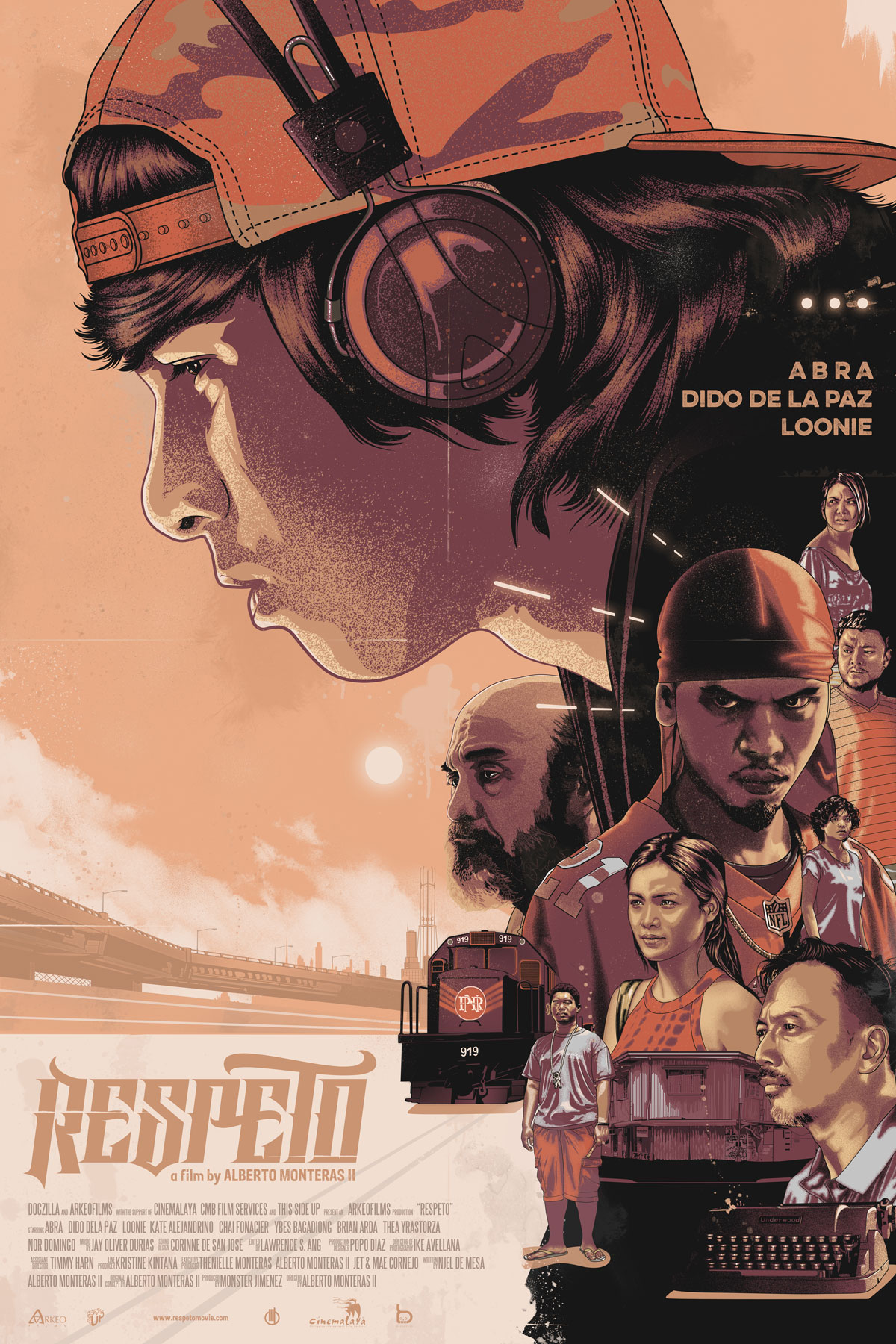
Respeto (Alberto Monteras II, 2017)

https://www.respetomovie.com/

https://www.respetomovie.com/“Respect” is a thorny issue, is it something which is conferred from a position of inferiority, an acceptance of equality, or taken by force? Should the older generation be “entitled” to the respect of the young simply for having been born earlier, lived longer, and have less time left, and should the state also be “entitled” to the respect of its citizens even if it abuses that respect? Respeto is the debut feature from Alberto (Treb) Monteras II but like much Philippine cinema it comes with heavy baggage as its scrappy youngster attempts to come of age in the hip hop dens of the Pandacan slums where all around him the increasingly oppressive Duterte regime brings back terrible memories for a generation only once removed from his own which paid a heavy price to rid themselves of a tyranny they now see returning.

Hendrix (Abra), a scrappy teen living with his older sister and her boyfriend who prides himself for his magnanimity in supporting his lover’s annoying kid brother, says he has the “mind of a gangster” and longs to prove himself in the underground rap battling world which represents a kind of escape from the harshness of his everyday existence. Hip hop maybe the music of the oppressed, but there’s little politicking in arcane world of petty gangsters and drugged up thugs. This is a world of humiliation – the rappers rap about rapping, about how their rhymes are sweeter than their opponent’s, how their opponent is weak and they are strong. Despite an often careful honing of a craft, this rap is vacuous – a misuse of words that could serve real purpose to do little more than replace the act of physical violence with macho male posturing.

This is certainly a very male, macho world. Inducted into the rap battle scene, Hendrix is tricked into battling an old veteran, Jambalaya – a larger lady with an intimidating presence, but all he can come up with is a steady stream of misogynistic fat jokes, badly delivered, before he wets himself live on stage. Jambalaya quite rightly destroys him with an elegantly delivered takedown which subtly suggests everything he’s just said is completely beneath him and is therefore doubly insulting. Hendrix is humiliated, as the loser of the battles is intended to be, but he’s slow to realise that the game itself is already a betrayal of its own power.

Having stolen the money to participate in the rap battle from Mondo (Brian Arda), his sister’s dodgy boyfriend, Hendrix hits on an extreme solution to pay him back – robbing the secondhand bookshop run by an old man, Doc (Dido De La Paz), seemingly suffering with the early stages of dementia. The plan fails because Hendrix and his buddies aren’t exactly master criminals, but as a result they find themselves tasked with having to repair the damage while Doc, mildly outraged by the youth of the day, begins to see enough potential in the obviously bright yet stubborn young man to want to try to save him.

What occurs between them is somewhere between a war of words and a war for words. Doc, now an old man, was an activist poet during the Marcos regime who lost a wife and child to its brutality. In the end, his words were not enough but unlike those of the rap battlers of Pandacan, they were both beautiful and filled with purpose. Doc’s verses were, in a sense, intended to humiliate a regime – in this they are not so different from Hendrix’s rhymes, but they failed to take the place of violence. A man of words faced with the possibility of revenge, Doc was not strong enough to resist but bought himself only more anguish in a single act of primal rage that soon forged another link in a chain stretching out in both directions across an eternity.

Peppered throughout, radio broadcasts make frequent reference to a debate surrounding the long delayed burial of former dictator Ferdinand Marcos who died in exile in 1989. The older generation fought an oppressive regime and thought they’d won only for their children to betray the revolution they gave birth to – literally in Doc’s case as his son became a corrupt policeman who abuses his power to humiliate those whose should “respect” he ought to earn through continued service. Rendered powerless by their oppressive environments, both Doc and Hendrix sought to reclaim their self respect by asserting their voice, but in the end their words find only empty air. Somehow awed by ancient technology, the kids find an old record of a Marcos era protest song in Doc’s bookshop and realise they already know the words. The singer, seemingly a young person, begs to be left out the political storm, not to be dragged into a war he sees as nothing to do with him, but an escape from this unending cycle of violence seems unlikely while words remain weightless.


Available to stream online via Festival Scope until 20th February 2018 as part of its International Film Festival Rotterdam tie-up.

Original trailer (English subtitles)