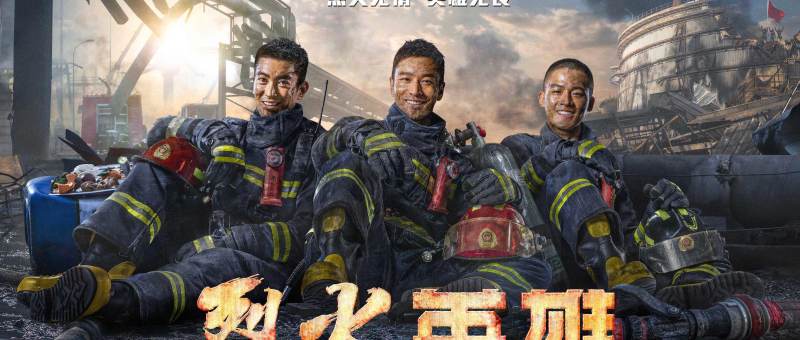
 2019 is an important year for China’s Communist Party. Not only is it the 70th anniversary of the founding of the People’s Republic, but it’s also the centenary of the May 4th Movement which saw Chinese students protest against increasing foreign influence. To mark the occasion, Bona Film Group is set to produce what it calls the “China’s Pride Trilogy”, or as the less generously minded might see it, a trilogy of propaganda movies of which The Bravest (烈火英雄, Lièhuǒ Yīngxióng) is the first. While China’s military has frequently taken centre stage in the nation’s increasingly jingoistic action movies, The Bravest is the first to focus on the heroic efforts of the fire service, which in China is operated by the army.
Inspired by a real life fire which broke out in Dalian, Liaoning Province in July 2010 and adapted from Mongolian author Bao’erji Yuanye’s book “Tears Are the Deepest Water”, The Bravest follows a collection of differing brigades who come together to battle a raging fire which has engulfed a coastal oil refinery. When we first meet our heroes, the Special Squadron, they’re in the middle of rescuing a little girl from a fire in hotpot restaurant. Though the operation is initially successful with the girl rescued and the fire extinguished, the owner has neglected to inform the fire fighting team that the back room is full of propane tanks, which is something he probably should have mentioned. One of the team is killed in the ensuing explosion while captain Liwei (Huang Xiaoming) is knocked out and thereafter removed from active duty while he deals with PTSD related to the incident.
Flashing forward, we’re told that if the wrong quantity of chemicals are added to the oil running through the refinery then it could catch fire, which it eventually does. The problem isn’t just the potential economic effects or even the possibility of a large scale explosion causing widespread infrastructure damage and loss of life, but that there is a possibility that the fire will release cyanide gas which has the potential to kill everything within the surrounding area. In the immediate aftermath of the fire breaking out, the harbour brigade, Special Squadron, and the tinpot rural team Liwei has been demoted to are all summoned to help but, unusually considering this is a propaganda film designed to praise the emergency services, are largely ill-equipped to deal with such a large and potentially hazardous incident.
Nevertheless, they live up to the movie’s name, bravely wading into harm’s way to minimise the damage. Meanwhile, mass panic is quickly overtaking the city as people begin to become aware of the potential danger through their smartphones or messages from someone connected to the refinery which is, after all, the economic centre of the area. Economics are partly what’s on the mind of the refinery’s chief who is often less than truthful with staff at the command centre, deliberately keeping information from them in an effort to control the situation and avoid being the guy who plunged an entire province into poverty. He does however give himself brownie points for sticking around when similar big wig villains in disaster movies usually get on their private jets and leave the emergency services to it. He’s joined by a selection of party officials who also break with cinematic tradition by standing next to the firefighters, a little way back from the frontline but very much still in harm’s way as they attempt to ensure a satisfactory outcome for all. In the hospitals too, doctors and nurses remain at their posts treating the injured rather than tending to their own wellbeing.
The focus is, however, the heroically altruistic actions of the firefighters who disregard their own safety in order to ensure that of others. Thankfully, in the real life incident no one was killed but in Movieland no one is that lucky and The Bravest remains remarkably unafraid to indulge in obvious foreshadowing such as poignant scenes of familial discord and even one pair of firefighters rushing to the scene still dressed in their outfits from getting their wedding pictures taken. Sad salutes and moments of silence are the order of the day while the firefighters divide up the hazardous duties by volunteering those with siblings so parents will be protected should the worst happen. Unashamedly melodramatic, there’s no denying the sheer spectacle of The Bravest’s cleverly crafted fire effects or its mammoth scale, even if it never manages to escape its nakedly propagandistic genesis.
Currently on limited release in UK/US/Canada/Australia/NZ cinemas.
Original trailer (English subtitles)


 Windows on Worlds