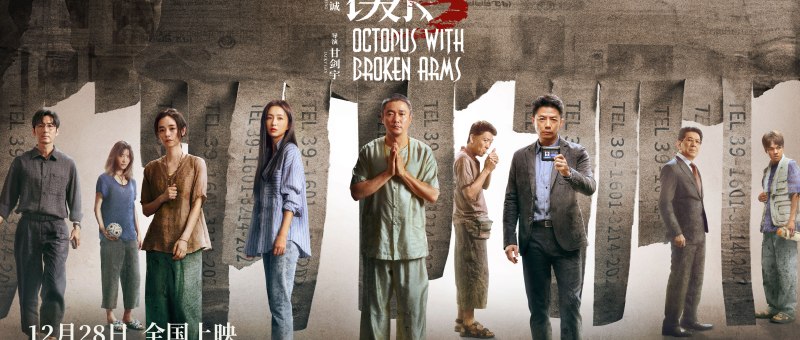
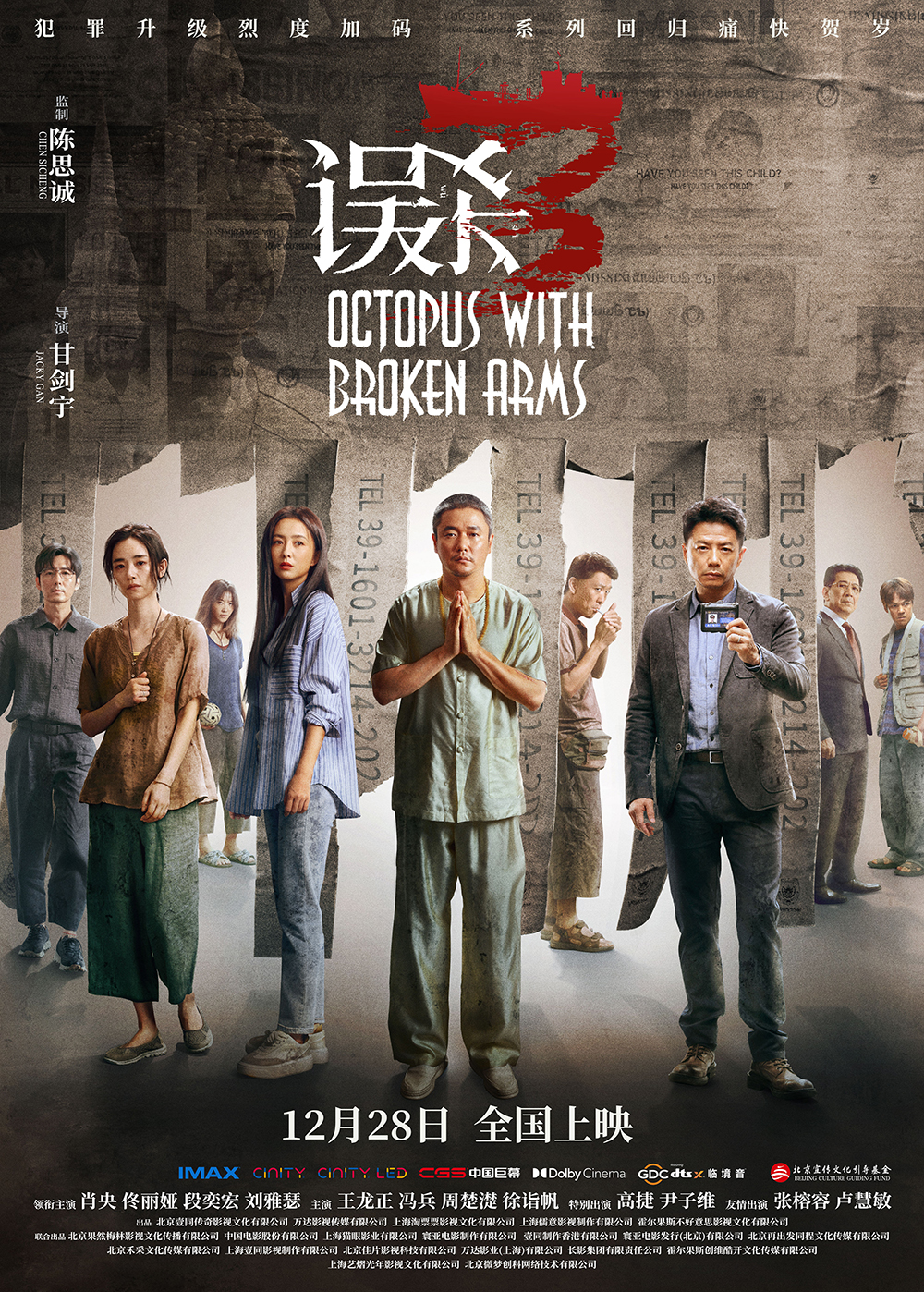
Octopus with Broken Arms (误杀3, Jacky Gan Jianyu, 2024)

It’s quite surprising, somehow, that Octopus with Broken Arms (误杀3, wùshā 3) gets away with as much as it does simply being another recent mainstream movie set in an unidentified South East Asian nation where, conveniently enough, almost everyone speaks Mandarin. The third in the Sheep Without a Shepherd series, it quite clearly takes aim at the tendency of authoritarian governments to cover things up and deny the public the truth in any situation. Ordinarily, the censor’s board wouldn’t like that pointed out, nor would it like implications of police violence and corruption though as this is all taking place in “Not Mainland China”, it seems to have passed them by.

Then again, by setting itself overseas the film also deflects the implications of its focus on child trafficking which is a huge and well documented problem on the Mainland though here it becomes something that only happens overseas. The closing title cards in English offer a series of statistics about missing children worldwide, but avoid mentioning the statistics in China where the One Child Policy contributed to a phenomenon of children being kidnapped from the cities to be raised on rural farms while the preference of sons often saw daughters otherwise sold off.

In any case, Bingrui (Xiao Yang) is an ethnic Chinese refugee raised in an orphanage who got a huge capital injection from a gangster after finding his missing child and turned it into an internationally successful cosmetics corporation. When his own daughter Tingting is kidnapped, he seems to know immediately that he’s not been targeted simply because he’s a wealthy man and suspects the involvement of Fu-an (Feng Bing), an old “friend” with whom he’d had “a few issues” who had approached him for money for his son’s heart transplant which he had given him. 

It doesn’t take long to figure out that Bingrui must have been involved in something untoward even if he’s now a devout Buddhist who’s just trying to be a good father having lost his wife in childbirth. Fed a series of clues to find his daughter, it’s clear he’s being led towards a kind of confrontation with his past along with a test of character. He may be able to say that he did the things he did because he had no other choice. If he had not joined the side of those acting against all common notions of humanity, he would simply have become one of their victims. But there is a choice involved all the same, and Bingrui chose survival through the sacrifice of other lives. 

The fact that the kidnapper lives streams much of the chase suggests they’re less interested in the money than truth and ultimately want Bingrui to blow the whistle on a vast conspiracy which otherwise can’t be investigated because it’s burrowed deep into the police force and perhaps beyond. As one of those working against him later says, there are too many secrets destined to remain so that should be brought out into the light. A newsreader, however, remarks on hearing about a possible cover up of the deliberate murder of a number of trafficked children passed off as “refugees”, that what he most fears is that the people have lost faith in their government. Nevertheless, there might be something quite subversive about the lengthy scenes of citizens expressing discontent with blatant lies from the authorities and openly begging for the truth given the famously tightlipped CCP’s usual approach to public information.

In any case, the more we learn about Bingrui the harder it is for us to sympathise with him and the film then becomes more about proper paternity and the willingness of a parent to surrender their own life for that of their child. The film takes its English title from an incredibly elaborate school play little Tingting is involved in at the beginning of the film about how Octopuses are all orphans because their parents abandon them soon after birth and then pass away. Bingrui wasn’t exactly an orphan, like many of the children he was kidnapped from a loving family, but became one and lost his sense of humanity in the process. The question is whether he will be able to abandon his instincts for self-preservation to save his daughter or if, in the end, he will choose to save himself just as he did when chose to join those who kidnapped him rather than become a victim. Like many similarly themed thrillers of recent years, the film is built around a series of outrageous twists many of which are startlingly obvious but in their way serve the shocking quality of those that aren’t. What’s truly shocking is the depth of this conspiracy which hints not just at children being stolen and sold to overseas adopters, but trafficked into sexual exploitation or for illegal organ harvesting. The barbarity knows no bounds, and while the actions of Tingting’s kidnappers are in themselves brutal it’s clear they have no other way to ensure the injustice they face will be addressed. Indignant but avoiding sentimentality, Jacky Gan Jianyu’s slickly designed B-movie thriller nevertheless ends on a note of karmic retribution that the “hero” may not have earned but does at least allow him to make good on his promise and symbolically atone for the all the pain and suffering his callousness self-interest has caused. 


Trailer (English subtitles)

The Looming Storm (暴雪将至, Dong Yue, 2017)

The Looming Storm posterGreat changes were afoot in China in 1997. While the rest of the continent contended with the Asian Financial Crisis, China saw the death of reformer Deng Xiaoping who had begun the business of putting the nation’s economy on a modern footing – something which was still very much in progress under the then premier, Jiang Zemin. The old unprofitable factory cities and the work unit system were on their way out, but with little in the way to replace them save the hope for a new and glorious future. The hero of Dong Yue’s debut, The Looming Storm (暴雪将至, Bào Xuě Jiāngzhì) has an unhappy destiny in that his name uses characters which could be translated as “unnecessary remnant of a glorious nation”. He, like many of his generation, is one caught out by his country’s sudden shifts and finds himself living out a fantasy, chasing at shadows and eventually destroying himself in a misdirected attempt to attack a society which has all but forgotten him.

We begin at the end – in 2008, Yu Guowei (Duan Yihong) is released from prison as a parolee, awaiting the return of his ID card and along with it his official existence as a member of society. Flashing back to 1997, Guowei is the security officer at the local factory. Having proved himself efficient in catching petty criminals thieving from the communal resources, Guowei gets himself a “model worker” commendation and the nickname “Detective Yu”. Fancying himself as a top investigator and there being very little to do in this no horse town, Guowei is, in a sense, excited when another body of a young woman turns up near the factory closely matching the pattern of other recent murders and hinting at a serial killer. Seeing as the police are short staffed in any case, the local sheriff decides to humour Guowei by allowing him to go on trying to solve the case on his own.

Guowei investigates the crime with methods he’s learned from hardboiled movies – staking out the crime scene and asking awkward questions in an illicit local disco where, it is suggested, some of the victims may have been earning money through casual sex work. He becomes obsessed with shadowy figures, faces hidden by raincoats, who lurk on the periphery anonymous and almost unseen but yet unsettling. Guowei finds and chases his quarry, only to abandon a friend in need while the suspect gets away leaving Guowei with only his shoe as a possible clue.

During his model worker speech, Guowei somewhat milks the occasion but proudly states that he intends to live a “meaningful live”. Given the depressing drudgery of his existence it’s unclear how he intends to do that, but then his “investigation” becomes his great and glorious destiny – something which will bring both meaning and acclaim to his otherwise meaningless existence. Like many of his age, Guowei has learned to be proud of his contributions to society through his work but remains unaware that the security bureau is not well respected. Everyone knows Guowei is a pure hearted sort who cannot be corrupted and pretends to respect him for it, but in reality they find him priggish and ridiculous. Unbeknownst to him to there have been many more mysterious thefts he’s never discovered because the entire factory and even his own assistant are engaged in a complex system of bribery to cover them all up.

When the factory is unceremoniously shut down, all Guowei is left with is his need to find the killer. Striking up a relationship with a pretty sex worker, Yanzi (Jiang Yiyan), who dreams of opening her own hair salon in Hong Kong – another new horizon in 1997 though one she fears she may never see, Guowei perhaps has another shot at building a “meaningful life” but rejects it, suppressing his natural desires for his obsessive pursuit in deciding to use his new muse as bait. Time and again, Guowei backs away from the reality, unwittingly sacrifices friends and lovers in service to his self created narrative in which he is a hero seeking justice whose victory is all but assured. Having discovered the truth, Yanzi’s eyes are opened – she has woken up from the beautiful dream of a possible future while Guowei is still boyishly dreaming of becoming a hero in an unheroic world.

Dong paints the industrial factory town in tones of washed out browns and greys as the rain falls without end, muddying the streets and thickening the air. Having made a life changing transgression, Guowei is asked what the point in any of this really was and seemingly has no answer, his fantasy perhaps shattered by his single act of horrifying violence intended for the world in which he lived which had already robbed him of so much, but vented on a possibly innocent party all because of a personal conviction more akin to prejudice. A victim of changing times denied his future, the “meaningful life” that would allow him to greet the new century with head held high, Guowei creates a new narrative for himself in which he can be the hero but there is a storm always looming and Guowei has been swiping at ghosts flickering on the peripheries of his fracturing mind. Eventually Guowei too decides it’s time to leave this place only to find no way out from the blizzard conditions which continue frustrate the path towards his future.


The Looming Storm screens at New York Asian Film Festival 2018 plus Q&A with director Dong Yue on 9th July at 9.30pm.

Original trailer (English subtitles)