Dream Home (維多利亞壹號, Pang Ho-cheung, 2010)

“In a crazy city, if one is to survive, he’s got to be more crazy.” according to the opening titles of Pang Ho-cheung’s surprisingly poignant slasher satire Dream Home (維多利亞壹號). In the 10 years since the handover, the average wage has increased by a measly 1% while house prices have risen by 15% in 2007 alone. Sheung’s (Josie Ho) one overriding mission in life is to buy a flat for her family to live in, but it’s clear that her struggles to become a homeowner aren’t the only pressure points in her life in an increasingly capitalistic society. 

As we later discover, Sheung is set on one particular flat because the building it’s in stands on the spot where she once lived as a child before her family was pushed out by rampant gentrification. In essence, she’s just trying to take back what’s hers and restore her family’s sense of dignity and security. A flashback to her childhood reveals her father’s own insecurity in having been unable to secure a larger living space in which she and her brother could have their own rooms while her grandfather, a sailor, longed for a sea view and the sense of an expanding horizon otherwise denied to the family in a cramped Hong Kong council flat. In a touch of irony, Sheung’s father himself worked in construction building apartment blocks he couldn’t afford to live in and in the end it killed it him through exposure to asbestos and other dangerous fibres. 

Sheung works at a bank but is conflicted about her job cold calling account holders to try to get them to buy into dodgy loans neatly echoing the film’s closing moments which hint at a coming economic crash precipitated by the subprime mortgage crisis which will threaten Sheung’s homeowning dream. Her friends think she’s crazy to buy a flat at all, but she’s completely fixated on repairing her broken childhood by taking back her family home and ending her displacement. Meanwhile, she’s in a dissatisfying dead end relationship with a married man which largely takes place in love hotels he sticks her with the bill for and turns up late to only to immediately fall asleep. When Sheung asks him for a loan to help pay for her father’s medical care after the insurance she got for him is voided because he never told her he’d been diagnosed with a lung complaint before she took it out, he tells her to use her deposit fund instead and give up on homeownership because only fools like her would buy in such a volatile market. 

Disappointment in both her personal and professional lives continues to place a strain on Sheung’s fragile mental state that eventually tips her over the edge. Hoping to bring the apartment’s price down, she goes on a murder spree in the building killing it seems partly out of resentment and otherwise pure practicality. There is irony here too, in that she kills her victims with the weapons of their privilege. A cheating husband who comes home unexpectedly after lying to his wife that he’s gone golfing but was actually with his mistress is whacked on the head with a golf club while an obnoxious stoner kid is stabbed in the neck with his bong. Sheung murders a Filipina helper, but also the snooty middle-class woman who employed her by using the vacuum pack machine the helper had been using on her behalf. One might ask if she really needed to kill the helper or the pair of Mainland sex workers in the next apartment, but when it comes to devaluing property prices “massacre” sounds much better than “killing” and so it’s the more the merrier. 

In the end, it’s this city that’s driven her out of her mind with its status-obsessed consumerism and constant sense of impossibility. After her killing spree, she doesn’t even seem very conflicted about selling dodgy loans to vulnerable people not so different from herself while she was so desperately trying to get approval on a mortgage there was no way she could afford despite working a series of other part-time jobs including one selling designer handbags to the kind of wealthy women she resents. Her dream apartment has a view quite literally to kill for, though there’s a sense that Sheung’s dream will always be futile with the same motivations that brought her here leading to the mortgage crisis and economic shock that could eventually take it from her. Bloody, gory, and at times sickeningly violent Pang’s satirical horror show paints contemporary capitalism as the real villain and even in its dark humour reserves its sympathies for the wounded Sheung pushed to breaking point by a pressure cooker society. 


Dream Home available to stream in the UK until 30th June as part of this year’s Odyssey: A Chinese Cinema Season.

International trailer (English subtitles)
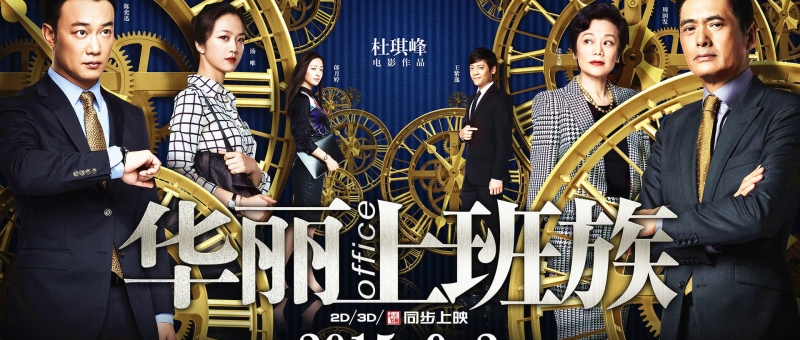
Office (華麗上班族, Johnnie To, 2015)

Johnnie To office poster 1Can love and capitalism walk hand in hand? Perhaps not, at least in Johnnie To’s beautifully choreographed musical exploration of high stakes finance and moral bankruptcy, Office (華麗上班族). Adapted from Sylvia Chang’s stage play, Office situates itself on the edge of an abyss as the 2008 financial crisis edges its way towards Hong Kong while enterprising businessmen try to figure out how to ride the waves even if that means standing on someone else’s shoulders as they sink deeper into the moral morass that is the modern economy.

Top Hong Kong trading company Jones & Sunn is about to go public. CEO Winnie Chang (Sylvia Chang) has long been running the show for her boss and lover, Chairman Ho (Chow Yun-fat), who has promised her a sizeable dividend once the floatation is complete. Meanwhile, two new interns have just joined the company, eager to make their marks in the corporate world and ensure they survive their three month probation. Bright-eyed and bushy-tailed Li Xiang (Wang Ziyi), “Lee like Ang Lee, Xiang like dream”, just wants to work hard and get rich so he can live a nice life, while his colleague Kat Ho (Lang Yueting) has just returned from studying economics at Harvard and appears to be slumming it in a lowly internship while (unconvincingly) pretending to be from a humble background. The funny thing is no one seems to pick up on the fact Kat has the same surname as the company’s owner, or they might have figured out she’s the boss’ daughter either forced to learn the trade from the ground up or working as a spy among the regular employees. In any case, Li Xiang is smitten.

Love, it seems, is the destabilising force at the centre of this great machine. CEO Chang, an all powerful woman in a male dominated industry, rules the office with a will of iron but allows herself to be manipulated by Ho with whom she has been having a longstanding affair. Ho has a wife in a coma, but neither of the pair object to the office gossip which brands Chang as “Mrs. Ho”, seeing it only as cutely romantic rather than a slight on Chang’s very real authority. Meanwhile, lonely in Ho’s lack of serious commitment, Chang has also been sleeping with her favourite underling, the feted David (Eason Chan), who in turn is getting fed up with feeling like a spare part who’s hit the peak of his career. Unbeknownst to Chang who may have taken her all-seeing eye off the ball, David has started playing with fire in gambling with company money and losing badly. As a counter measure, he’s begun romancing lovelorn accountant Sophie (Tang Wei), who unlike Chang, is still facing the work/home dilemma in that her fiancé back on the Mainland is pressuring her to give up work and settle down.

Li Xiang is very keen on following his “dreams” which in the beginning are charmingly naive – he wants a nice life for himself and the ability to pay off his friends’ debts (seemingly for entirely altruistic reasons, not as an excuse to show off). Slowly, however, his new world begins to corrupt him. He’s irritated that he’s not allowed to ride the executive elevator and badly wants in, but is still green enough to chivalrously cover up for Kat’s mistakes, while Kat is so clueless that she forgets turning up to work in designer outfits and in a chauffeur driven car is going to blow her cover. Li Xiang sees through her, but only to the nice part – it never really occurs to him she’s a mole or planning to betray Mrs. Chang who is kind of her step-mother. Chang isn’t blind to office politics. She sees Li Xiang take the blame for Kat and even likes him for it. She also likes his “originality” and plans to take him under her wing for her new expansionist plans but finds herself once again blindsided by all the difficult romantic drama bubbling under the surface of coldhearted capitalism.

David and Sophie decide they want to start a “love revolution”, but David has already gone to a dark place and his romantic confession is immediately followed by a manipulative request to get Sophie to help him with his nefarious plans. Meanwhile, Li Xiang’s gradual descent into corporatism begins to sour Kat who’d taken a liking to him because he wasn’t like everyone else. They didn’t mean to do it, but they’ve betrayed themselves and others in their relentless pursuit of conventional success. Drunken salarymen at a local bar ask themselves what all of this is for when their kids don’t recognise them and they barely recognise themselves, yet no one quite has the guts to get off the corporate train and go do something else.

In To’s elaborate set design, no one is ever truly able to leave the office. An elegant construction of neon and steel, the abstract theatricality of To’s artificial universe only underlines its essential meaninglessness – something the Office’s denizens eventually come to understand whether they choose to stay or not. As Chang quips, smart guys control money and stupid ones are controlled by it, but she herself is wise enough to know when the game is up and it’s time to move on. Did love destroy the system or did the system destroy love? Beautiful melodies telling us terrible things, To’s anti-capitalist musical crushes its earnest heroes under the wheel of progress while they dance blithely all the way over the edge.


Office screens in Chicago on Oct. 5 as part of Asian Pop-Up Cinema.

Original trailer (English subtitles)