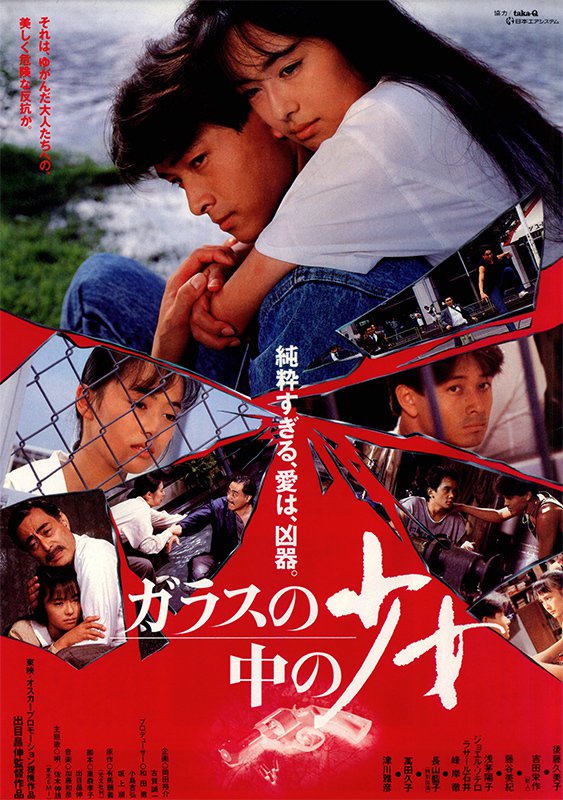
 The popularity of idol movies had started to wane by the late ‘80s and if this 1988 effort from Masanobu Deme is anything to go by, some of their youthful innocence had also started to depart. Starring Kumiko Goto, only 14 at the time, The Girl in the Glass (ガラスの中の少女, Glass no Naka no Shojo) is an adaptation of a novel by Yorichika Arima which had previously been filmed all the way back in 1960 starring another idol starlet – Sayuri Yoshinaga. Given a new, modern twist for the very different mid-bubble era, the 1988 edition of the familiar rich girl falls for poor boy narrative is no less tragic than it ever was. Gone is the cheerful, carefree invincibility of youth – The Girl in the Glass is a painful lesson in loss of innocence in which the forces of authority will always betray you but in the end you will betray yourself.
Middle schooler Yasuko (Kumiko Goto) has a very busy life. Accordingly, she maintains a coin locker at the station in which she keeps all the equipment she needs for her after school clubs which range from fencing to piano and cram school. Fiddling with the key one day she finds herself chatting with a rough young man who abruptly gives her something wrapped up in newspaper to stash in her locker with the instruction to meet him back there at nine to return it. Yasuko’s step-mother is a very strict woman who demands absolute punctuality and so Yasuko leaves a note to the effect that she’s taken the boy’s package home and will return it another time.
This is a big problem for the boy, Yoichi (Eisaku Yoshida), because the package contains a gun that some criminal types are quite keen to get back. After their factory closed, Yoichi and his Filipino friend have been forced into the fringes of the criminal underworld to make ends meet. Crafting pistols or adapting toy guns to fire real bullets, the boys are engaged in some shady stuff. Regretting his decision to get a random schoolgirl involved in all of this, Yoichi needs to get his gun back but also finds himself growing closer to Yasuko, particularly as he accompanies her on a personal journey to discover a few painful family truths.
Made the same year as Memories of You, The Girl in the Glass once again casts Goto as a spiky though eventually tragic heroine, unable to withstand the forces of time and society to fulfil her true love dream. The daughter of a prominent politician who is often absent for long stretches of time, Yasuko is devoted to her father though suspicious and hostile towards her noticeably cold step-mother. Her life is a tightly ordered one of swanky private school days followed by a series of clubs befitting an upper class girl, after which she is to return straight home lest she incur the wrath of her step-mother.
Yasuko, however, is getting to the age where doing what she’s told without question is no longer appealing. Yoichi’s appearance is then not an altogether unexpected development, but this very ordinary pull away from her overbearing family environment also coincides with its implosion as a chance telephone call tips Yasuko off to a long buried family secret. Yasuko’s father, so apparently doting on his pretty daughter, is forever the politician – cold, calculating and willing to sacrifice anything and everything for his political career.
Spouting nonsense about family values from the top of a bus with the resentful Yasuko made to stand beside him, Yasuko’s father is perhaps the symbol of a growing threat of a profligate and self centred authority whose selfishness and coldhearted austerity is already wreaking havoc on those who are excluded from Japan’s new found prosperity. Yoichi, fatherless, lives a typical working class life with his mother and younger sister. He’s left school but the factory where he worked has closed down and there are few other jobs for a high school graduate in these fast moving times. The family have taken in a Filipino friend, Jose, who also worked at the factory but is technically in the country illegally as his visa has expired. Yoichi has pulled Jose into the gun making business as a way to make ends meet, but even if the two are essentially nice kids making bad decisions, their accidental criminality will come back to haunt them.
About halfway through The Girl in the Glass, Yasuko and Yoichi end up on the run together. Holed up in Yasuko’s family summerhouse the pair enjoy a taste of domesticity as Yoichi cooks breakfast for an upperclass girl whose only culinary experiences have been in home-ec class, but their romantic dream is short lived. A stupid, pointless and tragic end, Deme dares to include the bizarrely silly outcome to a mad dash declaration of love which every viewer fears yet never believes will occur. The abrupt transition from romance to tragedy is not altogether successful as Yasuko’s coming of age takes on all of its painful, unforgivable wounds. Leaving on a note of total bitterness, there is no hope left for Yasuko, romantic love fails and familial love betrays. Strangely unforgiving, The Girl in the Glass lets no one off the hook from the corrupt politician, to the poor boy with empty pockets and a head full dreams, and the hardworking foreigner who finds himself caught up in someone else’s drama, but least of all Yasuko who is left with nothing more than the knowledge that she herself has been a prime motivator in all her suffering.
 Times change, and men must change with them or they must die. When Japan was forced to open up to the rest of the world after centuries of isolation, its ancient order of samurai with their feudal lords and subjugated peasantry was abandoned in favour of a more Western looking democratic solution to social stratification. Suddenly the entirety of a man’s life was rendered nil – no more lords to serve, a man must his make his own way now. However, for some, old wounds continue to fester, making it impossible for them to embrace this entirely new way of thinking.
 Windows on Worlds