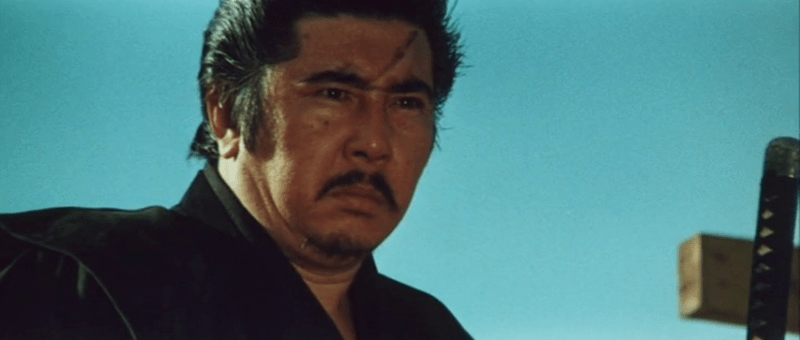
The Fort of Death (五人の賞金稼ぎ, Eiichi Kudo, 1969)

Shikoro Ichibei (Tomisaburo Wakayama) returns yet this time seemingly on the opposite side in the second in the Bounty Hunter series, The Fort of Death (五人の賞金稼ぎ, Gonin no Shokin Kasegi) this time directed by Eiichi Kudo. If the first film had been an Edo-era take on James Bond, the second is very much Spaghetti Western and feudal tragedy as Ichibei finds himself coming to, if not quite the rescue of the oppressed farmers, then at least moral support in taking stand against corrupt and self-interested lords.

This might be surprising in that in the first film Ichibei had been a shogunate spy and seemingly close friend of the man himself, yet this time around he’s working as a doctor while taking bounty hunter jobs to earn extra money to support the poor people who come to him for help. Like a true western hero, he has a small posse which includes the ninja lady, Kagero (Tomoko Mayama), from the first film only she’s being played by the actress who previously starred as his other love interest. In any case, he’s approached by a young man from a small village which is making a last-ditch appeal to the local lord to lower their tax burdens so they don’t all starve, though so far the lord’s response has been to add additional taxes and kill people for not paying them. 

On his arrival, Ichibei soon realises that the man who recommended him was actually the leader of the government forces during a previous peasant uprising at which Ichibei had also tried to help the farmers. In that case, Bessho (Shin Tokudaiji) had won, but it didn’t do him any good. His clan was dissolved and he became a wanderer, taken in by the village and now indebted to them, hoping Ichibei can help but fully aware of the brutality with which such challenges to the feudal order are put down. 

The lord later suggests it’s not really his fault. He has to curry favour with Edo to protect the domain, which is why he agreed to participate in a construction project that led him to confiscate all of his farmers’ rice and wheat. But then it’s also true that he is vain, and cruel. On realising the village has hired a man like Ichibei, some of the retainers suggest reopening negotiations but others complain that they must now crush the farmers or face ruin themselves while trying to ensure the strife in their domain does not come to the attention of the government in Edo. 

Part of their problem is that Ichibei simply has better technology in the form of gatling guns. Tying into the western themes, Ichibei is well versed in the use of firearms, while the samurai are mostly reliant on traditional weaponry such as arrows and swords. The lord later insists on using some canons, but is oblivious to the risk as the shogun has banned the use of gunpowder and using them may end up bringing him to his attention and thereby landing him in a lot of possible fatal trouble. 

In any case, it’s the villagers who suffer. Ichibei encounters a woman who has lost her mind, refusing to give up her baby who has died of malnutrition while her husband was executed for non payment of taxes. Meanwhile, some of the other ronin they hired attempt to rape a villager, and a young couple are prevented from marrying because the headman is worried that it would send the wrong message in a time so much strife. Then again, a woman basically attempts to rape Ichibei, descending on him while he’s still asleep which otherwise leads into a fairly comic sequence in which Ichibei must fight of a bunch of ninjas intent on stealing the gatling gun while dressed only his underwear.

Darkly comic it may be, but also surprisingly violent with a ninja at one point using a dead body as a Molotov cocktail not to mention the severed heads and limbs of the battle scenes. Ichibei is fully aware that the battle is a forlorn hope, but also that the villagers have no choice and perhaps this is better for them than simply accepting their fate and starving to death. Even so, he reserves his final words for the Edo inspector who arrives only when the battle is done to survey the scene, berating him that he ought to know what happened here from looking at the battlefield and deducing that this domain has not been run particularly well. It’s a tragedy of feudalism that provokes a tearful rage from the compassionate bounty hunter trying his best to heal the sickness in his society, though perhaps like the patient who visits him with a venereal complaint concluding the best solution is to cut it right off.
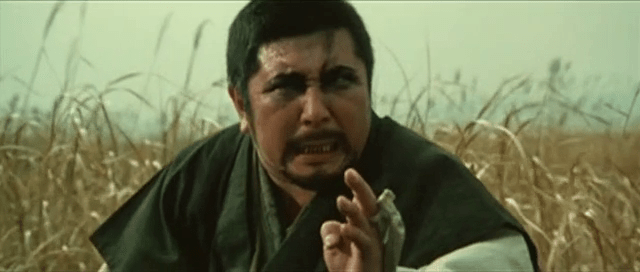

Wicked Priest 4: The Killer Priest Comes Back (極悪坊主 念仏三段斬り, Takashi Harada, 1970)

At the heart of the Wicked Priest series is an idea of rootlessness, the wandering monk Shinkai (Tomisaburo Wakayama), an orphan, often finding himself dragged into familial disputes between fathers and sons for one reason or another often estranged from each other. The aptly named Wicked Priest 4: The Killer Priest Comes Back (極悪坊主 念仏三段斬り, Gokuaku Bozu: Nenbutsu Sandangiri) finds Shinkai returning to his hometown after reencountering a childhood friend who’s found himself on the wrong side of a historical divide.

When Shinkai and Takegoro (Ichiro Nakatani) left their childhood village, they swore to become the best priest and mountain owner in Japan respectively but that obviously hasn’t worked too well for either of them. Takegoro evidently joined the wrong side during Bakumatsu chaos, a fact rammed home when his attempt to use currency issued by a feudal lord is rebuffed in a gambling den whose owner reminds him that it is now worthless. Only official currency issued by the central government is considered legal tender. On top of all that, it seems Takegoro might also have been cheating which signals just how far he has fallen. Running into him by chance, Shinkai ends up saving the day while accidentally humiliating a chastened Takegoro who is given a further dressing down by the old school lady yakuza boss Kuroda (Chieko Naniwa), also known as “the Thunder Woman”, who appears to be in charge, shooting off his little finger as an attempt to save face. 

In any case, the encounter has Shinkai feeling nostalgic and he decides to return to his hometown to hold a proper memorial service for his late mother. Only once there he ends up being drawn into another cycle of local corruption on discovering that the river workers are being exploited by rival yakuza groups who are working them to exhaustion and paying almost nothing. The leader of the Gondawara is quite obviously up to no good as he wears a western suit and has a handlebar moustache, quite clearly an amoral capitalist while his rival Ryuo (Eizo Kitamura) is a violent thug in ominous sunshades. In actuality, however, they are both branches of the yakuza syndicate led by Kuroda who is of the old school and doesn’t approve of their exploitative mindset. Just as she had Takegoro, she gives both men a good telling off reminding them that the river workers are essential for providing a steady supply of coal without which the new industrial economy will flounder. 

It’s also true that this same industry is fuelling militarisation and an eventual eye towards expanding imperialism, but Kuroda does seem to be mainly mindful of the workers welfare immediately insisting they should be paid a fair wage which is five times more than they’re currently getting. Ryuo and Godawara superficially agree but intend on simply exploiting their workers differently by demanding five times as much work for five times as much pay in a fifth of the time. Shinkai does his best to defend the rights of the local people, but is faced with a dilemma on realising that Takegoro is member of Godawara and hellbent on killing him having become cynical and desperate, willing to sell out a childhood friend for a few pennies. 

Part of Shinkai’s mission is winning Takegoro back over the side of right while reuniting him with his mother whom he’d been too ashamed to visit. On the other hand, this is perhaps the first time Shinkai shows a darker side to himself on threatening to rape a lascivious nun who tricked him into a martial arts contest while rebuffing his amorous intentions. He’s also still being pursued by Ryotatsu (Bunta Sugawara) and ironically ends up temporarily losing his sight himself but just as always Ryotatsu decides to come to his rescue mostly because it would be very annoying if someone else killed him first before he’s got his revenge. He also agrees to wait for Shinkai to finish his mother’s memorial service before scheduling their death match, the most patient revenger in jidaigeki history. In any case, it all ends with another massive showdown as a wounded Shinkai purifies the town of corrupt yakuza and liberates the river workers while finally getting to honour his late mother’s memory leaving Ryotatsu to make his exit deciding that vengeance can wait until the mourning’s over.


Lone Wolf and Cub: Baby Cart to Hades (子連れ狼 死に風に向う乳母車, Kenji Misumi, 1972)

lone-wolf-and-cub-baby-cart-to-hadesOgami Itto (Tomisaburo Wakayama) and his (slightly less) young son Daigoro (Akihiro Tomikawa) are going to hell in a baby cart in this third instalment of the six film series, Lone Wolf and Cub: Baby Cart to Hades (子連れ狼 死に風に向う乳母車, Kozure Okami: Shinikazeni Mukau Ubaguruma). The former shogun executioner, framed for treason by the villainous Yagyu clan intent on assuming his position, is still on the “Demon’s Way”, seeking vengeance and the restoration of his clan’s honour with his toddler son safely ensconced within a bamboo cart which also holds its fair share of secrets. In the previous chapter, Baby Cart at the River Styx, Ogami’s stoic personality came to the fore as he showed that sometimes there is more strategic value to be found in avoiding a fight rather than charging into one where it isn’t necessary. Baby Cart to Hades will further test this element of his life philosophy as he finds himself bound onwards, seeking his redemption.

Neatly attaching Daigoro’s cart for towing, Ogami boards a boat which appears to be being followed by underwater ninjas, if the reeds he notices whilst using his sword as a mirror are anything to go by. Also on the boat is a distressed young woman, apparently on her way to be sold to a brothel. Diagoro takes pity on the girl and catches her tiny bundle of belongings when the loquacious middle man knocks them overboard. Later they all end up at the same inn where the unfortunate woman kills her procurer when he attempts to rape her (bad business decision as that would be). Daigoro takes pity on the woman once again and Ogami decides to help her, especially after he notices the wooden memorial tablet among her belongings. Rather than fight off the brothel running samurai who come to find her, Ogami agrees to undergo the torture which is the alternative to entering a brothel on the girl’s behalf.

In addition to saving a life from fear and suffering, Ogami’s forbearance also earns him the respect of the madam in question, Torizo (Yuko Hama), who has another job for him. Her older sister was raped at the court of their lord and subsequently committed suicide, she and her father would like him dead and are willing to pay for it. Amusingly enough, the corrupt lord in question also tries to hire Ogami for another assassination for which he will pay double, but Ogami is an honest man. This latest mission brings him closer to his fated battle with the Yagyu but the Demon’s Way is long and Ogami is not yet approaching its end.

Directed once again by Kenji Misumi, this third instalment is much less psychedelic and action packed than the preceding film but seems keener to explore more of Ogami’s world which is often cruel and unforgiving. An early scene in the film features a discussion between four mercenaries, one a fine samurai who refuses to associate too much with the other three who are of a much more earthy character. Caring only for women and sake, the three men live a life of banditry by another name, fleeting from one clan to another participating in parades to bulk out an otherwise lacking show of force. Kanbei (Go Kato), by contrast, at least has a consciousness of the “true samurai” and a conflicted heart when it comes to his way of life. Having been a loyal retainer and later betrayed by the very lord he was seeking to protect over a matter of protocol, he has lost sight of his place in the world but knows himself to be superior to these venal, dishonest, empty scabbards for hire.

These same three men then attempt to have some sport with a well to do mother and daughter unwisely travelling with a single attendant. After despatching their escort, the three rape the two women before turning to Kanbei for help to clear up the giant mess they’ve just made. Kanbei does indeed clear it up by killing the two women in the gentlest and most elegant way he can before instructing the three culprits to draw lots – one of them will have to die and take the blame for everything to avoid getting entangled with the local police. Neither Kanbei or Ogami arrive in time to save the two women, whose deaths are both a solution to their “defilement” and the means to coverup a crime, leaving two thirds of the perpetrators free to commit the same crime again further along the road. Female life is both cheap and worth a lot of money to the right people, though there are precious few willing to defend it as a matter of honour – even Ogami’s decision to help the young woman about to be sold against her will has more to do with the cosmic coincidence of her memorial tablet than a desire to defend a vulnerable girl in trouble.

Where the dying monologue in Baby Cart at the River Styx was about the elegance and nobility of killing, Baby Cart to Hades focuses on the nature of the “true samurai” as the similarly disenfranchised Kanbei and Ogami discuss the “proper” way of life and death. Kanbei, like Ogami, is a brave man who served his lord in his own way, only to accomplish his mission and be cast out by those who disagreed with his methods. Is it really wrong to fight to live, rather than prepare to die? Both men say no, but the conclusion that is reached is that a samurai can only live by death. Meeting for the first time, Kanbei requests a dual from Ogami, promising to care for his son if only he survives. Ogami agrees but later sheaths his sword and declares the fight a draw. He would rather not fight a man who appears to be his equal in every way and has no quarrel with him, though the two will meet again for an unavoidable showdown.

Misumi is more straightforward his direction save for a few expressionist scenes of the bright sunset and a dramatic switch to POV as a head is severed from its body and rolls away. Nevertheless the ninja antics become ever more impressive, as do Ogami’s methods of detecting them. Once again Ogami attracts the attention of a grateful woman in the person of Torizo who, in keeping with the previous two chapters, watches him push his baby cart away with tears in her eyes (all accompanied by the first appearance of a closing ballad in the series). There are a lot more bodies behind him now as Ogami strides away from a battlefield littered with corpses, yet he’s seemingly no closer to achieving his goal despite his brush with the Yagyu. The price of vengeance is increasing, but the Demon Way is long, and Ogami must follow it to its end, no matter where it leads.


Original trailer (German subtitles for captions only, NSFW)