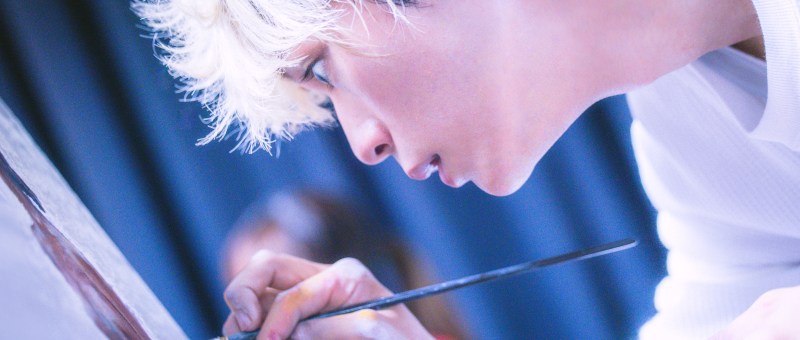
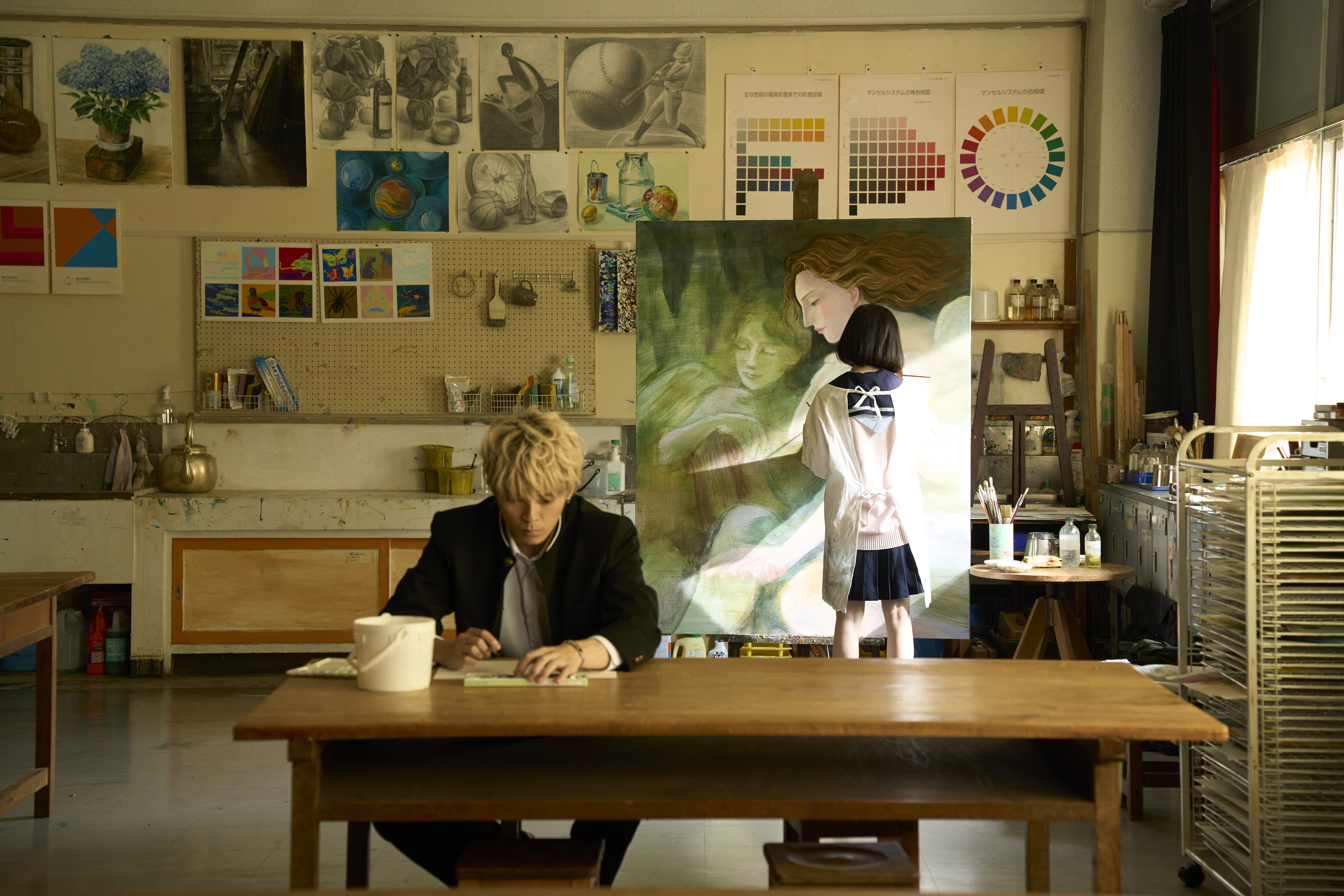
An ennui-ridden teen finds the world opening up to him after he discovers the power of art yet fears he can’t live up to his new epiphany in Kentaro Hagiwara’s adaptation of the manga by Tsubasa Yamaguchi, Blue Period (ブルーピリオド). Less about art itself, the film presents its hero with the cowardice of conformity, challenging him above all to know himself and wield his selfhood like a weapon in a world that can at times be unforgiving.
Even so, Yatora (Gordon Maeda) is a model student who gets good grades and is known for being well-mannered but secretly he’s filled with emptiness and has largely been just going through the motions. In his opening voice over, he relates that he does what he has to do, but declares himself unfulfilled and directionless. Unexpectedly captivated by a fellow student’s painting, he’s confronted by the power of art and the freedom it offers vowing to get into prestigious art school Tokyo University of the Arts.
The constraints he feels are partly economic in that his parents can’t afford a private university so he has to do his best to get into a public arts school while his mother seems dead against the idea of him going into the arts because it doesn’t put food on the table. Yatora parrots back similar lines describing art school as a pointless waste of time but is quickly taken to task by fellow student Yuka (Fumiya Takahashi) who challenges his tendency towards conformity and needles him into independent thoughts and action.
Yuka is also contrained by conservative social codes in that she dresses in a female uniform though many still call her by her male name, Ryuji. Though the pair have a rather spiky relationship, it’s Yuka’s attempts to challenge him that bounce Yatora towards discovering his true self which as it happens is done through embracing his least palatable elements. As Yuki correctly observes, his good boy persona and tendency towards hard work are just masks for his inner insecurity.
Yet as he’s also told, art isn’t just about talent but requires passion and tenacity which in its way makes it a perfect fit for Yatora’s hard-working nature as he buckles down to become a promising artist in the run up to his high school exams. As he later reflects, others may be more talented than him but they can’t make the things that he makes because the point is they come from himself. His early pieces are criticied for their superficiality, that he only sees what’s directly in front him rather than learning to see the world in other, more unique ways and engage with it on an individual level but through his artistic journey he discovers new ways of seeing along with his true self in all its complexity.
His newfound desire to follow his heart places him at odds with prevailing social codes which favour the sensible though it also spurs others on to do the same, one of his best friends deciding to become a pastry chef rather than get a regular salaryman job hinting at a greater desire for personal fulfilment among the young. Often poetic in his imagery such the sparks that fly from Yatora’s nascent artwork or the comforting blue of the Shibuya twilight that becomes his safe space, Hagiwara sometimes paints Yatora’s quest like a shonen manga with a series of bosses to beat in Yatora’s various rivals and challenges most which teach him something about himself that spurs him on to continue chasing his artistic dreams while the exams themselves are also mental exercises of strategy and thinking outside the box to unlock a particular kind of self-expression. There is something quite refreshing, however, in the fact that Yatora’s only real rival is himself in his ongoing quest for skills and self-knowledge, earnestly applying himself to master his craft eager only for the places his artistry will take him both mentally and physically and no longer so dissatisfied with the world around him but filled with a new curiosity and the confidence in himself to continue exploring it.
Blue Period screened in New York as part of this year’s JAPAN CUTS.
Original trailer (English subtitles)
 Windows on Worlds