Manila by Night (Ishmael Bernal, 1980)

Contemporary youth is swallowed by the darkness of the Marcos-era capital in Ishmael Bernal’s meandering nocturnal epic, Manila by Night. So bleak was its vision that it was blocked from release by first lady Imelda Marcos who objected to the film’s characterisation of her beloved city and insisted that all references to Manila be removed which is why the film was retitled City After Dark in an attempt to distance itself from the realities of urban life under the authoritarian regime. 

Bernal opens however with a scene of aspirational suburban living at the home of a wealthy family as they prepare for an evening out attending a live gig by eldest son Alex (William Martinez), an aspiring folk singer. In a quiet city bar he performs a wholesome cover of the ’69 Crosby, Stills & Nash classic “Teach Your Children”, but the otherwise serene atmosphere is abruptly shattered by gunshots ending the performance and scattering the spectators. The choice of song is in itself instructive in hinting at the generational divide between the apathetic Alex and his respectable middle-class suburban mother Virgie (Charito Solis) who we later discover is carrying a degree of shame over her past as a sex worker and has perhaps overcompensated in her desire to ensure her children become successful members of a conservative society. 

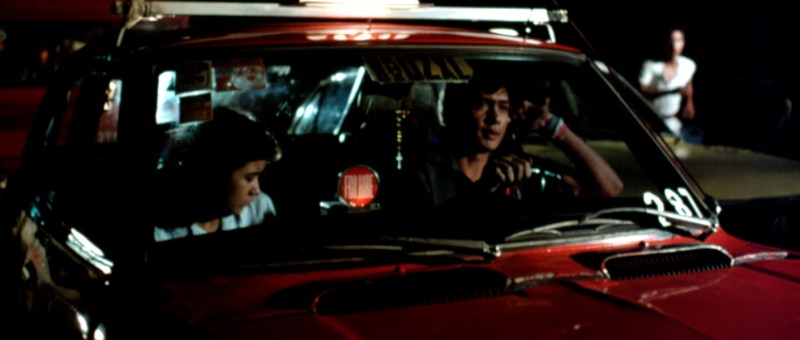
As the song says, Alex too is incapable of understanding his parents’ youthful suffering and finds himself lost in the nighttime city. On the one hand he’s dating a young woman of a similar social class who may be joking when she talks about their marriage but is evidently more serious about the relationship than he is while they retreat to a hotel room experimenting with sex and drugs. On the other hand he’s also experimenting with a gay man, Manay (Bernardo Bernardo), who is also in an awkward relationship with bisexual taxi driver Pebrero (Orestes Ojeda) who has two children and a wife while simultaneously dating naive and innocent country girl Baby (Lorna Tolentino ) currently working as a waitress at a diner where a sleazy pimp keeps hassling her to become a sex worker promising megabucks from wealthy Japanese clients. 

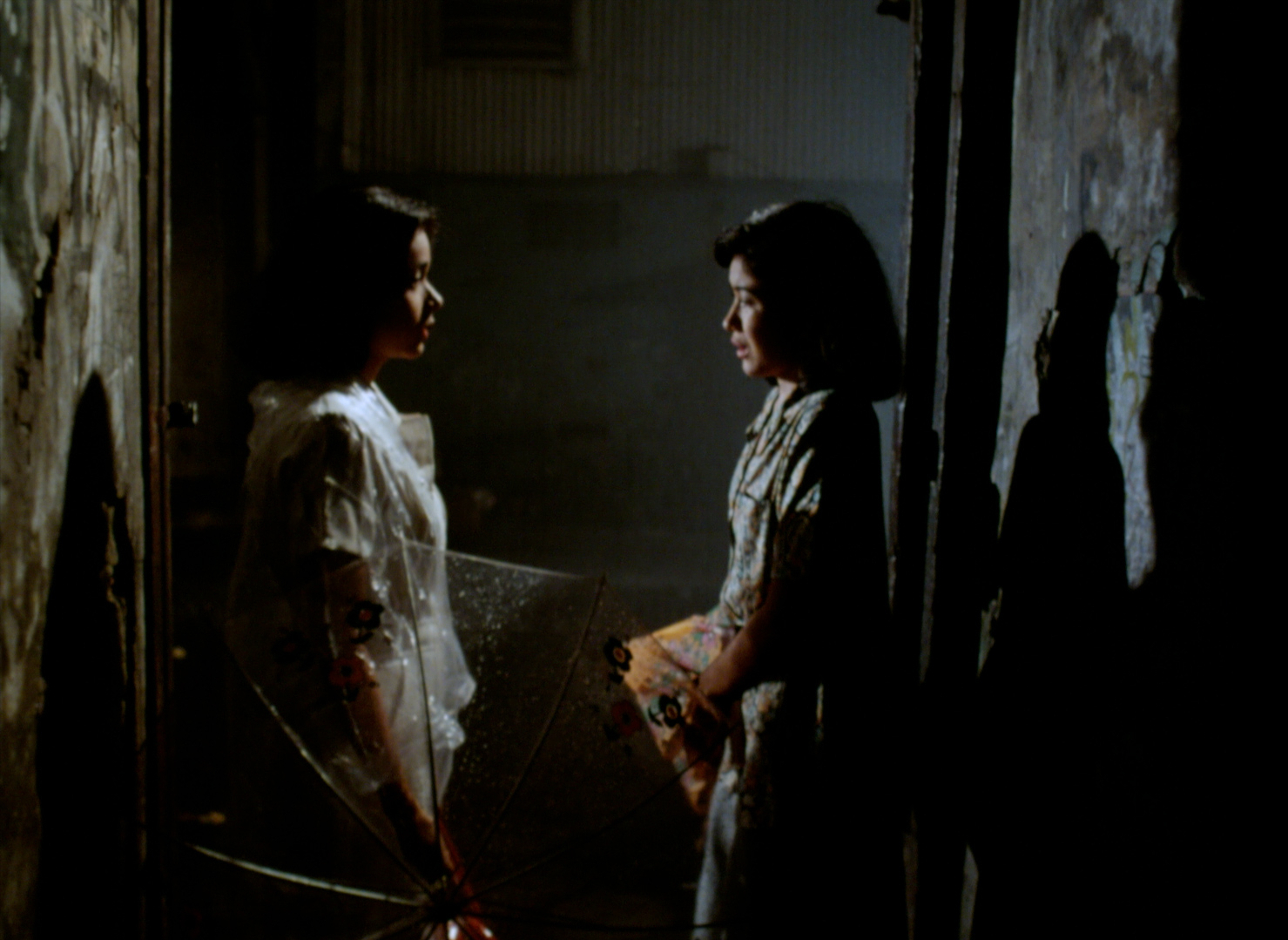
The presence of the Japanese as external economic force is in its own way a reflection of the desire many of the young people have to leave the Philippines, such as that of blind sex worker Bea (Rio Locsin) who is also involved with Alex but hoping to move to Saudi Arabia with her boyfriend Greg (Jojo Santiago) who has been offered employment there but later discovers that he’s been scammed, temporarily stranded in Bangkok until managing to arrange his passage home. Mass unemployment is a constant spectre, Baby’s father also out of work but lamenting the only job prospect he’s found pays so little and is so far away as to be economically pointless. Lack of other options later causes Greg to attempt to manipulate Bea into participating in live sex shows without her full consent while many of the women are forced into sex work in order to support their families. When Baby falls pregnant, realises Pebrero won’t marry her, and is sacked from the diner she too is pushed into accepting the sleazy customer’s offer but ultimately cannot go through with it. Meanwhile, Pebrero’s wife Adelina (Alma Moreno) is also exposed as a sex worker catering to wealthy Japanese clients rather than the nurse she had claimed to be leaving every day in a crisp white uniform for the hospital and later paying a heavy price for her duplicity. 

The crowded tenements inhabited by Baby and Adelina where several members of a large family share a single room stand in stark contrast to Alex’s well-appointed suburban home complete with servants his mother makes a point of talking down to, but what may start for him as a reckless curiosity rebelling against his comfortable life becomes a self-destructive odyssey through midnight Manila in which he eventually becomes addicted to drugs. In a climactic scene, Virgie and her husband batter him with nearby objects while the camera cuts ironically to a series of religious icons and a large statue of Jesus looking down on the scene of chaos before Alex abandons his family to reunite with Manoy. The capture of his friend Kano (Cherie Gil), a tomboyish lesbian in love with an unreceptive Bea, by the police is framed as a kind of crucifixion, the torturing of youth by an implacable authority which restricts its freedom and presents it only with despair. 

Adelina had tried to warn Baby that in order to survive Manila she would need to become “wiser than the men”, but the city is itself full of duplicities and secrets and Baby perhaps ironically the only one finally able to escape its false promises. The perhaps more hopeful coda in which a less curious Alex appears to awaken from his slumber lying peacefully in the light of a new dawn was apparently a concession to the censors but still leaves him lost in a kind of limbo neither in one place nor another but perpetually wandering. At once a portrait of a city lively and free with its series of gay discos and drag nights, weird cults in parks, and nighttime callisthenics classes, and of a place marred by exploitation and hopelessness, Bernal’s odyssey through through Manila by night finds only an elusive hedonism born of internal despair in the intense repressions of authoritarianism.


Trailer (dialogue free)
Big Night! (Jun Robles Lana, 2021)

In the opening scenes of Jun Robles Lana’s darkly comic farce Big Night! a young man is shot in the head by another young man, this one wearing a motorcycle helmet with its visor down, who calmly walks away and gets back on the back of the bike he arrived on his friend then driving them both away. Of course people are shocked but then again not all that much, they barely pause despite the fact that his man, Ronron, was well known to them and no one really thought he had much to do with drugs. Beautician Dharna (Christian Bables) gossips about the killing with his friend Biba but gives it little thought before returning to his day, so normalised has death on the streets become in Duterte’s Philippines. 

Dharna may not have given much thought to extrajudicial killings, but then it’s different when it’s you who might be next in the firing line as he discovers when Biba gets an advance view of the following day’s “Watch List” from her law enforcement boyfriend. What ensues is a kafkaesque quest to clear his name though there’s no real “official” path towards getting off a watch list when you’re on one. His boyfriend Zeus who is due to perform in a “Big Night” pageant at a local gay bar that very night suggests simply fleeing to another district, but flight implies guilt and as Dharna points out he’ll lose all his customers if he has to move to another area and neither of them have the money to start all over again somewhere new. Like many of Dharna’s friends and acquaintances Zeus doesn’t seem to share his concern. “The police won’t bother you if you’re not doing anything illegal” he naively advises, sure it’s all just a random mistake that soon will blow over but otherwise so numbed to the idea of extrajudicial killing that he doesn’t really think too much of it and is mainly annoyed that Dharna has lost interest in helping finish his costume for the big show. 

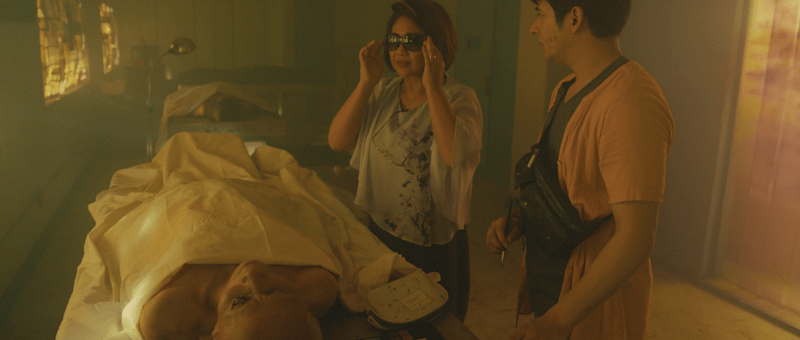
Neither of them can think of a reason why Dharna, under his full legal name, would have been placed on a list as he’s not a drug user and doesn’t know anyone who is. He does, however, have some useful connections including local law enforcement official Cynthia who isn’t terribly interested or helpful but manipulates his anxiety to force him to help her out by filling in for her regular mortician, Connie, who has mysteriously not shown up for work. The morgue is currently overflowing, Cynthia making a dark joke that undertaking is a growth industry while revealing that there are so many bodies in part because families have to pay a fee to get them back and most of those involved in extrajudicial killings are from the slums so they can’t afford it. Even so, she explains to Dharna that they get more donations when families can see the body which is why he’s supposed to make them up to look as good as they can despite many of them having sustained gunshot wounds to the head or face. 

Cynthia sends him on to local community leader Roja warning him that he’s “allergic to gays” while he too makes Dharna do his bidding pointlessly walking laps around a fountain in some sort of macho display of endurance while insisting that he’s so anti-drug that even if he gets a stomach upset he just powers through it with raw masculine energy. He too is a self-interested hypocrite spouting religious nonsense while hanging out in “massage parlours”, dangling the idea of salvation but unprepared to grant it. Dharna wonders if it might have been someone from the area where he grew up who reported him but discovers that unlicensed midwife Melba (Janice De Belen) makes a point of not putting any names forward at all and is herself willing to risk breaking the law to help women in need who are denied medical treatment because of their poverty.

It’s impossible to avoid the implication that this is happening to Dharna in part because he’s poor and powerless in an authoritarian and hierarchal society but he’s eventually forced to consider that someone may have put his name in a drop box anonymously, that perhaps they gave a random name when someone asked for one to save their own, because they had something against him, or sought to profit in some way from his absence. Like the witch trials of old, the war against drugs is another tool that can be manipulated for personal gain and so inured to violence has the society become that many are prepared to use it. Dharna finds himself at the centre of a random conspiracy in which he has no other option than to accept his complicity or die, discovering that as the radio report that opened the film had suggested the same officials in charge of prosecuting the war on drugs are in fact secretly using it to secure their stranglehold over the local drugs trade. 

Dharna finds himself compromised at every turn, beginning by offering free haircuts to help his case to progressing to covering up state crime, literally, by repairing the faces of the dead and graduating to faking a seizure in an ambulance to bypass a checkpoint. At the hospital he is confronted by the face of an old lady filled with despair one hand holding that of a little girl and the other a pair of bloody sandals before she simply collapses. Dharna tries to wash the sandals clean but there’s only so much you can do when the stain runs so deep. The irony of his big night taking place on All Souls Day is not lost though there’s precious little time for honouring the dead when your survival can no longer be assured. 


Big Night screens at UltraStar Cinemas Mission Valley, San Diego April 23/27 as part of this year’s SDAFF Spring Showcase.

Original trailer (English subtitles)

Mystery of the Night (Misterio de la Noche, Adolfo Borinaga Alix Jr, 2019) [Fantasia 2019]

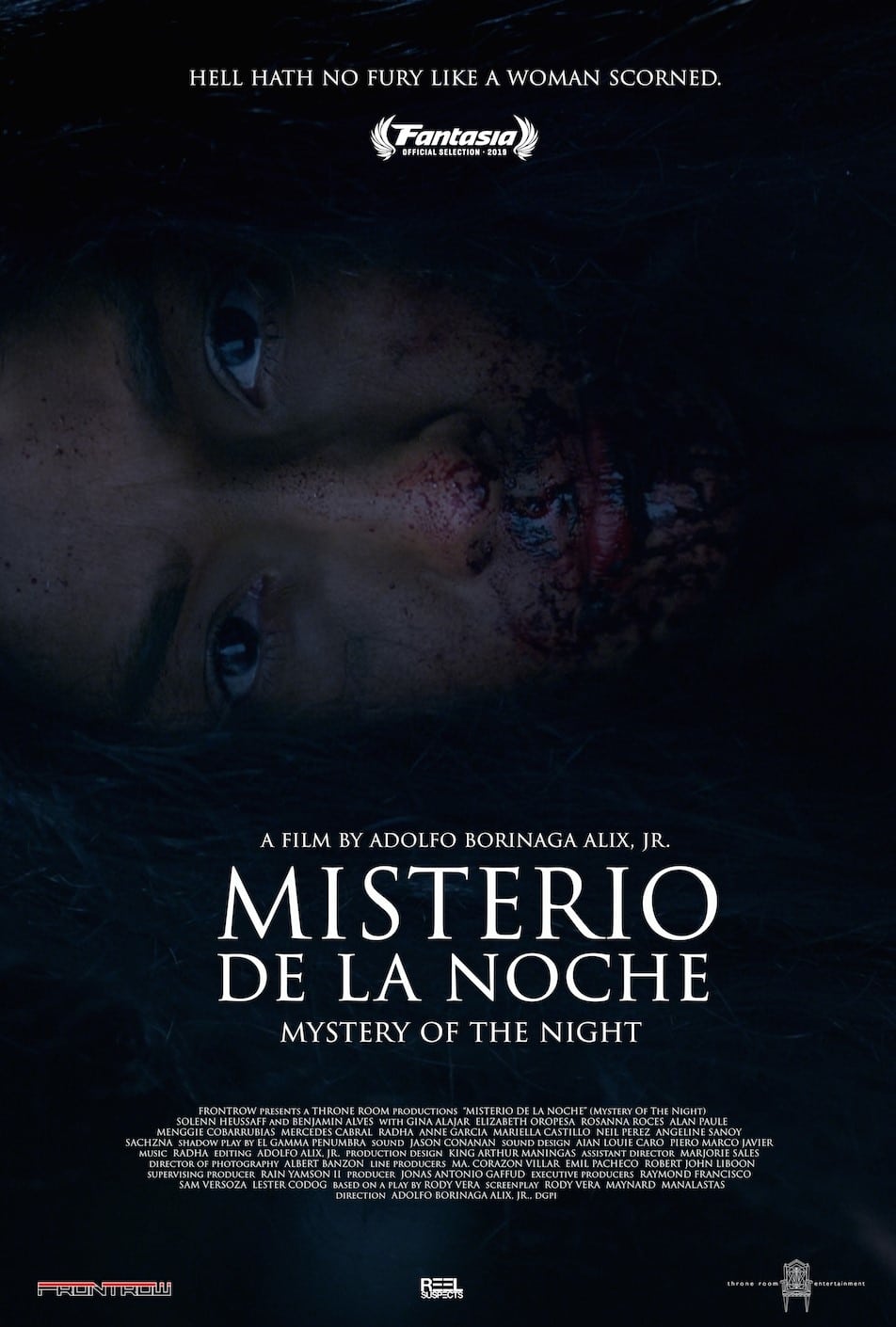
Mystery of the Night poster“There is nothing mysterious about the forest”, a traumatised traveller tries to tell himself, “only darkness”. Darkness is indeed a major theme of Adolfo Borinaga Alix Jr’s adaptation of the Aswang origin stage play Ang Unang Aswang, only this is darkness born of “civilisation” rather than its absence. The forest is mysterious, but largely because it is home to essential truths few now wish to see and are perhaps afraid to face. The evils of colonialism retold as folktale, Mystery of the Night (Misterio de la Noche) spins a less than ancient genesis for the iconic Philippine monster but hints at its origins in the darkness of the human heart.

In the early 1900s the Philippines was still firmly in the grip of Spanish colonial rule in which the Catholic Church and entrenched aristocracy remained all powerful. The tale begins when a young woman raped by a priest is condemned to the forest as the barer of a “Devil’s Child”. Though she rails and curses all around her, Mayor Alselmo (Allan Paule) consents to drag her into the wilderness as part of his own rite of passage, during which one of his men is killed. The woman, abandoned to her fate, gives birth alone but the effort costs her her life. The baby, meanwhile, is adopted by the forest dwellers of whom the civilised city folk are all so afraid. She grows up and meets a handsome young man, Domingo (Benjamin Alves) – Alselmo’s son, himself intent on exploring the forest’s mysteries. Nature takes its course, but Domingo is a young aristocrat with a wife and future in the city. Like many men, he takes his pleasures lightly and coldly rebuffs his forest bride when she comes calling on him in the austerity of civilisation.

Alix begins with a cold open flashing forward to the film’s conclusion before pulling back to introduce us to the world of the forest spirits, now pushed to the margins by the encroachment of the Spanish. To the Spanish, the spirits of the forest are frightening, demonic apparitions which threaten the primacy of their religion, dangerously undermining their hopes for peaceful, integrated governance. The forest spirits, however, may see themselves as “protecting” something, less the forest than a kind of ancestral essence slowly being eroded by outside influence.

“Nothing hidden remains unrevealed, no secrets are kept forever” Anselmo mutters to himself as he contemplates what the forest has taught him. He has been complicit in his own downfall, covering up the clergy’s crimes by abandoning a “crazy” woman to the forest in an effort to avoid dealing with her accusations or their evidence. The forest will give up its secrets, or at least take its revenge, on those who thoughtlessly pollute its darkness with the light of civilisation. The spirits maybe may be primitive, but they are not cruel – the baby’s life is saved only through their kindness and grows to maturity thought their careful nurturing.

Then again, according to the conflicted Domingo, the forest has its own logic and a belief different from the civilised. He wants to keep the forest’s secrets and protect the essence of existence in the belief that the mystery will complete us. When confronted by that mystery on his own terrain, however, he coldly rejects it in service of his civility. He brings back only atavistic violence and internalised shame along with his longing for something more innocent than the sophistication of his aristocratic position.

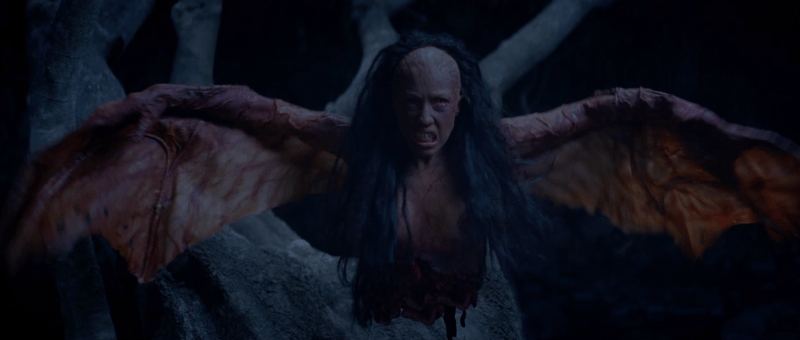
Scorned, “Maria” (Solenn Heussaff) as Domingo has named her, transforms into something else. A creature of rage and fear she screams into the night in grief for all she’s suffered at the hands of a fiercely patriarchal society which so cruelly killed her mother, broke her heart, and destroyed the safety of her world. The easy freedom of the forest has been corrupted by perverse civilisation which wields “morality” like a weapon and insists on authority that gives it the right to oppress. A grim parable of the destructive effects of entrenched colonialism, Mystery of the Night finds true horror in the most primitive of places – human weakness, greed, and hurt turned in on itself as a self-defeating act of protest against systemic cruelty. Beautifully dark, Alix’s shadow play spins a sad story of nature red in tooth and claw vs muted humanity, hauntingly ethereal and infinitely strange.


Mystery of the Night was screened as part of the 2019 Fantasia International Film Festival.

Teaser trailer (English captions)