
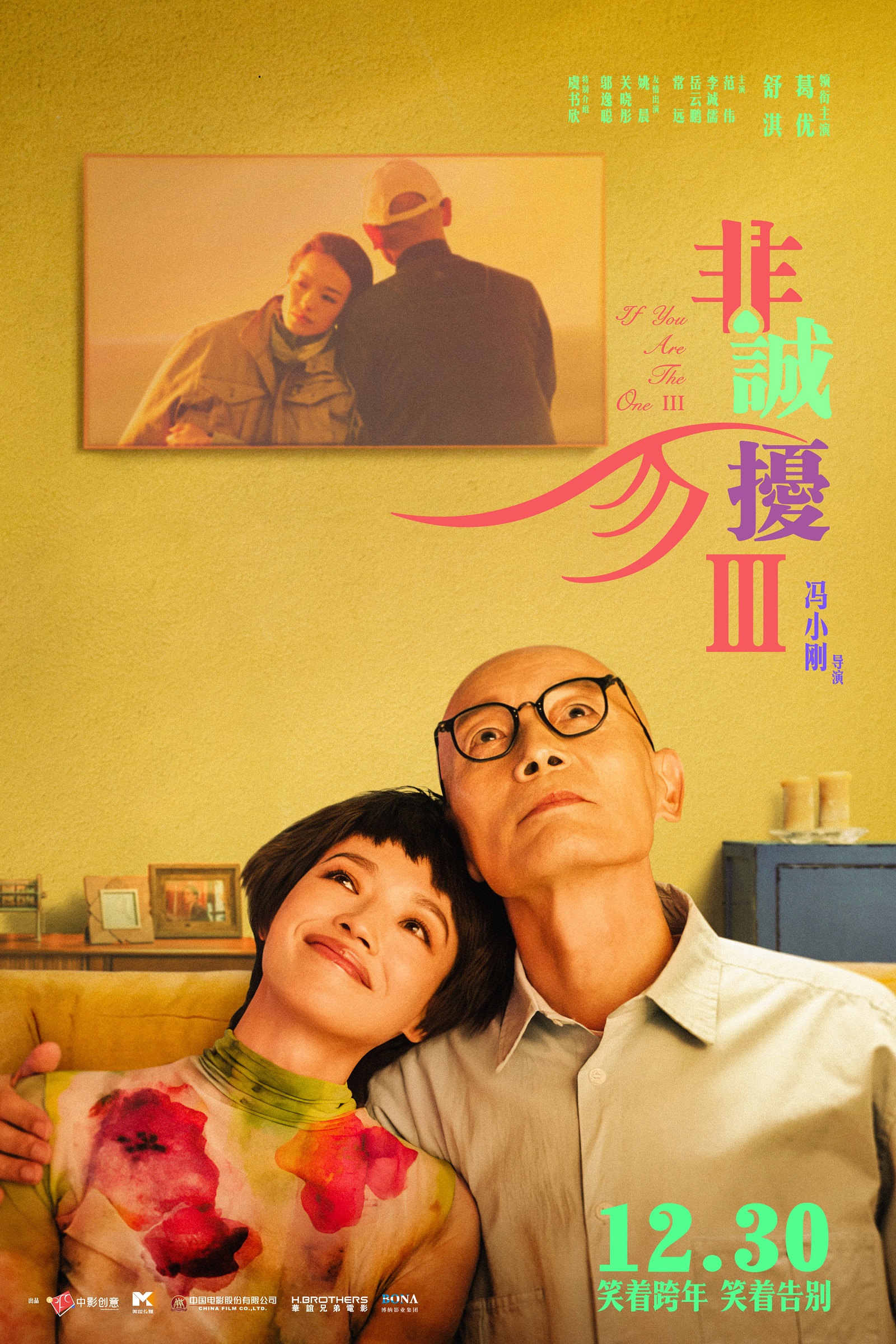
It’s been 15 years since the release of Feng Xiaogang’s If You Are the One, a phenomenally popular romantic dramedy in which a seemingly mismatched pair of lovelorn souls attempt to build on the spark of connection. A sequel was released in 2010 that turned a little more wistful in meditating on the brevity of life and its circular qualities, but returning all these years later Feng ventures in a surreal direction setting the film, as the sequel promised, in 2030 as Qin Fen (Ge Yu) approaches his 70th birthday in a colourful vision of an AI future.
Qin Fen still lives in the same house as he did in If You Are the One 2 only it’s had a complete redesign. Before it was cluttered and traditional, a comforting cabin overlooking the beautiful Chinese countryside but now it’s fairly minimalist and heavily stylised in a bold colour scheme that echoes the fashions of the mid-20th century. We learn that he has not seen Xiaoxaio (Shu Qi) for 10 years since she abruptly took off with a bunch on cult-like international rubbish collectors but has been patiently waiting for her return. His old friend Lao Fan (Fan Wei) who has launched a successful company selling uncannily real AI robots gifts him one that looks just like Xiaoxaio though it of course lacks her sarcastic character and is programmed to obey him totally which is how he thought he wanted but of course is nothing like the real Xiaoxiao.
At this point, the film seems to open a dialogue about the nature of love and the realities of marriage. Can the lonely Qin Fen be satisfied by this ersatz recreation of the woman he loved, or will it only cause him more pain? The answer seems to be a little of both, especially as she cannot eat or drink with him let alone sleep in the same bed. Meanwhile, unbeknownst to him the real Xiaxiao has returned but is too nervous to approach him having been out of contact for a decade, only now getting bored with rubbish collecting which is being taken over by AI robots anyway. Disguising herself as a upgraded version of the robot, she attempts to figure out how he really feels about her in a strange echo of the trial marriage from the previous film wondering if he’ll be able to figure out which version of her is “real” and which a fantasy of his own projections.
Then again, set largely within this futuristic cabin, now a little more surrounded by other similar dwellings, we might start to wonder if something else of going on and this place doesn’t quite exist in the way we think it does as if Qin Fen were literally living inside a memory. Having jumped on an additional eight years, the timelines and details do not always mesh exactly with a reappearance of Xiangshan’s daughter who should be around 30 but appears more like a sullen college student in the company of Xiangshan’s second wife, Mango (Yao Chen), who was not her mother nor raising her but apparently continued caring for her mother-in-law after her ex-husband’s death. Small splinters in the reality encourage us to doubt it, as if they corrupted files in Qin Fen’s ageing memory.
Feng presumably doubts our memory too, inserting frequent flashbacks to footage from the other movies whenever one of the returning cast allude to them in addition to providing a lengthy recap at the beginning of the film. Playing out a bit like a greatest hits compilation, the flashbacks prove unnecessarily clumsy and largely disrupt the flow of the ongoing drama while perhaps helping to fill in the blanks for those jumping in to part three without having seen one or two given that it has been fifteen years since the first film’s release. A little surprisingly given the tightening censorship regulations, Feng was able to continue the sympathetically presented running gag of Qi Fen’s male admirer, now having undergone a K-pop makeover and looking even younger, who also finds himself contemplating the nature of love after commissioning a Qin Fen robot to cure his own lovelorn desires.
A nod to the present day is given in a Lunar New Year movie-style epilogue (though the film was released around Western New Year) in which Shu Qi and Ge Yu play themselves dressed in matching outfits and nostalgically look back reflecting that young couples who came to see If You Are the One in 2008 might have teenage kids of their own or at least fond memories of an old love that wasn’t to be. Just at the end at they drop in the words that marriage is a commitment worth its weight in gold which feels like an approved message tackling the historically low rates of young people getting married. Nevertheless, it’s a cute and quirky way to bring the series to a close following the surreal absurdity of the two hours which preceded it.
International trailer (Simplified Chinese / English subtitles)
 Windows on Worlds