The Pollen of Flowers (화분, Ha Gil-jong, 1972)

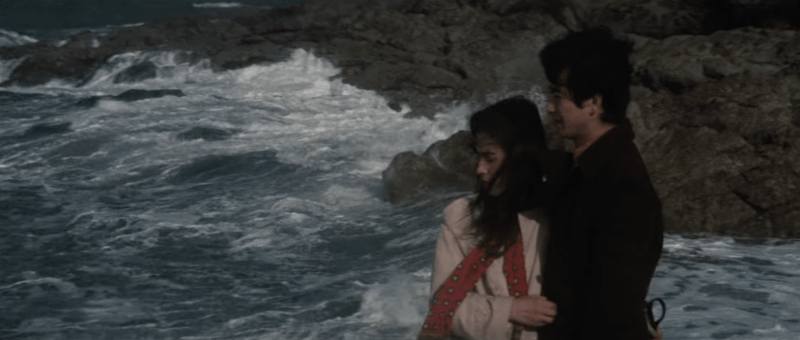
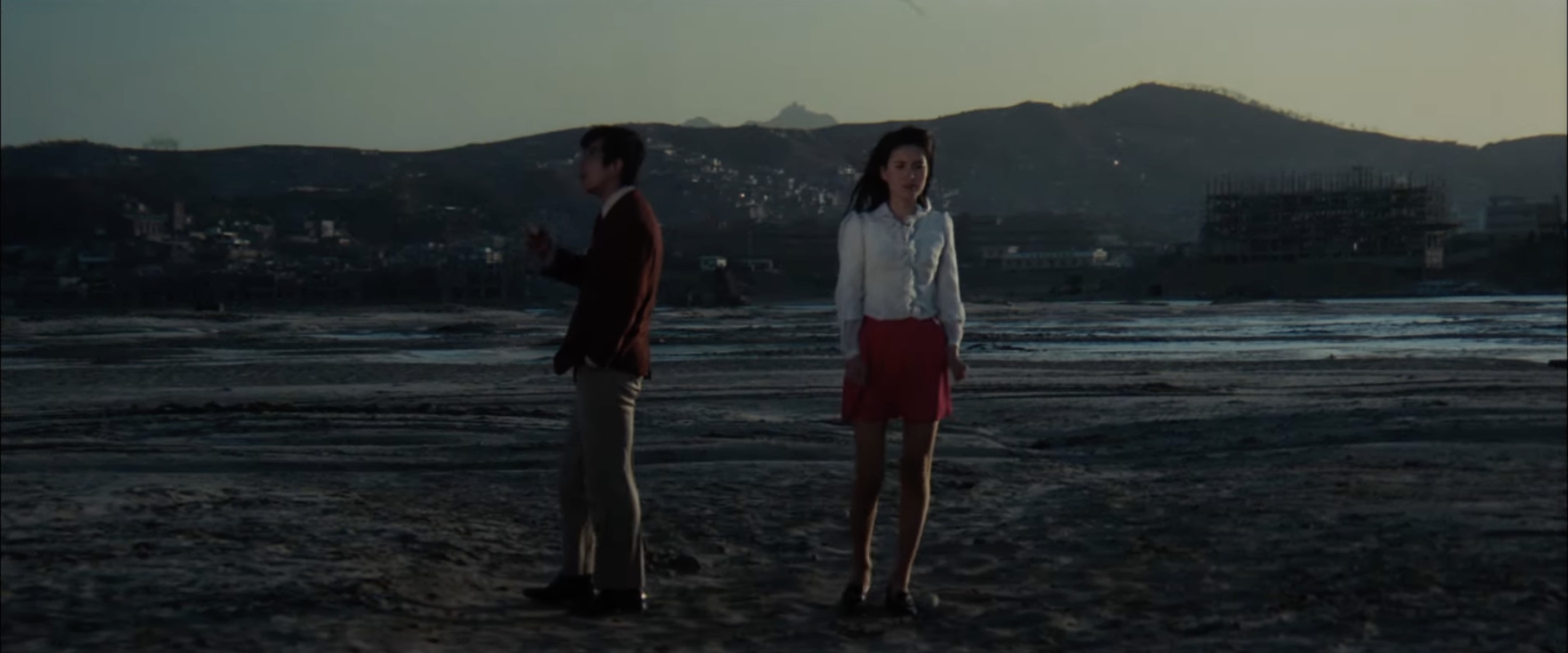
Park Chung-hee kept a tight rein on cinema which he saw as an important political tool and means of communication. That’s not to say, however, that criticising his authoritarian regime was impossible, but that criticism was often expressed in unexpected or abstract ways. The debut film of Hollywood-trained director Ha Gil-jong, The Pollen of Flowers (화분, Hwabun), was adapted from a novel by Yi Hyoseok that was published in 1939 when Korea was under Japanese rule but now speaks directly to the contemporary era as a young man and woman long for escape from the oppressive atmosphere of the “Blue House”.

The Blue House is the name for the residence of Korea’s president and where Park Chung-hee lived at the time, but within the context of the film, it’s inhabited by the mistress of a wealthy businessman, Se-ran (Choi Ji-hee), and her younger sister, Mi-ran (Yoon So-ra). The relationship between the sisters is, however, much more like mother and daughter with Se-ran repeatedly stating that Mi-ran is “everything” to her and that she must grow up to become a “great woman”. The slightly uncomfortable implication is that she is encouraging a possible relationship between Mi-ran and her patron Hyeon-ma (Namkoong Won) or at least that by “great woman” she means Mi-ran should be the partner of a great man who moves within their social circles. Ominously, however, the film opens with Mi-ran discovering that all the fish in their pond have died making it clear that the water here is poisoned and the atmosphere rancid. 

It’s not exactly clear how old Mi-ran is intended to be, only that Se-ran had been worried that hadn’t yet started menstruating. She’s spent her entire life in the cosseted environment of the Blue House and knows nothing of the world outside. That she gets her period for the first time when her father brings his secretary/secret lover Dan-ju (Hah Myung-joong) to the house suggests that she has, in a sense, been liberated by his arrival. For whatever reason, Se-ran had tried to warn her off him. She appears jealous while implying that Dan-ju is a dangerous social climber who threatens the integrity of her household. Mi-ran replies that you shouldn’t judge someone because of their background, but in a fit of pique also refers to Dan-ju as a “servant” which hurts both his feelings and his male pride.

But Dan-ju himself is something of a cypher whose motivations are often unclear. Having grown up working class, he’s risen in the world through complicity with Hyeon-ma’s authoritarian rule. As Se-ran says, Hyeon-ma is infatuated with him but perhaps more as a symbol of his overall control. He reminds Dan-ju that he controls his future and repeatedly asks him if he wants to go back to his old life of being a “scumbag” not quite realising that Dan-ju may have become fed up with his degradation and no longer thinks this kind of success is worth it. Hyeon-ma refers to Dan-ju as his “dream and ambition,” even going so far as to say he’d like to start a new life with him, though this is obviously not something that would be considered publicly acceptable in the Korea of the early 1970s. The film is often referred to as the first to depict a same-sex relationship, but it’s one motivated more by power than by love. It’s not clear if Hyeon-ma is so convinced that Mi-ran is completely safe with Dan-ju because he believes him to be interested only in men, or if he is certain that his control over him is absolute, while Dan-ju may not actually be interested in men at all and is only submitting himself to Hyeon-ma’s attentions in return for social advancement.

What he comes to represent for each is freedom. After running away, Mi-ran explains that she was happy with her life within the Blue House, in other words under authoritarianism, because it treated her well and so she could think of no other happiness. But meeting Dan-ju has shown her that happiness is possible outside of it. Love is a force that threatens the social order, and now Mi-ran resents her tightly controlled life and longs for the freedom Dan-ju represents over the patriarchal oppression represented by Hyeon-ma to which Se-ran has wholly submitted herself. Now that she’s committed to the regime, she cannot permit Mi-ran to leave it and tries to convince her to study music abroad and date an international pianist who could help career. Hyeon-ma, meanwhile, reacts in jealousy and frustration. He beats Dan-ju and throws him in his shed echoing the torture and imprisonment of dissidents that took place under Park’s regime. 

As time passes, however, something evidently goes wrong with Hyeon-ma’s business causing him to flee in a hurry abandoning Se-ran and Mi-ran to their fates. The ominous maid who has been dropping rats through their windows, eventually tries to release Dan-ju with whom she has some kind of intimate connection, with the consequence that he haunts the mansion like a ghost. Mi-ran appears to have reassimilated, dancing with another man while wearing what looks very like wedding a dress, but her desire for freedom is reawakened by Dan-ju’s return. The house itself is then stormed by the revolutionary force of Hyeon-ma’s creditors who are not exactly noble avengers. They raid the place looting his possessions to get back what they’re owned, even going so far as to cut off Se-ran’s finger to take her ring and pulling out her gold teeth. The message seems to be that the dictator will probably get away (Park didn’t, he was assassinated by the head of his own security forces), but a heavy price will be paid for complicity when the regime falls, as all regimes eventually do. 


The Last Witness (최후의 증인, Lee Doo-yong, 1980)

Last Witness Restoration posterThe Last Witness (최후의 증인, Choehuui jeungin), a pregnant title if there ever was one, begins with a melancholy voice over by way of a warning. It tells us that the path we are about to embark on will be a dark one but strikes a more optimistic note in affirming that 1980 was the year old evils were cleared away and, the narrator hopes, such darkness will have been left behind in the approaching new decade. Sadly this will not come to pass. The Last Witness is adapted from a novel by Kim Seong-jong which was published in 1974 but Lee Doo-yong filmed his adaptation in 1979 during the brief surge of hope for a brighter future following the assassination of dictator Park Chung-hee which ended with the military coup staged by general Chun Doo-hwan placing the country under martial law. A detective is assigned a case, but his investigation takes him on a long, soul searching journey into the recent past in which he finds countless crimes, betrayals, and proofs of human cruelty which ultimately destroy his ability to believe in the better, brighter future which has been promised yet denied.

Oh (Hah Myung-joong), a recently widowed, strung out police detective is handed a case by his sympathetic boss which seems to have been buried. A brewery owner, Young Dalsoo (Lee Dae-keun), has been murdered whilst fishing at a river and there appear to be few clues save that the woman he was living with was apparently not his legal wife. Oh’s preliminary enquiries all point back to an incident 20 years previously when Young was the youth leader in the village and supposedly helped to capture/kill a squad of rebel communist guerrilla fighters who had been hiding on Mt. Jirisan. 

Lee structures the tale to mimic Oh’s investigation; we follow him as he follows leads, jumping back to the 1950s and then forward again the world of 1980. The war becomes a corrupting and dividing line but Lee is bold in his tenet that the wounds did not heal after the truce. The villainy and greed continued, women were used and abused, men were cheated and betrayed. Justice no longer existed and the system continued to be bent to the will of the powerful rather than used for the defence of the weak.

It’s no surprise that Lee had such trouble with the censors. The version of the film restored by the Korean Film Archive runs 154 minutes (the first cut apparently ran 158) but for its original release the mandated cuts took it down to 120, leaving an already complex narrative near incomprehensible. Aside from the scenes of rape and violence, the censors took issue with the depiction of judicial corruption and particularly with its manipulation to facilitate sexual coercion of a defenceless young woman.

The woman at the centre of the storm is Son Jihye (Jeong Yun-hui) – the daughter of a wealthy man who nevertheless became a commander of a communist guerrilla unit during the war. When General Son went into the mountains he took his daughter with him, but realising he was on the losing side, and resenting orders he believed would result in nothing more than martyrdom, Son lost faith in “communism” and was murdered by his own men in an act of mutiny. Before he died he entrusted a treasure map marking the spot he buried his ancestral wealth to a fellow officer with the instruction to look after his daughter and make sure she gets her inheritance. The soldier failed to keep his promise. Jihye is raped and then gang raped, rescued by a sweet and simple man, Bau (Choi Bool-am), whom she later marries, and then forced to become the mistress of an official who also raped her. Jihye and Bau are the innocents chewed up by the system, good people pushed into a corner by the politics of others and then let down by a society so riddled with corruption that it can no longer command any degree of faith from its continually oppressed people.

The Korea of 1980 is being attacked through the legacy of 1950 but whether in concession to the censors or no, the communists do not come off well either. Son, described as an eccentric, is clearly a misguided madman who has betrayed his class on a superficial level, saving his own wealth for a rainy day, but he is allowed a semi-noble death in finally renouncing communism as a cruel, ambitious underlying has him brutally executed by bloody, violent bayonets while his daughter watches from behind a nearby bush. Once Son is dead the madness sets in as the guerrillas hide out beneath a primary school, listening to small children sing happy songs while they tie up and rape a terrified teenage girl having abandoned all concessions to morality and their supposedly noble cause.

If the communists were bad what came later was worse. Interviewing a witness, Oh is keenly aware that the man is telling him only a part of the truth, leaving out a painful detail but leaving in just enough for a skilled investigator to understand. It is this act of selective silence that Oh has come to challenge, exposing the whole sordid story of his nation across two decades of war, trauma, economic recovery and political oppression. Oh cannot resist meting out a little justice of his own in reciting the man’s hidden truth back to him, forcing him to confront the ugliness of his of youth and the guilt that he has long been repressing. Unable to prosecute him for his crimes, Oh hopes that the man will be punished “emotionally” by his words but his actions have far more severe consequences than he ever could have anticipated.

What Oh finds when he solves the crime is a long history of rape, secrecy, betrayal, selfishness, and the misappropriation of law by the powerful to oppress the powerless. It all goes back to the mountain and the war, a young woman robbed and violated, her protector imprisoned, and a legacy of pain which will come back to haunt those responsible but bring only ruin and anguish to its original victims. The question of the “last witness” remains unsolved – will these be the last witnesses to an era of fear and impotence now that the bright future is on its way, or is Oh the last witness, deciding to take his terrible knowledge with him to a better place? Then again the film itself stands as a testament to its times, butchered by censors but carrying forth its own hidden truths only to deliver them 30 years later than expected. Lee’s powerful murder mystery is an investigation into the death of a nation about to be reborn which makes its grim yet inevitable conclusion all the more painful in its brutal negation of a long buried hope.


Screening as part of the London Korean Film Festival 2017 at Regent Street Cinema on November 4th, 2pm.

The Last Witness is also available on all regions dual format DVD & blu-ray courtesy of the Korean Film Archive. In addition to English subtitles on the main feature, the blu-ray disc also includes subtitles for the commentary track by Park Chan-wook and film critic Kim Young-jin, while The DVD includes subtitles for the commentary track by Kim and Lee Doo-yong as well as an additional commentary by director of Kilimanjaro/The Shameless Oh Seung-uk and journalist Ju Sung-chul.

The accompanying booklet is fully bilingual and includes essays by Kim Young-jin, Ju Sungchul (Editor of Korean film magazine Cine 21), and Inuhiko Yomota (film critic – the booklet also includes the original, untranslated essay in Japanese), as well as a note on the restoration from the KOFA conservation centre.

(Not currently available on the Korean Film Archive’s YouTube Channel)

Original trailer (Restored, English subtitles)