“You were used by others for most of your life, haven’t you had enough?” a farmer asks on parting with his faithful donkey as it hesitates to leave him, but might as well be asking the question of himself. Set in 2010, Li Ruijun’s peaceful rural drama Return to Dust (隐入尘烟, yǐn rù chén yān) paints a bleak picture of life on the margins of the modern China in which the old ways are literally being eroded while the promised modernity has yet to materialise.
Middle-aged farmer Fourth Brother Iron (Wu Renlin) is a quiet and soulful man often exploited by his family members being the youngest of four brothers the elder two along with the parents having already passed away. Essentially wanting to be rid of him, his brother arranges a marriage to a local woman, Guiying (Hai Qing), whose family are also keen to offload her as she has a disability which has left her incontinent and unable to bear children. Neither she nor Iron say very much of anything but passively accept the marriage moving in together in one of the abandoned houses in their village.
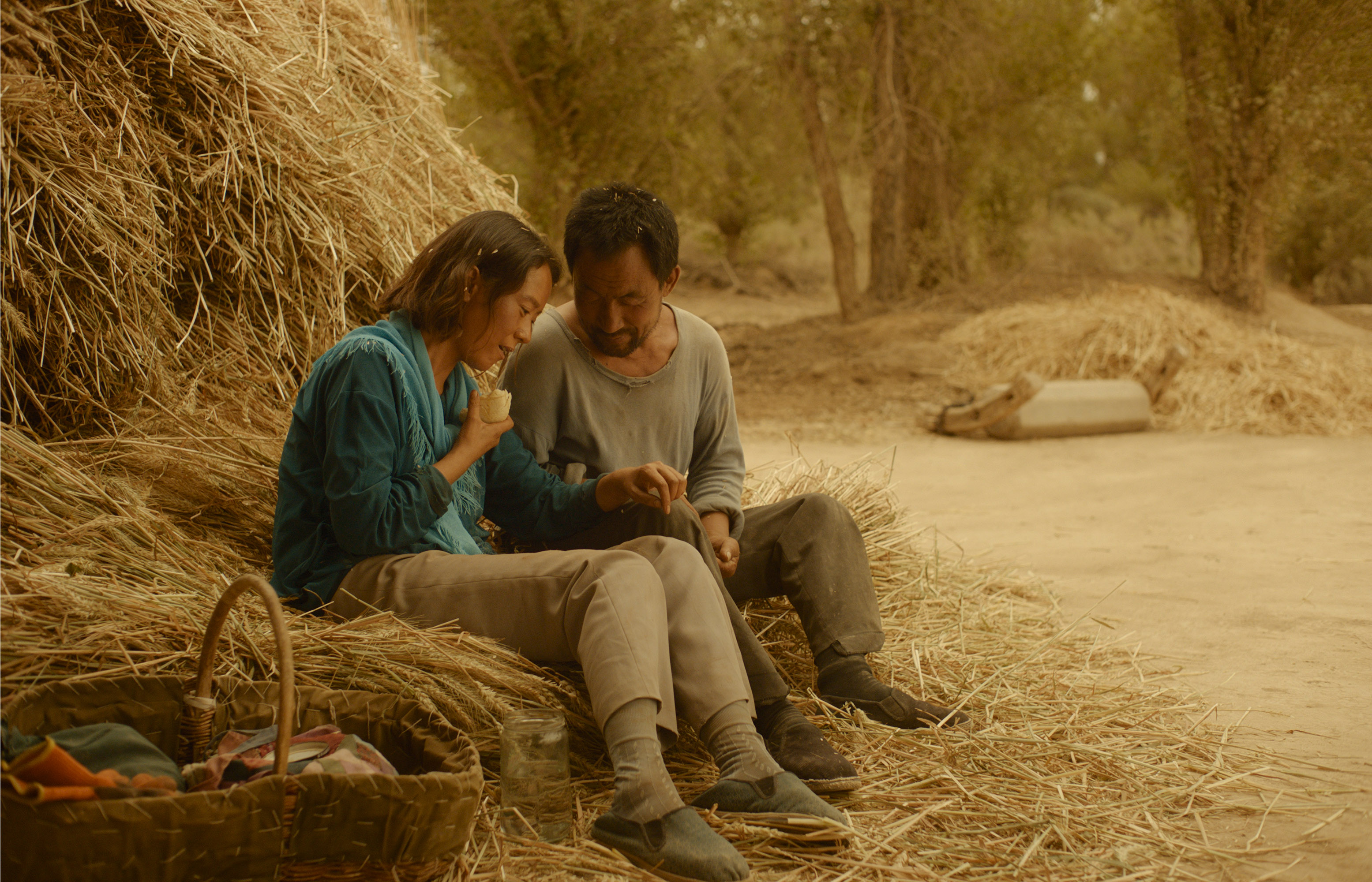
As villager had put it, Guiying had lived a horrible life shut up in a shed, beaten, and abused by her brother all her life. She thought Iron would make a good husband after seeing him comfort his donkey after his brother had beaten it and he does indeed begin taking good care of her even while it is clear the other villagers do not always accept Guiying, calling her a “wretched thing” or “useless idler” when she wets herself or is seen riding on Iron’s donkey cart. Slowly bonding through common purpose and mutual compassion, this marriage which could have meant only more misery for each of them becomes one of the few sources of joy in their lives. On moving properties, Iron cheerfully puts up the double happiness wedding character above their bed expressing the warmth which will fill the previously drafty home they will share together.
But life is hard in rapidly depopulating rural China. Many of the houses in the village are vacant, abandoned by those who’ve either migrated to the city or other rural communities with better opportunities. The government has instituted a policy of countryside renewal in which it will offer generous compensation for demolition or renovation of traditional homes which of course brings many of those who had left back with the intention of claming the free money for demolishing their abandoned properties. But for a man like Iron the policy ironically backfires pushing him into a cycle of continual displacement taking shelter in one abandoned property after another forced to move on when the owners return and ask him to leave. Pained, he asks one to hold off just a few days so a newly hatched swallow nesting under the roof of his home will be strong enough to fly away but the man is unsympathetic, insisting that he has no time to spare and must return to the city as soon as possible. The bulldozer goes in seconds after Iron and Guiying have picked up their cart.
Patiently baking mud bricks, the couple resolve to build their own home and farm their own land. So long as you do not betray the soil the soil will not betray you, Iron soulfully suggests yet his earthy rationalisation when Guiying sadly holds up a failed sapling that it will be fertiliser for the others sounds like a description of his own life. His status in the village is unbalanced when it turns out he has a rare blood type and is more or less forced to offer blood transfusions to a thuggish local businessman who owes the villagers both rent on the land he’s leased from them and wages which he’s not paying on the grounds that he’s ill and needs to sell the grain before he can settle. Bled dry, Iron receives small gifts from the man’s son such as a coat for Guiying he couldn’t afford to buy and accepts on the condition that it’s a loan, and a fancy dinner neither of them seem very comfortable with eating.
Because of his new connections, his brother, having not invited him to his son’s wedding banquet, fetches up and tries to intimidate Iron into getting an apartment in the city he clearly intends his son and daughter-in-law to live in. Bemused on looking out on the flat’s view of endless fields, Iron asks what he’s supposed to do with his chickens, the pigs, and the donkey, but the civil servants who are filming him presumably for propaganda purposes to show how people’s lives have been changed through the scheme, just laugh while his brother and sister-in-law mutter about the kitchen considering the suitability for the new couple. Iron signs all his bills with a thumbprint implying that he probably cannot write and perhaps cannot read. As he later puts it, what’s a peasant to do without land? The new future cannot look the same for everyone, and to succeed it will have to do away with the idea that the urban is inherently superior to the rural.
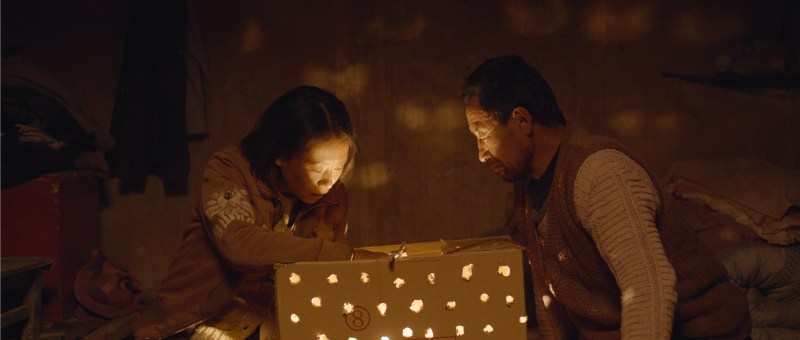
Continually displaced, Iron and Guiying accept their hardship with quiet dignity, stoically getting on with their lives while others only seek to exploit and misuse them. A brief scene of Iron setting up a box of lights to hatch chickens for Guiying to raise in place of the children they’ll never have adds a sense of wonder to their humble home while the compassion and kindness they show to the natural world would have perhaps repaid them if it had not been for the cruelties and contradictions of the modern China in which the rural has long been sacrificed in favour of increasingly consumerist cities. Iron pays his debts and prepares to move on though even in these vast plains it seems there is little space for him.
Return to Dust screened as part of this year’s Edinburgh International Film Festival and will be released in UK & Ireland on 4th November courtesy of Modern Films.
International trailer (English subtitles)

 Windows on Worlds