Operation Hadal (蛟龙行动, Dante Lam Chiu-Yin, 2025)

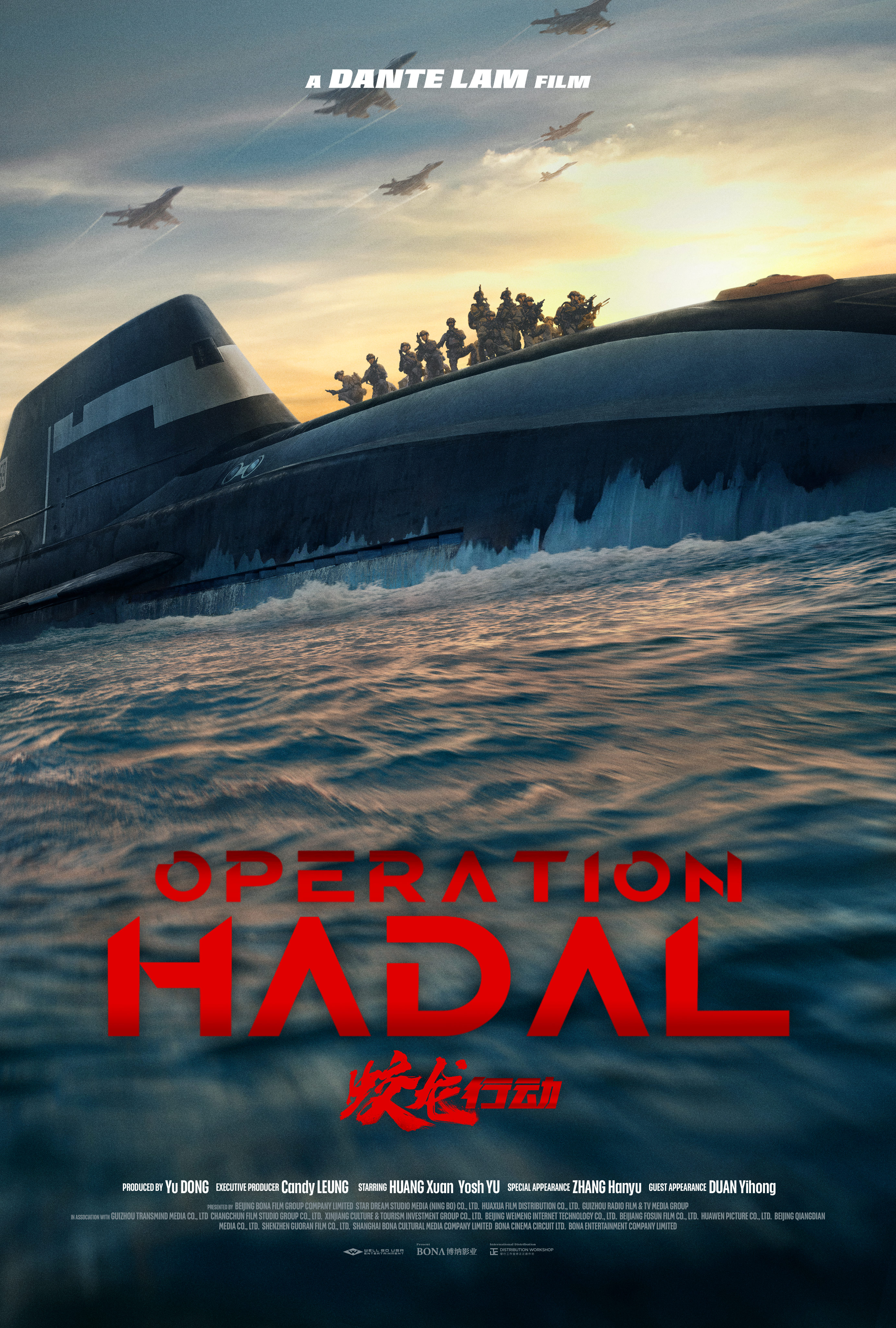
In recent years, Dante Lam has busied himself with a particular brand of Mainland propaganda actioner. Operation Hadal (蛟龙行动, Jiāolóng Xíngdòng) is intended as a kind of thematic sequel to earlier hits Operation Red Sea and Operation Mekong each of which featured the Chinese military springing into action to defend Chinese citizens from a plausible geopolitical threat while reminding the world at large that China will rise to defend itself and its citizens wherever they may be. 

All of which makes Operation Hadal a rather curious addition to the franchise. Unlike previous instalments, it’s set in the near future and revolves around round a completely ridiculous plot to blow up a volcano and destabilise East Asia with a series of what look to be natural disasters. Or so it would seem, the narrative is often incoherent and difficult to follow. If it were any other Chinese military propaganda film, it would doubtless want to show off the capabilities of the nuclear submarine at the film’s centre. The film even includes a quote from Chairman Mao in 1970 that the nation should hurry up and build nuclear submarines as soon as possible, but it’s not all that clear if this sort of submarine actually exists yet and the qualities the crew are most excited about on boarding the brand-new ship are that it’s much more spacious and comfortable to live in, while the fact that it’s much quieter and, therefore, can evade detection more easily is added as an after thought. 

Meanwhile, Captain Zhao Qing (Zhang Hanyu) is seen to make some questionable command decisions such as playing the harmonica on deck in a moment of crisis which is one thing that seems to have particularly upset the target audience. Zhang clarified that the tune he’s playing is a navy song and is intended as a call to arms for the submarine officers, though it doesn’t really play out that way and feels more like a misplaced homage to the western. Chinese technology is even eclipsed at times with the team finding themselves bogged down fighting robot dogs controlled by the other side, the so-called State of Siekerman, which at any rate seems to populated largely by people with American accents.

There is no clear reason why the State of Siekerman wants to destroy Asia with a series of “mid-sized nuclear bombs”, though there is division within the armed forces with some objecting to the plan because it will necessarily destroy the ecoculture of the area which is beneficial for the rest of the planet, leading to a mutiny by those who are in favour of blowing everything up. This sense of division is perhaps supposed to contrast with the intense unity of Chinese forces, in the same way as the friendship between Zhao Qing and the Admiral back on land is contrasted with that of the two State of Siekerman commanders who disagree about strategy.

The film’s biggest weakness is, however, a lack of characterisation among the Jiaolong team who are often indistinguishable due to the heavy equipment they are wearing. Interpersonal drama comes in the form of a man hung up on the death of a friend in a previous mission and his relationship with his fallen comrade’s son that is probably intended as a touching advocation of filial piety but largely gets lost among the chaotic action. The fact that everything comes down to one officer’s listening ability doesn’t seem like a very good advert for Chinese technology, if perhaps praising the abilities of rank and file soldiers to rise to the occasion. Subpar CGI often gets in the way of the action sequences which are the central draw, leaving the film quite literally all sea with no clear idea of what it’s trying to do. Where the violence of Operation Red Sea was realistic and horrifying, there’s a slightly camp quality with villains being dispatched by hatchets to the head or else popped by sliding doors. It’s not much of an advertisement for Chinese military prowess and never really discovers the sense of patriotic heroism that films like these generally rely on.


Operation Hadal is released on Digital in the US on 16th June courtesy of Well Go USA.

Trailer (English subtitles)蛟龙行动,

Wolf Pack (狼群, Michael Chiang, 2022)

A disillusioned doctor quickly finds himself in over his head when he’s kidnapped by Chinese mercenaries in Michael Chiang’s oddly positioned action thriller, Wolf Pack (狼群, láng qún). Once again, the action takes place in a completely fictional Middle Eastern/Central Asian country with the mercenaries playing mysterious spy games in which their heartless amorality is at least heavily implied to be an affectation and that they are ultimately interested in “more than money” while covertly protecting Chinese interests abroad.

The film heavily implies that they are in fact in some way working for the Chinese authorities with a lengthy focus on the Chinese flag outside the place of government in this foreign nation given the unlikely name of Cooley (in fact, most of the names given for various people and places seem mildly inappropriate). The photograph sullen doctor Ke Tong (Aarif Rahman) carries around also features his father in a Chinese military uniform which might be why he is so reluctant to believe that he may also have been a member of this “private army” as his new boss Diao claims. Though Ke Tong is originally very hostile to Diao’s gang who have after all kidnapped him he later undergoes an entirely unexplained change of heart accepting that his father must have had his reasons for whatever he did so Diao is probably OK anyway. 

In any case, their current mission involves defending Chinese energy interests against a local warlord who is working with European businessmen to disrupt a gas deal by placing faulty regulators designed to engineer an explosion which will apparently domino all the way back to the Mainland. Largely kept in the dark, Ke Tong is unable to see the big picture and keeps trying to help by doing righteous things such as shooting at a soldier hassling a young girl whose father he’d just killed but unwittingly making everything worse. Eventually he realises that the end client must be the Xingli group who are running the China-Cooley collaborative gas field, though even the energy official they’re later asked to protect seems to be prepared to die in order to ensure the project’s success and prevent a mass explosion. 

Diao’s selflessness is also well signalled thanks to his tendency to listen to a recording of a baby crying and meditate on “all he’s lost” to be a mercenary which again reinforces the idea that they have a greater cause than simply money along with Diao’s position as a surrogate father not just to Ke Tong but to the other soldiers who are all, it is said, looking for a place to belong. The gang apparently also have some kind of role funding orphanages in China to prove that they aren’t just in it for the cash. Ke Tong too comes to feel a kind of brotherhood that makes the mission more than just mercenary activity and gives him an excuse to chase the evil war lord even though that is not part of their mission and really the villagers, including a small child who has been forced to do their bidding, are not their concern. 

Despite starring two prominent martial arts stars, the film is much more focussed on technical wizardry and gunplay than it is on physical fights save for a late in the game confrontation between female mercenary Monstrosity and her opposing number as they try to liberate the gas field. Diao’s incredibly well equipped crew appear to be almost all-powerful, even if Ke Tong manages to play them at their own game, using fly-shaped drones to assist them in their work though the final mission involves an improbable plot device of the local government needing to sign a document by retinal scan within 60 seconds complete with an onscreen countdown via an encrypted briefcase computer in the middle of a firefight. 

Chiang does indeed bring action with a series of high impact sequences one involving a large petrol tank explosion which results in several of the warlord’s men being engulfed in flames. It does however leave a thread of mystery hanging over Ke Tong’s quest to solve the riddle of his father’s death with the suggestion that not all of his body parts were collected hinting that there may be further conspiracies in store for a potential sequel though what seems clear is that Ke Tong has discovered his place to belong alongside a surrogate father figure doing quite questionable things but apparently working for the national good. 


Wolf Pack is released on blu-ray in the US on 23rd January courtesy of Well Go USA.

International trailer (English subtitles)

Operation Red Sea (红海行动, Dante Lam, 2018)

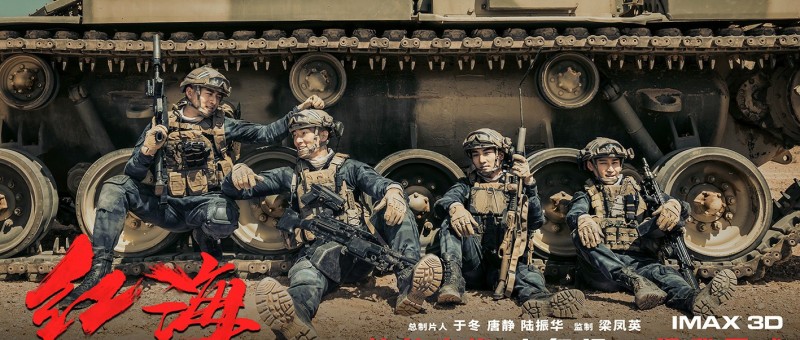
Operation Red Sea posterDante Lam, a Hong Kong action icon, is one of many to have begun looking North, tempted by the bigger budgets and audience potential of the Mainland. Following 2016’s Operation Mekong, Lam is back on manoeuvres with a second in what may develop into a series, Operation Red Sea (红海行动, Hónghǎi Xíngdòng). Red Sea is not connected to Mekong in terms of narrative and only features a cameo by the earlier film’s star, Zhang Hanyu, who remains firmly ensconced on the bridge of the all powerful Chinese warship while an elite troop of special forces handles the rapidly deteriorating situation on the ground, but it is once again “inspired” by a true story and perfectly positioned to show the Chinese security services in a more than favourable light.

The action begins in 2015 when the Chinese navy wades in to defend a merchant ship attacked by Somali pirates, managing to apprehend the “bad guys” with a minimum of bloodshed before they escape Chinese waters. Having suffered a casualty, the squad are then dispatched to rescue Chinese citizens caught up in an Middle Eastern coup. Their mission is helped and hindered by intrepid Chinese-French journalist, Xia Nan (Hai Qing), who has discovered evidence that a dodgy “businessman” caught up in the attack is in possession of a consignment of “yellowcake” along with a deadly dirty bomb formula which he plans to sell on to the terrorists currently waging war on the city.

Though Operation Red Sea is, perhaps, no more jingoistic than any British or American war film, its focus is more definitively centred on home concerns than an attempt to police the world. The Chinese military exists to defend Chinese citizens, even if those citizens are increasingly scattered throughout an unstable world. This presents a point of conflict between idealistic, and occasionally reckless, journalist Xia Nan whose mission is to stop the terrorists and rescue her friends, and the soldiers whose primary mission is to evacuate Chinese citizens though they hope to be able to provide assistance to citizens of other nations too if their mission parameters allow.

The Jiaolong, elite Chinese special forces, are indeed an impressive fighting force who proceed with military precision but are not without compassion. Informed by a local soldier that the terrorists often force civilians to become suicide bombers, the team’s bomb disposal officer puts himself at great risk to defuse a device and free a man destined to become a car bomb, rather than simply neutralising the threat. Protecting Chinese in peril is the official goal, but on a human level the soldiers are overcome with sorrow and anger for the local population, lamenting that they may have saved some lives but many have lost their homes and they will simply leave them behind to deal with the situation alone when they succeed in their mission of evacuating stranded Chinese diplomatic personnel.

Despite the overtly propagandistic elements which paint the Chinese military as a force for good, fighting bravely for their countrymen overseas, the landscape of war Lam paints is a hellish one full of blood, guts, and scattered body parts. Much of the film plays as a two hour recruiting video for the Chinese navy – it’s almost a surprise there aren’t people waiting with clipboards outside the theatre, but it’s difficult to believe anyone would be in a big hurry to sign up after witnessing the pure human carnage of a foreign battlefield and the very real threats the soldiers subject themselves to all while stoically pursuing their mission, committed to the protection of their nation and people.

Nevertheless Lam’s spectacle is impressive and action choreography unsurpassed. Working on a huge scale with everything from snipers to tank battles, Lam keeps the tension high as the team attempt to adapt to a situation which is rapidly deteriorating leaving them all but stranded behind enemy lines where each and every one of them faces a very real threat of death or serious injury. Despite an overuse of CGI slow motion bullet vision, Operation Red Sea largely earns its bombast with relentless fury, leaving its propaganda aims to dangle the background until the final coda which seeks to remind us that China rules the waves and will protect its citizens and territory wherever they may be.


Currently on limited release in UK cinemas courtesy of China Lion.

Original trailer (English subtitles)