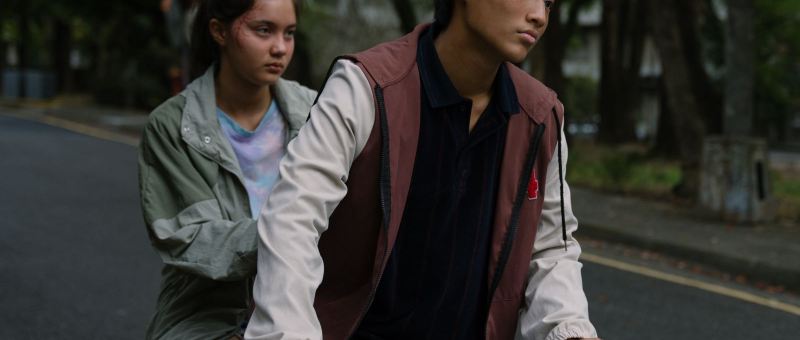

A young man on the cusp of adolescence longs to escape his miserable circumstances but gradually finds himself succumbing to the corruption all around him in Hsu Li-Da’s bleak coming of age drama, A Boy and a Girl (少男少女, shàonánshàonǚ). Though the title may sound like a cheerful rom-com, Hsu’s film is closer to anti-romance as the ill-defined relationship between the two provokes unforeseen changes and eventually dangerous situations.
In any case, all the Boy’s trouble’s start when his phone gets broken in the middle of a deal to sell in game points signalling an abrupt end to his escapist dreams. He’s desperate to get another one, but his mother can’t afford it and has problems of her own in that the hostess bar she runs is in financial trouble and she’s had to enter a sexual relationship with a local thug just to keep it running. The Boy catches them at it, and looks on voyeuristically laying bare his oedipal desires coupled with a moralistic objection to the act and resentment towards the gangster.
For these reasons he becomes determined to escape his moribund small town along with the hostess bar where his mother works by fighting back against adult duplicity. After meeting the Girl and gaining access to her phone, he discovers that she had been involved in a sexual relationship with their PE teacher which had resulted in a pregnancy. The pair of them attempt to blackmail the teacher with screen caps of his incriminating messages to her, but the plan backfires. The teacher doesn’t feel under threat and gets two of his underlings to beat the Boy up rather than pay. The Boy is morally outraged by the teacher’s behaviour and thinks someone ought to do something, but doesn’t know what to do so lands on blackmail as a form of punishment though as it turns out the Girl was less interested in vengeance or money than whether the teacher really loved her. Like the Boy, the Girl is mostly alone. She claims not to know who her mother is, while her father is suffering with an illness.
As expected they plot their escape together, but events soon overtake them. With the blackmail scheme ruined, the girl settles on sex work and the Boy becomes a kind of pimp if a conflicted one frustrated by the Girl’s whimsical businesses sense which sees her tell a potential client to forget about the money because he’s not quite as hideous as all the others. Meanwhile, she starts giving the boy a drug called Little Devil which causes those who take it to laugh manically and commit acts of extreme violence. Left without a moral arbiter the boy has nowhere to turn. Not only can he not talk to his mother’s boyfriend, but eventually encounters a corrupt cop whose immediate reaction is to tout for a bribe or, as he would have it, protection money.
In this very messed up environment, all relationships have become transactional. Gradually the Boy begins to behave like those around him and takes on the codes of the masculinity with which he is presented, posturing and squaring up to his mother’s boyfriend in contest over ownership of her. His mother wants escape too, but is afraid and constrained by the persistent misogyny of the present society even if, ironically, her work her also leans into it in running a karaoke bar where the some of the hostesses are encouraged to undress. The more they try to escape, the tighter the noose seems to grow refusing to let any of them leave and denying them even the hope of better life.
Already cynical, the Girl is resigned to her fate and in fact no longer really resisting it save for interactions with the Boy. Told that her father is much sicker than they thought and needs an expensive operation, the Girl suggests that she doesn’t intend to pay while the Boy tries his best to get cash to pay off the ganger, free his mother, and keep the bar only to be confronted with his naivety. The picture Hsu paints of contemporary Taiwan is bleak and unforgiving, refusing either of the pair the prospect of a happier future and guaranteeing only misery for all in a land of cheats and gangsters in which a good heart is weakness few can afford.
A Boy and a Girl screened as part of the 18th Season of Asian Pop-Up Cinema.
Original trailer (English subtitles)
 Windows on Worlds