Invasion of the Neptune Men (宇宙快速船, Koji Ota, 1961)

Japan was well on the way to economic recovery by 1961, but the newly prosperous society also gave rise to other anxieties and most particularly in the light of the Cold War and space race with the nation fearful of falling behind in scientific development. Or at least, that’s something that particularly bothers the young heroes of Koji Ota’s kids tokusatsu, Invasion of the Neptune Men (宇宙快速船, Uchu Kaisokusen), in which the nation’s failure to build a space rocket is conflated with its traditional visions of masculinity. 

At least, the boys all agree that Tachibana (Shinichi Chiba), a young scientist who runs a kind of club with them at the research facility where he works, is pretty great but also a bit of a wimp who failed to stand up to some bullies who were hassling him at a local cinema. They think it would be better if he were cool, re-imagining him as a kind of tokusatsu hero named “Iron Sharp” for whom they even come up with a theme song. As part of their club activities watching satellites, the kids accidentally stumble across a spaceship belonging to Neptune men who are planning to invade though obviously as they are children no one really believes them until the Neptune men start causing other forms of destruction. 

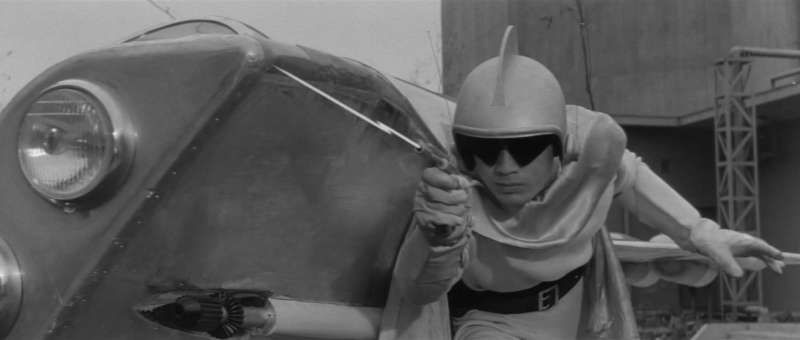
Attacked, the kids are saved by the hero they themselves made up flying in on a car/plane/spaceship though he too doesn’t really have a lot time for them and the kids don’t even really notice he looks a lot like Tachibana who is noticeably absent from the lab whenever he’s around. Even so, this being a kids film the major the problem is that no one else takes the boys very seriously, save Tachibana himself, leaving them to save the day on their own while the grown-ups argue amongst themselves. 

Getting people to argue amongst themselves turns out to be part of the aliens’ mission in exploiting Cold War paranoia to start world war three. The first attack results in a mushroom cloud which must have been fairly painful symbolism though the Americans immediately blame Russia who blame the US in return asking if they’re really intent on starting a nuclear war. The kids wonder why grownups are always so suspicious of other countries, hinting at a desire for a less xenophobic society eventually echoed in the calls for worldwide unity to defeat the Neptune men while otherwise repeatedly emphasising that Japan can’t be left behind by the US and Russia in the space race. 

Then again, there is something quite troubling in the fact that the invading Neptune men who’ve taken on human form appear as soldiers but wearing prominent feminine makeup, re-echoing the boys’ concerns regarding science and masculinity while introducing a seemingly unintentional dose of homophobia into the threat posed by the aliens who otherwise wield destructive nuclear powers echoing the atomic bomb in using their ray guns to vaporise their targets who then leave shadow imprints of themselves where they disappeared. The main weapon used to combat them is science, Tachibana and his boss, the father of one of the boys, coming up with an ingenious electric shield and then a series of magnetic rockets which allow them to shoot down the Neptunian’s ship. 

In this case, science is the “good” force that combats the “bad” use of nuclear weapons this time rendered alien rather than manmade therefore neutering the debate surrounding their use and the responsibilities involved with their discovery. Tachibana, the thinly disguised Iron Sharp, then becomes a hero of science racing round in his custom car and largely defeating the Neptunians through a more primal kind of hand to hand violence while embodying the kind of cool masculinity the boys the otherwise feared he lacked which is to say that unlike his real life guise, Iron Sharp is perfectly capable of standing up to “bullies” like extraterrestrial invaders. Reusing some of the effects footage from The Last War, the film emphasises the need for world unity and the end of the Cold War, but also sells a slightly contradictory, mildly nationalist message insisting that Japan can’t fall far behind technologically or will essentially be at the mercy of Russia and America, Tachibana having travelled to Moscow to assist with the creation of a new spaceship. Spurred on by their adventures, the kids all vow to become great inventors protecting Japan through their innovations, going on to explore Mars and Venus hinting at a new sense of possibility in the post-war society but also mindful of its geopolitical realities.
Singing Lovebirds (鴛鴦歌合戦, Masahiro Makino, 1939)

singing lovebirds still 5With things the way they were in the Japan of 1939, you might have expected cinema to have taken a universal turn to the dark side but surprisingly enough there was still room on the silver screen for silliness as the improbable marvel of Singing Lovebirds (鴛鴦歌合戦, Oshidori Utagassen) makes plain. Legend has it that musical master of the jidaigeki Masahiro Makino threw Lovebirds together in record time in order to fill a production gap after big time star Chiezo Kataoka was struck down by appendicitis in the middle of filming On the Road with Yaji and Kita. Kataoka is also Lovebird’s nominal male star though his appearance is understandably limited (his scenes were shot later and apparently in a matter of hours) leaving veteran actor Takashi Shimura to pick up the slack as an antiques obsessed disenfranchised former samurai who finds himself at the centre of a dastardly plot orchestrated by the higher ups to solve an ongoing romantic crisis among the youngsters.

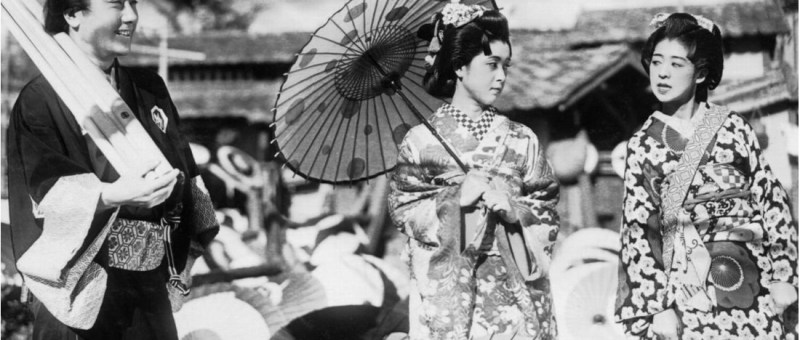
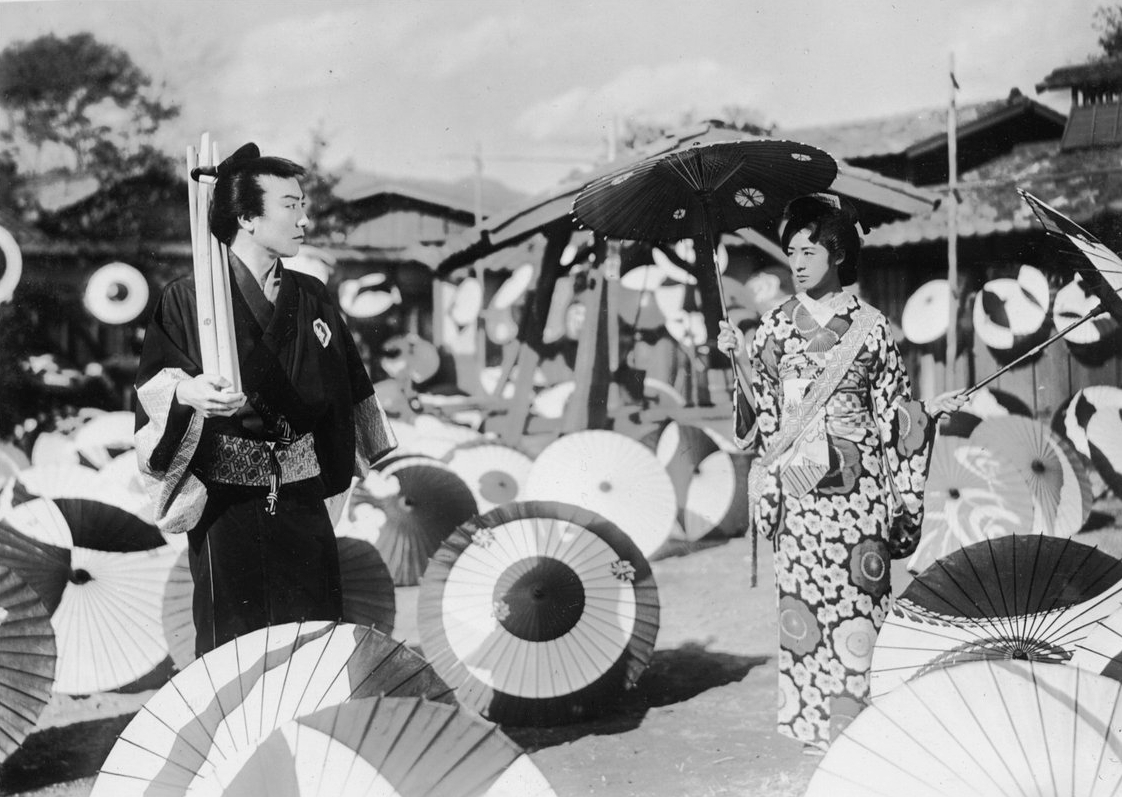
The crisis revolves around the handsome Reizo (Chiezo Kataoka) – a young ronin betrothed to a young lady from a well to do family, Fujio (Fujiko Fukamizu), whose father is keen to make the marriage official as quickly as possible. Reizo, however, has fallen for Oharu (Haruyo Ichikawa) – the daughter of ronin umbrella maker Shimura (Takashi Shimura). Meanwhile, Reizo has also become an object of affection for the daughter of a wealthy local merchant, Otomi (Tomiko Hattori), who is spoilt and entitled to the extent that Reizo’s resistance only enflames her ardour. If all that weren’t enough to be going on with, a randy local lord (Dick Mine) is also actively chasing most of the women in the area and after getting turned down by Otomi has his sights set on Oharu.

Peaceful times allow for small bursts of chaos and ongoing romantic silliness which is where we find our conflicted heroes, yet there is a persistent strain of anxiety in the precarious lives of the disenfranchised ronin who find themselves trapped in a cycle of wilful degradation which prevents them from taking on work unbefitting of a gentlemen and, consequently, permanently on the brink of starvation. Umbrella making, a frequent ronin-friendly occupation in the world of the jidaigeki, is one such way of making ends meet, but Shimura can only afford to feed his daughter barley much to her consternation. Rather than use his meagre resources for short term satisfaction he’s decided to “invest” them in various “antiques” which he believes both bolster his status and can be sold to provide a dowry for Oharu when she decides to marry.

Unfortunately, Shimura is mistaken – he’s not got as good an eye for antiques as he thought and is a well known mark for the local hawker. Everything he has is a fake and he’s wasted a small fortune on useless trinkets. Shimura’s antiques mania also leaves him open to other kinds of scams and manipulation when he gets himself into a small amount of debt to the randy lord and Fujio’s dad (Mitsuru Toyama) who have tricked him in order to try and get Oharu out of the Reizo picture and into the lord’s bedchamber. Unlike many Jidaigeki dads, however, Shimura is a nice guy and tells the higher ups where to get off because what kind of father sells his daughter for the price of a pretty tea bowl?

Shimura’s logic might not make much sense to the lords, or to many other residents of the jidiaigeki world, but is perfectly in keeping with the film’s surprisingly humanist morality in which all are made to realise that greed is bad, money is silly, and at the end of the day all that really matters is true love (even if you have to live in a hovel and survive on barley gruel for the rest of your life). Even the spoilt Otomi is finally forced to realise that you can’t force love and the best you can do is try to support other people’s happiness while you wait for yours to come along (which it is more likely to do once you start being nicer to everyone including your long suffering manservant).

Bright, cheerful, and filled with zany humour Singing Lovebirds is a refreshingly warmhearted piece of eminently hummable escapist fluff providing a much needed distraction from the austere world of 1939 in which its particular brand of anti-capitalist humanism would seem to be extremely out of place. Nevertheless, the corrupt and oppressive samurai order gets a much needed comeuppance, the little guy realises he doesn’t need to play their game anymore, and a young woman realises the only person she needed to feel good enough for was herself. A happy ending for all and an umbrella wielding dance routine to boot – who could ask for anything more?


Brief clip (extremely poor quality, no subtitles)

https://www.youtube.com/watch?v=GGQIzCN22tk