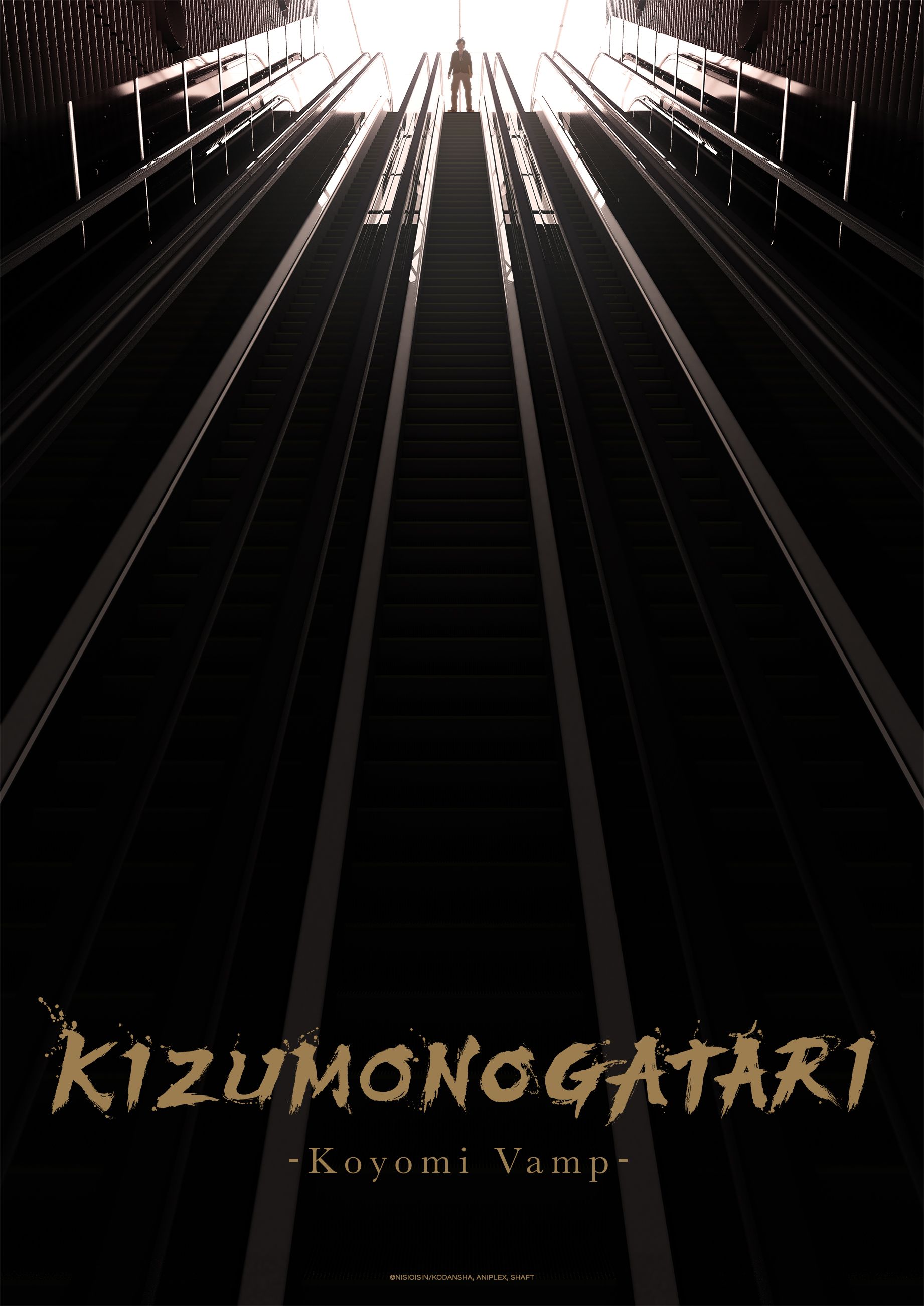
Kizumonogatari -Koyomi Vamp- (傷物語 -こよみヴァンプ-, Tatsuya Oishi, 2023) [Fantasia 2024]

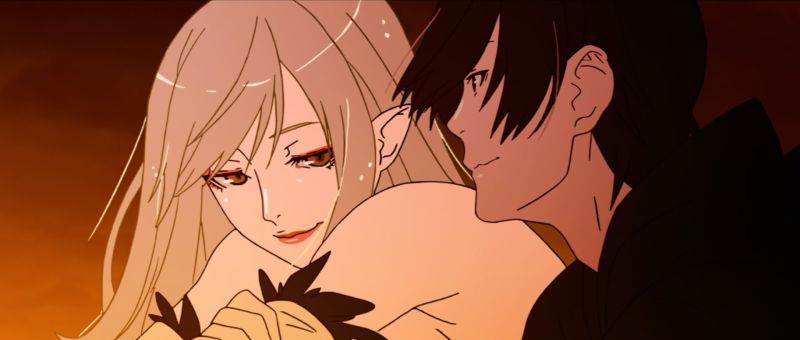
A young man walks into an empty subway station already ominously strewn with blood and finds there the corpse of a woman shorn of her limbs. The corpse rises and begs him to have her life by sacrificing his own in allowing her to suck his blood and surprisingly the young man agrees. He does not, however, die but is brought back as something else, not quite human and definitely subservient to the creature he has saved. 

Running 2.5 hours, Tatsuya Oishi’s Kizumonogatari -Koyomi Vamp- (傷物語 -こよみヴァンプ-) is in fact a compilation of three films released in 2016 and a part of the long running Kizumonogatari series which originated with Nisio Isin’s light novels and has gone to spawn an expansive universe of interconnecting spin-offs. This is technically a prequel, and in that sense begins with a black slate but also deliberately drops us into confusion with breakneck pace through the hero’s quest to recover himself and his place in the world after this rude awakening to the supernatural. 

Rude is in many ways a defining characteristic of Kiss-shot, the 500-year old vampire Araragi finds bleeding in the subway station at that point a blonde and alluring figure of forbidden desire. Araragi is drawn to her in an unconscious death wish linked with the sexual desire he struggles to understand, running into the subway minutes after buying a pornographic magazine from a convenience store after striking up a friendship with fellow student Hanekawa. But once he saves her life, Kiss-shot is transformed into a cheeky little girl who now tells him that he is her minion and he must recover her severed limbs from a trio of vampire in order to be restored to humanity even as the power dynamic between them becomes confused and distorted.

In his vampire state, Araragi becomes immortal, powerful and free of mortal jeopardy yet he remains uncertain and insecure while reliant on the support of Hanekawa who encourages him to reject his desire for death and remain alive. But this also presents a problem to Araragi who sees himself as self-sacrificing and is unwilling to accept the what he sees as a self-sacrifice from Hanekawa for whom he feels unworthy and inadequate. In some senses it’s a typically self-centred, adolescent male perspective that rejects any idea of her own agency and assumes Hanekawa performs these actions for him rather than considering that she performs them for herself and is simply doing what she wants to do which in the end is not really about him at all. He declares it a burden he’s too weak to carry, which might in some senses be fair but also again a mischaracterisation that is further evidence of his lack of self-worth.

It’s this sense of inadequacy that lies behind his desire to reclaim his humanity along with the concurrent disgust he feels in the degradations of vampirism. It genuinely comes as a surprise to him that Kiss-shot feeds on human beings and lost her own humanity so long ago that she no longer gives it a second thought. She is after all only being what she is, but like Araragi is drawn to death partly out of frustrated longing and lingering boredom with a relentless yet apparently uneventful 500 years behind her in which the only other highlight was her previous minion who rejected this life much more quickly than she ever expected.

Even so, Oishi lends their mutual dilemma a degree of absurdity in the expectedly comic sight of severed heads littering a sports filed or launching themselves in toothy attacks. Heavily inspired by the French New Wave, he breaks the action with sometimes barely legible title cards often reading a single world while his composition has a kind of jauntiness that is also bleak and melancholy. The world surrounding Araragi veers between the pristine entrance to the high school, and post apocalyptic devastation littered with crows emblematised by the depilated cram school in which Kiss-shot keeps him. Backgrounds often have a photo realistic quality that further sets the world at a kilter when matched with the more conventional character designs of the central players. The conclusion that Araragi is presented with amounts a sharing of the misery which is also akin the burden he didn’t want to carry but also perhaps symbolic of his path towards adulthood in acceptance of compromise and selflessness in being willing to carry a small part of others’ pain and despair and allowing them to carry a part of his own.


Kizumonogatari -Koyomi Vamp- screened as part of this year’s Fantasia International Film Festival.

Original trailer (English subtitles)

Gold Kingdom and Water Kingdom (金の国 水の国, Kotono Watanabe, 2022)

After centuries of conflict, two feuding countries finally begin to put the past behind them to work for a common future in Kotono Watanabe’s animated fantasy romance, Gold Kingdom and Water Kingdom (金の国 水の国, Kin no Kuni Mizu no Kuni). Adapted from the manga by Nao Iwamoto, this is very much a story of coming together to create a better future for all in which it’s always better to follow the most difficult path if it leads to longterm peace rather than opting for a quick fix like a dynastic marriage that won’t take place for another fifty years. 

In this case, the dynastic marriage actually works out but only because romantic heroes Sara (Minami Hamabe) and Naranbayar (Kento Kaku) end up meeting by chance and falling in love organically despite the class disparity and cultural differences between them. The kingdoms of Alhamit and Balkari had been feuding in part for the petty reasons of a dog and cat respectively doing their business on the wrong side of the border wall erected after previous war. Neither nation being very much interested in the dynastic marriage proposed by the previous generation in which Alhamit would give its most beautiful woman as a wife to Balkari’s cleverest man, Alhamit sent a cat instead while Balkari sent a dog. Poor Balkari engineer Naranbayar simply laughed off his new “bride” while Princess Sara of Alhamit decided to go along with the ruse knowing that to kick up a fuss would likely send both nations back to war. 

They happen to meet when Sara transgressively ventures beyond the wall in search of her dog, Lukman, who has fallen in a hole in the forest. With her pretty sisters needling her, Sara asks Naranbayar to pretend to be her new husband, little realising that he is the man she is intended to marry. The youngest of four sisters, Sara has always felt inferior and fears that she cannot live up to the title of Alhamit’s most beautiful woman but begins to fall for Naranbayar who is in fact very clever but also kind in the way most of her family aren’t. Naranbayar genuinely cares about the people of Alhamit and quickly works out that in this incredibly wealthy, “golden” desert city they will run out of water within 50 years while water is something the poor nation of Balkari has in abundance. 

An alliance will save the lives of people in Alhamit, but also also benefit those of Balkari in boosting its economy but not everyone is motivated towards a diplomatic solution with many in the court clearly agitating for war in which they would simply conquer Balkari to capture its resources. The King is under pressure in thinking of his historical legacy, not wanting to be seen as a weak monarch as his namesake earlier was in having restored with relations with Balkari rather than seeking to dominate it militarily. Under the sway of potentially corrupt shaman Piripappa (Chafurin) he rules with an authoritarian fist, while his haughty daughter Leopoldine (Keiko Toda) has appointed a handsome actor as an advisor to signal her opposition. 

Only through the genuine love which emerges between Sara and Naranbayar can the country be saved in turning away from pointless acrimony towards a more open future marked by mutual cooperation and friendship between two equal nations. Through falling in love with Naranbayar, Sara grows in confidence and learns to see herself as beautiful no longer inferior to her sisters but playing a full part in the life of the court as they work together to solve the water issue and return life to their arid land. Beautifully designed with its Middle-Eastern aesthetics and strong contrast between the desert kingdom of Alhamit and the beautiful forests of Balkari, the film also features charming paper art bookends and a watercolour credits sequence depicting a happier future for both nations as they forge a new society together. Heartfelt in its central romance, Watanabe’s charming love story positions cross cultural connection as the best means of overcoming centuries of pointless conflict along with allowing each of its heroes to become more of themselves as they work together to create a new world of love and peace in which all can prosper and live in happy harmony. 


Gold Kingdom and Water Kingdom screened as part of this year’s Nippon Connection.

International trailer (English subtitles)

The Night is Short, Walk on Girl (夜は短し歩けよ乙女, Masaaki Yuasa, 2017)

The Night is Short posterHave you ever had one of those incredibly long nights that seemed to pass in an instant? Masaaki Yuasa returns to the absurd world of Tomihiko Morimi with the charming one night odyssey, The Night is Short, Walk on Girl (夜は短し歩けよ乙女, Yoru wa Mijikashi Aruke yo Otome), which takes place in the same world as Yuasa’s TV anime adaptation of the author’s Tatami Galaxy. The Girl with Black Hair dreams her way through Kyoto, relentless as a steam train in her pursuit of new experiences, but perhaps the speed at which she travels leaves her horizons perpetually unclear.

Beginning where many stories end, The Night is Short, Walk on Girl, opens with a wedding. “Sempai” (Gen Hoshino) longs for the “Girl With Black Hair” (Kana Hanazawa). He doesn’t know her name or really very much about her at all other than she’s in the year below him and they belong to the same club, but this is a love for the ages fated to come true. To this end, Sempai has been engineering “coincidental” meetings with the Girl so that she knows he exists, in a “there’s that guy again!” sort of way, hoping to travel into her heart by means of osmosis. Until then he’ll just stare at her lovingly from three tables away at social events involving mutual friends…

The Girl, however, has her own plans. She’s determined to make her way into the world of adulthood this very night, travelling by the power of alcohol (for which she seems to have a seriously impressive tolerance). For the Girl, the night is filled with possibilities. She’s open to everything and everyone, ready to say yes to whatever strange adventure the gods have in store for her. Which is lucky, because this is going to be a very strange night indeed.

The Night is Short pivots around the idea of connection as its two poles – Sempai and The Girl, are perpetually kept apart, orbiting each other in an endless search for a home. The Girl drinks and claims she feels the interconnectedness of all things, at one with the world and everybody in it. The miserly, miserable local god she’s in the middle of a drinking contest with understands her reasoning but has lived too long to agree with it. After all, at some point you have to stop drinking and the world is cold and lonely. The old man tastes only life’s nothingness, for him life is fruitless and nearing its end but for the girl all the world is flowers and warmth, filled with promise and possibility.

If the old man is right and alcohol provides only a fleeting, essentially fake feeling of contentedness, then perhaps there are other routes to true connection – such as the universal circulation of books. Books carry ideas between people and take feelings with them yet there are those who try to staunch the flow – namely book collectors who try to stem the system by hoarding copies to push up the price. Sempai and the Girl each find themselves caught up in this act of anti-human profiteering as allies or enemies of the strange little creature who presides over the great book fair of life.

Even those, like the old man, who feel themselves to be excluded from human society prove themselves connected by one very special unifying factor – the passage of disease. The Girl is committed to spreading happiness wherever she goes, healing the sick and ministering to the lonely, but even those who feel they have nothing to give have still given away a part of themselves in the form of the common cold as it rips like wild fire through old Kyoto with the desperate force of a lifetime’s painful rejection. It’s kind of beautiful, in a way, as the old man’s life suddenly brightens in not feeling so alone anymore after casting himself as patient zero.

Yuasa’s drunken night in Kyoto is strange and surreal. Time runs inconsistently, revealing the uncomfortable truth that it speeds up as you grow older and night approaches dawn to the still young Girl, too full of life and possibility to think of looking at a clock. Sempai remains a cypher, his only clear personality trait being his certain love for the strange girl who’s always too busy chasing dreams to see him. His friends are also facing their own strange nights from the one who’s decided not to change his undies until he’s reunited with his one true love with whom he shared but one fateful encounter, and the other whose taste for female attire receives a slightly muddled reception, but they each find themselves caught up with three level pagoda trains, guerrilla theatre practitioners (or “school festival terrorists”) whose protest turns out to be romantic rather than political, not to mention the persistent threat of underwear thieves. Is this fate, or mere “coincidence”? In the end perhaps it doesn’t matter, but the night is short. Walk on Girl, just slow down a little, you have all the time you need.


The Night is Short, Walk on Girl is released in selected UK cinemas on Oct. 4 courtesy of Anime Ltd. Check the official website to see where it’s screening near you.

Original trailer (English subtitles)

Psycho-Pass: The Movie (劇場版 PSYCHO-PASS サイコパス, Katsuyuki Motohiro & Naoyoshi Shiotani, 2015)

psycho-pass movieThe Japan of 2116 is a peaceful place. Crime is at an all time low thanks to the Sybil system which monitors the nation’s citizens issuing them a “Crime Coefficient” rating assessing how likely they are to commit a crime. When a potential criminal’s Psycho-Pass reaches an unacceptable level, the Public Safety Bureau are called in to hopefully put a stop to any criminal activity before it has the chance to occur.

However, the world outside of Japan is not quite so ordered and so its Sybil system has become an important political export. Things are about to get murky as the nearby SEAUn (South East Asia Union) is currently in a state of civil war and its de-facto leader has struck a deal with Japan for additional support in return for trialling the system in a new reclaimed land development. Not everyone is happy with sacrificing personal liberty for social safety and so an active resistance unit working against both the deployment of Sybil and the leader they see as a dictator is continuing to prove a destabilising force.

This all comes to a head when a group of so called “terrorists” manage to sneak in Japan hoping to  take the fight to Sybil itself. After a brief but intense shootout with the PSB, the gang is neutralised save for one which famed Inspector Akane Tsunemori manages to capture and take in for questioning. However, whilst Akane is waiting for the captive to come round from the sedative she gave him, her bosses have taken drastic action which amounts to lethal torture. Akane is horrified, but when the recovered information flags up the familiar face of her former colleague Kogami, she quickly finds herself at the centre of covert, international political machinations which cast her own nation in far from a positive light.

Psycho-Pass: The Movie (劇場版 PSYCHO-PASS サイコパス, Gekijo-ban Psycho-Pass) is the big screen outing for the hit TV anime which has so far spanned two series each with their own distinct narrative arcs. Series creator Gen Urobuchi handled the first season but sat out the second (handing the reign’s over to Murdock Scramble’s Tow Ubukata) in order to work on this film which takes place after season two but was actually developed at the same time so avoids direct reference to its events. For the most part, Psycho-Pass: The Movie works as a stand alone enterprise though it does make reference to plot elements from season one, or more exactly its villain, without further explanation which may leave newcomers feeling lost. Fans of the franchise already familiar with the characters and their relationships will undoubtedly get the most out of the set-up, but in depth knowledge of the series is never a prerequisite for understanding the action.

“Action” is an apt place to start when it comes to the themes of Psycho-Pass: The Movie as it acts more as an exciting side story to the main series than the grand conclusion that might be expected. Broadly speaking, the central concern is the increasing interference of powerful nations in the “domestic affairs” of smaller ones. Akane is as idealistic as they come despite everything she has already seen and is unprepared for the extent her own nation’s complicity in this very dirty, possibly proxy, war. In this country, those with flagged Crime Coefficients are forced to wear a standard issue collar which is designed to explode Battle Royale style and are treated as an underclass not permitted to board the same public transport or occupy the same “public” space as the general population. Once again this sits uncomfortably with Akane, but there isn’t a lot she can do about it.

Kogami, now a drifting mercenary since going on the run from the PSB, has become a rebel revolutionary trying to help the oppressed citizens fight for democracy in this war torn land. To some, he’s a terrorist (though the rebels are never shown targeting civilians or carrying out “terrorist action” so much as acting as a resistance group) but his sights are firmly set on hypocritical, oppressive regimes and especially those acting as puppet states for a third party. Akane and Kogami’s relationship status continues in the “it’s complicated” direction which has progressed throughout the series and they aren’t given very much time to build on that here though their mutual respect for each other adds to the tension as each comes to terms with being on opposing sides yet somehow still “together” in spite of external obligations.

Even if Psycho-Pass: the Movie proves disappointing in terms of its character development (betraying its side story origins), it excels in the action stakes with several impressive, high octane battle scenes not to mention the strange ballooning effect of the explosive Dominator weapons. Though it sets up a complicated, geo-political conspiracy of superpowers exploiting civil unrest to steal puppet states and install dictatorial stooges who oppress the local population into a sublime obedience with the promise of long desired peace, it wisely avoids expository dialogue preferring to keep things moving in a more urgent fashion. A minor entry into the Psycho-Pass world, Psycho-Pass: The Movie is nevertheless an exciting return to its increasingly dystopian universe and even if it adds little in terms of themes or characters, does at least point towards a promising continuation of the series.


Reviewed as part of the “biennial” Anime Weekend at BFI Southbank. Psycho-Pass: The Movie has also been licensed for UK distribution by All the Anime (and Funimation in the US).

English Subtitled trailer: