Black Night Parade (ブラックナイトパレード, Yuichi Fukuda, 2022)

According to the opening voiceover of Yuichi Fukuda’s seasonal comedy Black Night Parade (ブラックナイトパレード), we’ve all got Christmas wrong. It’s not completely true that Santa only gives presents to the nice kids for there are in fact two Santas, the other one, the anti-Santa, making sure that bad children have a very unhappy Christmas receiving gifts ranging from the traditional lump of coal to offal. The Santa dressed in black is described as being a little more egalitarian, but does indeed pedal in disappointment and the opposite of the holiday spirit though in another way perhaps he’s just an embodiment of a sense of resentment towards to the unfairness of the contemporary society. 

Miharu (Ryo Yoshizawa) is very definitely grown up and a good example of someone who regards themselves as earnest but is becoming fed up with seeing those he regards as acting inconsiderately prosper. Still working part-time at a convenience store having repeatedly failed to get into university or find a full-time job, he’s irritated by his loudmouth slacker colleague Kaiser (Taishi Nakagawa) who just seems to constantly fall up in life while Miharu ends up being the responsible one doing most of his work for him. When Kaiser asks him to cover his shift Christmas Eve so he can go on a date with his pretty girlfriend seconds after telling him he’s actually had a full-time job offer, it obviously stings more than a little. But when Miharu takes a leaf out of his book and tries to take home one of the expired Christmas cakes, he’s immediately caught and threatened by his boss not to mention being deemed a bad boy by the Santa in black. 

Though in his case, it results in an ironic job officer to become one of Santa’s helpers at a gloomy Santa centre where they run a virtual surveillance state to figure out whether the kids that send in letters to Santa have really been as good as they claim to have been. Surveillance queen Shino (Kanna Hashimoto) decides one little lad hasn’t on catching him cheating on a test despite having emphasised how hard he’d been studying in his letter. Cheating on a test is obviously not “good”, but perhaps it’s not innards in your stocking bad either and Miharu’s moral compass is going haywire trying to understand the strange world he finds himself in while participating in a contest to join the elite Reindeer division of Christmas shock troops. Meanwhile, he’s also confronted by a conspiracy in which the red Santa has already been murdered by rats controlled by a mysterious group who hate Christmas and are trying to eradicate it. If they don’t find a new red Santa soon, the magic will be broken forever.

Despite the zaniness of the concept, the humour is a little less grating than the broad variety style generally employed by Fukuda in his other films even if several of the performances are on the larger side. Rather than rediscovering the true meaning of Christmas or coming to an accommodation with the unfairness of the contemporary society, Miharu is guided towards dealing with his own unresolved childhood trauma which repurposes the empty consumerism of a contrived holiday tradition as a means of signalling of a lack of something or the roots of unhappiness. Even if most most kids are asking for the latest toys it may be because they want others to play with with them, while some just want company because their parents have to work long hours and they’re lonely at home. 

Despite making the astute observation that the best way to disappoint a naughty child is to get them what they asked for but not quite right, Miharu eventually discovers a calling in making sure no child is left empty-handed on Christmas Day spreading the spirit of the season wherever he goes even while being chased by packs of evil rats out to destroy the joy of Christmas forever. Then again, there is some mildly satirical humour in the likening of Santa Claus House to a “black company” ruthlessly exploiting its employees while engaging in some very dubious corporate shenanigans in its use of customer data and clear invasion of privacy in its all-seeing surveillance network. In any case, it does appear that Christmas is safe from the rat race for the moment and children good or bad will wake up to a surprise equally so on Christmas morning for years to come.


Original trailer (no subtitles)
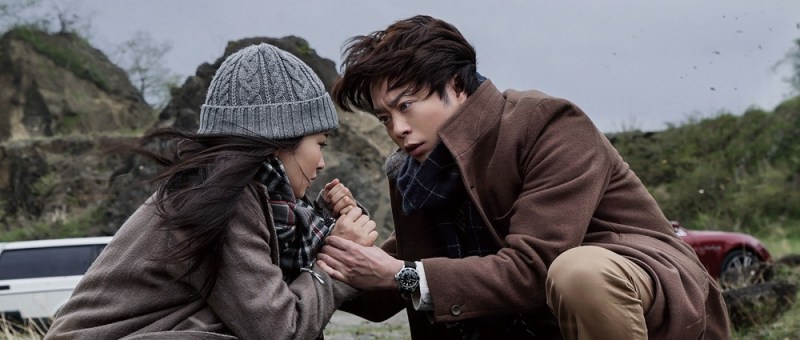
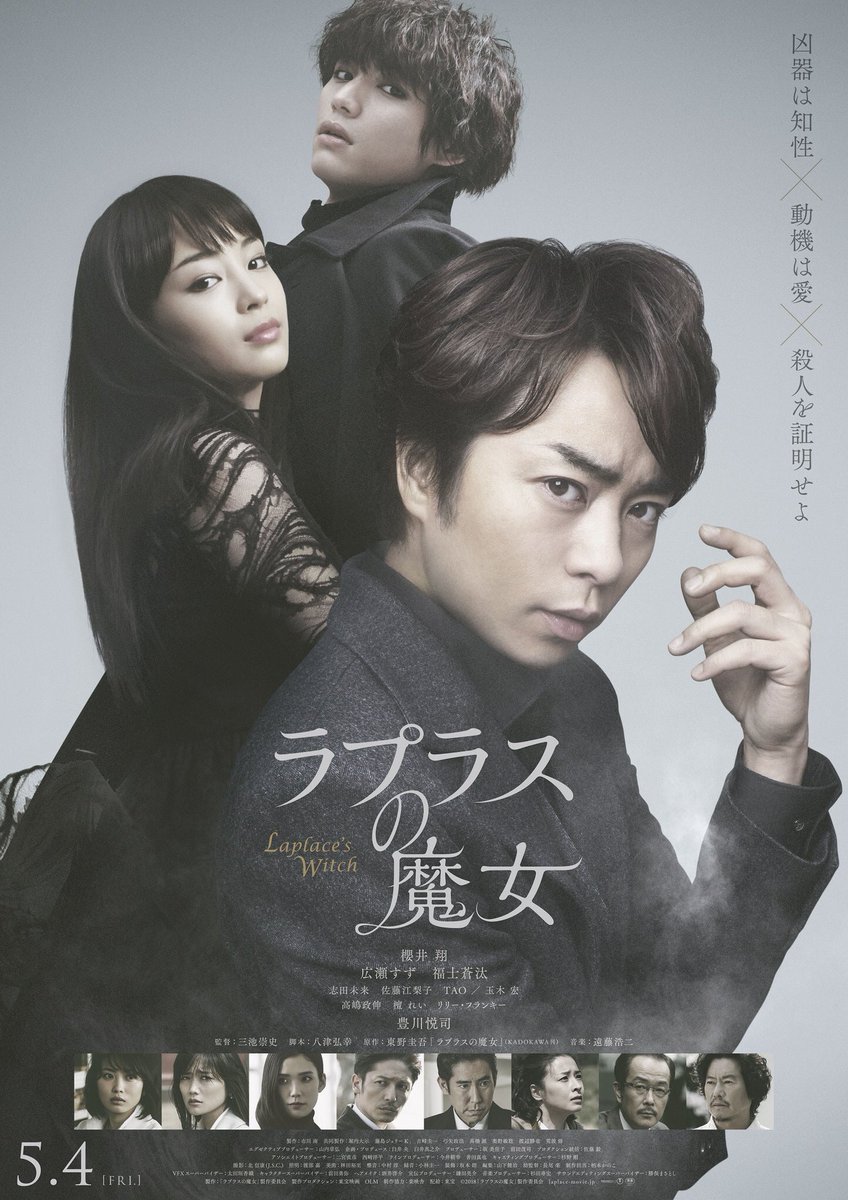
Laplace’s Witch (ラプラスの魔女, Takashi Miike, 2018)

Laplace's Witch poster 2Takashi Miike, among Japan’s most prolific of directors, teams up with one of the nation’s most prolific authors, the often adapted Keigo Higashino, for a dose of scientific mystery in Laplace’s Witch (ラプラスの魔女, Laplace no Majo). Responsible for the international smash hit The Devotion of Suspect X and the Galileo series, Higashino too has worked across several genres ranging from the detective novels for which he is best known to children’s books and fantasy. Perhaps in contrast to the director, however, Higashino’s novels tend towards the socially conservative, occasionally cynical if at times perverse. Nevertheless, there is something a little ironic in Miike choosing to adapt this particular title which revolves around the idea of authenticity in art and meaningful legacy.

The unlikely hero of the tale, climate scientist Shusuke Aoe (Sho Sakurai), is called in to investigate the mysterious deaths of a film producer and an out of work actor who appear to have died of hydrogen sulphide poisoning at separate hot springs resorts. Dying of hydrogen sulphide poisoning outdoors is considered a scientific impossibility and Aoe has no real explanation for how it might have occurred but is stunned by policeman Nakaoka’s (Hiroshi Tamaki) assertions that foul play may have been involved.

Nakaoka is not exactly a bumbling policeman, but his certainties – born of policeman’s instinct, are held up for ridicule as he rapidly switches suspects, knee-jerk accusing the film producer’s widow of conspiracy to murder before deciding there must be more involved than a simple attempt at financial gain. He is however eventually correct, quickly figuring out the surprising connection between the two dead men is a famous film producer, Amakasu (Etsushi Toyokawa), who lost his own family in ironically similar tragic circumstances some years earlier and seems to have dropped off the radar ever since.

All of which means, Aoe’s scientific knowledge is increasingly irrelevant. His major contribution to the case at hand is in his strange friendship with a mysterious teenage girl who is engaged in her own missing persons case which may have some overlap with the murders. Aoe quickly notices that Madoka (Suzu Hirose) appears to have preternatural powers which she later alludes to in branding herself the “Laplace Demon” in honour of a scientific theory which suggests that if someone were to know the exact location of each and every atom in the universe then it would be perfectly possible to calculate their courses and trajectories with mathematical certainty and thereby possess absolute knowledge of the future.

Whether one might want such all encompassing knowledge is a bigger question. As one character later puts it, the ability to discern the future may impede one’s ability to dream and therefore hinder the progress of human society. The central message is, however, somewhat banal in pointing out that we are each of us connected, essential parts of a cosmic machine in which each has a specific role to play. By such logic, murder is then not so much a moral failing as one of over engineering in which attempts to tweak the system may lead to its destruction.

Then again, we hear from the depressed Amakazu that what he fears is that life is essentially meaningless and that many go to their deaths without leaving a mark. His central theory is that objective truth is a matter of record, that whatever is shot is “real” because that is what will be “remembered” long after the fact. Through his films, which are amusingly described in a piece of meta irony as dealing with edgy themes which don’t pander to audiences, he attempts to reorder his world by recreating it, improving on its many disappointments by envisioning it differently. Yet he still yearns for authenticity in his work and may have gone to great lengths to get it in a seemingly pointless piece of behind the scenes theatre.

Perhaps it is this sense of fatalistic ennui that Miike is attempting to capture through Laplace’s continually listless aesthetics but it has to be said that the central mystery, filled with plot holes and contradictions as it is, is particularly unengaging and despite the cheerful we’re all one narrative also carries some decidedly unpleasant undertones. Never quite finding the register to unlock its central philosophy, Laplace’s Witch proves a curiously flat outing for the famously out there director which may very well be the point but then again perhaps it’s a strange point to be making. 


Singapore release trailer (English subtitles)

It All Began When I Met You (すべては君に逢えたから, Katsuhide Motoki, 2013)

It All Began When I Met You posterChristmas, in Japan, is an occasion for romance. Strangely, the Christmas date movie has never quite taken off though there are a fair few examples of this oft maligned genre even if they don’t generally help to ameliorate the contempt in which it is held. Truth be told, It All Began When I Met You (すべては君に逢えたから, Subete wa Kimi ni Aeta kara) won’t help to do that either but then it isn’t really intended to so much as provide a little warmth combat the to Christmas cold whilst celebrating the centenary of Tokyo Station (a destination surely as romantic as meeting under the clock at Waterloo).

Spinning out from Tokyo Station, the film splits into six interconnected stories of love ranging from dealing with long distance romance to an orphaned little girl who has projected her need to believe in the existence of her parents onto a faith in Santa Claus. Counting down to Christmas Day, the protagonists each progress towards some kind of crisis point which will allow them to deal with their various problems whilst getting into the holiday spirit.

Couple one are a pair of youngsters, one a fashion designer, Setsuna (Fumino Kimura), and the other an engineer, Takumi (Masahiro Higashide), who are separated because of differing work commitments. She’s in Tokyo, he’s up North, but they chat on the phone all the time and seem close despite the distance between them. The truth is revealed when Takumi comes to Tokyo and is supposed to meet up with Setsuna but stays out all night drinking with a (female) colleague instead.

Meanwhile, a college student (Tsubasa Honda) is invited to a karaoke party but isn’t sure whether to go because her crush is going and she can’t pluck up the courage to confess to him. Her boss at the pastry shop (Chieko Baisho) where she works tells her to go get him rather than allow her true love to slip away as, we later find out, happened to her when her boyfriend failed to appear at Tokyo Station 49 years earlier when they had arranged to elope. One of their regular customers, a Shinkansen driver (Saburo Tokito), has just retired early and, it turns out, may not have long to live but wants to make the most of his last Christmas with his son (Ryutaro Yamasaki) who is preoccupied about a “half-coming of age” ceremony they’re having at school.

Across down, the train driver’s brother-in-law, an arrogant CEO (Hiroshi Tamaki), runs into an aspiring actress (Rin Takanashi) who is currently in rehearsals for a play she puts on every year at a local orphanage. This year might be her last, however, because she’s begun to accept that her acting career will never take off and it’s time to go home. One of the little girls at the orphanage, Akane (Emiri Kai), is particularly looking forward to the festivities because she’s invested in the unseen figure of Santa as a substitute for believing in the unseen figures of the parents she never knew.

Each of the stories is intended to capture something of the complicated business of modern city living – a long distance relationship is, perhaps, something that many will be familiar with, relating to the pain and confusion of being not quite sure where each party currently is in terms of commitment. The pace of contemporary life frustrates romance, but the station is there to connect people and bring them back together. The conclusion is perhaps a little optimistic in its sudden cementing of a romantic bond but broadly in keeping with the Christmas theme.

The CEO and the actress, by contrast, are a much more conventional rom-com couple. Serendipitously meeting each other at various upscale joints, the CEO immediately tags the actress as a gold digger after she (accidentally) catches him flashing his premium credit card. Offended she spins him a yarn about a dead boyfriend as payback but finds it backfiring when he is unexpectedly moved and tries to make it up to her. Warmer in tone, this strand sets the station up as a symbol of the interconnectedness of city life where such mini miracles are indeed possible even if the perfectly rational reason for all the coincidental meetings is later explained to us.

However, where there’s joy there’s also heartbreak. The train driver’s tale seems out of place here, but plays into other themes of coming to terms with reality and committing to enjoying the now rather than worrying about the past or future. Similarly, the little girl begins to work out her faith in Santa maybe misplaced because the letter he’s written her is in Japanese, which is weird because isn’t Santa Swedish? Learning to accept that not having parents is not due to a lack of faith and that she has good people looking after her helps Akane move past her loneliness while the baker gets a surprise visitor who helps fill in a few details about her failed romance which in turn helps her offer advice to her young assistant faced with her own typically adolescent love worries.

Miracles really do take place at Tokyo Station, which, it has to be said, is quite picturesque. Saccharin and superficial, It All Began When I Met You is nevertheless a heartwarming tribute to the strange serendipity of city life, throwing in a good amount of Christmas cheer with hope for the future and presumably a happy new year.


Original trailer (no subtitles)

Waterboys (ウォーターボーイズ, Shinobu Yaguchi, 2001)

Japan has really taken the underdog triumphs genre of sports comedy to its heart but there can be few better examples than Shinobu Yaguchi’s 2001 teenage boys x synchronised swimming drama Waterboys (ウォーターボーイズ). Where the conventional sports movie may rely on the idea of individual triumph(s), Waterboys, like many similarly themed Japanese movies, has group unity at its core as our group of disparate and previously downtrodden high school boys must find their common rhythm in order to truly be themselves. Setting high school antics to one side and attempting to subvert the normal formula as much as possible, Yaguchi presents a celebration of acceptance and assimilation as difference is never elided but allowed to add to a growing harmony as the boys discover all new sides of themselves in their quest for water borne success.

Dreamy high school boy Suzuki (Satoshi Tsumabuki) is currently the only member of his high school’s swimming team, and unfortunately he’s not a particularly good swimmer. His interest is piqued when he spots a synchronised swim meet, but he forgets all about it until a new teacher arrives and pledges to revive the school’s fortunes in the pool. Seeing as their new teacher is a pretty young woman with an interest in swimming, the team suddenly becomes much more popular but when she reveals her synchronised swimmer past numbers dwindle once again. Unfortunately, the hot new teacher suddenly has to leave the school so the boys are left to fend for themselves in their new and possibly embarrassing career in a generally feminine sport.

Being teenage boys who only started this whole thing because of the pretty teacher, most of the other guys are are looking for a way out but they also don’t like to be called quitters and so they become determined to make a success of themselves. Suzuki, who secretly wanted to become a synchronised swimmer anyway, is the most committed but also, perhaps, the least confident in his choice of sport as he embarks on a tentative romance with a girl from another school – herself an enthusiast of the more masculine karate. Terrified that she will find out and laugh at him, Suzuki goes to great lengths to avoid telling her what it he really does in his club activities, possibly putting the growing romance at risk in the process.

This mild challenge to masculinity is the main joke of the film but Yaguchi neatly subverts as the guys become cool again thanks to mastering a difficult skill and creating an impressive spectacle through hard work and group mentality. The boys gain an unlikely mentor in the form of a dolphin trainer at Sea World who they hope will be able to train them in the same way he trains his marine creatures but quickly sets them off on some Karate Kid style practical training which involves a lot of menial tasks around the park before dumping them at the local arcade to play dance dance revolution until they learn the art of synchronicity through the power of idol pop. Waterboys is, essentially, a hymn to the harmonious society as the boys eventually find their common rhythm and the power that comes from many acting as one.

Unusually, this does not requite a loss of individuality or for any erasure of essential personality traits but rather a greater need for acceptance as difference merely adds to the strength of the whole. Though there are a fair few gay jokes in what is essentially a movie about high school boys in skimpy trunks, the joke is not homosexuality but reactions to it as Yaguchi adopts a “get over it” attitude and so when one of the boys does confess his love for another it’s treated with no particular reaction other than lack of surprise. Similarly the cross dressing mama-san from the local gay club (a surprising turn from Akira Emoto) becomes one of their greatest supporters and may provide comic relief but is never a figure of fun. In order to succeed the boys will need to be in tune with each other, but that in tune sounds better when it allows for harmony rather than insisting on dull monotony.

Visually inventive and often hilarious, Waterboys lacks the heart of Yaguchi’s similarly plotted Swing Girls but nevertheless succeeds in its tale of inexperienced young guys working hard and achieving the impossible, growing up and discovering new things about themselves as they do. Waterboys may be lighthearted, crowd pleasing fun, but its good natured message that great things are possible when determined people work hard at them together, and that group harmony does not necessarily require social conformity, only add to its warm and gentle tone.


Korean trailer (Korean captions/subtitles only)