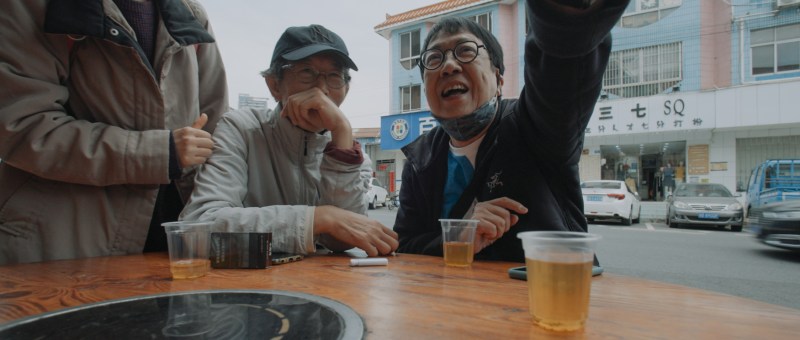
Elegies (詩, Ann Hui, 2023)

Many of the poets featured in Ann Hui’s documentary Elegies (詩) are keen to emphasise that poetry is rarely about what it says it’s about and often as much about what doesn’t say. The documentary is much the same, making a point about the power of poetry in an age resistance, an elegy for the disappearing Hong Kong the poets lament two of them no longer living in the city but somehow still defined by it. 

The tables reversed by one of her subjects, Hui explains that the documentary is a labour of love. She admits that it’s not a mainstream movie and that no one would fund it, but she decided to do it anyway despite or perhaps because of the ongoing coronavirus pandemic which is itself makes frequent appearances in the film. In any case, Hui splits her time mainly between veteran poet Huang Canran who now lives in Mainland China and his younger disciple Liu Wai Tong who lives in Taiwan. 

As Canran says, the poems prove his love for Hong Kong but he also feels as if it was Hong Kong that forced him to leave. Joking that he’s an economic exile, he explains that he mainly moved after being forced out by the rapid cost of living in the city. He cheerfully explains that being a poet means embracing destitution and is embarrassed about the other kinds of writing such as penning a newspaper column that he did solely for the money. Canran’s main source of income comes from translation though his personal motto is to work hard to not earn money while practicing his art. His daughter doesn’t really get it and is confused about why Ann Hui wants to make a documentary about her father, though as Canran admits prophets are rarely appreciated in their hometowns. The Hong Kong he writes about is another place, perhaps somewhere that never really existed or any rate exists no longer. 

A photographer and lecturer in poetry, Liu Wai Tong heads in a more philosophical direction while also living as an exile in Taipei, never quite explaining the reasons he left Hong Kong though perhaps because it would awkward to do so directly. He quotes Brecht and asks what the point of poetry is in an age of protest, how their voices can resonate among a thousand other horrors crying out for speech. Yet as other poets had said, poems about nature are not always about nature just as political poems are not always about politics. By saying one thing and not another they can make a message felt but then there’s nothing really wrong with talking about beauty amid myriad horrors. 

Another poet writes about the everyday, causing others to ask if you can really call it a poem if it’s just about the unexpected appearance of a cockroach. The words should be simple, they insist, their meaning at least clear even if the message is ambiguous. Obscurity for obscurity’s sake is always doomed to failure. Many of the poets write from their direct experience detailing their ordinary lives in the city while others rejoice in wordplay or metaphor, but Hong Kong colours all of their work. Echoing the other poets, Hui too admits that it’s poetry that sustained her in her darkest hours. The poems that she learned as a child gave her strength when she needed it. A woman who has been writing to a friend in prison is moved to tears on recalling his reaction to a poem she had sent him, feeling that poem if can touch someone years after it was written than it must have intrinsic meaning.

Thus poetry in itself becomes an act of resistance if solely in defiance and the determination to endure even the most difficult circumstances from the anxiety of a global pandemic to the spectre of political unrest and lingering oppression. At once an elegy for the Hong Kong the poets speak of and its many rueful exiles, the film makes a passionate defence of poetry as a lifeline thrown by one lonely soul to another across often turbulent seas and carrying with it a message most powerful in its silence. 


Elegies screened as part of this year’s San Diego Asian Film Festival.

Original trailer (English subtitles)
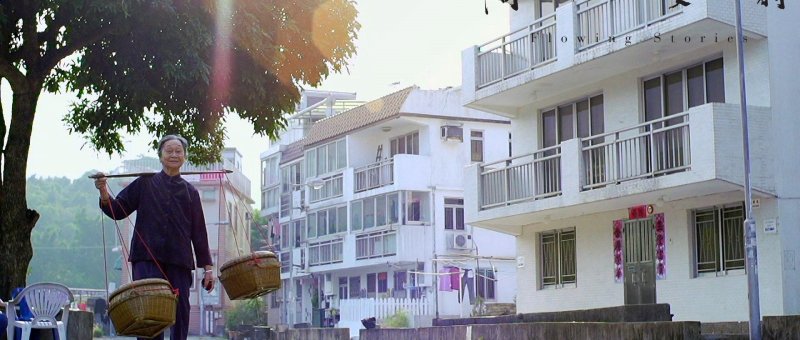
Flowing Stories (河上變村, Jessey Tsang Tsui-shan, 2014)

Shooting in her own home village, documentarian Jessey Tsang Tsui-shan spins a meandering tale of diaspora and dislocation in her 2014 documentary Flowing Stories (河上變村). Beginning in the small village of Ho Chung in which almost all of the residents have gone abroad to find work, the film charts the paths of migration along with the hardships discovered both at home and away while centring the village festival held every 10 years as a point of reunion as sons and daughters return in celebration of an idealised village life the modern world has denied them. 

Tsang begins her tale with Granny Lau, an elderly lady who lived next-door to her when she was a child whose relatives often brought her souvenirs from Europe. As Granny Lau explains, her life was always hard. She married Grandpa Lau at 19 in an arranged marriage but he left to find work abroad soon after, returning only a handful of times in 20 years during which they had several children Granny Lau had to raise alone. She describes her familial relationships as without affection, her husband a virtual stranger to her while she also had to work in the fields leaving her disconnected from her sons and daughters. Later, many of them traveled to Calais to work in the restaurant Grandpa Lau had set up with the intention of reuniting his family in France. 

The children who went also talk of hardship, being unable to speak the language and mixing only with other migrants from Hong Kong many from the same the village. Fourth daughter Mei Yong remarks that only the thought of the village festival kept her going when she came to Calais at 17 leaving all her friends behind and having nothing much to do other than work in the restaurant. Her sister-in-law says something similar, that when she arrived she was immediately put to washing dishes and only reprieved when the children were born but that wasn’t much better because the only source of entertainment available to them was to have dinner together. The second of the sisters Mei Lan moved to London with her husband and still doesn’t know the language, having regular mahjong parties with with her neighbours who are also from Hong Kong and many of them nearby villages. 

Most of the others say they don’t think they’ll ever move back, as Grandpa Lau eventually did, because they’ve spent more than half their lives abroad and have had sons and daughters who have grown up and made lives in other countries. But for Mei Lan it’s different because she has no children. She and her husband regret the decision to go abroad, suggesting they did so because their parents encouraged it thinking it would be easier for them to find work but really there were opportunities to be had in Hong Kong and they might have been happier living in a place where they spoke the language. 

But life is hard in every place, and equally for those who leave and those who are left behind. Some reflect on the changing nature of Ho Chung with its new settlement across the river dominated by detached houses which has, a daughter who moved to Edinburgh suggests, disrupted the sense of community. Where people once rarely closed their doors and neighbours wandered through each others homes helping each other out where needed, now everyone is scattered in disparate settlements. Then again, Granny Lau seems to think that sense of community is largely a myth explaining that in her day you had to do everything yourself, no one was going to feed your cow or plough your field if you couldn’t do yourself.

In her own way strangely cheerful in her stoicism, Granny Lau is a tough woman who asks why she would cry for a husband who was over 80 years old when he died, insisting that she had “nothing to be nostalgic about” and counting herself lucky as long as she has two meals a day. Now only around 900 people remain in the village, while it is said that the Shaolin Temple may be looking to build a new complex in the area as the natural vistas are disrupted once again by diggers further eroding the traditional qualities the village festival celebrates. The stories of migration flow in and out of Ho Chung taking pieces of the of the village with them as they go but equally leaving behind a melancholy sense of loss for a disappearing way of life.


Flowing Stories screened as part of this year’s Hong Kong Film Festival UK.

Original trailer (Traditional Chinese / English subtitles)

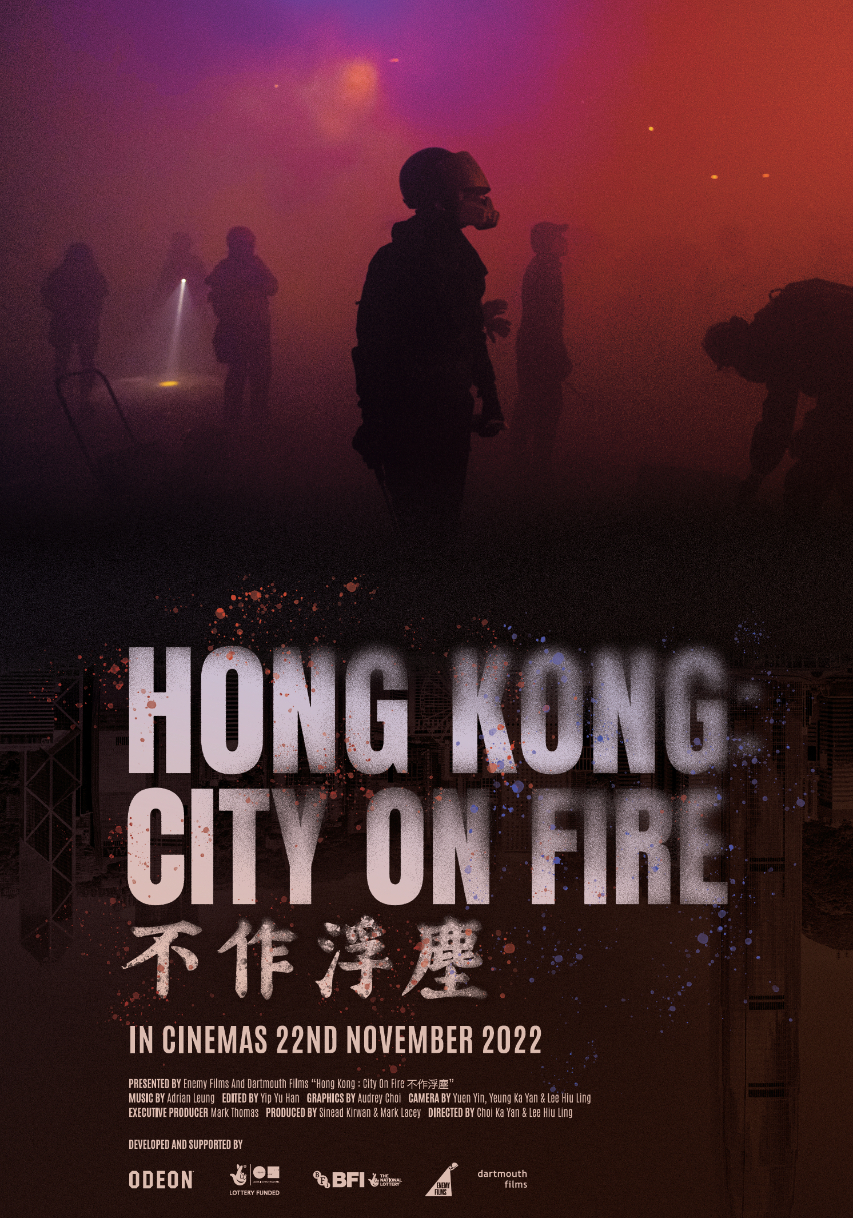
Hong Kong: City on Fire (不作浮塵, Choi Ka-yan & Lee Hiu-ling, 2022)

“Each day is more absurd and darker than the last” a former protestor reflects, deciding to move his family abroad resolving that the only way to protect his children is to ensure they do not grow up in Hong Kong. The latest in a series of documentaries focusing on the 2019 protest movement against the Extradition Law Amendment Bill, Choi Ka-yan and Lee Hiu-ling’s Hong Kong: City on Fire (不作浮塵) is among the most visceral with a potent sense of what it was like to be a young person on the ground, but is also among the least hopeful with the majority of its protagonists deciding that their only future lies in exile. 

First protagonist Yan is a law student at Chinese University who is left wondering if her studies are still relevant in the wake of the National Security Law. Rather than participating directly, she helps arrange legal representation for protestors who have been arrested by the police. AJ, meanwhile, is a young man who finds his relationship with girlfriend Jennie strained by his commitment to the protests, while the mysterious Shin Long is a frontliner who finds himself conflicted in his responsibilities while his wife is pregnant with their second child. 

Each of them seems to feel that time is running out and these are the last days of the battle for democracy in Hong Kong. The film opens with stock footage from the Handover with Chris Patten declaring that it is time for the Hong Kong people to run Hong Kong but of course that wasn’t really the case and the One Country Two Systems philosophy has been steadily eroded to the point of oblivion long before its 2047 expiry date. While some students feel it is a privilege that they have been able to voice their opinions at all let alone protest given that the same situation could not occur on the Mainland others are becoming frustrated not least because of the increasingly oppressive behaviour of the local police force. 

In one particularly impassioned moment, students at the Chinese University confront their principal begging him to issue a statement denouncing police violence but he remains impassive refusing to acknowledge any such brutality has taken place. Several students break down in tears while one young woman recounts her sexual assault at the hands of the police. Intense footage from the middle of the protests captures policemen kneeling atop students while middle-aged and older men and women step in to challenge them, asking what these young people have done so wrong as warrant this kind of treatment. AJ talks of the “solidarity of the streets”, older people in so-called “parent cars” offering free rides to protestors while others offer meals or make simple shows of support. Shin Long, however, offers darker counter of “street justice” in which the crowd turns on a young women they believe was photographing protestors demanding she hand over her phone and delete any photos fearing she will otherwise be sending them to the police. 

As the protests intensify, so does a feeling of paranoia as students are rounded up from their homes and threatened by the police. AJ is arrested and bailed but told that he’ll be sent to prison if caught at another protest, further straining his relationship with Jennie who already feels neglected by the amount of time he spends on the protest rather than with her. Like Shin Long, he feels guilty that he’s leaving a gap in the line and others may end up getting hurt because he isn’t there to protect them. But then as Shin Long points out, every time he manages to escape it’s because someone else was caught, slowing the police down and allowing him to get away. He might not always be so lucky and with a wife and soon to be two children he feels that he is being irresponsible in putting himself at so much risk. 

With the passing of the Security Law, enacted so quickly its contents were kept secret until after it was voted through, all hope is drained from each of the protagonists. AJ learns he will be going to prison for a year for having done nothing more than stand in the street and chant slogans, while Shin Long also receives a lengthy sentence resolving to raise his children abroad on his release. Jennie to decides to emigrate, leaving a dejected AJ behind alone with only painful memories and little hope for the future. A raw document of the protest movement live from the ground, City on Fire has only sympathy for its wounded protagonists but equally perhaps for a disappearing Hong Kong that in the end could not be protected. 


Hong Kong: City on Fire is in UK cinemas on 22nd November.

Trailer (English subtitles)

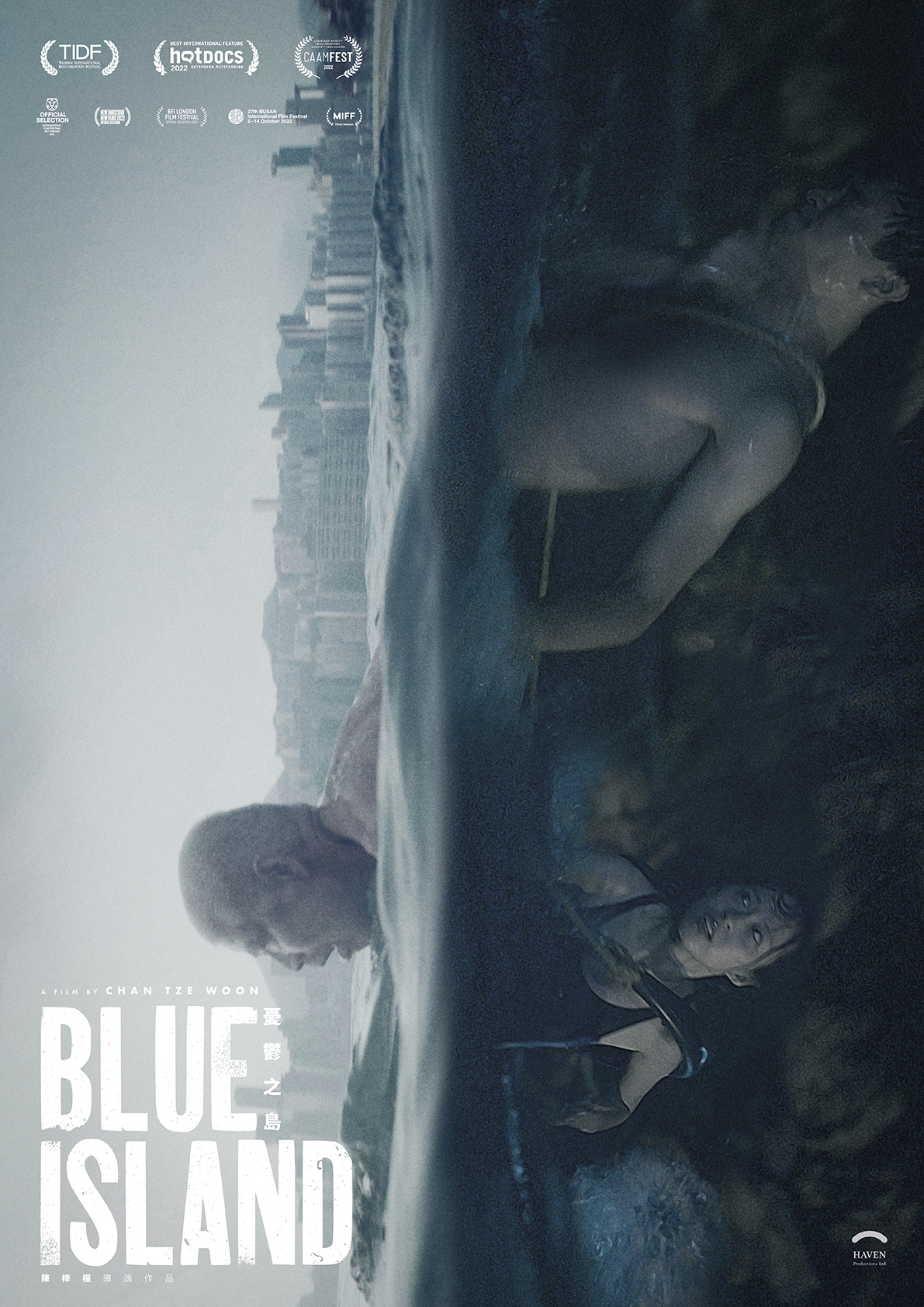
Blue Island (憂鬱之島, Chan Tze-Woon, 2022)

“In reality, we are just the abandoned kids of the riot.” an ageing protestor advises, sitting in a jail cell talking to a younger version of himself about the way that youthful revolutions fail and age erodes ideals. Chan Tze-Woon’s documentary Blue Island (憂鬱之島) places the protestors of today into the protests of the past, asking them to reenact the actions of their forebears while considering what Hong Kong means to them now and how they feel about those who simply decide to leave believing this is a battle that cannot be won. 

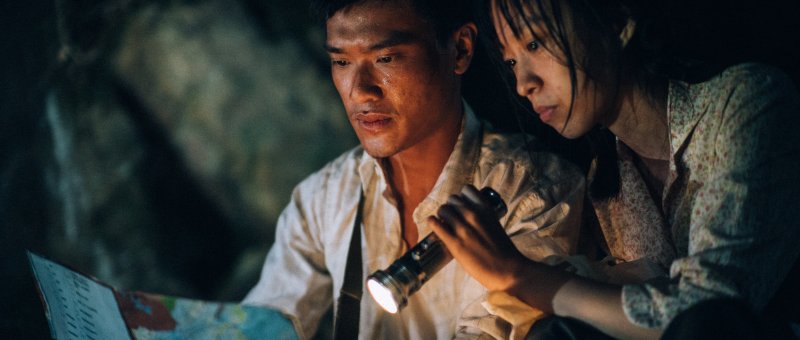
In a scene that seems to reference Tang Shu Shuen’s China Behind, a young couple fleeing the Cultural Revolution in 1973 attempt to reach Hong Kong by swimming, the camera then finding the same man nearly 50 years later still swimming in the bay. As one of the protestors of today puts it, he fled injustice because he could not fight it as many young Hong Kongers have also now chosen to do in the wake of the Security Law. Yet most of these young people have chosen to stay, most accepting the choice of others to leave though perhaps feeling it premature, explaining that to them Hong Kong is their home and their family. 

The old man, Chan Hak-chi, says he saw Hong Kong as a place of freedom yet it was also colonial outpost ruled by another distant and oppressive power. In a key scene a young protestor, Kelvin Tam, is charged with paying the part of a protester arrested during the anti-colonial riots of 1967. “I am Chinese” he answers the English civil servant, in English, when pressed why he resists them as someone who grew up in their colony and attended their schools, “And here belongs to China”. He tells the Englishman that this is his place and it is the Englishman who should leave. The situation then reverses, the now invisible voice on the other side of the table asking him in Cantonese “why do you oppose China?” as someone raised on Chinese soil who studied in government schools. “I’m a Hong Konger”, he replies.

The man whose shoes he’s filling is in many ways his opposite number. The riots of 1967 were led by left-leaning activists who desired a reunification with Mainland China in reaction to oppressive British colonial rule. The scenes of young people being carted off by the police are near identical, but it is true enough how identity is often constructed in opposition. The ’67 rioters declared themselves Chinese as distinct from the British, while Tam identifies himself as a Hong Konger in opposition the Chinese. Yet as Raymond Young, once a young man imprisoned for riot, points out when has Hong Kong ever been able to control its own fate? Other young protestors lament that they are offered only two conflicting narratives of their history, one which begins with British rule as if the island just popped up out of the sea in the early 19th century, and the other penned by Mainland authorities to encourage a One China philosophy.   

Now a disappointed old man, Young remarks that he no longer takes an interest in Hong Kong politics also pointing out that in order for you to love your country your country must first love you implying perhaps that he does not particularly feel loved by the Mainland. He may have something in common with Kenneth Lam who arrived in Hong Kong in 1989 after Tiananmen Square and holds up a small scarf with the innocuous message that the people will not forget now that the annual vigils that used to mark the June 4 Incident have been banned. Becoming tearful at a gathering he remarks that he has something in common with the youngsters in that they both dreamed of a better world and have experienced the “shattered faith” of a failed revolution, like Young feeling abandoned in the society he failed to change. 

Lam now works as social justice lawyer, defending many of these young people who have been arrested for vague offences such as “incitement to incite public nuisance”, “conspiring to subvert state power”, or simply “rioting”. Chan ends on a montage of faces sitting in the dock accompanied by their occupations and the “crime” with which they have been charged, some young some old, many students but also lawmakers and civl servants, delivery people, your friends and neighbours accused just for voicing an opinion. The court itself is ironically a colonial hangover in which barristers wear wigs and conduct their legal business, if not the questioning, in English. A blue island indeed, Chan ends on a note of sorry futility echoed by an extending list of credits marked only as “anonymous”. 


Blue Island screened as part of this year’s San Diego Asian Film Festival.

Original trailer (English subtitles)

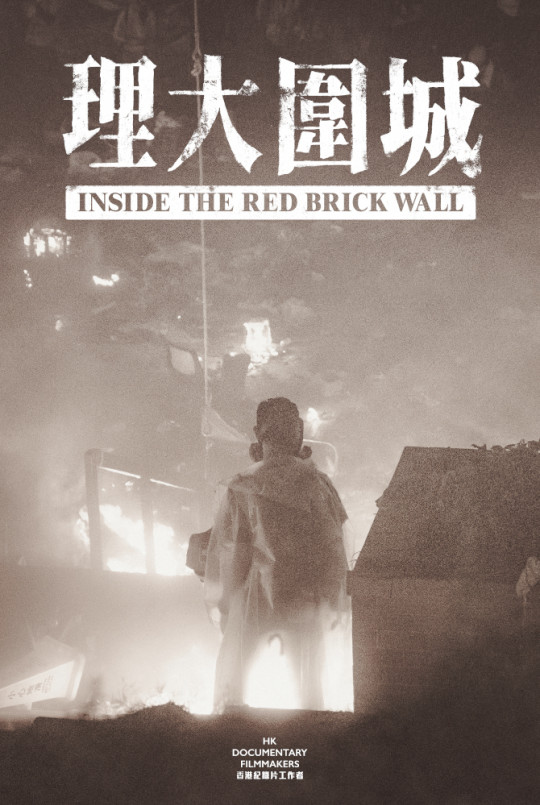
Inside the Red Brick Wall (理大圍城, Hong Kong Documentary Filmmakers, 2020)

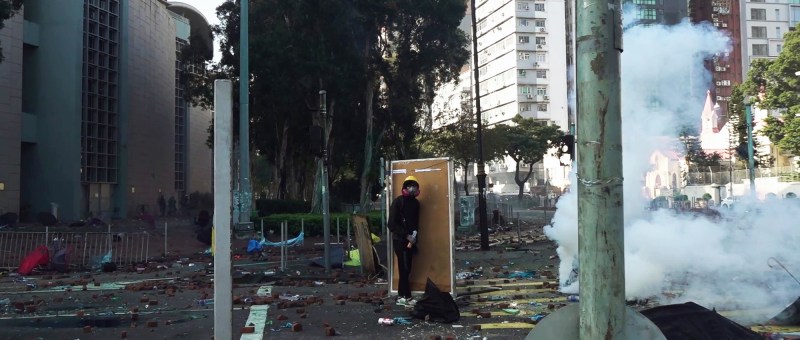
“We can’t afford to be afraid” insists a protestor trapped inside the siege of Hong Kong Polytechnic University during the 2019 protests sparked by opposition to the Extradition Law Amendment Bill. Credited only to the Hong Kong Documentary Filmmakers collective, its directors for obvious reasons choosing to remain anonymous, Inside the Red Brick Wall (理大圍城) is a visceral exploration of life behind the barricades as the trapped youngsters, some of whom are under the age of 18, grow increasingly frustrated and afraid, desperate for escape but fearful of police violence. 

The police, it has to be said, do not come out of this well. While the protestors blast local hip hop highly critical of law enforcement, the officers negotiating via loud speaker repeatedly troll them with ironic pop songs with titles such as “Surrounded” or “Ambush From Ten Sides” while otherwise taunting them with ridiculous insults and talking about going out to kill cockroaches. Such deliberate provocation at least giving the impression that they are merely looking for an excuse to storm the university does not endear them to the protestors trapped inside most of whom already want to leave but not if it means walking out into the arms of the police. With the mounting hysteria, it isn’t even the immediacy of the threat that causes the most anxiety but the possibilities of its aftermath, many fearing not just police brutality but sexual violence and that their mistreatment will not end with their arrest. This is one reason that many struggle to trust a cohort of high school principals who are permitted to enter the university in order to lead out some of the school-aged protestors, promising to protect them from the police batons in order to deliver them to their homes safely and directly. In return the protestors are asked to provide their IDs, leading many to fear they will simply be arrested the following morning. 

Nevertheless, as the situation inside begins to decline it becomes clear to many that they must leave by whatever means possible, some engaging in potentially dangerous escape attempts such as abseiling from a bridge to be met by friends on motorbikes, or exiting through the sewers. Others debate the wisdom of leaving at all, correctly as it turns out surmising that the police will eventually be forced to end the siege because allowing it to continue is simply far too expensive. Even so, these are extremely young people under intense strain, mentally and physically exhausted while also fearing for their lives. Remarking that many have made their wills, one young man insists it’s not death he fears, he’s prepared for that, but that he may die in here and no one would know.  

The necessity of hiding their faces, the documentarians are scrupulous in blurring even the faintest trace of identifiable features, adds to the sense of the collective which becomes in the eyes of some at least their best weapon of defence. Yet through repeated attempts to break through the blockade and the gradual shedding of those who cannot endure any longer deciding to accept the threat of arrest and surrender, the group necessarily weakened causing many to fear their reduced numbers leave them increasingly vulnerable. Some protestors loudly harangue their friends for leaving, while others offer only comfort as their fellow protestors tearfully apologise but can clearly remain no longer. A few pledge to wait it out while debating the ethical dimensions of leaving if it means abandoning those who are already too injured to make their own way out. 

In the midst of the action, the documentarians hover over blood-stained helmets and the aftermath of violence but are also relatively free to record police brutality seemingly ignored by officers otherwise pinning protestors to the floor and in some cases recklessly firing rubber bullets in close proximity even at one point appearing to fire directly at the back of a fleeing protestor’s head. Interrupting these scenes with shots of empty corridors – discarded clothing, a lone shoe inches away from the fire, all those battered umbrellas – the filmmakers evoke an almost apocalyptic atmosphere of total desolation offering little hope for the future in a society dominated by fear and authoritarianism. 


Inside the Red Brick Wall screened as part of this year’s San Diego Asian Film Festival

Trailer (dialogue free)