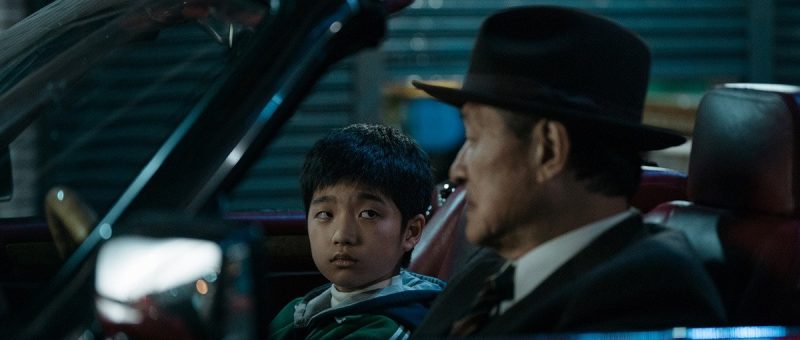

It’s all about “inequality”, according to the titular Old Fox (老狐狸, lǎohúli). Or at least knowing how to leverage it. Inequality is something that’s coming to bother the young hero of Hsiao Ya-chuan’s coming-of-age drama in which a small boy finds himself torn between two father figures, one a wily old slumlandlord with a heart of stone and the other his melancholy and disappointed but kindhearted father who simply endures the many blows that life has dealt him.
Set in Taipei in 1989 shortly before an apocalyptic stock market crash in the post-martial law economy crushes the hopes of millions of ordinary people convinced to invest their savings, the film wastes no time in showing us the various inequalities in play in small alleyway of traditional stores all owned by Boss Xie (Akio Chen) whom many seem to regard as a kind of saviour even if he cares not at all about them. Jie’s (Bai Run-yin) father Tai-lai (Liu Kuan-ting) works in a local restaurant and rents a room above a beef noodle cafe for which he pays in cash every week to Miss Lin (Eugenie Liu), a pretty young woman working for Boss Xie and enjoying an unusual amount of power for someone of her age and gender for a society still somewhat conservative.
Tai-lai has been patiently saving money so that he can afford to buy a house and open a hair salon which was the dream of his late wife, but obvlious to the world around him he hasn’t noticed that prices are continuing to rise placing his dream of homeownership further out of his reach. Meanwhile, Jie is bullied at school and called a “snitch” without understanding why or even what the word means. This sense powerlessness and inferiority maybe be why he’s drawn to Boss Xie, a man who does after all exude power if also a sense of menace and melancholy. Xie in turn sees in Jie a potential protégé, both a mirror of his younger self and an echo of the son he lost who rebelled against everything he represents.
Nicknamed Old Fox, Xie stands for everything that’s wrong with the contemporary society which is about to implode in the financial crash. Wounded by his childhood poverty in which he, like Jie, also pleaded with a local landlord to sell his mother a property, Xie has adopted a ruthlessly selfish disregard for the lives of others teaching Jie his mantra of “none of my damn business” while the boy develops a worrying admiration for the aura a man like Xie projects and actively enjoys the sensation that others fear him. While hanging out with Xie he comes to look down on men like his father whom Xie calls “losers” who care only for others and disregard themselves. Xie teaches him to leverage the inequalities of power and turn his enemies’ weakness back against them to increase his own strength placing him further at odds with Tai-lai’s innate goodness and down-to-earth humanity.
Yet we can also see that Tai-lai has had a life of disappointment. A woman who comes into the restaurant (Mugi Kadowaki) now married to a thuggish local big wig is a former childhood sweetheart from whom he was separated by time and circumstance while it also seems that Miss Lin has taken a liking to him though he appears not to have noticed. At home he plays the saxophone and takes in tailoring while resigned to saving a little longer before he’ll finally be able to buy a house and achieve his dreams. Tai-lai is one of the few who does not play the stock market and is therefore free of the danger it represents while Jie soon becomes sick of his his father’s frugality in their regular practice of turning the boiler off after having a bath and keeping their taps on a slow drip so they don’t trip the water metre and longs to become a man like Boss Xie unafraid to exploit any advantage in complete disregard for the lives of others.
A brief coda set in the present in the day suggests that the older Jie may have found a happy medium, at least disguising a genuine concern for the safety and happiness of others as being solely about profit, while Xie’s sadness and doubts about the path his life has taken are never far from the surface as the society teeters on the brink of financial disaster. Capturing a palpable sense of late ’80s Taipei the film has a nostalgic atmosphere but also an equally prescient quality in the things that are only half-visible to the younger Jie in the melancholy disappointments of the adults who surround him still struggling to reroot themselves in a new society while overburdened by the failures of the old.
Old Fox screens April 22nd as part of this year’s San Diego Asian Film Festival Spring Showcase.
Original trailer (English subtitles)
 Windows on Worlds