
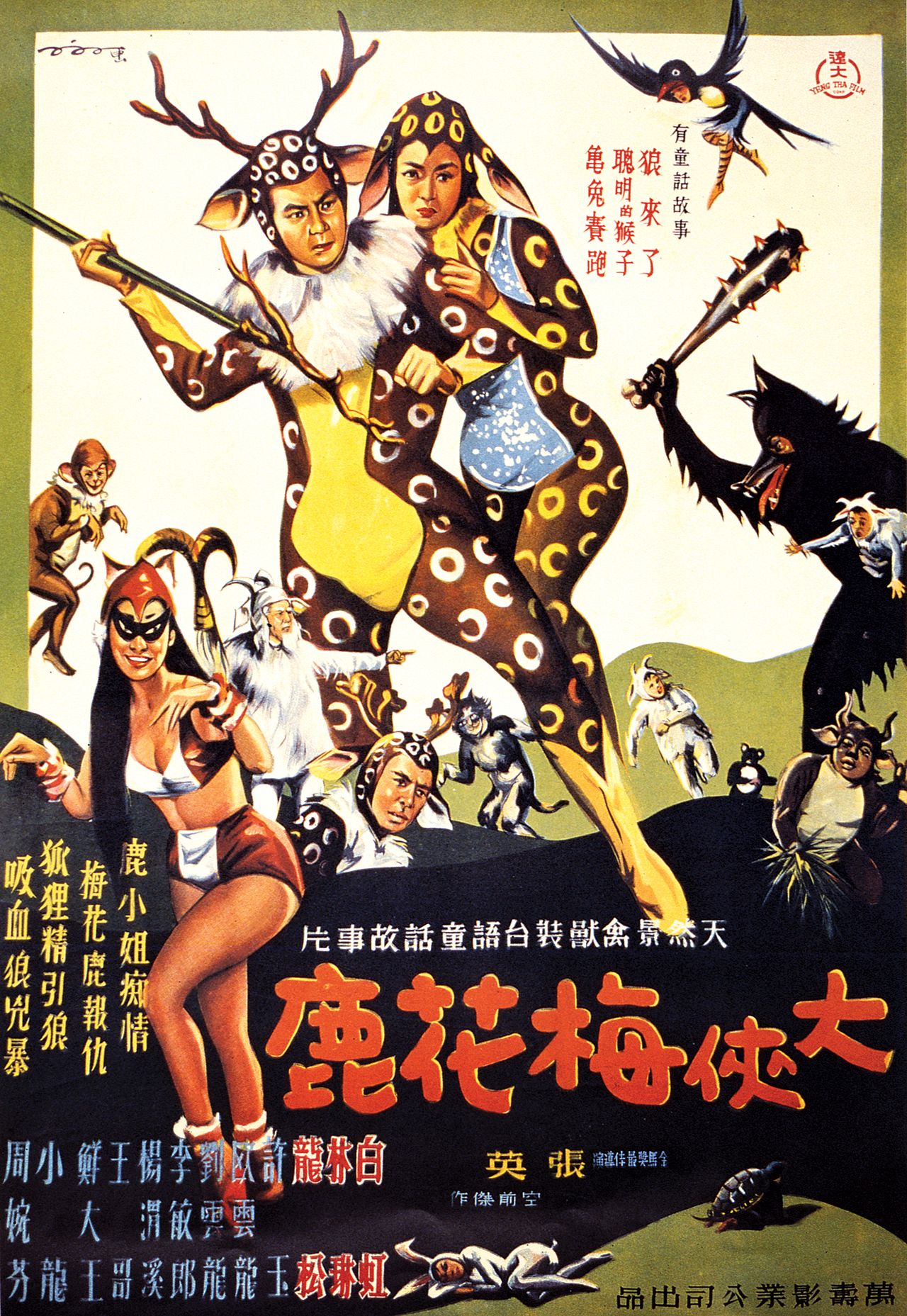
A fearless warrior’s solipsistic priorities and obsession with male pride begin to endanger his community in Chang Ying’s incredibly bizarre Taiwanese-language forest fable, The Fantasy of Deer Warrior (大俠梅花鹿). Seemingly aimed at children with its series of moral messages and anthropomorphised animal characters, Chang’s drama is surprisingly violent not to mention a little on the raunchy side for a family film while ending on a note entirely at odds with the prevailing wisdom of children’s cinema as the righteous hero takes bloody revenge on his bound and defenceless enemies but is nevertheless embraced by his innocent love interest for having brought “justice” back to the forest.
Opening with a surreal scene of children in animal outfits dancing to jingle bells in the middle of the woods, the cheerful atmosphere is soon disrupted by an incursion of “wolves” carrying nailed bats. An emissary is dispatched to fetch “Sika Deer” (Ling Yun), the forest’s most fearsome warrior, but he is busy having fight with love rival Elk (Li Min-Lang) over the beautiful “Miss Deer” (Pai Hung) who according to the mischievous Foxy (Lin Lin) has been kind of dating both of them. Foxy is incredibly jealous of Miss Deer and stirs the pot by suggesting that Elk and Sika Deer continue in a formal duel with the winner taking Miss Deer’s heart. Shockingly this is what they do and Sika Deer wins only to be immediately called away to the wolf attack, discover his father is already dead, and decide the best thing to do is not see Miss Deer again until he’s finished avenging his father’s death by killing Bloody Wolf.
As you can see, Sika Deer has his priorities all wrong. First of all, he was off pointlessly fighting Elk while his family were eaten by wolves, then he decides to take the manly path by leaving Miss Deer alone and vulnerable not to mention his community largely defenceless. Later he does something similar when Miss Deer is kidnapped, stopping to lock horns with his love rival rather than devoting all their resources to tracking Bloody Wolf and saving Miss Deer. He does belatedly think to send her a letter explaining he’s busy with important revenge business and will call her later which foils Foxy’s plan to convince her he’s dead so she’ll date Elk instead (unclear why she wants this) but the fact remains that he basically just abandons everyone to selfishly pursue his own revenge ironically leaving the village vulnerable to attack.
Despite this and being absent for most of the picture, Sika Deer is still held up as the hero even when he marches Bloody Woolf and minion to his father’s grave and executes them with surprising violence while they are bound and gagged. Where most children’s films would end with some kind of forgiveness, a restoration of the forest’s harmony brokered by the hero’s magnanimity which in itself causes the villains to reform, Deer Warrior ends with quite the reverse which would seem to run contrary to most of the other moral messages presented throughout the film.
Then again, “There is no justice in this world” Miss Deer is told on appealing first to a tree and then an elderly buffalo for a moral judgement on whether or not the wolf should be allowed to eat her even though she saved his life. As the tree points out, people took shelter under him but then they cut him down for firewood, while the buffalo complains that he’s been exploited all his life but as soon as he’s too old to work he’ll be killed and eaten. Miss Deer’s moral conundrum is as to whether a kindness ought to be repaid, convinced that Bloody Wolf is in the wrong for wanting to eat her and should let her go to repay the kindness of her saving his life. But Bloody Woolf is a wolf which is to say a creature without morals the only surprising thing being that he patiently waits while she makes all her petitions rather than just eating her as he pleases. Even so, the film seems to say not so much that Miss Deer is at fault for her innocent naivety in having trusted a wolf, but the world itself is wrong because one should never suffer for having been kind to another for kindness should always be repaid.
Mildly critical as it is of an increasingly selfish society in which justice has become a casualty of increasing economic prosperity, Fantasy of Deer Warrior nevertheless ends on an uncomfortable note with the hero essentially delivering justice as vengeance. Meanwhile it’s also clear that prior to the arrival of the wolves which could perhaps be read either as a metaphor for Mainland China or indeed the KMT government threatening the natural harmony of the native Taiwanese society as represented by Sika Deer, the forest was not altogether harmonious before as evidenced by the rivalries between Miss Deer and Foxy and Elk and Sika Deer. These divides perhaps hint at a wounded unity, suggesting that the Taiwanese people are ill-equipped to defend themselves against external threat while preoccupied with petty disputes and personal concerns.
Such messages are most likely above the heads of the target audience but then again, the film is curiously transgressive including several scenes of Foxy living up to her name, performing sexy dances and off “having fun” with Bloody Woolf in the forest while at one point talking Elk into attempting to rape Miss Deer to force her to marry him which whichever way you look at it is fantastically dark for a children’s film even if the metaphorical quality of the wolf as representing animalistic lust is still very much present in his determination to “eat” Miss Deer. To that extent it is also transgressive sexual energy which destabilises forest society in Foxy’s resentment of Miss Deer even if her implication that she’s been two-timing Elk and Sika Deer undercuts her otherwise innocent and pure nature which is in such contrast with Foxy’s chaotic and classically tricksy personality.
Perhaps more of an ironic take on a kids film aimed at jaded adults, Fantasy of Deer Warrior is undeniably bizarre starring actors dressed in onesies mimicking their animal characters, deer with antlers on their heads fighting with antler staffs, and bird messengers hanging from obvious wires flapping their arms to mimic flight. Adopting the style of a classic fairytale, Chang incorporates several of Aesop’s fables such as a musical number themed around a strangely militarised tortoise and a cocky rabbit, or a literal instance of a boy crying wolf and never having the opportunity to learn his lesson. Yet the kind of justice with which the film concludes is disquieting suggesting perhaps that all is not so well in the forest after all.
Remaster trailer (Traditional Chinese / English subtitles)
 Windows on Worlds