Polar Rescue (搜救, Lo Chi-leung, 2022)

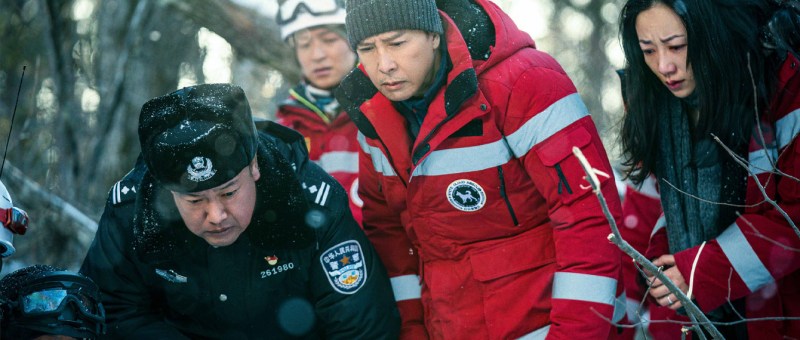
One of the more surprising things about Polar Rescue (搜救, sōujiù, AKA Come Back Home), a rare vehicle for Donnie Yen outside of the martial arts and action genres, is just how unheroic its panicked hero is. Though he may start off as a frantic parent who has our sympathies, we later begin to realise that he is at least severely flawed while there are also a few perhaps subversive hints towards the pressures of the modern China which have frustrated his attempts to be what he would assume a good father to be.

Despite later hints that the family is in a spot of financial bother, they’ve all gone on what looks like a fairly expensive skiing holiday in a European-style resort. The problem begins towards the end of their stay when eight-year-old Lele starts acting up in part because his father, De (Donnie Yen), promised to take him to Lake Tian to see the monster but has broken his word because of road closures due to the adverse weather. Wanting to make it up to his son, De decides to try going anyway via the backroads which are still open but soon enough gets stuck in a ditch. Events from this point on are deliberately obscured, but somehow Lele gets separated from his parents and sister and goes missing in the freezing wilderness. 

Rather than a father’s one man race against time to find his missing son, the film soon shifts into familiar China has your back territory as the full force of artic rescue complete with helicopters and specialist equipment is deployed to find this one missing boy. De is still not satisfied and at several points frustrates the rescue effort by getting into trouble himself without really reflecting that it’s his own irresponsibility and paternal failure that have caused the rescuers to risk their own lives trying to find his son. 

Though we might originally have sympathised with him, particularly as it seems clear Lele is behaving very badly and will not listen to either of his parents, we later come to doubt De on learning that Lele’s disappearance is at least in part related to an incredibly ill-advised though perhaps understandable parenting decision. As the film would have it, De is both too old fashioned in his authoritarian approach in which he’s often been violent towards his son, and too slack as evidenced by the boy’s bad behaviour. He’s failing in most metrics as a father given that he’s run into career difficulty as an engineer after challenging some of the nation’s famously lax safety regulations on a site he was working on he believed to be unsafe and then getting swindled on another construction project by a client who ran off with all the money. He also seems reluctant to allow his wife (Han Xue) to work to ease the family’s financial burden out of a mistaken sense of male pride. 

This ties in somewhat to the propagandist themes as we see him totting up how much it would cost to send his kids to school overseas only for his wife to tut that Chinese education is good too, while the fact the family have two children also hints at a new ideal in the wake of the loosening of the One Child Policy to encourage correction to the rapidly ageing population. The rescuers, meanwhile, are portrayed in a perhaps slightly ambiguous light given than many of them quickly become sick of De and think they should stop looking given the unlikeliness of a child surviving alone for several days in such freezing conditions. Some even suspect De may be responsible for his son’s disappearance and is using them to cover up the crime. Even so, they get to sing a rousing song to the tune of Bella Ciao and re-echo their commitment not to give up until they’ve found Lele even if it turns out to be too late to save him.

A subplot about the two-sided nature of social media in cases like these is dealt with only superficially, while many other things do not quite make sense including the inclusion of a bear and his cub whose appearance, though obviously serving a symbolic purpose, seems like overkill. Nevertheless, there’s a good degree of ambiguity in the central disappearance that helps to head off the otherwise predictable nature of its trajectory. 


Polar Rescue is out now in the US on Digital and Blu-ray courtesy of Well Go Usa.

US trailer (English subtitles)
I am Not Madame Bovary (我不是潘金莲, Feng Xiaogang, 2017)

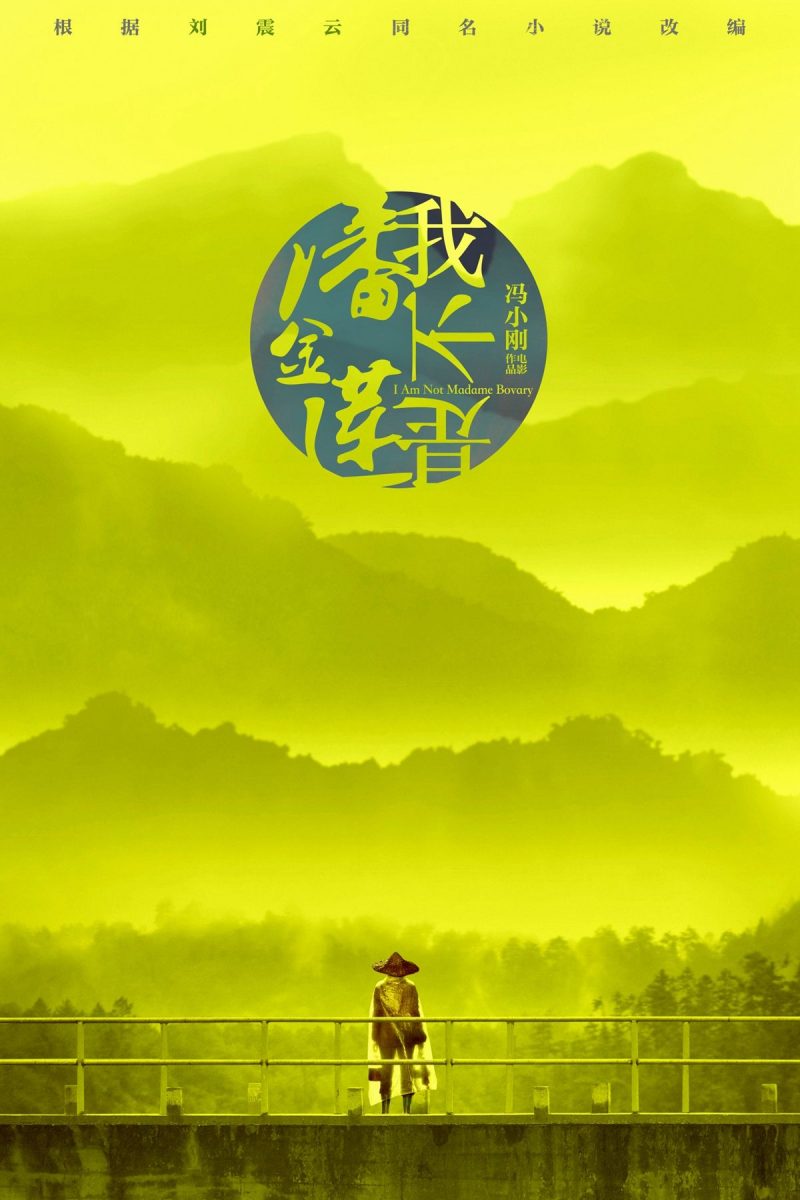
I-Am-Not-Madame-Bovary-posterFeng Xiaogang, often likened to the “Chinese Spielberg”, has spent much of his career creating giant box office hits and crowd pleasing pop culture phenomenons from World Without Thieves to Cell Phone and You Are the One. Looking at his later career which includes such “patriotic” fare as Aftershock, Assembly, and Back to 1942 it would be easy to think that he’s in the pocket of the censors board. Nevertheless, there’s a thin strain of resistance ever-present in his work which is fully brought out in the biting satire, I am not Madame Bovary (我不是潘金莲, Wǒ Búshì Pān Jīnlián).

Truth be told, the adopted Western title is mostly unhelpful as the film’s heroine, Liu Xuelian (Fan Bingbing), is no romantic girl chasing a lovelorn dream to escape from the stultifying boredom of provincial bourgeois society, but a wronged peasant woman intent on reclaiming her dignity from a world expressly set up to keep people like her in their place. Feng begins the movie with a brief narrative voice over to set the scene in which he shows us a traditional Chinese painting depicting the famous “Pan Jinlian” whose name has become synonymous with romantic betrayal. More Thérèse Raquin than Madame Bovary, Pan Jinlian conspired with her lover to kill her husband rather than becoming consumed by an eternal stream of romantic betrayals.

Xuelian has, however, been betrayed. She and her husband faked a divorce so that he could get a fancy apartment the government gives to separated people where they could live together after remarrying sometime later. Only, Xuelian’s husband tricked her – the divorce was real and he married someone else instead. Not only that, he’s publicly damaged her reputation by branding her a “Pan Jinlian” and suggesting she’s a fallen woman who was not a virgin when they married. Understandably upset, Xuelian wants the law to answer for her by cancelling her husband’s duplicitous divorce and clearing her name of any wrongdoing.

Xuelian’s case is thrown out of the local courts, but she doesn’t stop there, she musters all of her resources and takes her complaint all the way to Beijing. Rightfully angry, her rage carries her far beyond the realms a peasant woman of limited education would expect to roam always in search of someone who will listen to her grievances. When no one will, Xuelian resorts to extreme yet peaceful measures, making a spectacle of herself by holding up large signs and stopping petty officials in their fancy government cars. Eventually Liu Xuelian becomes an embarrassment to her governmental protectors, a symbol of wrongs they have no time to right. These men in suits aren’t interested in her suffering, but she makes them look bad and puts a stain on their impressive political careers. Thus they need to solve the Liu Xuelian problem one way or another – something which involves more personal manipulation than well-meaning compromise.

Bureaucratic corruption is an ongoing theme in Chinese cinema, albeit a subtle one when the censors get their way, but the ongoing frustration of needing, on the one hand, to work within a system which actively embraces its corruption, and on the other that of necessarily being seen to disapprove of it can prove a challenging task. Xuelian’s struggles may lean towards pettiness and her original attempt to subvert the law for personal gain is never something which thought worthy of remark, but her personal outrage at being treated so unfairly and then so easily ignored is likely to strike a chord with many finding themselves in a similar situation with local institutions who consistently place their own gain above their duty to protect the good men and women of China.

A low-key feminist tale, Xuelian’s quest also highlights the plight of the lone woman in Chinese society. Tricked by unscrupulous men, she’s left to fend for herself with the full expectation that she will fail and be forced to throw herself on male mercy. Xuelian does not fail. What she wants is recognition of her right to a dignified life. The purpose of getting her divorce cancelled is not getting her husband back but for the right to divorce him properly and refute his allegations of adultery once and for all. Xuelian wants her good name back, and then she wants to make a life for herself freed from all of this finagling. She’s done the unthinkable – a petty peasant woman has rattled Beijing and threatened the state entire. Making oneself ridiculous has become a powerful political weapon. All of this self-assertion and refusal to backdown with one’s tail between one’s legs might just be catching.

Adding to his slightly absurdist air, Feng frames the tale through the old-fashioned device of an iris. Intended to recall the traditional scroll paintings which opened the film, the iris also implies a kind of stagnation in Xuelian’s surroundings. Her movements are impeded, her world is small, and she’s always caught within a literal circle of gossip and awkward, embarrassing scenes. Moving into the city, Feng switches to a square instead – this world is ordered and straightened but it’s still one of enforced rigidity, offering more physical movement but demanding adherence to its strict political rules. Only approaching the end does something more like widescreen with its expansive vistas appear, suggesting either that a degree of freedom has been found or the need to comply with the forces at be rejected but Xuelian’s “satisfaction” or lack of it is perhaps not worth the ten years of strife spent as a petty thorn in the government’s side. Perhaps this is Feng’s most subversive piece of advice, that true freedom is found only in refusing to play their game. They can call you Pan Jinlian all they please, but you don’t need to answer them.


I am not Madame Bovary was screened as part of the 19th Udine Far East Film Festival.

Original trailer (English subtitles)