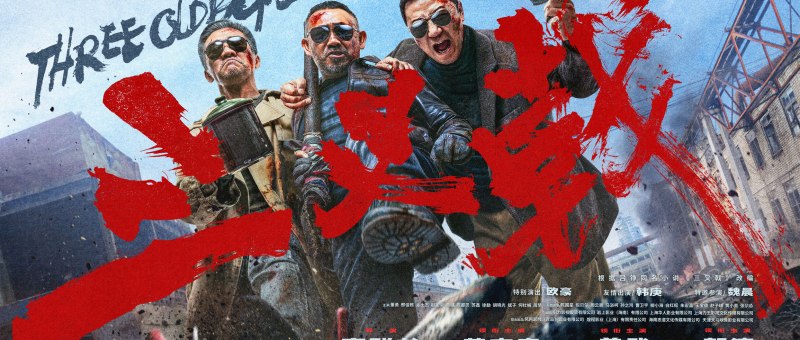
Three Old Boys (三叉戟, Gao Qunshu, 2024)

In a surprising development of Chinese propaganda cinema, the once untouchable subject of police corruption has become a prominent feature albeit often in tales of righteous cops who stand up for real justice against the few bad apples who’ve allowed themselves to be corrupted by contemporary capitalism. Then again, its subject matter might explain why TV police procedural veteran Gao Qunshu’s Three Old Boys (三叉戟, sānchājǐ) has been languishing on the shelf since at least 2020 if it were not also for the inevitable effects of the pandemic. 

In any case, Gao’s film has a distinctly retro vibe with use of classic Chinese pop and very ‘70s soundtrack while its maverick cop heroes all dress in the fashions of 40 years previously. All born in the late 1960s, they are products of an even more authoritarian era and began their careers in the late 1980s. Like any other old cop movie, they bemoan the restrictions of the contemporary society and suggest modern notions of appropriate police behaviour prevent them from doing their jobs which has its degree of awkwardness on the one hand implying the modern police force is now not so hardline but also that it should be because that’s what gets the job done. 

As they contemplate retirement, the trio are offered positions as part of a new squad set up to tackle economic crimes and specifically international money laundering, the chief problem with being that the criminals had the effrontery to move the money out of China which is stealing from honest, hardworking, Chinese citizens aside from having already ripped them off with fraudulent investment schemes and good old-fashioned blackmail operations. Of course, as it turns out, the case has a connection to something that happened 20 years earlier and police officer Cui’s (Huang Zhizhong) desire for revenge on the gangster king pin, Huang Youfa (Jin Shijie), who caused the death of his younger brother murdered by gangster Donzgi who was then shot dead by fellow officer Big G (Jiang Wu). 

The convoluted narrative is heralded by a homeless man who takes the police chief hostage and mutters something about a sword of justice that sounds like something right out of a wuxia serial before being updated to the present day. The sword does actually make a reappearance and is wielded by Big G against a young whippersnapper out for revenge and to take care of what he sees as corruption in the earlier generation. When the trio are first put on the case, they are given a young rookie to help them because he’ll be able to do the tech stuff which the old guys probably can’t because their idea of policing was largely rooted in their fists and a capacity for intimidation. But this doesn’t really work with the youth of today who are for some reason fond of reminding them they aren’t their fathers so they don’t have to do what they say. This is particularly true of young thug Blondie who is caught between Ghost, the old gangster king, and Qing an upstart who is actually working for Huang but in pursuit of his own particular goals. 

Huang has his claws well and truly embedded in the modern society and has it seems manoeuvred favourable people into the police force ensuring that Cui and his team are neutered before they get the chance to do anything. Then again, Big G seems to have a very co-dependent relationship with Ghost who tells Blondie off for getting into a fight with him because cops are off limits. Nevertheless, the point is to dismantle Huang’s networks of influence to restore the integrity of the police force so they can enforce the law which exists for the protection of the people. It’s all rather confusing, but generally lightened by the intense action sequences designed by Yoo Sang-Seob which are also suitably retro but make good use of sword play along with a motorcycle chase. Perhaps ironically inspired by Hollywood hero cop dramas, the film ends with a regime change and a new photo being taken of the guys in their more modern uniforms receiving a commendation with the clear indication that something has been put to rest and the rebellion suggested by Qing’s attempt to steal power from the old quelled while the old boys seemingly decide that justice requires they put off their retirement just a little longer.


International trailer (English subtitles)

I Love You, to the Moon, and Back (穿过月亮的旅行, Li Weiran, 2024)

The economic realities of a changing mid-90s China conspire against a young couple who find themselves stranded in different cities and only able to meet up once a month for a night of passion in a hotel in Li Weiran’s wholesome romantic dramedy, I Love You, to the Moon, and Back (穿过月亮的旅行, chuānguò yuèliang de lǚxíng). Based on a novel by Chi Zijian and themed around the Mid-Autumn Festival, the film has a quirky, nostalgic quality but also a degree of poignancy amid the absurd journeys the lovers make in pursuit of their love.

Gradual flashbacks reveal that Wang Rui (Hu Xianshu) and Lin Xiushan (Zhang Zifeng) married in their home village but like many youngsters of the day left soon after for the city in search of work. Forced to leave school by his farmer father who saw no point in education, Wang Rui quickly finds works in construction but Xiushan, who was also forced to leave school early, is unable to find anything in Shenzhen and eventually takes a job in a dumpling factory in Guangzhou where she lives in workers dorms. Their plight reflects the economic reforms which were taking place throughout the 1990s giving rise to a new, much more capitalistic society as embodied by the employers who give Wang Rui an extra day off for lying on TV that they’re not exploiting him, and an obnoxious businessman Xiushan has the misfortune to sit opposite on the train who talks loudly on his mobile phone about an important deal and even drips cigarette ash all over the old lady next to him justifying himself that he doesn’t want to damage his expensive suit. 

By contrast, Xiushan and Wang Rui are incredibly frugal shopping mainly at markets with Wang Rui padding a fancy pair of shoes that are too big for him but available at a large discount. They save all their money for their monthly meetups which, as they’re both living in communal dorms, take place in cheap motels. Xiushan tries to ameliorate their grimness by covering the stained mattresses with her own sheets featuring a pattern of large sunflowers and blue skies that help her feel as if they’re back in the village lying down together in a pretty garden. To this extent it’s clear that living in the city in addition to so far apart has corrupted the innocence of their romantic connection. Xiushan was warned by her brother that if she wanted to hear Wang Rui’s harmonica playing she should put off going out with him because the romance will die once he’s won her, and it’s true enough that Wang Rui never plays the harmonica for her anymore in part because they’re now quite expensive and he’d rather save up his money for another cross-country visit. 

Xiushan’s decision to buy one for him with some money from an unexpected windfall is then an attempt to rescue their romantic connection which is now under threat because of their geographical displacement and economic oppression. On the train, however, she runs into another man who plays harmonica and has apparently been arrested for an undisclosed crime. Out of compassion she asks the policeman escorting him to allow the condemned man to play a song which he does and reduces the entire carriage to tears hinting at other sad stories of separated lovers in modern China. Wang Rui encounters something similar in a one armed man caring for a wife from whom he was separated who has since become ill and is apparently in love with someone else. His cynicism causes Wang Rui to doubt Xiushan, so paranoid that another man may take a liking to her that he puts back the pretty dress he’d intended to buy as a present and gets the much more temporary gift of a bunch of roses instead.

These respective choices of items might signal where they are in their relationship, but there’s still a pureness to their love that can’t be destroyed completely. Both unexpectedly given an extra day off for the Mid-Autumn Festival they decide to make surprise visits to other’s cities only to perpetually miss each other, stuck travelling back and forth by train and only able to make contact via “their” set of payphones for as long as their phonecards would allow before fate finally, if briefly, smiles on them under the light of the autumn moon. Charmingly quirky and hopelessly innocent, the film nevertheless captures something of the chaotic undulations of the mid-90s society in which youth is on the move but love it seems is standing still.


Original trailer (Simplified Chinese & English subtitles)