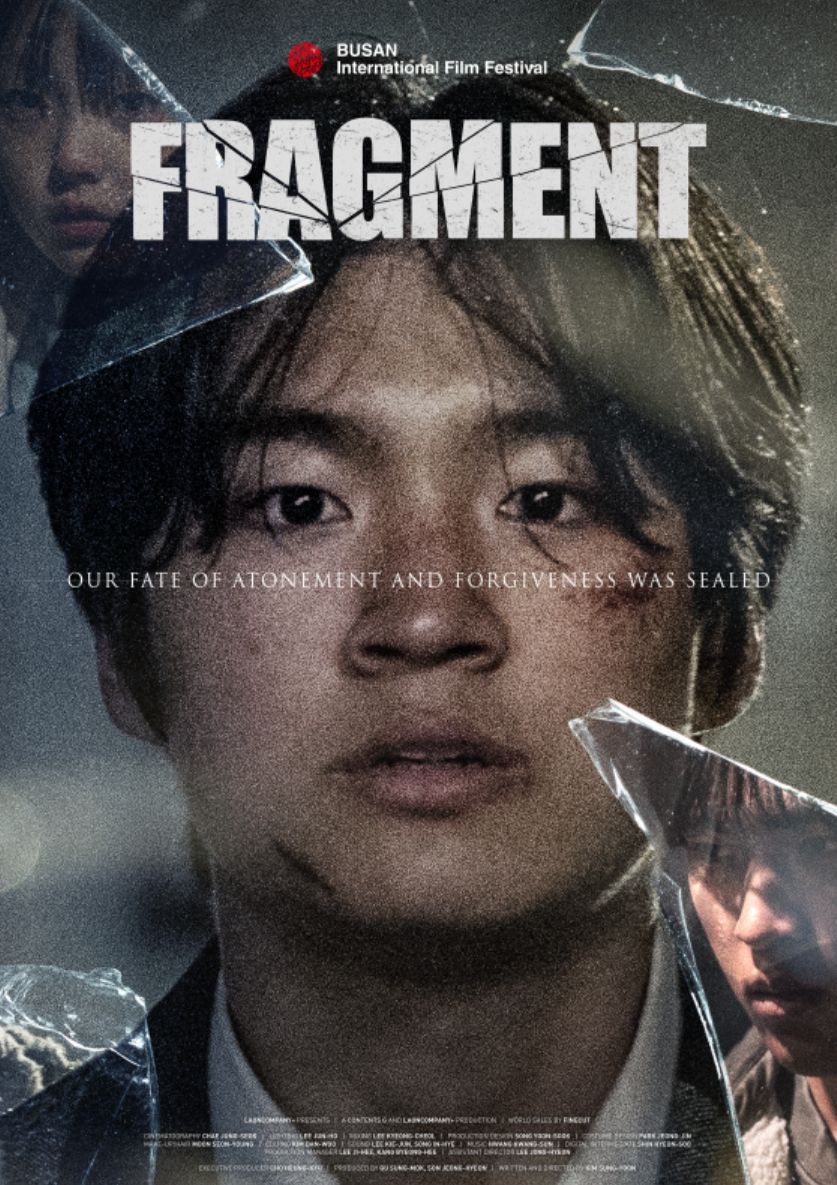
Fragment (파편, Kim Sung-yoon, 2024) [Fantasia 2025]

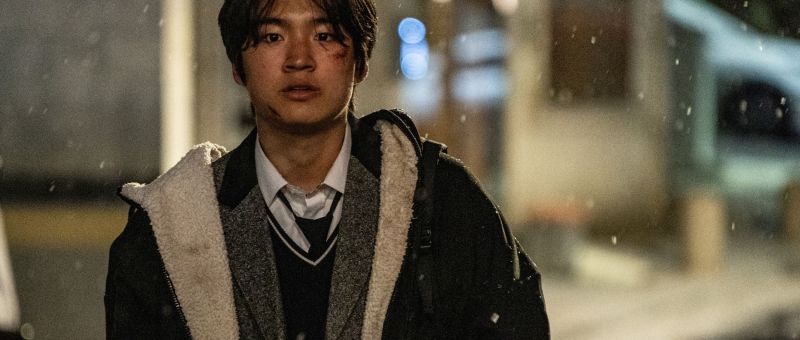
People often think of crime as something linear that ties together villain and victim but is otherwise an isolated event. The truth is that crime reverberates through the world around it, shattering the lives of others in the backdraught of its irrational violence. Son of the murdered couple, Gi-su is fond of saying that he’s the victim as if trying to reclaim this role and make it his identity while it remains to that Jun-gang and his sister Jun-hui are victims too for they have also lost their father who is now in prison.

Indeed, while Gi-su may face overbearing care from his well-meaning relatives, Jun-gang is burdened with the stigma of being a murderer’s son while trying to protect his sister from the fallout of this awful situation. His most pressing problem is that they don’t have any money. His father did not appear to have any before either, but now their utilities are about to be cut off and their landlady’s sick of being strung along. Yet these aren’t problems a 15-year-old boy can fix on his own. He tries to get a job in a local convenience store but is first turned away because boys his age should be in school, and then offered a job but only on parental consent which he can’t get for obvious reasons. His teacher, Mr Park, is one of the few people to know the truth and keen to help him but has few real ways of doing so. As the son of the murderer, most are content to leave him to his fate and believe that he simply doesn’t deserve support because of what his father has done.

Jun-gang too feels guilty, though none of this is his fault. He knew what kind of man his father was and is always eager to prove that he is different. But the fact that he seems nice, honest, and polite doesn’t really matter. He’s still chased and bullied with kids at school going on about killer genes and actively singling him out for a beating. Jun-hui too is ostracised by her friends who’ve been told not to play with her because of what her father did. Gi-su tries to ease his frustration on him, breaking into their apartment and smashing the place up after coming to school to find him. As much as Gi-su tries to insist that he’s the victim, Jun-gang is a victim too and unlike Gi-su has no further family to support him and no one else to turn to for help. He fights back with decency, but largely finds it thrown in his fate.

Gi-su, meanwhile, is broken by his trauma and in the midst of a nervous breakdown exacerbated by exam stress. Like Jun-gang he blames himself as a means of asserting control over the situation and struggles to accept the new world he now inhabits following his parents’ deaths. His sympathetic aunt tries her best to get through to him, but his well-meaning uncle is a font of toxic masculinity screaming at him that he’s wallowed in his grief long enough and needs to man up and get over it. Though they’re cast in the roles of killer and victim, the boys are really much the same, each having lost their homes and families and now being essentially displaced from within their new lives.

The battle is really whether they can hang in there long enough to begin to see the other side and that there are still possibilities in their lives. The reason for the killing is never revealed, nor is it particularly important, if hinting at the constant pressures of the outward society. Jun-gang’s father’s behaviour implies long years of paternal failure, domination, and abuse from which Jun-gang is trying to emerge unscathed while Gi-su must on the other hand come to terms with the implosion of a seemingly perfect family life. That they each come to recognise that none of this is their fault and they’re really just the same is testament the boys’ innate goodness and growing sense of solidarity in the midst of so much acrimony. Hard-hitting though it may be in its exploration of how societal prejudice can allow people to slip through the cracks, Kim Sung-yoon’s film is also in its way uplifting in the presence of those are willing to help and Jun-gang’s refusal to give in to what the world tells him he should be,


Fragment screened as part of this year’s Fantasia International Film Festival.
Devils (악마들, Kim Jae-hoon, 2023) [Fantasia 2023]

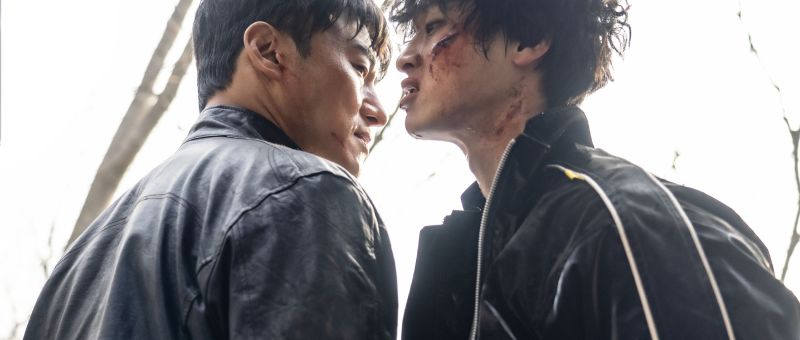
A detective consumed by thoughts of vengeance suddenly wakes up in the body of the serial killer he had been hunting, but how can we truly know who is who when each is so transgressively corrupt? The pluralisation in the title of Kim Jae-hoon’s bodyswap thriller Devils (악마들, Akmadeul) is no accident as the two men become in some senses interchangeable, their identities constantly shifting and largely dependent on those ascribed to them by others. “If you closed your eyes you’d swear he was Jae-hwan,” his confused partner admits though having witnessed him brutally torture a suspect/witness by hammering nails into his thighs. 

Jae-hwan’s (Jang Dong-Yoon) rage is partly born of guilt in that he failed to properly support his previous partner, who was also his brother-in-law, during a raid on a killer’s lair during which he got his throat slit by sadistic murderer Jin-hyuk (Oh Dae-Hwan) who has been brazenly posting snuff videos on the internet while continuing to evade the police. Two years later, Jae-hwan has been partnered with reletive rookie Min-sung and is determined not to make the same mistake when they get another shot at Jin-hyuk instructing him to stay behind and let Jae-hwan lead. But during the operation Jae-hwan goes rogue, chasing Jin-hyuk on his own and going missing after diving over a ridge in the woods. A month later a car carrying both men rams into a bollard outside police HQ only when he wakes up Jin-hyuk insists on speaking only with Min-sung and claims that he is in fact Jae-hwan.

Of course, Min-sung doesn’t really believe him despite being presented with information only Jae-hwan would know but is a little more convinced on visiting his former partner and observing him behaving strangely. The problem is, how can you tell the difference between a man using extreme violence for “justice”, which in this case is actually revenge, and one who uses it for pleasure? After teaming up with him, Min-sung is called to a station and assists Jin-hyuk/Jae-hwan drag an old man to a grimy trailer in the woods where he tortures him into giving up information on his fellow criminals by hammering nails into his legs while filming his “confession” as the kind of backup evidence which can’t be used it court but still might prove useful. You could say that it’s Jin-hyuk’s subconscious poking through, but Min-sung is fairly unfazed by this unorthodox investigative tactic and his conviction that Jin-hyuk is really Jae-hwan never wavers despite seeing him commit such a violent act so naturally.

Jae-hwan too hints at similarity between himself and Jin-hyuk when he complains that as a police officer he must “fight inside the fence known as law,” while the criminals are bound by no such constraints. He completely misses that this is what ought to separate them, to make their identities distinct, but now they are more or less the same in Jae-hwan’s willingness to turn vigilante, step outside the protection of the law, and do anything it takes to catch Jin-hyuk. “You’ve got my face, take advantage of it” Jae-hwan/Jin-hyuk sneers as he sends his opposite number to catch the men that have betrayed him, while each of them is to an extent adept at playing the role assigned to them at this and any given time. 

It goes without saying that the women who were murdered in the snuff videos have been more or less forgotten, Jae-hwan’s desire to catch Jin-hyuk is born of that to avenge himself as a policeman and gain vengeance for his brother-in-law’s death. In a pointed exchange, Jin-hyuk asks Jae-hwan how he knows that he is not merely toying with him, allowing Jae-hwan to think that he’s manipulating him but secretly in control, hinting at a kind of cat and mouse game between the two to claim the identity of the chaser and the chased. Yet whichever way you look at it, Jae-hwan has overplayed his hand, releasing a “hunting dog” he can’t control with disastrous consequences for himself and others. With a distinctly B-movie sensibility, Kim plays with identity and the malleability of memory to ask if we can really be sure of who we are at any given time while suggesting that’s something Jae-hwan should have been asking himself in his relentless pursuit of his spiritual mirror.


Devils screened as part of this year’s Fantasia International Film Festival.

International trailer (English subtitles)

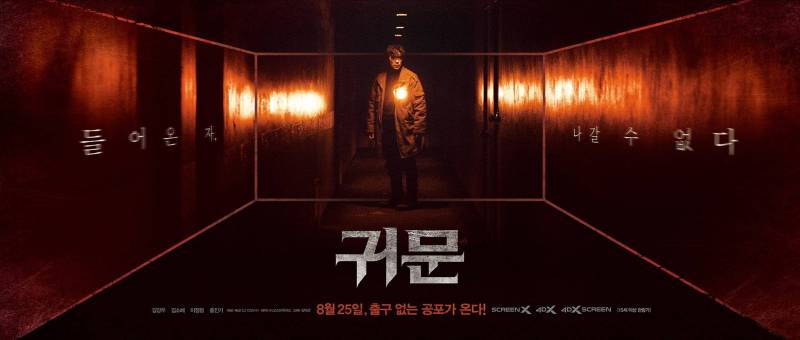
Guimoon: The Lightless Door (귀문, Sim Deok-geun, 2021)

A collection of lost souls find themselves trapped between this world and the next in Sim Deok-geun’s eerie haunted house horror, Guimoon: The Lightless Door (귀문, Guimoon). On a literal quest to exorcise his demons, the hero traverses an impossible and elliptical passage attempting to atone for his sins while freeing others from a similar burden yet finally finds himself becoming his quarry as kind of jailor or perhaps guardian spirit making sure that doors which should never be opened remain forever closed not least to the morbidly curious. 

Do-jin’s (Kim Kang-woo) troubles begin when he casts off his destiny as a shaman leaving his ageing mother to battle a powerful spirit said to belong to a mass killer who suddenly snapped one day and murdered all the guests at small community centre. When the building is torn down, workers discover a body bricked up in the walls which seems almost untouched. Do-jin’s mother is brought in to exorcise the evil spirits but is finally overpowered, a dark presence causing her to stab herself in the neck. Overcome with guilt and apparently “harassed” by his mother’s ghost, Do-jin resolves to atone by releasing each of the spirits killed by the murderous custodian and solving the mystery of the body in the walls in the hope of releasing his mother’s soul so that she can move on to the afterlife and stop nagging him from beyond the grave. 

The “Guimoon” is a kind of portal open on the turn of the year by the lunar calendar. Dojin intends to venture through it assuming it will be easy enough to nix a few ghosts and then come home but soon finds himself lost in a world of uncertain time and forever looping corridors. He meant to travel to the afterlife of 1990, but his world is soon disrupted by the arrival of three university students from 1996 who really shouldn’t be here. Armed with a video camera, they are dead set on crafting their own found footage horror in the hope of winning a competition so one of them won’t have to drop out of school. For the students, this world is “real”. They entered it voluntarily and as far as they are concerned are wandering round a derelict building, not really believing it to be “cursed” or haunted in any way. But for Do-jin it’s a liminal and unreal space he has entered for a specific purpose and from which he hopes to expel those who should have left long before. 

Yet even in trying to solve the mystery, Do-jin concentrates his efforts on Seok-ho (Jang Jae-ho), the shovel-wielding custodian, taking a kind of register of the other guests while knowing little about them. He soon discovers that Seok-ho may not quite be the boogeyman he first thought him to be, realising that his sudden descent into homicidal mania may not have been of his own volition. The solution he edges towards hints at the ironically named community centre as a nexus of trauma, a nightmare world created by an entity trying to escape its suffering and finding empowerment in taking control of its oppressors. 

“I was always here” one of the lonely souls proclaims, while Do-jin and the students find themselves locked in, prevented from leaving by a literal absence of exits. While the students eventually turn against each other, seeking escape by submitting themselves the malicious evil of the entity haunting the centre, Do-jin does his best to complete his quest of vanquishing the ghosts with his shaman’s dagger but is eventually brought to a cruel realisation in a maddening series of loops and repetitions which only lead towards a door which should never be opened. In some ways frustratingly oblique, Sim Deok-geun’s eerie meta horror is an exercise in found footage psychology in which the lost wander lonely corridors while searching for an elusive truth they may already know but have perhaps forgotten. On a night between two worlds lit by a blood red moon, Do-jin ventures into a labyrinth to save his mother’s soul but comes to realise that if you walk through the door between life and death you may discover that there is no exit from existential torment.


Guimoon: The Lightless Door screened as part of this year’s London Korean Film Festival.

International trailer (English subtitles)