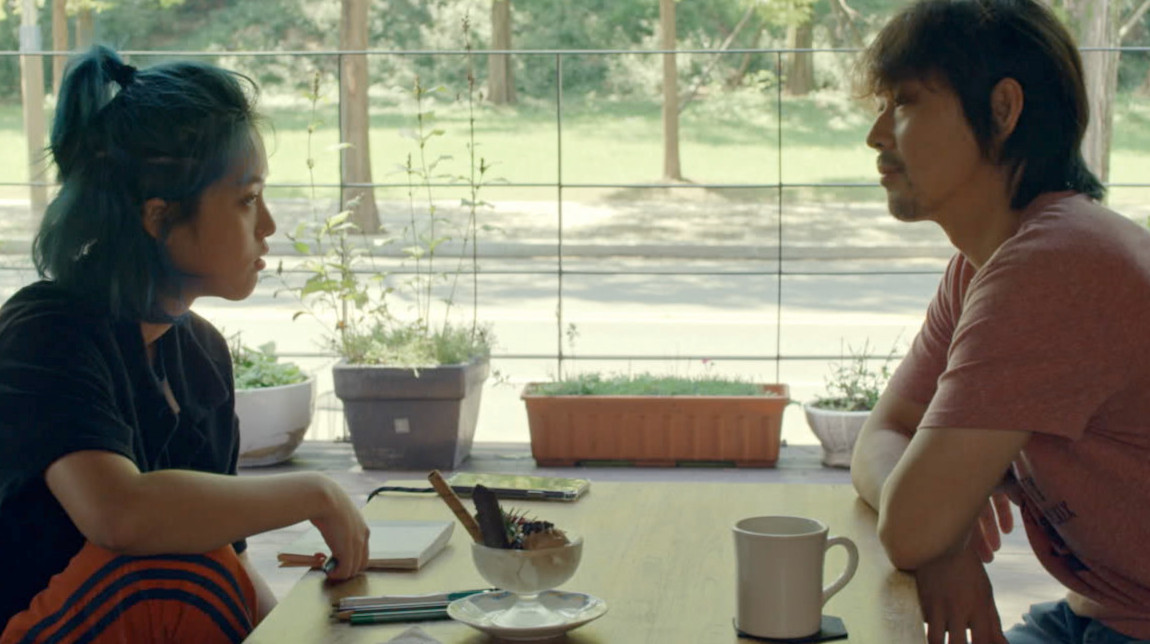
Iron Mask (만분의 일초, Kim Sung-hwan, 2023)

A young man seeking revenge sets his eyes on kendo glory in Kim Sung-hwan’s sporting drama Iron Mask (만분의 일초, Manbun-ui Ilcho). As his coach reminds him, a swordsman’s only opponent is himself though he continues to fixate on the man he blames for the destruction of his family still as an adult seeking reparation for the paternal influence he feels was stolen from him and the right to a legacy he feels to be rightfully his.

That might be one reason Jae-woo (Joo Jong-hyuk) is sometimes taken to task for his “entitlement” while some of the other students attending this training camp in the hope of making it onto the national team think he shouldn’t even be here seeing as he only came second in a regional competition when the others are veteran champions. But then as it turns out, Jae-woo has an ulterior motive for his participation. He is obsessed with number one challenger Tae-su (Moon Jin-seung) but for reasons outside of the sport, apparently hellbent on taking his revenge through kendo though it isn’t particularly clear what he hopes to achieve by it save personal vindication.

Kim pays particular attention to the peculiar rituals of the sport, a sense of rigorous order in the folding of the bandannas and tightening of the strings that fix the mask to the swordsman’s face while it’s clear that Jae-woo’s weakness is his emotional volatility. Though he manages to strike an impressive blow against Tae-su on the first day, his game then declines largely thanks to a hand tremor partly caused by a blow from Tae-su but also a manifestation of his jangling nerves.

He resents Tae-su on a personal level, irritated when he hears him talking on the phone to his wife about parenting their young daughter outraged that this man who he holds responsible for the implosion of his family has a family of his own while Jae-woo appears to have nothing other than his rage and resentment. He cannot forgive his estrangement from his kendo master father or that he chose to train another boy and not him, though perhaps that was simply his father’s way of coping with an impossible situation in the hope of making something good out of a personal tragedy. As another kendo master later tells him, as his father once did Jae-woo will have to find his own answers if he is to find success in kendo and indeed in life.

Still he struggles with fatherly relationships, first bonding with an older man who has two sons of his own and tries to impart paternal wisdom and comfort to the volatile Jae-woo but later accidentally injuring him during a sparring match when his temper gets the better of him. The only way he can free himself, is by moving past his image of his father to become his own man and also claim his own kendo rather than being resentful of that which was not bequeathed to him but to Tae-su for whom kendo is also a means of atonement and honouring of a paternal legacy.

Kim lends the battle a quasi-mythical quality, shooting a realm of eye-shaped mist as Jae-woo confronts Tae-su in his mind seeing only clashing swords and shadows while still unable to recognise that the man he is in competition with is only himself, his resentment and hurt in his abandonment, still a lonely little boy failing to become a man while Tae-su at least seemingly has been able to move on and make something of himself. Only by calming his nerves can he begin to perfect his art, taking the advice given to him by the team’s video replay expert seriously and apologising for his petulant behaviour. 

In essence, he has to escape from the “iron mask” of his repressed emotion and deal seriously with the traumatic past in order to progress to adulthood and also assume his rightful place on the kendo board. A psychological sports thriller, Kim lends a noirish touch to Jae-woo’s dark obsession even as it continues to consume him but finally implies the implosion of his rage through a dissolve transitioning to the falling snow as he now in white allows his resentment to melt away in favour of a more balanced hope for a peaceful future.


Iron Mask screened as part of this year’s London East Asia Film Festival.

Original trailer (Korean subtitles only)

A Lonely Island in the Distant Sea (절해고도, Kim Mi-young, 2021)

A dejected artist finds himself reconsidering his life’s choices when his teenage daughter drops out of education to become a Buddhist nun and he falls in love with a forthright professor in Kim Mi-young’s contemplative drama, A Lonely Island in the Distant Sea (절해고도, Jeolhaegodo). Though the title could easily enough refer to the hero himself, it echoes the sense of impossible longing symbolised by an island he could see but did not travel to though there was no real reason preventing him save his own feelings. In any case, the island and the day on which he saw it have become lodged in his memory as a nostalgic image of irresolvable desire. 

Now in early middle-age, Yun-cheol (Park Jong-hwan) is an unsuccessful sculptor who feels he has failed to live up to the promise of his youth and mainly earns his keep through commercial work such as crafting replicas of the solar system for a local museum. Divorced from his workaholic wife, he’s called in by his daughter Gina’s (Lee Yeon) school when they object to some admittedly disturbing artwork she had drawn on a series of roller blinds without permission. Yun-cheol is less concerned with the fact the paintings suggest that Gina is experiencing some kind of mental anguish than the school’s reaction to them, her teacher admitting that they took the blinds out and burned them. His anger is directed towards their wilful destruction of a work of art because it seemed to them more akin to vandalism or destruction of their property. Describing Gina as “mean”, they imply that they will ask her to leave suggesting that she would benefit from a different environment. In many ways that’s how Gina feels too, eventually revealing that she has decided to leave education altogether and later giving up her art to practice Buddhism. 

It’s the idea of abandoning her obvious talent that Yun-cheol struggles to understand. As a young man, he’d also considered becoming a monk or even a Catholic priest as, as he describes it, “safe paths for lost souls” if he failed to realise his ambitions of becoming an artist. Discovering that his daughter had had the same dilemma, even if she took a different path, shakes his sense of self in realising that his internal conflict was not unique. While trying to understand Gina’s desire to renounce the world, he begins to fall in love with a free spirited professor and cancer survivor but Ji-young (Kang Kyung-heon) is not prepared to wait around for him to sort himself out on his own and is quickly tired of his tendency to retreat into isolation rather than face his problems. Having learned only half a lesson, he later moves into Gina’s retreat where he is eventually asked to leave by the head nun bluntly who tells him that he is not suited for the monastic life. 

It may be that Yun-cheol exists outside of regular society because of his unusual upbringing in a mountain shack with his similarly isolated father, yet he struggles with himself and his relationship to art while seemingly unable to build lasting relationships with people as if they too were islands in a distant sea he could only gaze at from afar. He tells his daughter he would never abandon her in the way his mother had him but in a sense he might have done so in having lost the will to live amid his intense loneliness and lack of artistic fulfilment. Nevertheless, his growth comes in a kind of acceptance in acknowledging Gina’s choice to become a nun along with Ji-young’s declining heath and desire for isolation. 

When he had first met her, Yun-cheol had responded to Ji-young’s lecture about a would-be-revolutionary who did not go through with his cause by asking her why he would seek to implode the world in which he lived though this is the same thing Yun-cheol eventually does in his own mini-revolution choosing new paths in middle age whether in fear and regret or in search of possibility. A mystical meeting with a maternal wild boar helps to give him clarity though it seems he is forever destined to be a lonely island looking out at a distant sea filled with an unanswerable longing.


A Lonely Island in the Distant Sea screened as part of this year’s London Korean Film Festival.

Original trailer (no subtitles)