A Movie Capital (映画の都, Toshio Iizuka, 1991)

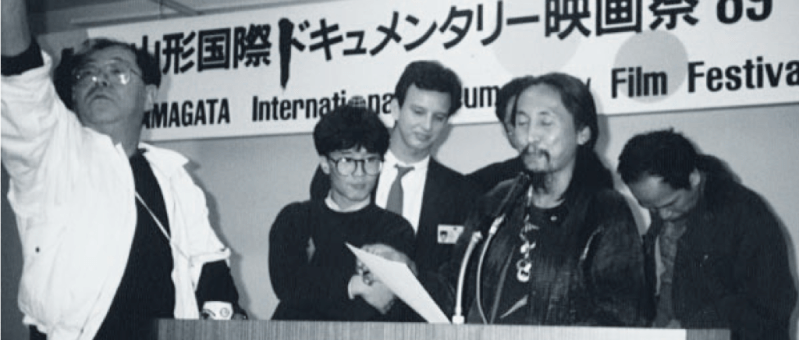
As the opening of Toshio Iizuka’s A Movie Capital (映画の都, Tokyo no Miyako) makes plain, 1989 was a year of turbulence all over the world but also perhaps also of hope as many of the directors invited to the very first Yamagata International Documentary Film Festival often insist in positioning their art as an act of resistance against authoritarianism. In essence a visual record commemorating the festival’s inauguration, Iizuka’s film also has its meta qualities interrogating not only what documentary is and what it’s for but its potential as a means of bringing disparate communities together in an exchange of truth and solidarity. 

In fact, the film opens with a brief prologue dedicated to Dutch documentarian Joris Ivens, who sadly passed away just before the festival opened, contrasting Ivens’ 1928 work The Bridge with the box office hit of that year in Japan, Shozo Makino’s Chushingura. Jumping into the film proper we witness something similar as the tranquility of the Bubble-era nation is directly contrasted with the events of Tiananmen Square as seen in a video sent to the festival by a Chinese associate living in Hong Kong. In actuality, the first Yamagata featured no films from Asia in its competition section provoking a symposium in which a number of Asian directors, producers, and critics discuss why that might be. Ironically enough, fifth generation Mainland Chinese director Tian Zhuangzhuang (The Horse Thief) was invited but unable to speak because, as his wife explains during an exasperating phone call, it’s not as easy for someone from China to travel abroad as it would be for someone elsewhere. The authorities haven’t granted him permission to leave and so he cannot even apply for a passport. 

Censorship and an element of personal danger to oneself or one’s family are otherwise cited as reasons documentary filmmaking has not taken taken off in Asia. The director of May 80 Dreamy Land which concerns the Gwangju Uprising is also unable to attend because he is currently on trial. Meanwhile, his representative Kong Su-Chang laments that he is among the older members of his small circle of documentary filmmakers who are of a generation without mentors having to teach themselves how to make films because there was no one there teach them. Filipino directors meanwhile cite the continuing influence of America along with wealth inequality as potential reasons the documentary has not flourished while asking if documentary and entertainment are in some way incompatible given that documentary is at its most popular at moments of crisis. 

Still as almost every interview states at one time or another, their primary goal is to make sure the voices of their subjects are heard and their faces seen determined to capture the everyday experiences of ordinary people as honestly as possible. While it’s obviously true that none of them were themselves included in the competition, many directors also claim that more important is the opportunity to meet other filmmakers in order to generate friendships and exchange ideas. They see their mission as making the world a better place to live hoping to challenge the status quo through their filmmaking while what Yamagata becomes to them is an opportunity to improve the fortunes of documentary filmmakers throughout Asia through mutual solidarity while the town of Yamagata itself also comes together as a community in order to celebrate documentary art even recruiting the marching band of a local primary school to help. 

One director’s suggestion that the future will become harder for dictators thanks to the democratisation of technology may in a sense be naive but in its own way true in the ability of ordinary people to record their own stories even if they face the same difficulties and dangers. Even so Iizuka’s assembled footage from the films which played that first edition alongside interview and Q&A footage not only help to give an impression of the open and enquiring nature of the festival, but also to interrogate itself and its art asking what it’s for and what purpose it can serve at a moment of geopolitical instability as the Berlin Wall falls and the echoes of Tiananmen reverberate while documenting not only a single event but its purpose and intention. 


A Movie Capital streams worldwide (excl. Japan) via DAFilms Jan. 17 to Feb. 6 as part of Made in Japan, Yamagata 1989 – 2021 (films stream free Jan. 17 – 24)

My Atomic Aunt (波の向こう, Kyoko Miyake, 2013)

“I can’t let TEPCO ruin my life” the heroine of Kyoko Miyake’s personal documentary My Atomic Aunt (波の向こう, Nami no Mukou) eventually asserts, explaining that when you have no more tears to cry then you become defiant. Having lived in London for 10 years prior to filming the documentary, a lack of defiance was something that had initially interested Miyake, wondering if she’d simply been away too long no longer understanding why everyone in her family’s hometown of Namie in Fukushima continued to refer to the Tokyo Electric Power Company in such affectionate terms. Then again, as her aunt Kuniko points out before losing her patience, “anger won’t get us anywhere”.

Returning to Japan soon after the 2011 earthquake and tsunami, Miyake details her own relationship with Namie, rendered uninhabitable after the Fukushima nuclear disaster, during her opening voiceover describing it as a warm and nostalgic place marked by a sense of rural tranquility. Nevertheless through making the documentary she comes to question both herself and the town, wondering why it was that people were so keen to have the plant come when the prevailing wisdom of her own generation was anti-nuclear and wary of duplicitous heavy industry. As her aunt and her friends reveal, however, post-war Namie was a poor village where farmers often had to leave for city jobs over the winter to make ends meet. Some grew envious of other local towns which had become economically prosperous thanks to corporate investment while others remained sceptical. Those who refused to sell their land for the development of another nuclear plant were harassed into submission by those convinced of its benefits, while TEPCO was keen to invite the local community to inspect existing plants to prove that they were safe. 

An awkward and in fact incredibly sexist propaganda video targeted at local wives and mothers demonstrates that safety was still an issue as late as the ‘90s, a company representative ominously claiming that the plant has been designed to withstand a tsunami before adding “we will never betray your trust”. Many residents still want to believe in TEPCO’s promises, sure that they will somehow fix what is broken even while many of them are trapped in temporary housing with no idea when or if they’ll be allowed to return home. Aunt Kuniko tries to stay cheerful, bored with trying to kill time having previously devoted herself entirely to work. Miyake describes her aunt as a feminist pioneer who showed her how to be glamorous and successful while also having a rich family life. Ironically enough, Kuniko ran both a wedding parlour and a funeral home right next to each other with a bakery in-between. She wanted her children to take the businesses over, but her three sons have already moved on, one buying an apartment and starting a business of his own far away without saying anything at all about it to her. 

The tsunami disaster has deepened a generational divide with the young leaving the area to make new lives elsewhere while as one old lady puts it the elderly are left behind with nothing to do but laugh. These people haven’t just lost their homes, they’ve lost their hometown, in a sense orphaned and free floating in a Japan struggling to find space for them as the heartrending echoes of plaintive folksong Furusato make clear. Forced to accept they may never be able to return, Kuniko looks for new premises but only for her funeral home conceding that there’s not much future in the wedding business, with all of the youngsters gone there’s no one left to get married. “There’s no such thing as absolute safety” she laments, regretting having been duped by TEPCO and the dubious promises they sold even as they positioned themselves as the driving force of the post-war economic miracle. The town felt proud by proxy that the energy they generated went into rebuilding the country, but as Miyake admits as long as the lights stay on in Tokyo no one cares about Fukushima or about the people still living in temporary accommodation caught in a never-ending limbo waiting for someone to tell them what they’re supposed to do now that everything they’ve ever worked for or built is lost in an instant. 

While her husband remains somewhat sympathetic to TEPCO, arguing that the problem isn’t nuclear power but safety, Kuniko begins to lose her patience taking part in protest marches against the plant while trying to salvage what she can from her old life. Miyake bookends the film with images of post-Fukushima Namie now an eerie ghost town, pastries still sitting in Kuniko’s bakery the area’s timelessness ironically mirroring Miyake’s description of it in her childhood memories as a kind of time-warp to post-war Japan from bubble-era Tokyo. An elegy for a community erased, Miyake’s quietly angry documentary takes aim at indifferent government and corporate greed, but finds also a stoical sense of endurance as Kuniko waters her abandoned flowers and prepares to start again. 


My Atomic Aunt streams in the US until Dec. 23 as part of Japan Society New York’s Flash Forward series.

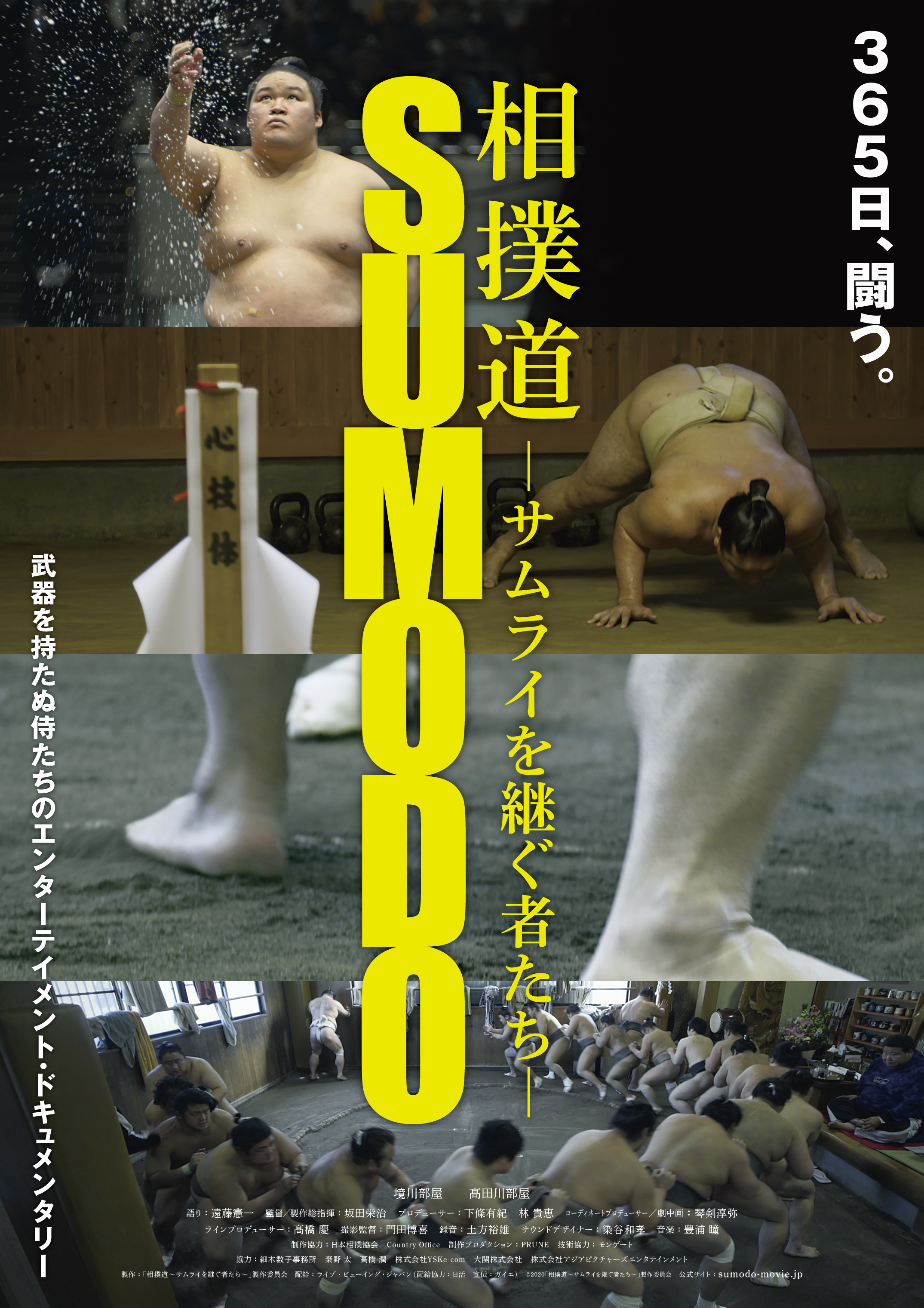
SUMODO ~The Successors Of Samurai~ (相撲道~サムライを継ぐ者たち~, Eiji Sakata, 2020)

“Every day is a traffic accident” according to a sumo wrestler describing the motion of two men colliding each trying to shove the other out of a protected area. Often regarded as a quintessentially Japanese combat sport, sumo has also come in for its share of misconceptions sometimes mocked or dismissed as a pastime popular mainly among the elderly or else a source of comedy in which in two large men clumsily grapple with each other. It’s precisely these unfair stereotypes that Eiji Sakata’s documentary SUMODO ~The Successors Of Samurai~ (相撲道~サムライを継ぐ者たち~, Sumodo ~Samurai o tsugu monotachi~) hopes to correct in gaining unprecedented access to the usually secretive world of professional sumo. 

He does this largely through focussing on two very different sumo stables and two key tournaments, one at New Year and the other in May. Though he interviews several of the rikishi at each, he adopts two main subjects who eventually clash in the ring but otherwise avoids clear narrative for an overview of what it’s like to live as a professional sumo wrestler in the present day which is to say a lifestyle that is largely unchanged over hundreds of years. Perhaps surprisingly, he even stops to appreciate the way in which a sumo tournament has also become something of a fashion show in which an audience comes expressly to appreciate the traditional kimono modelled by the rikishi as they make their way towards the auditorium. Living communally at the stable where they train, sumo wrestlers are expected to dress in traditional clothing at all times and wear their hair in a traditional style. 

Their diet is of course strictly monitored in order to help them maintain their weight. At the second of the stables, Takadagawa, food is a particular issue one rikishi stating that the high quality of the cuisine is one reason he chose to train there and while the chef explains that he keeps the vegetable content high and is keen to encourage healthy, nutritious eating the stable master is also determined that the meals be tasty rather than an austere exercise in body building. Sumo wrestlers do nevertheless eat quite a lot, the director perhaps regretting his decision to take the rikishi from the first stable Sakaigawa out for Korean barbecue when they literally eat the place out of its entire stock of meat generating a bill for US$8000 for under 50 people. 

Even so, despite their size the sumo wrestlers are necessarily extremely fit and spend much of their time deliberately building muscle. Whereas Sakaigawa is more traditional in its rather austere outlook, the master at Takadagawa, a former rikishi himself, explains that the sport has in a sense changed in keeping with the modern society in that he’s moved away from an aggressive coaching style that some might regard as bullying or harassment towards something kinder that values endurance and perseverance. The contrast is also visible in the choice of the two protagonists, Goeido being much more the traditional image of a sumo wrestler with his rather intense demeanour and emphasis on manly stoicism, whereas Ryuden is a surprisingly cheerful man with a joyful laugh and aura of serenity. 

Yet even Goeido describes the tournament process as mentally and physically exhausting despite fighting only one bout a day. At one particular tournament he tears a muscle in his upper arm but refuses to have it strapped unwilling to expose his area of weakness to an opponent later criticising younger wrestlers for making too much fuss over injury advising them that they should remain stoical without complaint like “true men”. Despite his more progressive coaching style, the master of Takadagawa says something similar in regarding injuries as tests from god or else a clear sign that more training is necessary. Ryuden himself suffered recurrent problems from a broken pelvis that saw him temporarily demoted but worked his way back to health by concentrating on “the basics”, later advising younger rikishi that there’s no hurry what’s important is to keep pushing through and avoid giving up too easily. The spirit of sumo, however, never changes at least according to the closing text. Illuminating the sport’s ancient history and ties to shinto ritual through a brief animated sequence, Sakata is most interested in the everyday lives of sumo wrestlers and the physical, emotional toll the sport can take on their lives as they push their bodies to the absolute limit of their capabilities. 


SUMODO ~The Successors Of Samurai~ screens in Canberra (Oct. 31), Perth (Nov. 7), Brisbane (Nov. 14), Melbourne (Nov. 20/23) and Sydney (Nov. 26/28) as part of this year’s Japanese Film Festival Australia.

Original trailer (English subtitles)