A Princess’ One-Sided Love (公主님의 짝사랑 / 공주님의 짝사랑, Choi Eun-hee, 1967)

“Those are the rules of the palace for a princess” the rebellious heroine of Choi Eun-hee’s second directorial feature A Princess’ One-Sided Love (公主님의 짝사랑 / 공주님의 짝사랑, Gongjunimui Jjaksarang) is told, though the “palace” is really the society and the “rules” those which all women are expected to “endure”. Quietly and perhaps subversively feminist, Choi’s humorous tale draws inspiration from Roman Holiday but unexpectedly engineers a happier ending for its lovelorn heroine who is permitted to transcend the constraints of her nobility if not quite of her womanhood. 

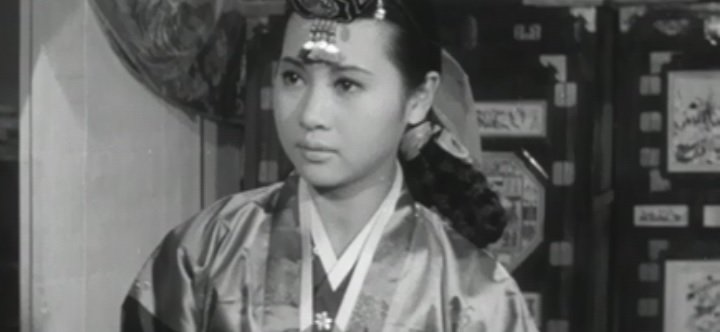
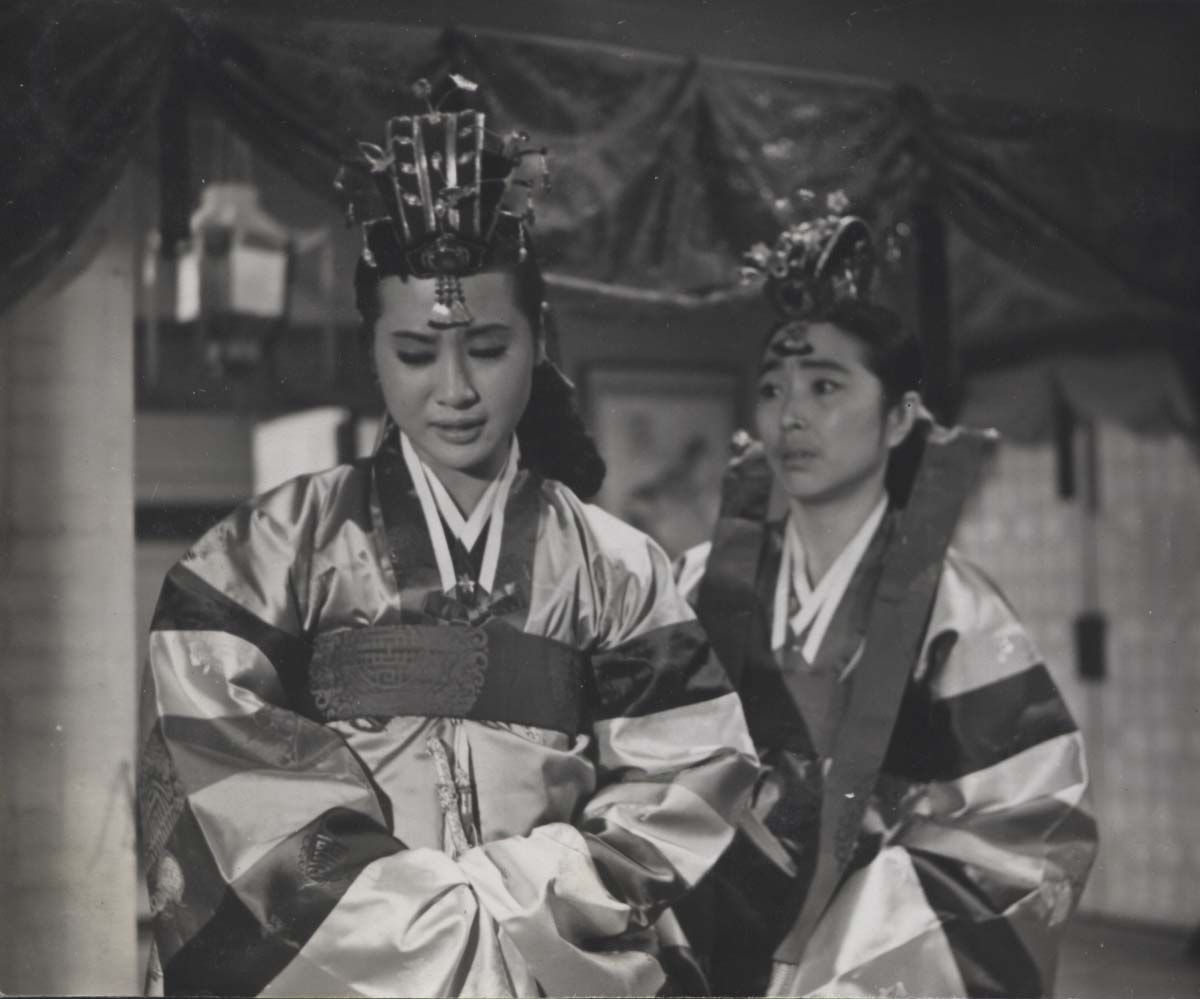
Tomboyish princess Suk-gyeong (Nam Jeong-im) is the youngest of six princesses and the last to remain at home in the palace yet to be married. Consequently, she is infinitely bored all the time and continually up to mischief in part because as a princess she is not permitted to leave the estate and has a natural curiosity about the outside world. That curiosity is further sparked when she lays eyes on handsome scholar Kim Seon-do (Kim Gwang-su) who picks up a shoe she had dropped while inappropriately running on the day of her mother’s birthday celebrations. Possibly the first young and handsome man she has even seen, Suk-gyeong cannot help but be captivated by him and manages to convince her sisters to help her escape the palace to venture in search of her probably impossible love under the pretext of visiting her grandparents whom she has apparently never visited before.  

Like Audrey Hepburn in Roman Holiday, what Suk-gyeong wants is a break from the “tedious and pathetic” life of a princess, but soon discovers herself to be entirely naive as to how the “real world” works. Her sisters agreed to help her in part because they acknowledge how difficult it was for them when they married and had to leave the palace with no understanding of how to live outside it. Having left in the clothes of a servant, the first thing that Suk-gyeong realises is that the outside world is governed by a different set of hierarchies and even if she’s a princess she is still a woman and therefore presumed to be “inferior” to men to whom she is expected to remain subservient. Her grandfather, who has never met her before, wastes no time exerting his patriarchal authority in his own, comparatively humble, home. “A woman, once married, must abide by the rules of her new family, the confucian ethics, and respect your father and husband and become a wise and obedient wife” he explains, striking her across the calves with a cane to teach her a lesson for her imperious tone in failing to pay him the proper respect. 

Failing to use appropriately polite language with those around her, forgetting that she should now be deferent both to men and to those who exceed her in age, gets her into constant trouble. Nevertheless, a trip to the marketplace gains her a further understanding of the extremes in her society firstly when she misunderstands a rice cake seller’s patter and assumes he intended to gift her some of his produce as he might to a princess, and secondly when she bumps into a woman with a baby on her back and breaks the pots she was hoping to sell to pay for her husband’s medical care. Introduced to such desperate poverty, the undercover princess knows not what to do but later gifts her a jade pin hoping perhaps to at least cure the husband’s malady, only to wander into another dangerous situation when she is mistaken for a sex worker by a trio of drunken noblemen who pull her into a drinking establishment which is in fact a brothel. Naively drinking with the men she mocks them for their attempts to play on their names each boasting of their famous fathers and personal connections to men she knows to be elderly cranks and obsequious fools. Shocked to discover what goes in establishments like these she tries to make her escape but is almost assaulted by one of the men, Shim, who is later posited as an ideal match by her unsuspecting mother laying bare another patriarchal double standard as Shim plays the part of the gentleman in order to effect his advancement. Luckily, she is saved by Seon-do who happens to be passing but mistakes her for a boy because of the disguise she is currently wearing. 

Selfish in her naivety, Suk-gyeong is warned that her impossible crush might end up harming Seon-do’s hopes of making it into the elite through success in the state exam while he, once made aware of the truth, immediately does the right thing by kindly rebuffing the princess’ inappropriate interest leaving her with a poetic love letter claiming he’s gone off to a temple for a spell of intensive study. Perhaps improbably it’s the love letter that eventually saves them, touching the king’s heart and convincing him to acquiesce to his sister’s wishes of escaping the gilded cage of nobility. Suk-gyeon’s pleas to renounce her royal title might also stand in for a desire to renounce womanhood in that it “stops us from doing anything we want. We are matched up with an unknown husband and we spend our youths in misery for our lives are tedious and pathetic”, reminding her brother that as a king but in truth as a man he cannot understand even while he reminds her that these are the “rules” endured by countless ancestors. The king is moved, he breaks with tradition and frees his sister yet he does so to allow her to become a wife even if he has also granted her the freedom to choose her husband and live in the outside world unconstrained by the strictures of nobility but nevertheless bound by oppressive patriarchal social codes. Nevertheless, it’s an unexpectedly progressive conclusion advocating for change and personal happiness over the primacy of duty and tradition. 


A Princess’ One-Sided Love streamed as part of the Korean Cultural Centre UK’s Korean Film NightsFilming Against the Odds 

Ilwol: The Sun and the Moon (일월 / 日月, Lee Seong-gu, 1967)

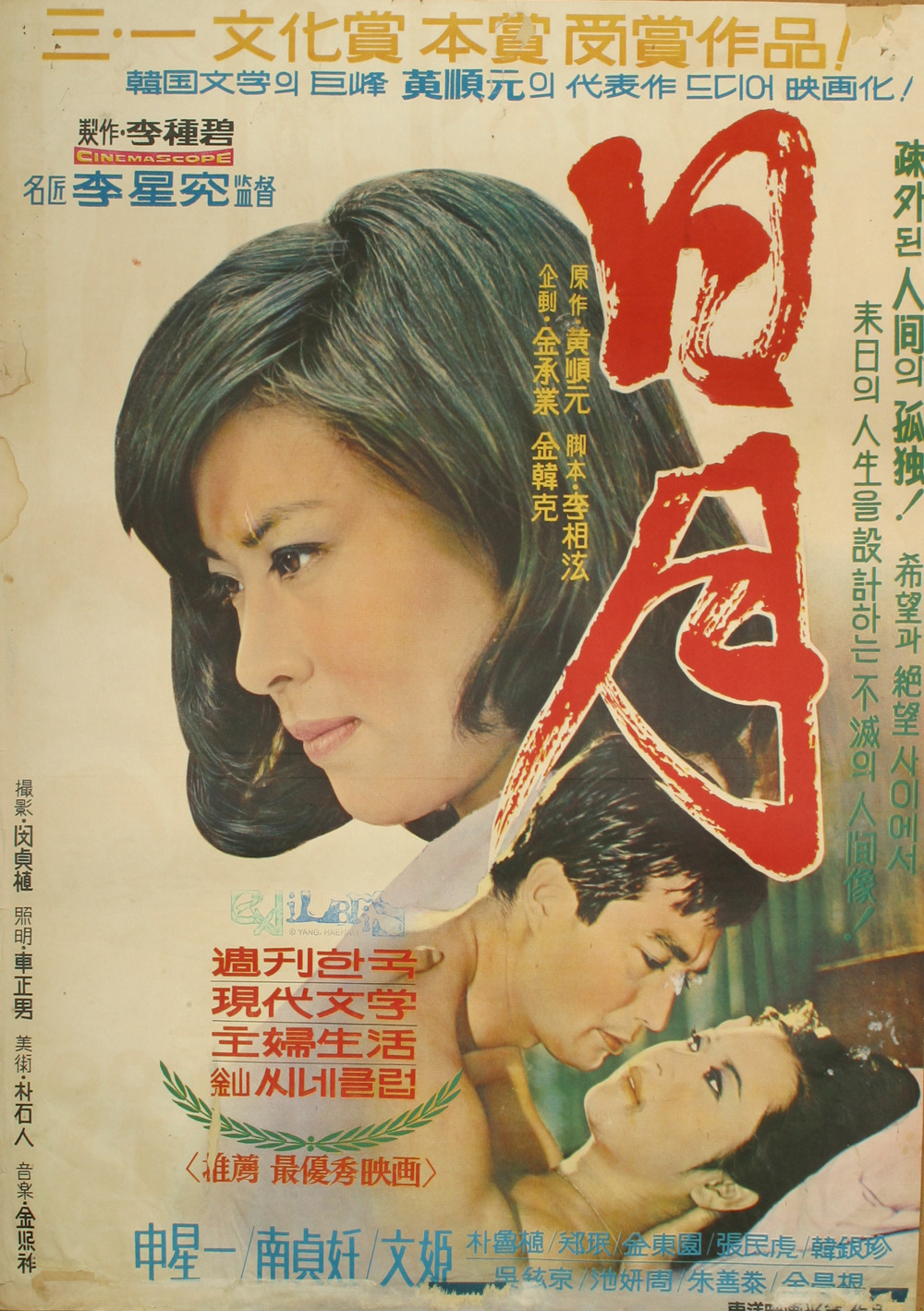
Sun and Moon posterOld habits die hard in Lee Seong-gu’s Ilwol: The Sun and the Moon (일월 / 日月). The feudal past refuses to ease its icy grip even in the new “democratic” era in which freedom and prosperity are promised to all. Lee Seong-gu, closely associated with the Western Modernist movement, flexes his Literary Film muscles with an adaptation of Hwang Sun-won’s novel. Mixing a standard melodrama narrative with an exploration of “outdated” social prejudices and the gradually fracturing psyche of a man who learns a “dark secret” regarding his personal family history, Lee isolates the individual within a changing society as an ordinary man finds himself unable to move forward despite his own desire to be free of the superstitious past.

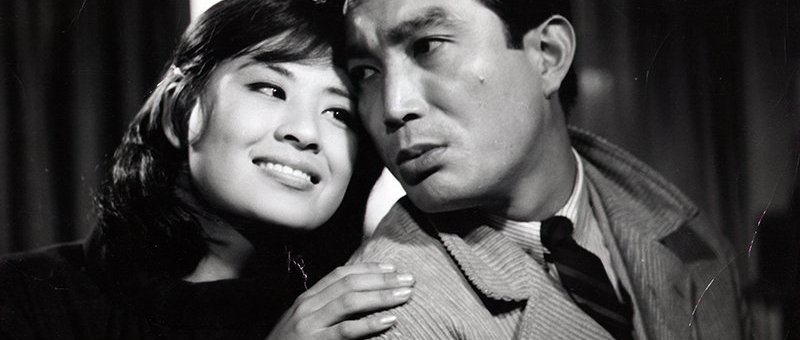
Lee opens with a scene more in keeping with a romantic comedy. Aspiring architect In-cheol (Shin Seong-il) meets drama student Na-mi (Nam Jeong-im) at an upscale ski resort and is instantly smitten. After spending time with her, In-cheol goes home and visits a childhood friend, Da-hye (Moon Hee). Da-hye is quite obviously in love with In-cheol – a fact of which he is obviously unaware or just completely insensitive since his purpose in coming is to tell her about Na-mi. Despite her personal pain, Da-hye is a good friend and gives In-cheol the appropriate advice regarding his romantic endeavour, reminding him that many of his previous relationships have failed because he was too diffident and he let them drift away.

Meanwhile, In-cheol is called into his father’s study to meet his dad’s new business contact who, it happens, wants a house designed. In a piece of near dynastic finagling, In-cheol gets a new job and, surprise surprise, the house turns out to be for Na-mi who is the daughter of the bank manager In-cheol’s dad wants a loan from. Everything is working out just fine, but then In-cheol’s brother – the Mayor of Gwanju (Jang Min-ho), turns up in a state of agitation and tells them he’s being blackmailed. Someone has discovered their dark family secret – In-cheol’s dad ran away from his family because they were butchers, a near “untouchable” class even in the Korean society of 1967. In-cheol thinks this is all very silly, who cares about things like that anymore? But on another level the discovery profoundly disturbs him in what it says about him as a person and about the society in which he lives.

It does seem ridiculous to stigmatise such commonplace occupation in a supposedly modern society, but In-cheol can’t seem to move past it. He pays a visit to a slaughter house which is just as awful as he’d expected it to be as he watches a once powerful cow twitching helplessly on the floor while other workers dismember the corpses of animals, pulling out entrails and severing heads ready for keener butchery. Still, In-cheol reminds himself it’s just a job and resolves to meet his cousin, but his cousin, insisting that he has no relatives, won’t talk to him. In-cheol takes this for rudeness or rejection, but really his cousin is attempting to protect him. In having internalised the constant abuse he suffers – even once being arrested by the police when a murder took place nearby solely because he is a butcher and had no alibi, In-cheol’s cousin avoids contact with those outside of his group and does not want to taint him with the butcher brush. Yet In-cheol keeps pushing, only for his cousin to roundly tell him to leave it alone unless he has the courage to accept his butcher blood fully for all it is.

The problems are manifold. In-cheol’s father’s first engagement was broken when the bride found out he came from a butcher family, while his wife (who married him without knowing) became a religious obsessive after learning of her husband’s origins. In-cheol’s marriage prospects are almost certainly off the table if anyone finds out, but even if someone agrees to marry him knowing the truth should he really invite them to do so knowing that they (and their children) will share his shame?

Unable to speak, unable to move forward or back, In-cheol spirals into a depressive cycle of inertia and suffering. Da-hye tries to talk to Na-mi to get him to wake up, but Na-mi tells her she’s not much bothered about In-cheol’s mental state and has only been messing around. Nevertheless, she finally draws closer to him as means both of assuming the leading role in her relationship, and as a way of annoying her father whilst potentially getting herself involved in a small scale scandal. Meanwhile, Da-hye who had pointed out that In-cheol’s problem was his passivity, ironically reveals that she too has been waiting for him to wake up and realise her feelings for him, only now realising she has probably missed her chance. The melodramatic device of the love triangle becomes a symbol of In-cheol’s ongoing psychological fracturing as he finds himself caught between two women and realising he can choose neither of them because his “ancestral curse” has effectively disqualified him from living in the modern world.

Using innovative editing techniques, Lee dramatises the tragedy of an isolated generation, supposedly living in a “modern” society but unable to escape the outdated social codes of the past. Rather than attempt to free themselves from irrational and superstitious ways of thinking, they choose self-exile and willingly accept their unhappiness in an otherwise altruistic intention of preventing the spread of a contagion. Melancholy yet urgent, Ilwol: The Sun and the Moon uses the ridiculous survival of an ancient prejudice to lay bare a dark secret at the centre of its own society but finds only tragedy without sense of an escape.


Ilwol: The Sun and the Moon is the first film included in the Korean Film Archive’s Lee Seong-gu box set. (Not currently available to stream via the Korean Film Archive’s YouTube Channel).

Jagko (짝코, AKA Pursuit of Death, Im Kwon-taek, 1980)

Jagko poster

During the dark days of the dictatorships, the “anti-communist film” was a mainstay of the Korean film industry. Though it wasn’t exactly possible to make a pro-communist film and that therefore any and all films were at least implicitly anti-communist, the authorities had been especially keen on films which took a hardline on anything remotely leftwing. By the late ‘70s however times were changing and a more nuanced view of recent history began to become possible. Im Kwon-taek is thought to be among the first directors whose work precipitated a shift from the “anti-communist” to the “division” film in which the tragedy of the division itself takes precedence over the demonisation of the North (though such views were perhaps not as uncommon as might be assumed in films from the late ‘50s and early ‘60s before the passing of the Motion Picture Law). Jagko’s (짝코) two haunted protagonists are both flawed men betrayed by their country and changing times realising they have wasted their youth on a cat and mouse game over an outdated ideological disagreement when the conflict that defined their lives was merely a proxy war fought by two super powers on Korean soil.

Song (Choi Yoon-seok), a former policeman, is picked up by a vagrancy patrol and taken to a “rehabilitation centre”. Despite the name the centre is more like a debtors’ prison and Song is now a prisoner of poverty who will not be allowed to leave unless redeemed by a family member (of which he has none or he might not be here). Nevertheless, the men are treated well, fed three meals a day, and only asked for a couple of hours of non-strenuous work with the rest of the time marked “free”. Once Song has begun to calm down, he makes a shocking discovery. He is convinced that a man lying ill a few beds over is none other than Jagko (Kim Hee-ra) – a former North Korean partisan and the man he holds responsible for ruining his life.

Im lets us in on the stories of both men via a series of flashbacks. Though he pretends not to know him, the other man, calling himself Kim, is indeed “Jagko” though his life has been just as miserable as Song’s. Back on Mount Jiri at the end of the Korean war, Song was a respected policeman – he left school at 12 and made a name for himself catching partisans. When he catches the legendary Jagko, wanted for a series of atrocities and terrorist acts, all Song can do is boast and talk of his imminent promotion after which he will enjoy a life of comfort. Unsurprisingly, Jagko is not exactly happy for him but allows his captor to prattle on in order to buy time for his escape. It is Song’s own arrogance which permits him to do so. Claiming to need the bathroom, Jagko offers Song a gold ring hidden in his shoe which Song scoffs at, but he does loosen his cuffs to facilitate Jagko’s relief at which point he manages to headbutt him and run away. Song is accused of taking bribes and dismissed. He is humiliated and loses his status, job, and family all in one go. Fixated on Jagko, Song gives up everything to chase him in order to turn him in to his former commander and have him clear his name by confirming that he was not bribed and did not sell out his country for gold.

Almost thirty years later both men are older than their years, broken and defeated. As one of the rehabilitation centre residents puts it, they’re all about to die – what does it matter now if someone was a communist or a partisan, what good could it possibly do to drag the past up all these years later? For Song it’s almost as if there is no “past”, the last few decades have been spent in a relentless pursuit of the man who holds the key to his good name. He wants to undo the folly of his hubris by overwriting it, but time has passed and what he’s lost cannot be reclaimed. Meanwhile, Jagko is not an ideologically crazed leftist, but a lonely old man who is now in poor health and has nothing but regrets. The two men bond in their mutual suffering and work together to escape, but the world they emerge into is not that of their youth. Song was disempowered when he entered the facility – they took his arrest rope away from him, but when he tackles the weakened Jagko to the ground and tries to call two policemen on patrol over to arrest him as an “escaped communist guerrilla” the young officers of the law have no idea what he’s talking about. Those words no longer mean anything. The bemused policemen conclude the old men must be escaped mental patients before spotting the rehabilitation centre uniform and jogging off to phone someone to come and take them back.

The old men’s quarrel is exposed as ridiculous. Jagko, less angry more soulful, remarks that men like he and Song are the most pitiful souls on Earth as he watches America sit down with Russia on the TV and realises he is merely a victim of ongoing global geopolitical manoeuvring. It’s no longer a question of left and right, both men are victims of their times, neither “good” nor “bad” but flawed and human. We do not know if Jagko did the things Song says he did but he has paid a heavy price all the same. Song, by contrast, has shifted all the blame for his fate onto Jagko, believing that if he can catch him he can somehow make it all right, but of course he can’t and is trapped in a spiral of denial in refusing to accept his own responsibility for the tragedies of his life. What is to blame is the folly of war and particularly of an internecine fraternal conflict which remains unresolved and may well be unresolvable unless an attempt is made to address the past with empathy and understanding in place of enmity and rancour.


Jagko is available on blu-ray courtesy of the Korean Film Archive. The set includes subtitles in English, Japanese, and Korean with the audio commentary by Kim Dae-seung and editor of Cine21 Ju Sung-chul also subtitled in English. The audio commentaries from the DVD edition included with the Im Kwon-taek boxset, one by director Im Kwon-taek and film critic Huh Moon-yung, and the other by screenwriter Song Gil-han and film critic and director Kim Hong-joon, unfortunately do not carry over the English subtitles. The set also comes with a bi-lingual Korean/English booklet featuring an essay by film critic and professor Park Yuhee. Not currently available to stream via the Korean Film Archive’s YouTube channel.