Dream Home (維多利亞壹號, Pang Ho-cheung, 2010)

“In a crazy city, if one is to survive, he’s got to be more crazy.” according to the opening titles of Pang Ho-cheung’s surprisingly poignant slasher satire Dream Home (維多利亞壹號). In the 10 years since the handover, the average wage has increased by a measly 1% while house prices have risen by 15% in 2007 alone. Sheung’s (Josie Ho) one overriding mission in life is to buy a flat for her family to live in, but it’s clear that her struggles to become a homeowner aren’t the only pressure points in her life in an increasingly capitalistic society. 

As we later discover, Sheung is set on one particular flat because the building it’s in stands on the spot where she once lived as a child before her family was pushed out by rampant gentrification. In essence, she’s just trying to take back what’s hers and restore her family’s sense of dignity and security. A flashback to her childhood reveals her father’s own insecurity in having been unable to secure a larger living space in which she and her brother could have their own rooms while her grandfather, a sailor, longed for a sea view and the sense of an expanding horizon otherwise denied to the family in a cramped Hong Kong council flat. In a touch of irony, Sheung’s father himself worked in construction building apartment blocks he couldn’t afford to live in and in the end it killed it him through exposure to asbestos and other dangerous fibres. 

Sheung works at a bank but is conflicted about her job cold calling account holders to try to get them to buy into dodgy loans neatly echoing the film’s closing moments which hint at a coming economic crash precipitated by the subprime mortgage crisis which will threaten Sheung’s homeowning dream. Her friends think she’s crazy to buy a flat at all, but she’s completely fixated on repairing her broken childhood by taking back her family home and ending her displacement. Meanwhile, she’s in a dissatisfying dead end relationship with a married man which largely takes place in love hotels he sticks her with the bill for and turns up late to only to immediately fall asleep. When Sheung asks him for a loan to help pay for her father’s medical care after the insurance she got for him is voided because he never told her he’d been diagnosed with a lung complaint before she took it out, he tells her to use her deposit fund instead and give up on homeownership because only fools like her would buy in such a volatile market. 

Disappointment in both her personal and professional lives continues to place a strain on Sheung’s fragile mental state that eventually tips her over the edge. Hoping to bring the apartment’s price down, she goes on a murder spree in the building killing it seems partly out of resentment and otherwise pure practicality. There is irony here too, in that she kills her victims with the weapons of their privilege. A cheating husband who comes home unexpectedly after lying to his wife that he’s gone golfing but was actually with his mistress is whacked on the head with a golf club while an obnoxious stoner kid is stabbed in the neck with his bong. Sheung murders a Filipina helper, but also the snooty middle-class woman who employed her by using the vacuum pack machine the helper had been using on her behalf. One might ask if she really needed to kill the helper or the pair of Mainland sex workers in the next apartment, but when it comes to devaluing property prices “massacre” sounds much better than “killing” and so it’s the more the merrier. 

In the end, it’s this city that’s driven her out of her mind with its status-obsessed consumerism and constant sense of impossibility. After her killing spree, she doesn’t even seem very conflicted about selling dodgy loans to vulnerable people not so different from herself while she was so desperately trying to get approval on a mortgage there was no way she could afford despite working a series of other part-time jobs including one selling designer handbags to the kind of wealthy women she resents. Her dream apartment has a view quite literally to kill for, though there’s a sense that Sheung’s dream will always be futile with the same motivations that brought her here leading to the mortgage crisis and economic shock that could eventually take it from her. Bloody, gory, and at times sickeningly violent Pang’s satirical horror show paints contemporary capitalism as the real villain and even in its dark humour reserves its sympathies for the wounded Sheung pushed to breaking point by a pressure cooker society. 


Dream Home available to stream in the UK until 30th June as part of this year’s Odyssey: A Chinese Cinema Season.

International trailer (English subtitles)
Love Off the Cuff (春嬌救志明, Pang Ho-cheung, 2017)

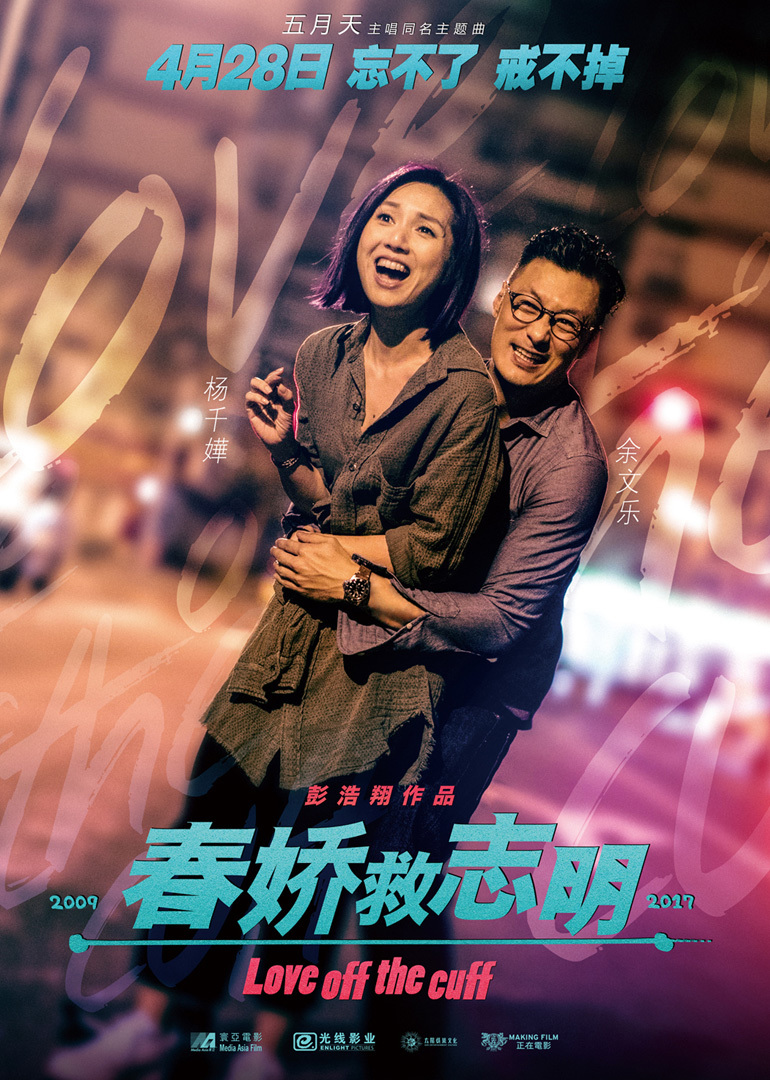
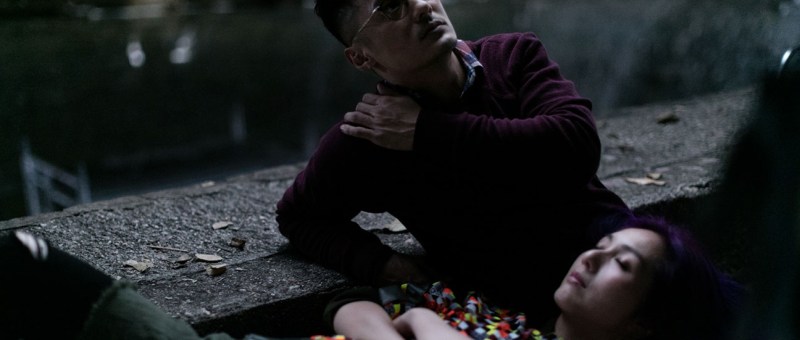
love off the cuff posterJimmy and Cherie, against all the odds, are still together and in a happy longterm relationship in the third addition to Pang Ho-cheung’s series of charming romantic comedies, Love off the Cuff (春嬌救志明). Following the dramatic declaration at the end of Love in the Buff, the pair have continued to grow into each other embracing each of their respective faults but after all this time Jimmy and Cherie have to make another decision – stay together forever or call it quits for good.
The major drama this time around occurs with the looming spectre of parenthood as Cherie’s long absent father and Jimmy’s “godmother” suddenly arrive to place undue strain on the couple’s relationship. These unexpected twin arrivals do their best to push Cherie’s buttons as she’s forced to re-examine her father’s part in her life (or lack of it) and how he may or may not be reflected in her choice of Jimmy, whilst Jimmy’s Canadian “godmother” makes a request of him in that he be the father of her child. Jimmy, a self confessed child himself, does not want anything to with this request but is too cowardly to hurt the feelings of a childhood friend and is hoping Cherie will do it for him. Cherie is wise to his game and doesn’t want to be trotted out as his old battle axe of a spouse but at 40 years of age children is one of the things she needs to make a decision on, another being whether she wants them with Jimmy.

Cherie’s father was an unhappy womaniser who eventually abandoned the family and has had little to do with any of them ever since. In his sudden return he brings great news! He’s getting married, to a woman much younger than Cherie. Building on the extreme insecurities and trust issues Cherie has displayed throughout the series, her faith in Jimmy crumbles especially after she intercepts some interestingly worded (yet totally innocent) text messages on his phone which turn out to relate to an unfortunate incident with their dog. Jimmy’s reliability continues to be one of his weaker elements as the behaviour he sees as pragmatic often strikes Cherie as self-centered or insensitive. Things come to a head during a disastrous getaway to Taipei in which the couple are caught in an earthquake. Cherie freezes and cowers by the door while Jimmy ties to guide her to safety but his efforts leave her feeling as if he will never value anything more than he does himself.

Moving away from the gentle whimsy of Love in a Puff, Cuff veers towards the surreal as the pair end up in ever stranger, yet familiar, adventures including a UFO spotting session which goes horribly wrong landing them with community service and accidental internet fame. A real life alien encounter becomes the catalyst for the couple’s eventual romantic destiny as does another of Jimmy’s grand gestures enlisting the efforts of Cherie’s father to help him win back his true love. Cherie’s troupe of loyal girlfriends even indulge in some top quality song and dance moves in an effort to cheer her up when it’s looking like she’s hit rock bottom though, improbably enough, it’s Yatterman who eventually saves the day.

Supporting cast is less disparate this time around relying heavily on Cherie’s dad and Jimmy’s godmother but Cherie’s friends get their fare share of screentime even if Jimmy’s seem to fade into the background. Cherie never seems to notice but one of her friends is in love with her and is not invested in her relationship with Jimmy, constantly trying to get her to come away on vacation to a nostalgic childhood destination, but most of the girls seem to be in the dump camp anyhow loyally making sure Cherie thinks as little about Jimmy as is possible lest she eventually go back to him.

Trolling the audience once again with the lengthiest of his horror movie openings (so long you might wonder if you’ve wandered into the wrong screen), Pang begins as he means to go on, mixing whimsical everyday moments of hilarity with surreal set pieces. It’s clear both Jimmy and Cherie have grown throughout the series – no longer does Jimmy skip out on family dinners with Cherie’s mother and brother but patiently helps his (future?) mother-in-law figure out her smartphone as well as becoming something like her errant father’s wingman. Things wrap up in the predictable fashion but it does leave us primed for the inevitable sequel – Love up the Duff? Could be, it’s the next logical step after all.


Love off the Cuff was screened at the 19th Udine Far East Film Festival.

Original trailer (Cantonese with Traditional Chinese/English subtitles)

Mad Detective (神探, Johnnie To & Wai Ka-Fai, 2007)

mad-detective

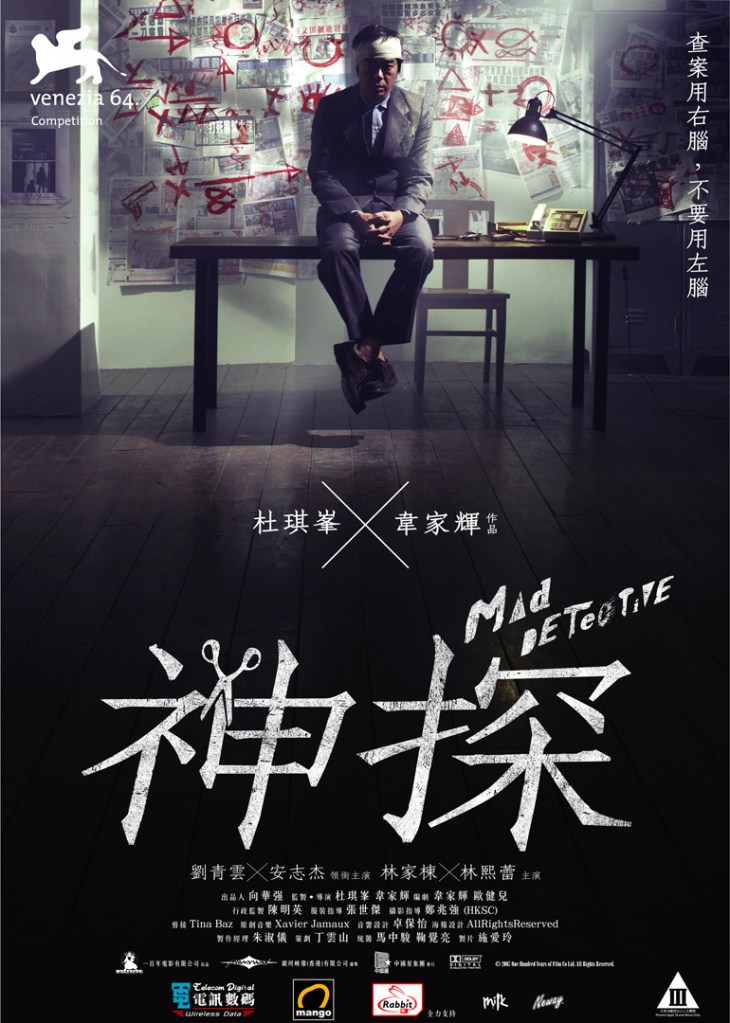
The border between “eccentric” and just “insane” can be quite a thin one but that tiny liminal space of uncertainty is where the hero of Johnnie To and Wai Ka-Fai’s Mad Detective (神探) resides. The titular Mad Detective, Bun (Sean Lau Ching-Wan), is about as unreliable a narrator as they come owing to the fact that he experiences frequent hallucinations and delusions meaning that absolutely nothing of his perception can be taken at face value. Despite his unorthodox approach, Bun is a fine a detective with an almost supernatural crime solving ability but, tragically, sometimes he sees more than he would like of human nature.

The day rookie detective Ho (Andy On) joins the force, he walks in on an unusual scene. Knives and cutting implements are lined up on a table while a pig’s carcass hangs from the ceiling. Veteran cop Bun then enters into the mind of a killer by viciously stabbing the pig carcass (and lovingly caressing it afterwards), before tucking himself inside a suitcase which he asks Ho to throw down the stairs only so he can then leap out and shout “The guy at the ice-cream store did it!”. A montage of newspaper cuttings testifies to Bun’s track record, but his career is over when he suddenly decides to cut off his own ear and present it to his boss at his retirement party.

Not so long after, two cops enter a forrest and only one leaves. That’s one problem, but the missing cop’s gun has been used in a series of robbery/homicides which is another. Exhausting all leads in trying to find out what happened between gun losing Wong (Lee Kwok-Lun) and his shady partner Chi-wai (Gordon Lam Ka-Tung) in a dark forest 18 months previously, Ho turns to Bun despite the misgivings of his colleagues. Bun’s wife begs him not to go back to police work, fearing for both his life and his mental state but Bun would rather live crazy than bored and so it’s back to burying himself alive and chatting with ghosts among other strange pursuits undertaken in the name of law enforcement.

Bun’s major talent is his ability to see people’s “inner personalities” which take the form of personified aspects of their psyches. We see through Bun’s POV as the figures in front of him change without warning – fighting one moment with a lady cop in a men’s bathroom but turning to see an overweight veteran in her place at the next. Bun comes to suspect Chi-wan thanks to his overly complicated personality which has seven different “ghosts” – an amusing sight when they all end up piled into the back of his tiny car. This goes someway to explaining the bemused looks Bun often attracts as he chats with people no one else can see.

Reactions to Bun’s outburst in a convenience store seem like they might just be mild embarrassment at his causing a scene, but could also easily be because he’s shouting at someone who isn’t really there. Whether “real” or not, it’s clear that Bun’s emotional intelligence and ability to read people are key to his crime solving talent. As he later tells Ho, it’s not about logic, it’s about emotion. Through “extreme profiling”, Bun “becomes” the killer, experiencing their emotions to get to the heart of the crime. Bun, like Manhunter’s Will Graham, absorbs too much of the world he sees around him and is unable to reconcile his reality with the commonly accepted one. Quite mad, but also brilliant, Bun’s genius makes him dangerous in a hundred different ways.

To and Wai create doubles and dualities left, right, and centre. Fittingly enough, Mad Detective takes inspiration from The Lady from Shanghai for its shoot out finale which occurs in a house of mirrors. This time it’s not just Bun’s vision which is uncertain even as he can see multiples of ghosting personalities, but ours too as reality fractures into tiny, reflective fragments. Ho, by the film’s conclusion, may have absorbed too much of Bun, but also perhaps of the worst aspects of his profession. Bun’s tragedy is his innocence – he literally sees the bad the in people and tries to exorcise demons through exposing their presence, but Ho’s is cowardice in his refusal to truly look at the people in front of him rather than blindly follow the nearest available leader. A supremely complex and original thriller, To and Wai’s Mad Detective is a fascinating psychological journey constructed with unusual rigour and as oblique and elliptical as it is entertaining.


Original trailer (English subtitles)