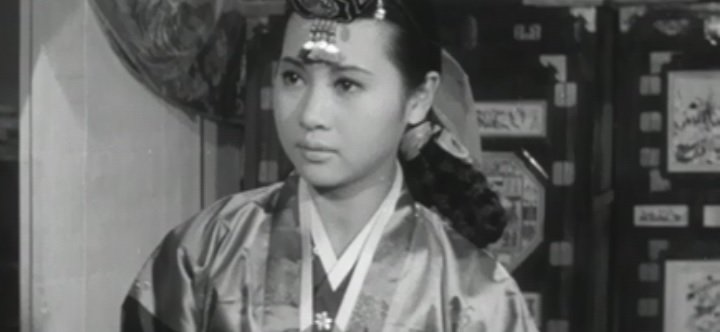
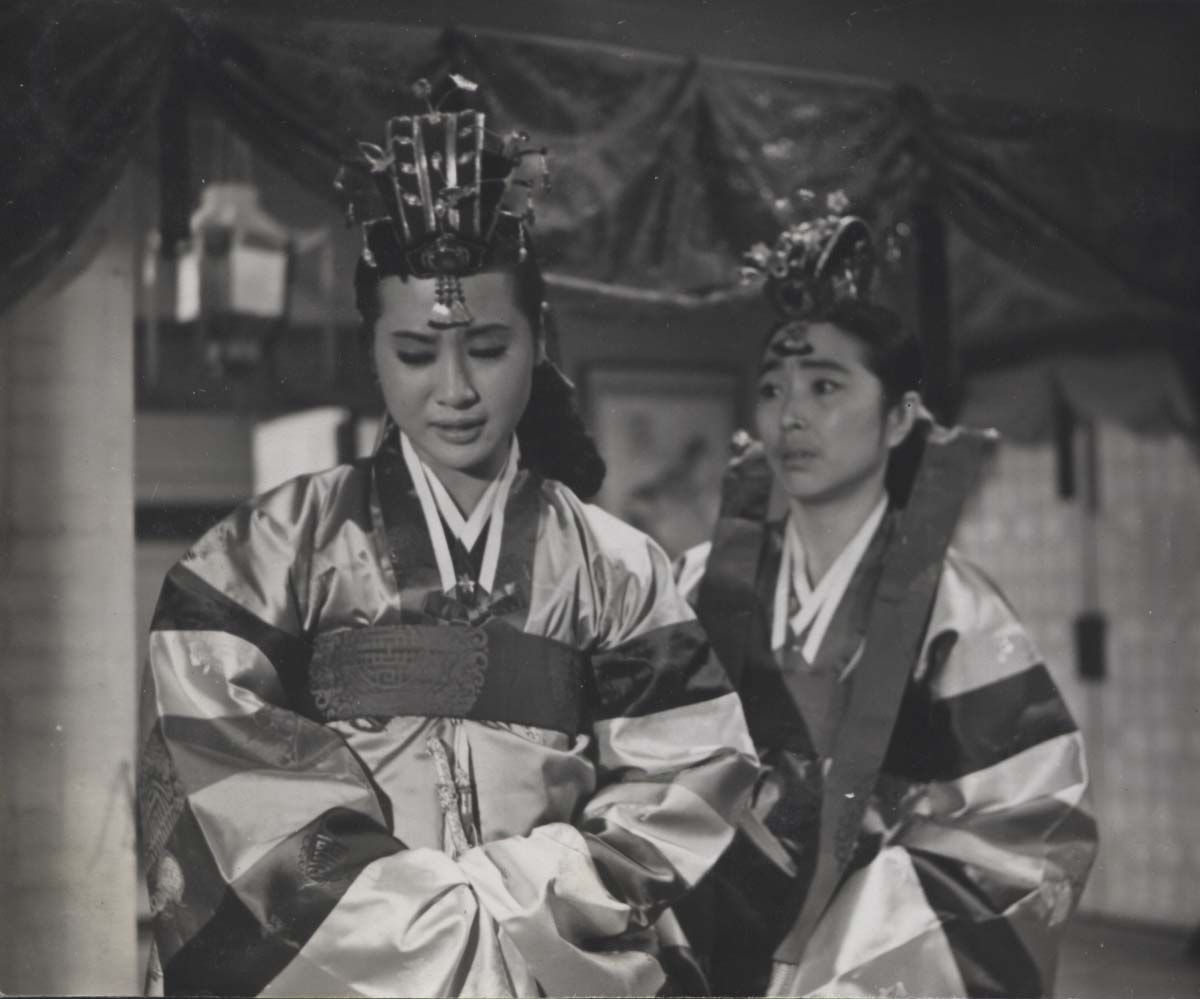
A Princess’ One-Sided Love (公主님의 짝사랑 / 공주님의 짝사랑, Choi Eun-hee, 1967)

“Those are the rules of the palace for a princess” the rebellious heroine of Choi Eun-hee’s second directorial feature A Princess’ One-Sided Love (公主님의 짝사랑 / 공주님의 짝사랑, Gongjunimui Jjaksarang) is told, though the “palace” is really the society and the “rules” those which all women are expected to “endure”. Quietly and perhaps subversively feminist, Choi’s humorous tale draws inspiration from Roman Holiday but unexpectedly engineers a happier ending for its lovelorn heroine who is permitted to transcend the constraints of her nobility if not quite of her womanhood. 

Tomboyish princess Suk-gyeong (Nam Jeong-im) is the youngest of six princesses and the last to remain at home in the palace yet to be married. Consequently, she is infinitely bored all the time and continually up to mischief in part because as a princess she is not permitted to leave the estate and has a natural curiosity about the outside world. That curiosity is further sparked when she lays eyes on handsome scholar Kim Seon-do (Kim Gwang-su) who picks up a shoe she had dropped while inappropriately running on the day of her mother’s birthday celebrations. Possibly the first young and handsome man she has even seen, Suk-gyeong cannot help but be captivated by him and manages to convince her sisters to help her escape the palace to venture in search of her probably impossible love under the pretext of visiting her grandparents whom she has apparently never visited before.  

Like Audrey Hepburn in Roman Holiday, what Suk-gyeong wants is a break from the “tedious and pathetic” life of a princess, but soon discovers herself to be entirely naive as to how the “real world” works. Her sisters agreed to help her in part because they acknowledge how difficult it was for them when they married and had to leave the palace with no understanding of how to live outside it. Having left in the clothes of a servant, the first thing that Suk-gyeong realises is that the outside world is governed by a different set of hierarchies and even if she’s a princess she is still a woman and therefore presumed to be “inferior” to men to whom she is expected to remain subservient. Her grandfather, who has never met her before, wastes no time exerting his patriarchal authority in his own, comparatively humble, home. “A woman, once married, must abide by the rules of her new family, the confucian ethics, and respect your father and husband and become a wise and obedient wife” he explains, striking her across the calves with a cane to teach her a lesson for her imperious tone in failing to pay him the proper respect. 

Failing to use appropriately polite language with those around her, forgetting that she should now be deferent both to men and to those who exceed her in age, gets her into constant trouble. Nevertheless, a trip to the marketplace gains her a further understanding of the extremes in her society firstly when she misunderstands a rice cake seller’s patter and assumes he intended to gift her some of his produce as he might to a princess, and secondly when she bumps into a woman with a baby on her back and breaks the pots she was hoping to sell to pay for her husband’s medical care. Introduced to such desperate poverty, the undercover princess knows not what to do but later gifts her a jade pin hoping perhaps to at least cure the husband’s malady, only to wander into another dangerous situation when she is mistaken for a sex worker by a trio of drunken noblemen who pull her into a drinking establishment which is in fact a brothel. Naively drinking with the men she mocks them for their attempts to play on their names each boasting of their famous fathers and personal connections to men she knows to be elderly cranks and obsequious fools. Shocked to discover what goes in establishments like these she tries to make her escape but is almost assaulted by one of the men, Shim, who is later posited as an ideal match by her unsuspecting mother laying bare another patriarchal double standard as Shim plays the part of the gentleman in order to effect his advancement. Luckily, she is saved by Seon-do who happens to be passing but mistakes her for a boy because of the disguise she is currently wearing. 

Selfish in her naivety, Suk-gyeong is warned that her impossible crush might end up harming Seon-do’s hopes of making it into the elite through success in the state exam while he, once made aware of the truth, immediately does the right thing by kindly rebuffing the princess’ inappropriate interest leaving her with a poetic love letter claiming he’s gone off to a temple for a spell of intensive study. Perhaps improbably it’s the love letter that eventually saves them, touching the king’s heart and convincing him to acquiesce to his sister’s wishes of escaping the gilded cage of nobility. Suk-gyeon’s pleas to renounce her royal title might also stand in for a desire to renounce womanhood in that it “stops us from doing anything we want. We are matched up with an unknown husband and we spend our youths in misery for our lives are tedious and pathetic”, reminding her brother that as a king but in truth as a man he cannot understand even while he reminds her that these are the “rules” endured by countless ancestors. The king is moved, he breaks with tradition and frees his sister yet he does so to allow her to become a wife even if he has also granted her the freedom to choose her husband and live in the outside world unconstrained by the strictures of nobility but nevertheless bound by oppressive patriarchal social codes. Nevertheless, it’s an unexpectedly progressive conclusion advocating for change and personal happiness over the primacy of duty and tradition. 


A Princess’ One-Sided Love streamed as part of the Korean Cultural Centre UK’s Korean Film NightsFilming Against the Odds 

A Bonanza (노다지, Chung Chang-wha, 1961)

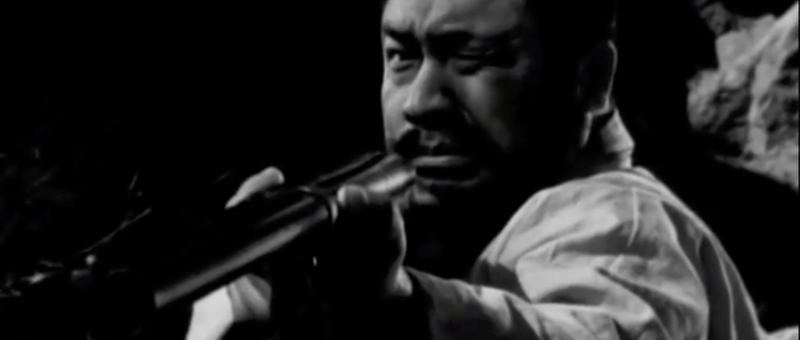
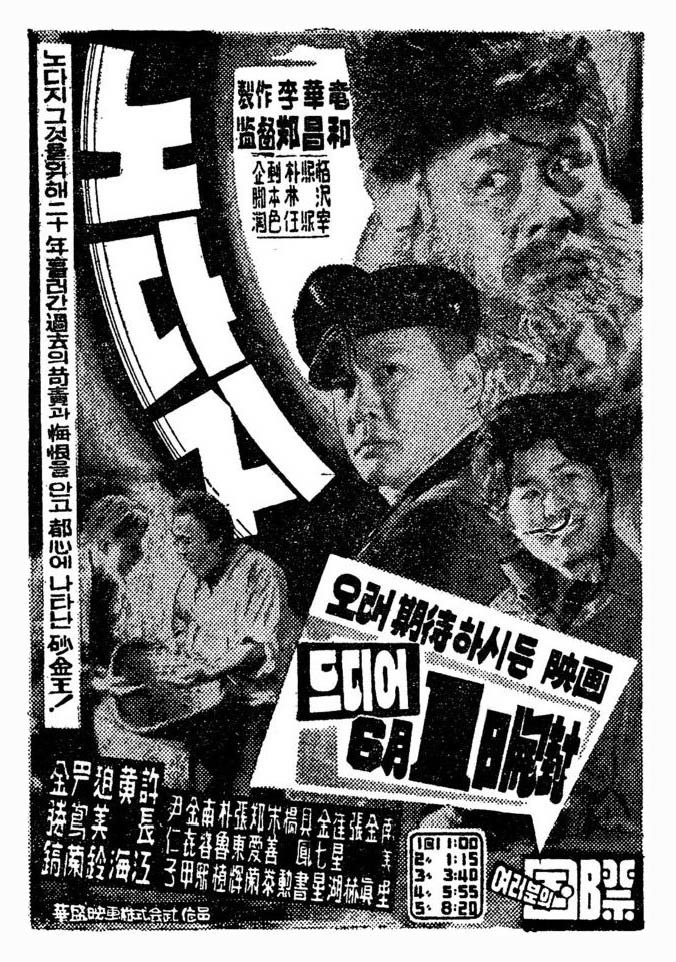
Chung Chang-wha is best remembered as a pioneer of Korean action cinema, eventually travelling to Hong Kong to direct martial arts movies with Shaw Brothers. 1961’s A Bonanza (노다지, Nodaji) arrives at a moment in which melodrama was the predominant genre and does in a certain way conform to contemporary tastes in its strong message of familial responsibility and reconciliation, but is also influenced by European and American crime cinema adding a touch of noir to its clearly delineated worlds of rich and poor which the hero has, perhaps incorrectly, attempted to cross through abandoning his social responsibilities to chase fortune in the wilderness. 

First on the scene, however, is lonely sailor Dong-il (Hwang Hae) who has returned to Busan after a six month voyage. He tries to visit his mother who is working in a restaurant, but finds her cold and unreceptive. We learn that prior to becoming a sailor, he’d been unemployed and embarrassed not to be able to support his ageing mother as a son should. Dong-il’s father apparently went off to the mountains to look for gold 20 years ago and hasn’t been heard from since. His mother has remarried and his step-father appears not to like him very much, so Dong-il’s longed for familial reconciliation seems unlikely to take place. Angrily leaving the restaurant, he punches an old hobo in the street in frustration. 

Unbeknownst to him, the man, Wun-chil (Kim Seung-ho), is like his father a prospector only apparently a lucky one. After 20 years living “like an animal” in the mountains, he’s struck gold and a lot of it. Wun-chil sells some of the gold to an unscrupulous dealer who immediately cheats him and turns out to be partly responsible for the marriage of the woman he loved to a much wealthier man, and thereafter sets about living as a member of the elite, taking a room at a plush hotel the staff didn’t even want to let him into after taking one look at his mountain man attire. A lengthy flashback informs us that after getting his heart broken, Wun-chil married a woman who was fond of him on the rebound but he never loved her and so the marriage floundered while he became a drunk dependent on his wife’s labour picking coal at the railway. Eventually he decided to leave for the mountains with Dong-il’s dad Dal-su (Heo Jang-gang), leaving his wife and baby daughter Yeong-ok (Yun In-ja) behind. Dal-su passed away shortly after they found the gold together and so Wun-chil is keen to track down Dong-il to ensure he gets his dad’s share of the money while also hoping to reunite with Yeong-ok. 

The gold becomes a corrupting influence in Wun-chil’s life. He has been away 20 years and no longer has any friends while those he makes after becoming rich cannot exactly be trusted. The unscrupulous jeweller has him splashed all over the papers where he talks about his desire to find Dong-il and Yeong-ok, causing a series of imposters to appear claiming to be the long lost children as well as one fake detective offering to find them. When Dong-il eventually finds Wun-chil himself, Wun-chil has all but given up and chosen to self isolate to protect himself from the virus of greed and so doesn’t believe Dong-il is who he says he is. 

Meanwhile, he’s consumed by a sense of guilt and regret in his abandonment of his family and failure as a man to behave honourably towards the woman that he married. We discover that the motivation for Dal-su and Wun-chil to go into the mountains was less economic than romantic. Dal-su’s wife had apparently left him and he hoped to win her back after getting rich, while Wun-chil was still smarting from the loss of the woman he loved to a wealthier man and thought he could gazump him by happening on a gold mine. On his deathbed, Dal-su is sure his fate is payback for the abandonment of his family, while Wun-chil’s guilt runs still deeper. His wife was eventually killed in a rail accident while he was away, leaving Yeong-ok all alone, eventually taken in as a servant and exploited by a wealthy family. Wun-chil came and got her back, but was unable to care for her, eventually tying her to a tree and walking off which is why he has no idea if she is alive or dead. 

Yeong-ok (Um Aing-ran) appears to have survived but has been further corrupted as a member of a vicious street gang, seducing men in the street and then mugging them at knife point but beholden to her boss, Hwang Hog (Park No-sik), who more or less owns her in return for the investment he has made in feeding her. In the course of her activities she encounters Dong-il who heroically fends off her attempt to rob him and prompts her into a reconsideration of her way of life. The youngsters hit it off and begin to fall in love, especially once they discover their shared trauma as children essentially abandoned by irresponsible fathers who ran off to look for gold and never came back. 

Of course, their tripartite destinies eventually converge as the gang sets its sites on Wun-chil’s millions while he starts to reflect on the meaninglessness of wealth when you actually have it. He finds himself wandering down to the railway tracks and observing the other women working there in memory of his late wife, slipping a bundle of notes inside the blanket of a baby on its mother’s back and handing more cash to those he passes on his way. That does not mean, however, that he’s willing to surrender his gold which is why he kicks off when he discovers the map to the mine and all his money has been stolen from the hotel. Culminating in a tense shootout between the righteous forces of Dong-il picking up his father’s gun, a regretful Wun-chil hoping to reunite with Yeong-ok, and the gang he hopes to free her from, the battle is not so much over the money but for Wun-chil’s frustrated paternity. Vanquishing the greedy, the family is in a sense restored as Wun-chil vows to become a “good father” to Yeong-ok, embracing Dong-il as a potential son-in-law as the kids support the wounded patriarch back towards civilisation and a presumably happier future. 


A Bonanza is available on DVD courtesy of the Korean Film Archive in a set which also includes a bilingual booklet featuring writing by Park Sun-young (Research professor, Center for Korean History at Korea University). It is also available to stream online via the Korean Film Archive’s YouTube Channel.

A Coachman (馬夫 / 마부, Kang Dae-jin, 1961)

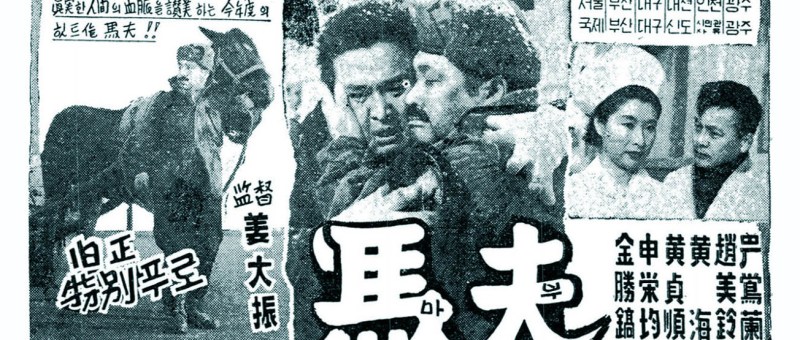
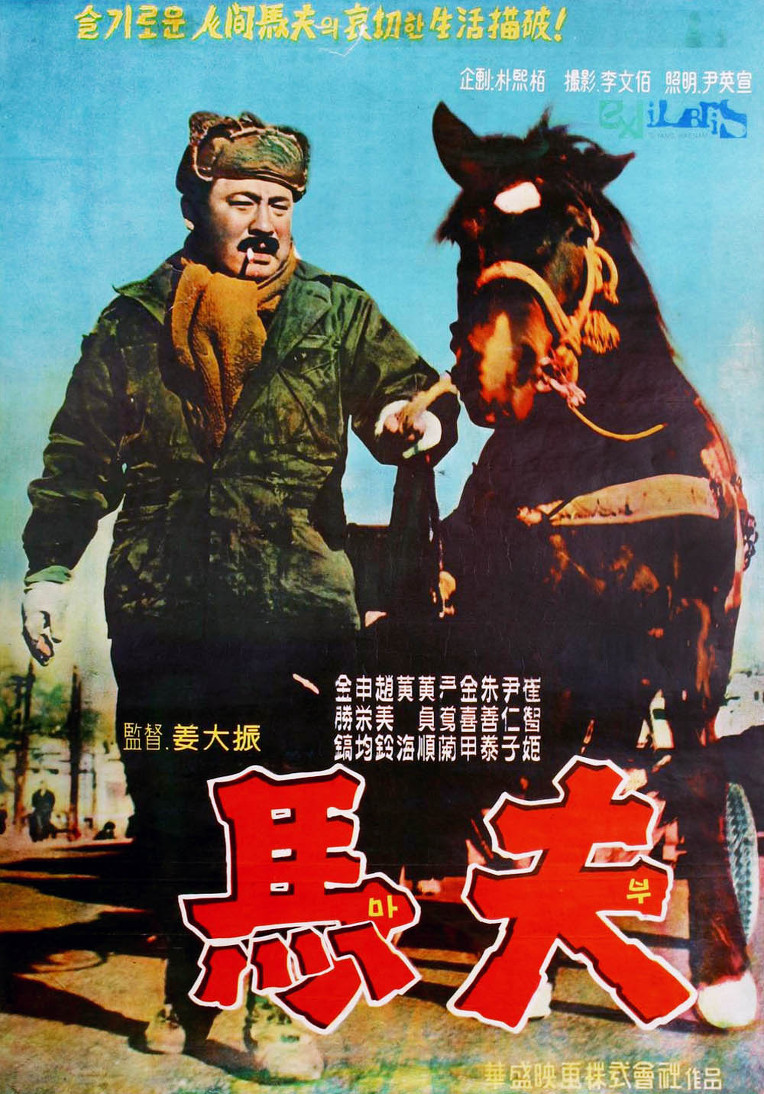
A coachman poster 1The Korea of 1961 was one of societal flux, mired in post-war poverty but striving towards a brighter economic future. The rising tides of affluence had given birth to a new middle-class with the old feudal attitudes while others were largely left behind on the shores of prosperity. Kang Dae-jin’s A Coachman (馬夫 /마부, Mabu), the first Korean film to win a major international award with the Silver Bear Extraordinary Jury Prize at the 1961 Berlin Film Festival, finds itself at just this juncture as an old man pulling a horse and cart is forced to face up the automobile age while worrying what is to become of his family in the perilous modern society.

Ageing patriarch Chun-sam (Kim Seung-ho) has been guiding a horse and cart since his father died in Manchuria when he was 14. Technically speaking, he is not the owner of his horse, Dragon, but operates it on behalf of the owner, the mistress of an upper middle-class salaryman. As business is slow, she is always threatening to sell the horses which would leave Chun-sam and the other coachmen without a means to support themselves. Meanwhile, Chun-sam’s four children whom he raised alone after his wife passed away at a young age are each looking for different ways out of their impoverished existence. Chun-sam married off his eldest daughter Ok-nyeo (Jo Mi-ryeong) who is deaf and mute to a man he saved during the Korean War but he is abusive and treats her like a servant while openly inviting his mistress into their home. Oldest son Su-eop (Shin Young-kyun) is currently studying to retake the bar exam for the third time, middle daughter Ok-hee (Um Aing-ran) has begun dating a shady salaryman, and youngest boy Soo-up has become a high school delinquent.

Kang opens with an exciting sequence following Soo-up who has attempted to steal a bicycle as he tries to escape from its owner chasing him. Returning home covered in mud, slowing to a walk and putting his student’s cap back on to avoid suspicion, he makes his way from the modern houses of the new city back through traditional Korean homes towards his rather makeshift family abode which they share with the horse stabled in a side room. Chun-sam is obviously not a wealthy man, but the family bear their struggles with fortitude, perhaps to some extent avoiding each other but rarely arguing directly. Even the news that Ok-hee has once again quit her latest job, working in a cafe, in record time is greeted with exasperated acceptance rather than anger or resentment.

Ok-hee quit the cafe to fall in with her ultramodern friend Mi-ja (Choi Ji Hee) who has arranged a double date with a pair of sleazy executives, telling them that Ok-hee is a university graduate and daughter of a wealthy CEO. Intensely ashamed of her working class background as a mere coachman’s daughter, Ok-hee tries to catapult herself into the middle classes by weaponising her sex appeal, too proud to take the long way round through honest work. She rejects the attentions of family friend Chung-soo (Hwang Hae) who is good and kind because he is only a driver, taking little notice of his earnest warning that nothing good ever comes of hanging around with shady types like her boyfriend. He keeps trying to persuade her to take a job in a nearby factory, but she still thinks she’s above that kind of life and is convinced she can get the executive to marry her.

Chang-soo’s interest is of course romantic, but the advice he gives her is honest and altruistic. Unlike his unsavoury money lender father, Chang-soo is a salt of the earth type, but good men are hard to find and trying to escape poverty through marriage is a road fraught with danger as Ok-nyeo discovers. Chun-sam thought he’d done the right thing in marrying her off, believing a match would be hard to come by because of her disability and worrying she’d be left alone with no-one to look after her, but she is forced to endure mistreatment and humiliation at the hands of her husband. Ok-nyeo repeatedly returns to her family home, only able to show them the bruises to explain what’s happening, but Chun-sam always sends her back unable to break with the old patriarchal rules which insist that once married she must forever remain this man’s wife.

Chun-sam faces a similar dilemma of his own when he strikes up a tentative relationship with the kindly maid at his boss’ mansion who often heats up rice wine for him and goes out of her way to give him little treats. The odious moneylender is also after Suwon (Hwang Jung-seun) who is considered “old” to be unmarried at 37, but she favours Chun-sam because, as she says, she has always known him to be a “good man”. The “courtship”, if you could call it that, is innocent in the extreme with Suwon largely taking the lead while Chun-sam lags bashfully behind, childishly excited but also embarrassed because he cannot afford a wife and would be ashamed to ask her to share his life of poverty.

Looked down on by everyone, Chun-sam is forced to go cap in hand to his employer where he is made to “know his place” and reminded he is “just a coachman” with no right to talk back. When Hwang, the boss’ lover, injures Chun-sam through reckless driving, Su-eop becomes fed up with persistent feudalism and intends to have a polite word but is quickly shut down, reminded that he is nothing more than coachman’s son and told that his dreams of becoming a lawyer are not only unrealistic but an offence to the social order.

Su-eop alone takes the conventional route out of poverty in pursuing education and a steady government job, but is repeatedly told that he’s getting above himself and should be content with becoming a coachman like his dad, despite the fact that being a coachman is already close to an obsolete profession given the increasing affordability of the motorcar. He alternates between guilt and despair, wondering if he’s being irresponsible in pinning all his hopes on the bar exam and worrying that he’s not doing enough to support the family.

Yet Chun-sam, forced to consider his own obsolescence, is keen for him to succeed, not only because the family needs him to make a success of himself but because he wants his son to have a better kind of life than he had taking full advantage of the possibilities of the new society. Though their lives are hard, Chun-sam and his family remain kind and honest (even Ok-hee and Suo-up eventually conclude that hard work is the way after all), bonding with others of the same mindset like the maid Suwon who eventually quits her job in protest, and Chang-soo who rejects his father’s underhanded venality for simple human decency. United by friendly solidarity, the family is repaired and resolves to live on as a tiny unit of cheerful resistance against the feudalistic greed and selfishness of the modern society.


A Coachman was screened as part of the 2019 London Korean Film Festival.