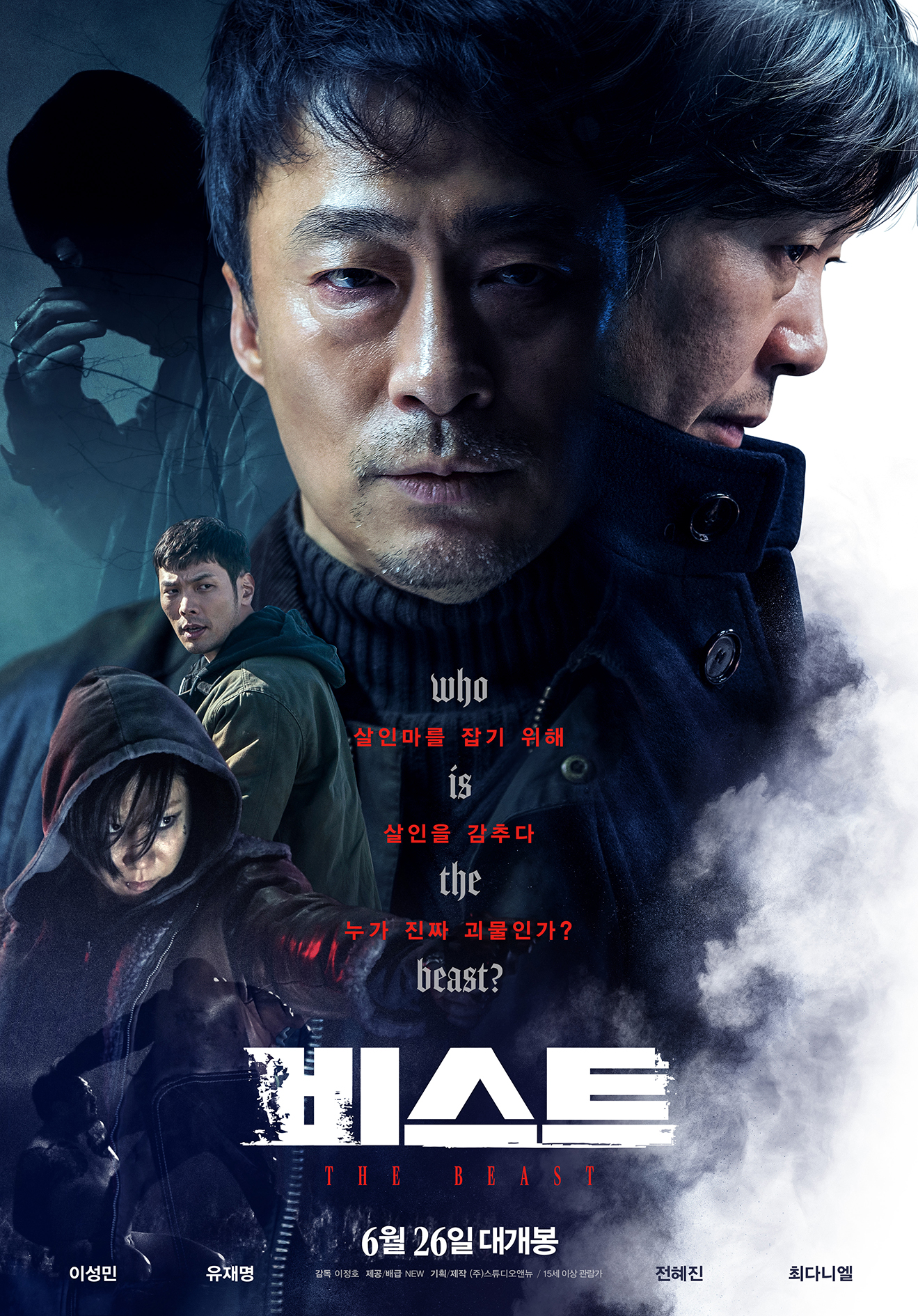
The Beast (비스트, Lee Jung-ho, 2019)

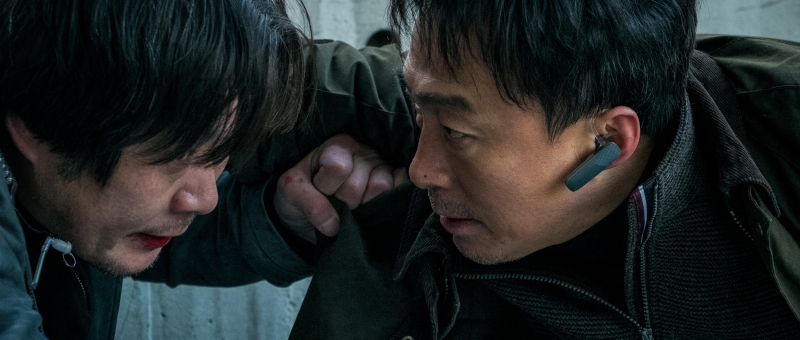
Internal police politics frustrate the hunt for a potential serial killer in Lee Jung-ho’s dark social thriller, The Beast (비스트) inspired by Oliver Marchal’s 36 Quai des Orfèvres. As a pathologist suggests, we all may have a hidden beast and it’s certainly true of the film’s conflicted protagonist, thuggish policeman Inspector Jung (Lee Sung-Min) who finds himself dragged ever deeper into a mire of corruption as a natural result of a series of bad decisions that started long ago, while his rival, Captain Han (Yoo Jae-Myung), presents the facade of efficient modern policing but inevitably turns out to be little better. 

As the film opens, Jung and his subordinate Yang are each wearing balaclavas while driving a heavily tattooed man out into the middle of nowhere though only for the purposes of frightening him so that he’ll back off their informant, local bar owner Madame Oh (Kim Ho-jung). Jung’s inner conflict is palpable as stares at his bloodied, shaking hands asking himself how it is it’s come to this while Yang later reminds him not to become too attached to his sources because once they’ve exceeded their usefulness they’ll simply be arrested. While all of this is going on, the police force is under immense pressure and receiving a lot of negative press over their handling of the case of a missing teenage girl, Mi-jin. Unfortunately, the girl later turns up dead with the murder enquiry split between two teams, those of Jung and Han each of whom are in the running to take over from the superintendent who before all of this happened was about to be promoted which is why he is desperate to solve the case as soon as possible. 

It might at first be tempting to read Jung and Han as representatives of different kinds of policing with their rivalry representing a battle for the soul of the police force only as it turns out each is merely corrupt in their own way. Jung is very much of the jaded veteran cop school, wanting to shift the case off his books as soon as possible by pushing the most likely suspect to confess. In this case that’s a shady pastor at a church Mi-jin used to frequent who was found in possession of her underwear and a series of photos of very young girls. Jung pushes the pastor to “confess” by selling him a story that a woman he was accused of assaulting in university took her own life as did her mother while her father later developed cancer as a result of all the stress and tragedy. Of course the pastor breaks down insisting that he killed her and it’s all his fault, only he’s talking about the other girl not that Jung cares too much about that. Han meanwhile quickly exonerates him by doing actual investigating, but only really so that he’ll still be in the running to solve the case and get the big promotion thereby besting his former partner turned rival. Jung had been the first to mention the possibility of an active serial killer only to be shut down because that would mean they’d lose the case to Major Crimes and therefore the personal opportunities for career advancement solving it would present. 

Both men eventually end up at the showdown by each of their respective routes implying there’s little practical difference between them. Han jeers that he can’t tell anymore if Jung is a bad guy or a cop but all he can answer is that it might be a matter of perspective, while he is also aware of Han’s backdoor deals and willingness to compromise himself in order to win advancement. In the midst of all this jockeying for power, it gets forgotten that a young woman lost her life in the most heinous of ways while whoever really did it may still be out there looking for the next girl to torture and kill. Everyone may indeed have a beast inside them, Jung already acquainted with his in his morally compromised soul while Han battles his internal ambition but the real beast may be the contemporary city and the infinitely corrupt hierarchies of the modern Korea along with the toxic masculinity that forces these men to betray their ideals simply not to be accounted a failure trapped at the bottom of the pyramid by their own problematic righteousness. When they’ve served their usefulness, the system chews them up and spits them out but until then it’s only hanging on as long as they can in the utter futility of a morally bankrupt existence. 


International trailer (English subtitles)

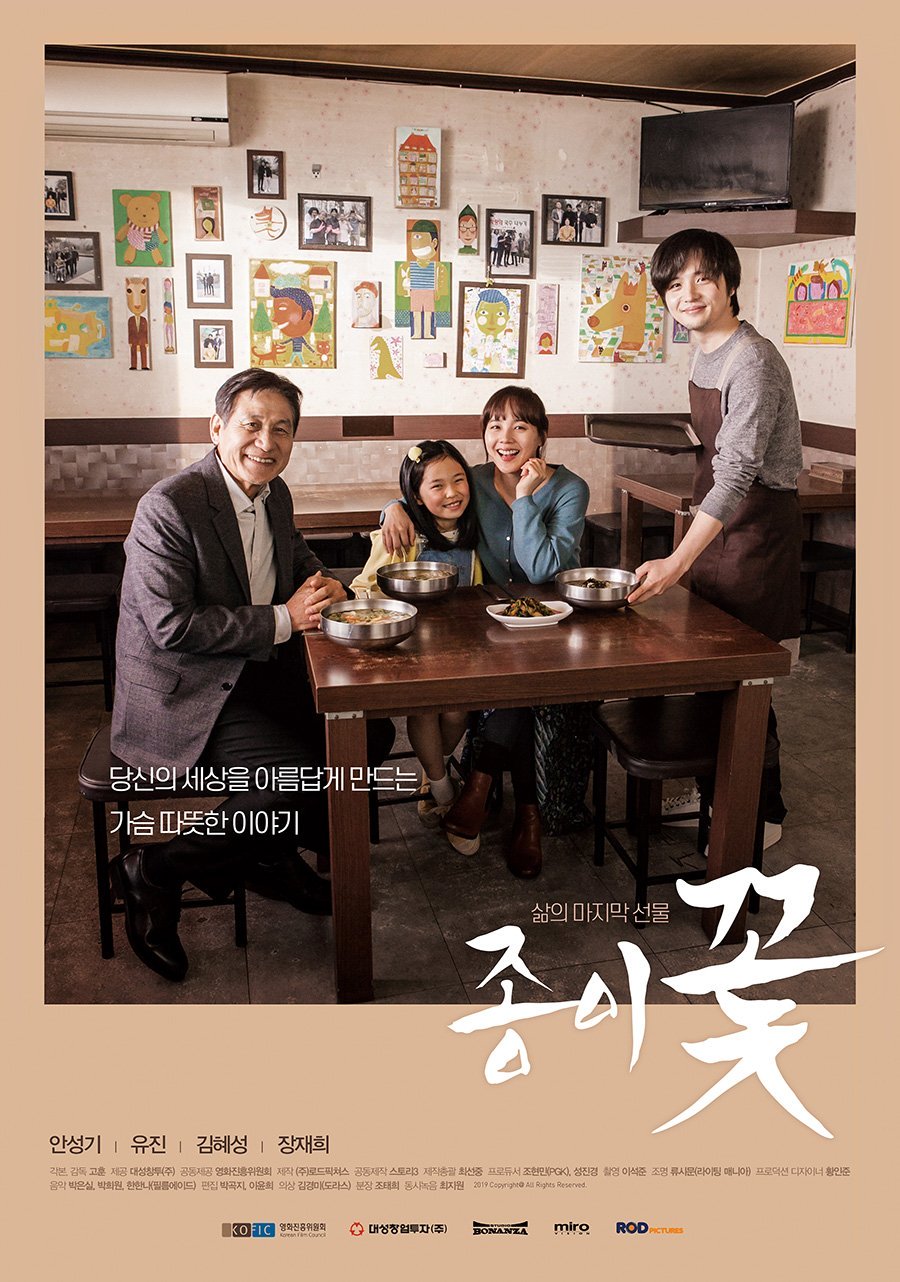
Paper Flower (종이꽃, Koh Hoon, 2019)

Rich or poor, we’re all the same when we die, according to dejected funeral director Sung-gil (Ahn Sung-ki). A mild rebuke on the heartless corporatism dominating contemporary Korean society, Paper Flower (종이꽃, Jongikkot) looks for beauty even in the depths of despair, but is unafraid to admit that the world has its ugliness too as its twin protagonists practice entirely contrary reactions to the traumatic past. While a single mother on the run fills her life with joy and light, Sung-gil struggles to hold on to his principles while never quite as cynical as the years have conspired to make him seem. 

Sung-gil’s problem is that his funeral business has run into trouble now that a conglomerate has entered the marketplace providing a more convenient, modern service which vastly undercuts his own. He’s been stubbornly holding out, but his rent is long overdue and his landlord’s getting antsy, meanwhile he’s also responsible for the care of his paralysed son Ji-hyuk (Kim Hye-seong) whose carers keep quitting because he keeps attempting suicide and generally makes their job as difficult as possible. All things considered, Sung-gil has no option other than to become a franchisee of the enemy conglomerate, Happy Endings. 

Across town, single mother Eun-sook (Kim Yoo-jin AKA Eugene) is facing a similar problem in that she’s just been unceremoniously let go from her cleaning job despite being promised a year’s contract because the company decided to outsource to a conglomerate who didn’t want to keep her on. Meanwhile, she’s also being pursued by men in suits handing her court orders which say that she has to go into “rehabilitation” as soon as possible or the order will be forcibly enforced. Overdue on her rent, she hopes to evade them by doing a flit, moving into the vacant apartment opposite Sung-gil’s with her small daughter No-eul. The pair are warned about the bad tempered old man next-door and quickly find out for themselves when he grumpily complains about their moving boxes cluttering the hallway but Sung-gil still needs someone to look after his son, and Eun-sook needs a job, so the obvious solution presents itself. 

What Sung-gil couldn’t have expected, however, is the light that Eun-sook brings into his home. We can infer that she’s had a difficult life, the prominent scar along her jaw proving a cause for concern at the job centre, but unlike Sung-gil and his son she remains unrelentingly cheerful, determined to find the tiny moments of joy in the everyday precisely because she’s known what it is to be without them. Her daughter No-eul is much the same, hilariously unfiltered and prone to asking the most inappropriate of questions with childlike innocence, but eventually bonding with the gruff Sung-gil after she pays his bus fare when he comes up short and he teaches her a few lessons about the funeral business. 

Sung-gil’s greatest crisis, however, arrives when a local man who’d been a hero to the homeless in operating a restaurant which became a point of refuge offering free noodles to anyone who needed them no questions asked, suddenly dies. Like Eun-sook and Sung-gil, Jang (Jung Chan-woo) also suffered at the hands of an increasingly capitalistic society, dropping dead while being pressed by a greedy landlord. Because Jang had no family and no named next of kin, no one is permitted to claim his body. The authorities send him to Happy Endings, which is where Sung-gil comes in, but the company resent having to deal with a case of death by poverty, instructing him to dispose of the body as quickly as possible. Even if Jang had no legal “family” he had a community who loved him and wanted to say goodbye even if they didn’t have the money to reclaim the body or give him the proper send off. Sung-gil remains conflicted. He believes Jang should be treated with dignity in death and that his friends should have the right to pay their respects, but he’s already in trouble for working with too much care and needs to make sure his contract is extended so he can pay his rent and look after Eun-sook. 

Jang’s friends want to have a public funeral in the local square where many of them first met him at his noodle stand, but that presents a problem for the local council who are in the middle of a clean streets campaign and trying to win the right to host Miss World in the hope of boosting the local economy. The authorities are very interested in “dealing” with “the homeless” but not at all with the issue of homelessness which is only exacerbated by their increasingly heartless social policies. Of course, they make a good point, somebody somewhere has to pay, but Sung-gil remains conflicted, originally opting for a kind of compromise but finally pushed towards reconsidering the source of his own trauma which turns out to have a curiously symbolic, national quality that encourages him to think that perhaps it is time to take a stand against this worryingly inhuman obsession with margins and conviction that nothing is worth anything if it can’t be monetised. Moved by Eun-sook’s sunniness which eventually gives new hope to the dejected Ji-hyuk, he begins to find the strength to fight back, masking the darkness with paper flowers in defiance of those who would say that some lives aren’t even worth that.


Paper Flower screens at Chicago’s Davis Drive-In on Sept. 10 as the opening night presentation of the 11th season of Asian Pop-Up Cinema.

Original trailer (English subtitles)

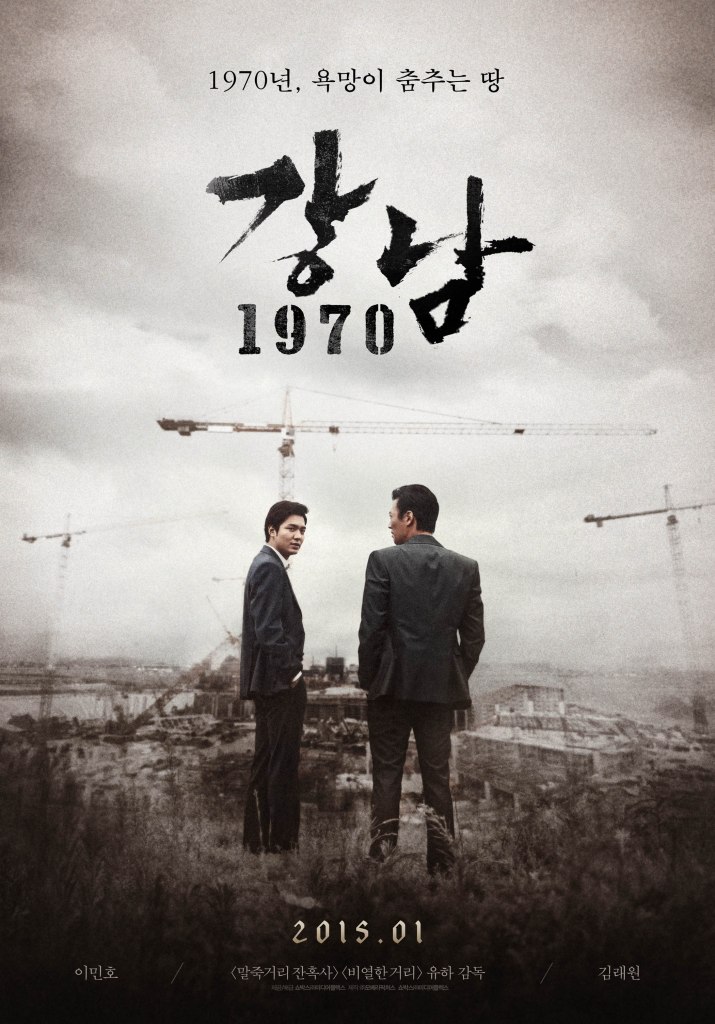
Gangnam Blues (강남 1970, Yoo Ha, 2015)

gangnam-bluesYoo ha takes us back to the 1970s for some Gangnam Blues (강남 1970, Gangnam 1970) in a sorry tale of fatherless men caught up in dangerous times of ambition and avarice, very much at the bottom of the heap and about to be eclipsed by the “new world” currently under construction. Back then, Gangnam really was all just fields, owned by farmers soon to be cheated out of their ancestral lands by enterprising gangsters engaged in a complicated series of land grab manoeuvres, anticipating the eventual expansion of the bursting at the seams capital. Far from the shining city of today, Gangnam was a wasteland frontier town, the sort of place where a man can make a name for himself trading on his wits and his fists alone.

In 1970, Jong-dae (Lee Min-ho) and Yong-ki (Kim Rae-won), sworn brothers from the same orphanage, are two street rats trying to survive in straightened times. When the shack they were squatting in is demolished and they come in to contact with a petty gangster, Kang (Jung Jin-young), the pair end up getting a one off job as thugs sent to smash up a political rally but get separated when the police arrive. Jong-dae finds himself taken in by Kang and his daughter Seon-hye (Kim Seol-hyun AKA Seolhyun) as a surrogate son and brother, repaying their affection by saving Kang’s life during an assassination attempt which later prompts his decision to retire from the criminal world altogether. Yong-ki joins the rival gang instead and seems to be making a success of himself but both find themselves at the mercy of an increasingly corrupt, dishonourable system hellbent on progress but only for the few.

Gangnam Blues has an overly complex, intricate narrative overlaying the generic brotherhood and betrayal theme that runs through the film. Dipping into a particularly dark period of history, Yoo is not afraid to step back into those difficult days marked by both rapid progress and increasing inequality furthered by complicated systems of interconnected corruption. The gangsters are at the service of the politicians but it’s always debatable who is running the show. Jong-dae’s participation in the land grab scheme is painted as amusing cleverness (at least at first) but little attention is paid to the farmers who are being “convinced” to sell their land off cheaply to gangsters who are each competing for the prime sections. Modern day Gangnam was built on blood and extortion, by men like Jong-dae and Yong-ki, even in the knowledge that they will be discarded as soon as their usefulness has been exhausted.

Jong-dae and Yong-ki are the bottom of the pile, orphaned and without family connections they have only each other to rely on yet their brotherly bond is repeatedly tested. The ‘70s Philippine folk song, Anak by Freddie Aguilar, which forms the film’s major musical motif has some very poignant lyrics about parents and their children but neither Jong-dae nor Yong-ki are able to find the kind of family they’re looking for. Both end up opting for the fraternal bond of a crime syndicate to replicate the kind of support usually offered by the family unit with Jong-dae finding a father figure in Kang who eventually takes him into his household as a son outside of the criminal world, and Yong-ki eventually marrying and soon to become a father himself. Forced into crime by their poverty, each becomes an outcast, permanently shut out from the thing they most want even whilst living a life of material comfort.

Yoo opts for a highly stylised approach filled with beautifully photographed, expertly choreographed scenes of violence including the traditional mass brawl in the rain, and a sequence of intercut killings each artfully sprayed with blood. Lee Min-ho acquits himself well enough in his first leading role as the noble hearted gangster Jong-dae with quality support from Kim Rae-won as the much less noble Yong-ki though the superfluity of secondary characters leads to an avoidable lack of depth. Relative newcomer Kim Seoul-hyun also does well with her underwritten role of the film’s most tragic character even if her domestic violence themed subplot seems like one too many. Another classic slice of gangster action from Korea, Gangnam Blues is an unflinching look back at a difficult era with uncanny echoes of the present day, and a suitably period tinged tale of melancholy ‘70s bleakness in which brotherhood and honour are merely words misused by men trying to justify their own ambitions.


International trailer (English subtitles)
Freddie Aguilar’s Anak as featured in the film: