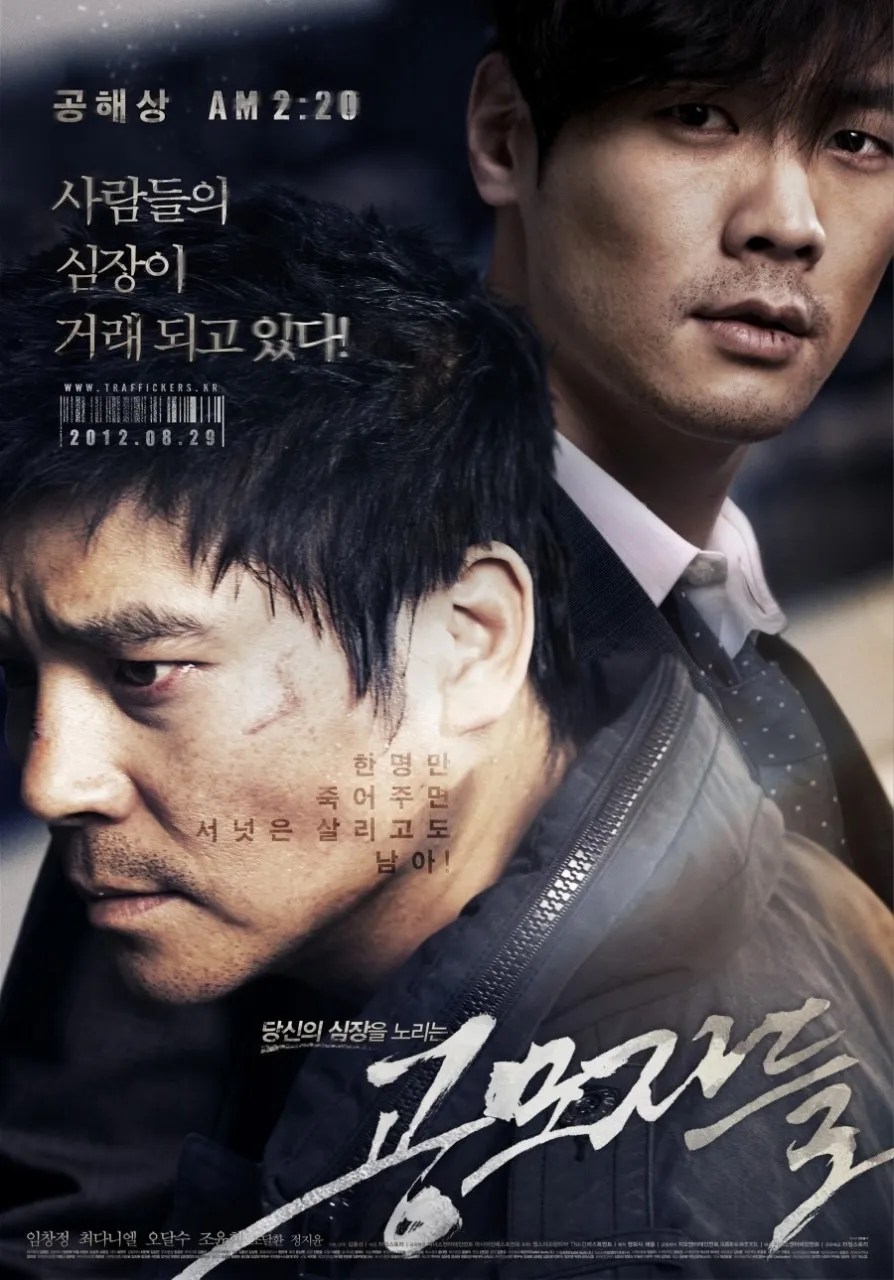
Traffickers (공모자들, Kim Hong-sun, 2012)

The one with money and power wins. The ones without it lose everything they’ve got. In many ways, it’s the overriding message of contemporary Korean cinema, but the words take on an even darker hue when uttered by the villain of Kim Hong-sun’s illegal organ transplant drama, Traffickers (공모자들, Gongmojadeul). The film’s Korean title, Conspirators, hints at the ways that this world reduces everyone to one degree or another to something less than human as they chase often small dreams of health, comfort, and happiness, in which the central conspiracy comes to stand in for a world ruled by power and money.

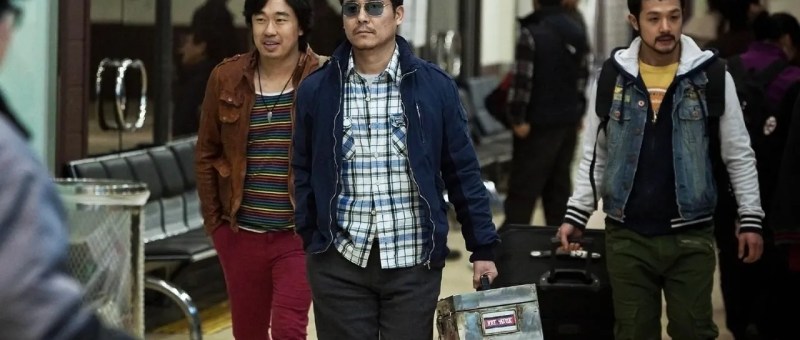
Young-gyu (Im Chang-jung) used to be an organ trafficker, but gave up that side of his business when his best friend was killed by a victim who woke up unexpectedly and tried to escape. Since then, he’s smuggled moderately less inhuman things and has developed a crush on a young woman who works on the ticket counter at the port. Yu-ri (Jo Yoon-hee) has a sick father who needs a transplant, but the one was lined up for is cancelled at the last minute apparently because she neglected to inform them of an issue which gave them an excuse to pull out in what seems to be a suggestion that the list is being manipulated. Fearing her only option is the black market, Yu-ri is in desperate need of money and turn to one of Young-gyu’s acquaintances, the leader of a Chinese gang. To get her the money Young-gyu decides to pull one last job, but soon finds himself in over his head as his new target turns out to have a connection to his past.

The film never really goes into Yu-ri’s decision get her father a black market transplant but rather focuses on her desperation as someone who has been frozen out of the legitimate system which itself already prioritises those with means to fight for better or more efficient treatment. It’s not clear if she is aware that the organ may come from someone who has been killed deliberately for that purpose, or if she knew but decided her father’s life was more important than theirs. Nor is it clear if she’s thought through the repercussions of indebting herself to gangsters for some of whom organ harvesting is just another means of debt collection. In any case, all she really cares about is saving her father and it seems she is willing to do whatever that takes. 

To that extent, what they prey on is desperation. The gangsters don’t expect their victims to ask too many questions, because this is all illegal anyway and they’re already at their last resort to save a loved one’s life. That said, it seems strange that they would choose Chae-hee (Jung Ji-yoon), a young woman who uses a wheelchair and thinks she’s just going to China on holiday, who is travelling with her husband, to be their next victim given that there is obviously someone who is going to be looking for her. They generally assume most of their other victims won’t be missed and write them off as those of little consequence swallowed by a dog-eat-dog world. It seems that part of the gangster’s motivation is that they don’t want to become victims themselves so have chosen the path of violence and inhumanity. 

But despite his occupation, Young-gyu is conflicted about the bloodiness of his work and on realising that he has a connection to Chae-hee begins to want to save her while equally wanting to save Yu-ri and her father. The traffickers have, however, sold them all false promise in that it’s mainly the people who were trying to buy transplants that end up becoming victims and it’s not actually clear who is getting any of these organs until a final suggestion that they’re actually going to rich people in Korea who wanted to jump the transplant queue, meaning people like Yu-ri and and her father lose out twice over. Organ trafficking works hand in hand with life insurance scams looking to make money off human misery while rich elderly men buy the blood and organs of young ones in a kind of human sacrifice they think will return their youth and and vitality in an one the nose metaphor for how the older generation oppresses the young. In this bleak and nihilistic world, the film suggests that its villain was right. The ones with money and power win, while those without are quite literally consumed and exploited by a corrupt and inhuman system. 


Trailer (English subtitles
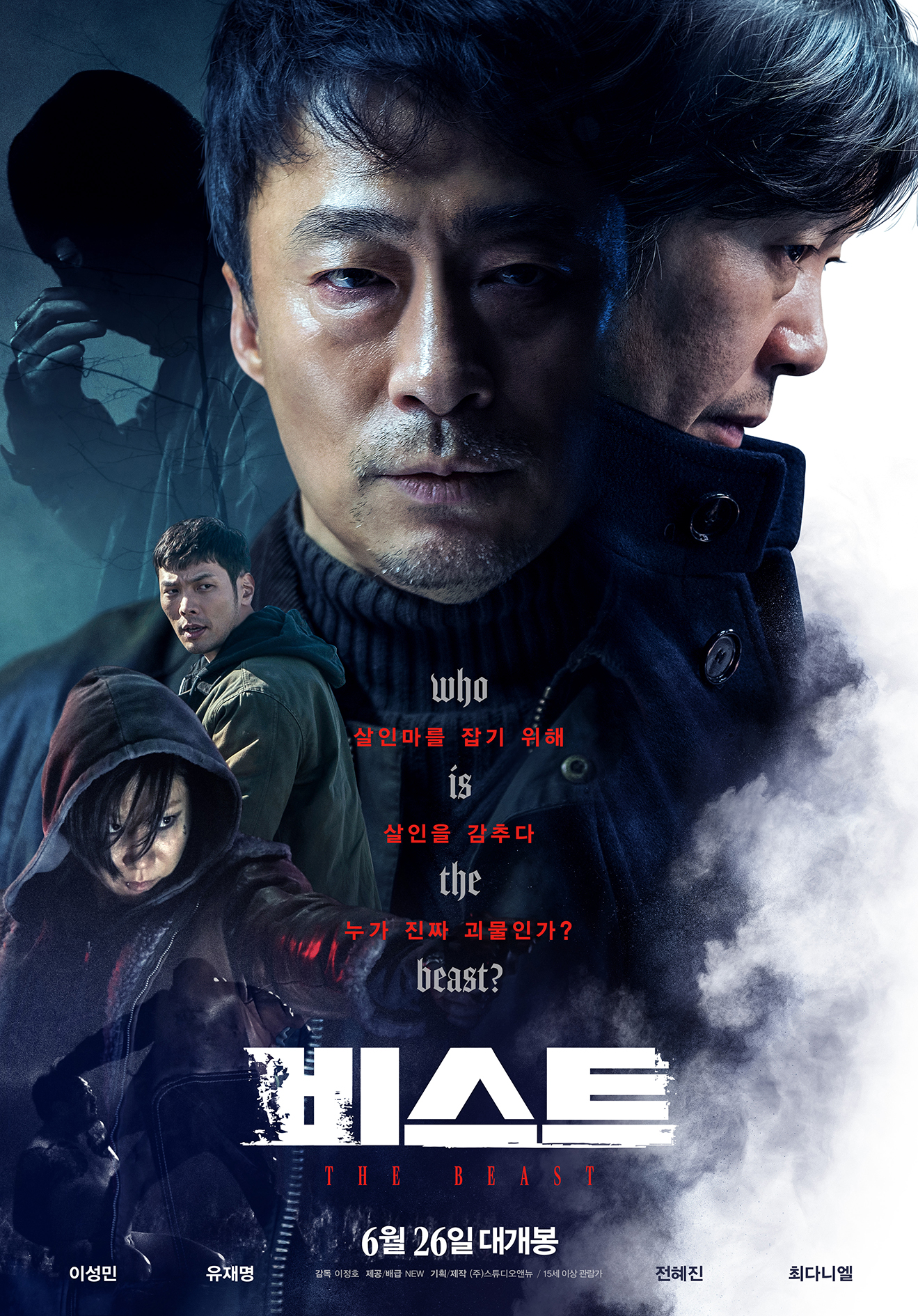
The Beast (비스트, Lee Jung-ho, 2019)

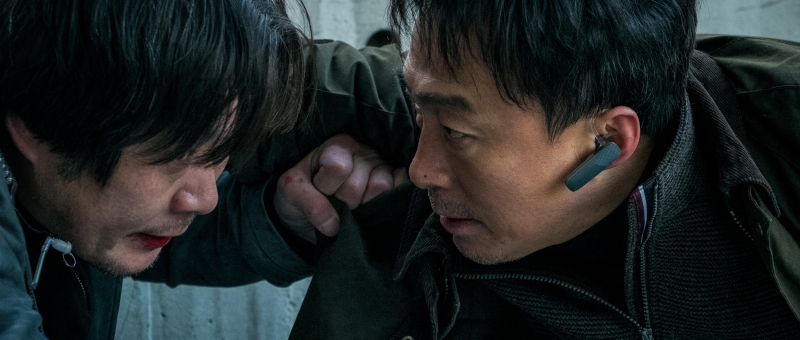
Internal police politics frustrate the hunt for a potential serial killer in Lee Jung-ho’s dark social thriller, The Beast (비스트) inspired by Oliver Marchal’s 36 Quai des Orfèvres. As a pathologist suggests, we all may have a hidden beast and it’s certainly true of the film’s conflicted protagonist, thuggish policeman Inspector Jung (Lee Sung-Min) who finds himself dragged ever deeper into a mire of corruption as a natural result of a series of bad decisions that started long ago, while his rival, Captain Han (Yoo Jae-Myung), presents the facade of efficient modern policing but inevitably turns out to be little better. 

As the film opens, Jung and his subordinate Yang are each wearing balaclavas while driving a heavily tattooed man out into the middle of nowhere though only for the purposes of frightening him so that he’ll back off their informant, local bar owner Madame Oh (Kim Ho-jung). Jung’s inner conflict is palpable as stares at his bloodied, shaking hands asking himself how it is it’s come to this while Yang later reminds him not to become too attached to his sources because once they’ve exceeded their usefulness they’ll simply be arrested. While all of this is going on, the police force is under immense pressure and receiving a lot of negative press over their handling of the case of a missing teenage girl, Mi-jin. Unfortunately, the girl later turns up dead with the murder enquiry split between two teams, those of Jung and Han each of whom are in the running to take over from the superintendent who before all of this happened was about to be promoted which is why he is desperate to solve the case as soon as possible. 

It might at first be tempting to read Jung and Han as representatives of different kinds of policing with their rivalry representing a battle for the soul of the police force only as it turns out each is merely corrupt in their own way. Jung is very much of the jaded veteran cop school, wanting to shift the case off his books as soon as possible by pushing the most likely suspect to confess. In this case that’s a shady pastor at a church Mi-jin used to frequent who was found in possession of her underwear and a series of photos of very young girls. Jung pushes the pastor to “confess” by selling him a story that a woman he was accused of assaulting in university took her own life as did her mother while her father later developed cancer as a result of all the stress and tragedy. Of course the pastor breaks down insisting that he killed her and it’s all his fault, only he’s talking about the other girl not that Jung cares too much about that. Han meanwhile quickly exonerates him by doing actual investigating, but only really so that he’ll still be in the running to solve the case and get the big promotion thereby besting his former partner turned rival. Jung had been the first to mention the possibility of an active serial killer only to be shut down because that would mean they’d lose the case to Major Crimes and therefore the personal opportunities for career advancement solving it would present. 

Both men eventually end up at the showdown by each of their respective routes implying there’s little practical difference between them. Han jeers that he can’t tell anymore if Jung is a bad guy or a cop but all he can answer is that it might be a matter of perspective, while he is also aware of Han’s backdoor deals and willingness to compromise himself in order to win advancement. In the midst of all this jockeying for power, it gets forgotten that a young woman lost her life in the most heinous of ways while whoever really did it may still be out there looking for the next girl to torture and kill. Everyone may indeed have a beast inside them, Jung already acquainted with his in his morally compromised soul while Han battles his internal ambition but the real beast may be the contemporary city and the infinitely corrupt hierarchies of the modern Korea along with the toxic masculinity that forces these men to betray their ideals simply not to be accounted a failure trapped at the bottom of the pyramid by their own problematic righteousness. When they’ve served their usefulness, the system chews them up and spits them out but until then it’s only hanging on as long as they can in the utter futility of a morally bankrupt existence. 


International trailer (English subtitles)