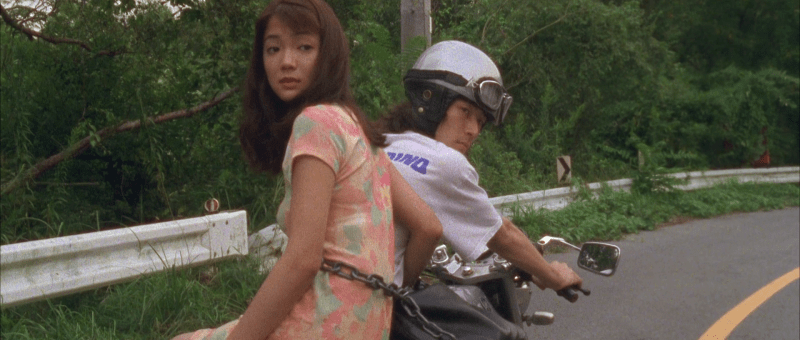
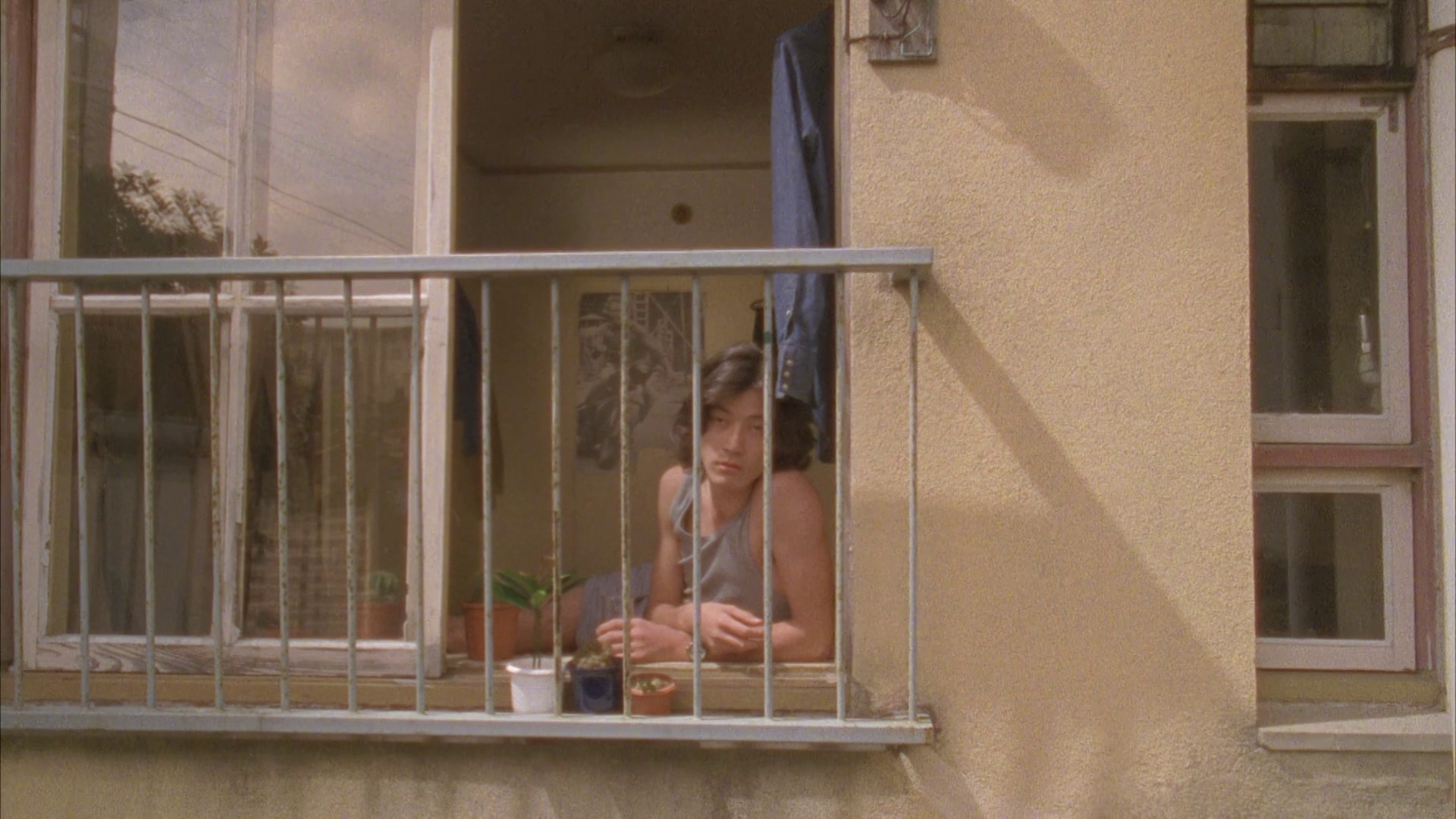
A title card close to the beginning of Shinji Aoyama’s debut film Helpless (ヘルプレス) lets us know that this drama which spans a single day takes place on Sept. 10, 1989. It is indeed late summer for most of the protagonists, refugees from the Showa era living on borrowed time in Heisei and intensely resentful towards the contemporary society which appears to have no place for them while the glamour of the Bubble economy does not appear to have trickled down to their peaceful provincial existence.
Yakuza, for example, are very much associated with the post-war past and one-armed foot soldier Yasuo (Ken Mitsuishi) is an old-school street thug who can’t accept that his former boss literally is as dead as the institution itself. He’s met at a train station by two former associates, but it’s clear the older at least is awkward around him finally telling Yasuo not to call “too often”. “It’s nice to be normal,” Yasuo sneers, realising his former comrade has gone straight and lives an ordinary life as a regular businessman which is why he really wants nothing to do with his yakuza past. Yasuo takes his as more than just a personal betrayal and shoots him dead with his own gun.
He is quite literally helpless, there’s no place for him in the contemporary society and his only hope is killing his old boss, who is already dead, so he can go back to prison. The only sticking point his younger sister Yuri (Kaori Tsuji) who has learning difficulties and had been living in residential care. Another of Yasuo’s former associates now longer a yakuza, Kenji (Tadanobu Asano), is similarly caring for his father who is in hospital for serious medical treatment. Kenji’s father hums the Internationale to himself and seems to have been consumed by the failure of his personal revolution muttering about blast furnaces while at home Kenji looks out on the now rusty aspirations of another “new era” in a moribund steel plant. He lies to his father that he has a received a job offer from there.
The two men seem destined to collide, Kenji’s numbed resignation and Yasuo’s irrational rage, though it’s Kenji who later snaps after learning that his father has hanged himself while he was busy taking care of Yasuo’s sister. Even an old classmate he runs into is filled with resentment, talking about taking his “revenge” at the class reunion by poisoning the punch. He says he “forgives” Kenji because he once helped him find his PE kit, though Kenji claims he did it mostly for selfish reasons.The chef at the roadside diner where they wait for Yasuo also seems to be henpecked by his wife who calls him “weaker than a woman.” Kenji later says that he killed them because they ridiculed him, tipped over the edge by his own insecurity and sense of futility.
Yasuo discovers something similar after being stopped at a roadblock, a policeman expressing sympathy that “they forgot about a punk like you.” Yasuo points the gun at his own head, discovering one last bullet, but it’s not quite clear what happens after that. Yasuo was a wandering ghost anyway, a man of the Showa era haunting the streets of Heisei with a mission to kill a man like himself already dead. On the severed arm Kenji later discovers in his bag, there’s a tattoo of a skull and the motto “help me” which might speak for them all desperately looking for some kind of way out but finding little support.
But then again, Kenji proves unexpectedly kind caring for Yuri even while Yasuo selfishly considers a double suicide. Dressed in white though also in a T-shirt featuring the cover for Nirvana’s Nevermind which was released in 1991, Kenji is the light and Yasuo the dark despite their mutual violence one bound by nihilism and the other a strange positivity blithely searching for an escaped rabbit just as helpless as he himself may be. Filled with ironic whimsy the film takes place in a purgatorial space inhabited by those displaced by the Bubble who no longer have anything to pin their hopes on while living on borrowed time in a late summer rapidly drawing to a close.
 Windows on Worlds