

A listless young couple attempt to rebel against the world’s meaninglessness, but discover only further despair if tempered by their togetherness in Kiyoshi Kurosawa’s oblique drama, Barren Illusion (大いなる幻影, Oinaru Genei). The film’s title could refer to the world itself which has its own degree of unreality while offering little of consequence to either of the protagonists who might dream of escape but are incapable of effecting it. Instead, they exist like ghosts trapped within the perpetual limbo of the contemporary society.
Musician Haru (Shinji Takeda) literally fades in and out of his surroundings, captured in a slow dissolve as if somewhere else he were awakening from this dream only to blink back into existence. In the early stretches of the film, he’s repeatedly told to “disappear,” which in an odd way affirms his existence even while negating it. He appears to react to this instruction with violence, throwing rubbish bags around in the street, but also placing a bag under the head of a sleeping person in a small gesture of kindness.
Michi (Miako Tadano), meanwhile, seems to rebel against her monotonous life as a postoffice clerk by pilfering from the mail and dreaming of going abroad. To add to her sense of isolation, the customers at the postoffice are unable to see her face or she theirs. There is a vertical blind in front of her through which customers hand their packages or documents to be processed. This seems to be done wordlessly. Customers don’t even state which service they require, but simply pass whatever they’ve brought across and then leave. Michi’s job chiefly seems to consist of stamping things in triplicate, removing the top level to hand to the customer, and then filing the counterfoil.
Tellingly, her stamp says that it is 2005, which is six years after the film was released. Yet a kind of inertia has set in even in this near future setting. Michi encounters a strange woman who complains that the photocopier has been broken since the year 2000, perhaps a casualty of the millennium bug, but no one has made any attempt to fix it. The woman seems strangely insistent about the broken photocopier while her face is ominously hidden in shadow. Michi meets the same woman later on the rooftop where she again throws papers around before trying to pull Michi over and then abruptly jumping herself just as Michi will later do.
It might be tempting to think of this woman as a ghost. Her actions have a looping quality as if she were stuck in a purgatorial cycle, but then this seems to be true of pretty much everyone. Someone ought to do something, people seem to say, but just as no one bothered to fix the photocopier, no one is really applying themselves to anything either or seriously trying to resist their despair-filled existence. The pollen that has begun to plague the young with allergies seems to be a metaphor for this sense of inertia as it saps their energies, causes them to wear masks that further isolate them from human connection, and eventually forces them into a binary choice between infertility and becoming a functioning member of society.
Both Haru and Michi later agree to try the new drug even if it prevents them from having children, but then in many ways they continue to behave like children themselves. They spend significant amounts of time playing with inflatable balls in the local park, and though they discuss getting a dog or cat, quickly tire of caring for it. A foreign woman attempts to hand out postcards in a bar which may hint at a desire for geographical escape, though she finds no takers. Michi, meanwhile, is fascinated by an inaccurate map she discovers in the home of a Chinese woman who for some reason barged in on her looking for escape from a persistent boyfriend. “You can go on your own,” the woman tells him in Mandarin, “I’m not going,” before he simply picks her up and takes her away all while ignoring the literal alarm bells that Michi later tries to warn her about.
Michi trails her suitcase along while pursued by both a wandering band of percussionists that seems to follow her around, and a gang of black-clad, seemingly violent fascists who beat her with clubs as if they were either symbol of societal collapse or a cleanup tool trying to remove a bug from the system. She seems to come to the conclusion that leaving would be pointless without Haru, but the two of them remain trapped on either side of an external door until an attempt to take action seems to put them on the same side, albeit as passive observers amid the cacophony of the percussionist band. The low-level thrum of interior spaces hints at industrial corruption and a deadening effect on human communication, while it seems that togetherness is perhaps the only real path to enduring this looping existence in which everything is just an echo of something else and that remains is a vague desire to know what lies over the horizon.
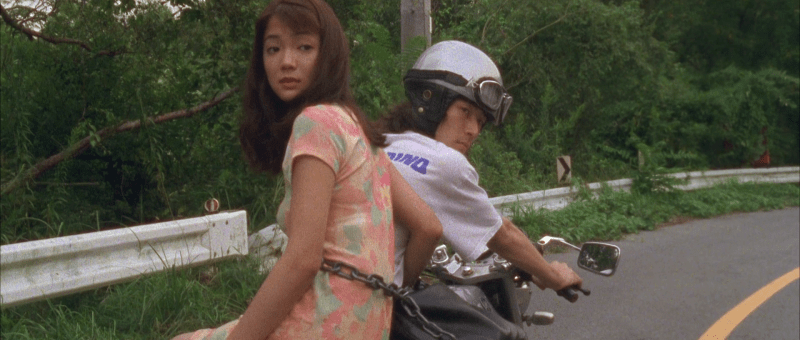
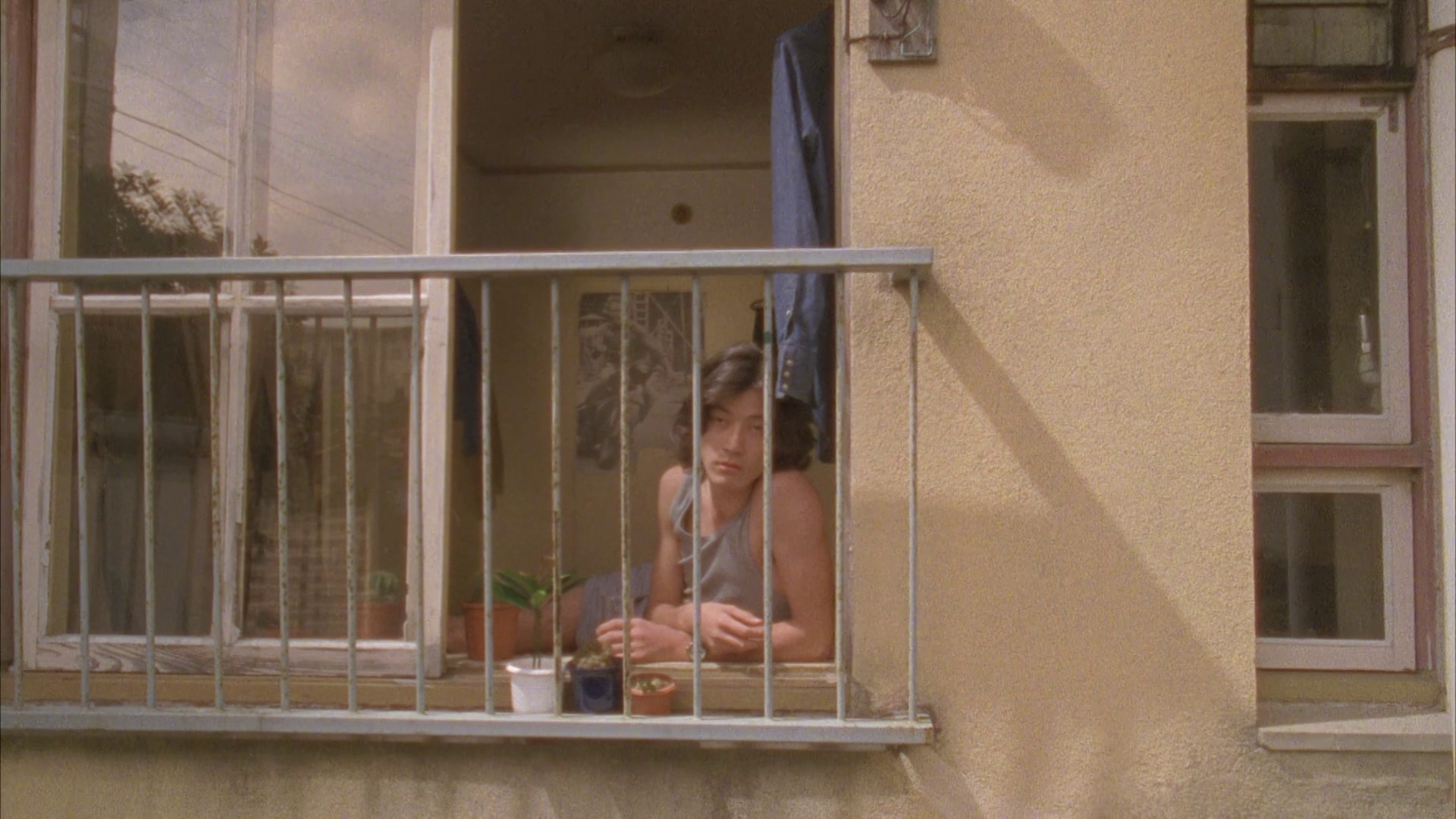

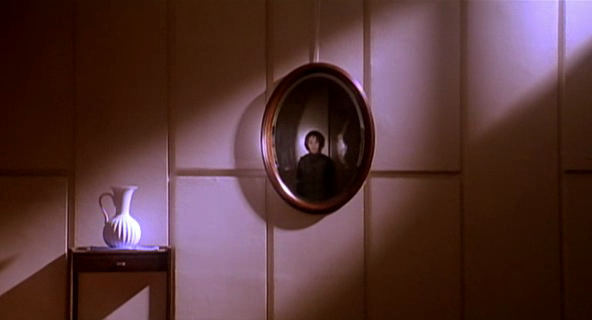
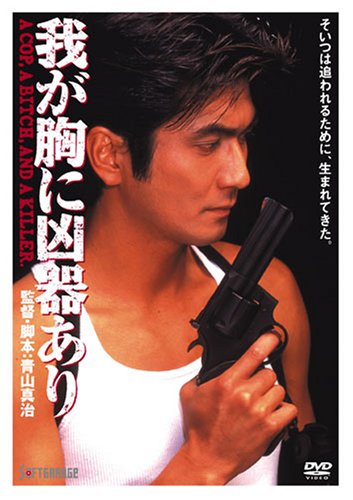 Shinji Aoyama would produce one of the most important Japanese films of the early 21st century in Eureka, but like many directors of his generation he came of age during the V-cinema boom. This relatively short lived medium was the new no holds barred arena for fledgling filmmakers who could adhere to a strict budget and shooting schedule but were also aching to spread their wings. After a short period as an AD with fellow V-cinema director now turned international auteur Kiyoshi Kurosawa, Aoyama directed his first straight to video effort – the sex comedy It’s Not in the Textbook!. Released just after his theatrical debut, Helpless, A Weapon in My Heart (我が胸に凶器あり, Waga Mune ni Kyoki Ari, AKA A Cop, A Bitch, and a Killer) is a more typically genre orientated effort with its cops, robbers, and femme fatale setup but like the best examples of the V-cinema trend it bears the signature of its ambitious director making the most of its humble origins.
 Windows on Worlds