The Hunter and the Hunted (油断大敵, Izuru Narushima, 2004)

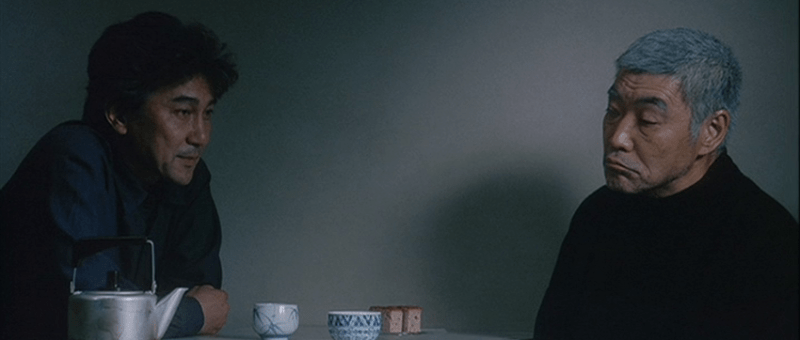
The thrill and excitement of being a thief only exist when there’s a great detective around, according to the legendary cat burglar, Nekoda, in Izuru Narushima’s warmhearted crime drama, The Hunter and the Hunted (油断大敵, Yudan Taiteki). The film takes its title from a four-character idiom, a proverb advising that the greatest danger is complacency, which is indeed one of the weapons employed by Neko, nicknamed “the Cat”, as he builds a relationship with the man he hopes will become his greatest adversary. 

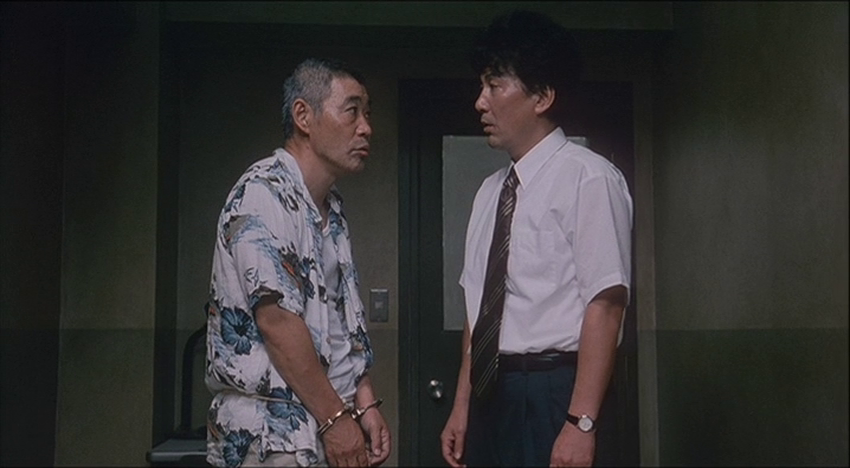
Jin (Koji Yakusho) is a widowed single-father coming to the conclusion that his career as a policeman is incompatible with his responsibilities as a parent. Perhaps bearing out the still sexist nature of the early 2000s society, everyone keeps telling him to remarry so that he won’t have to worry about childcare any more, or else find a job that doesn’t require being constantly available in order to work on the criminals’ schedule. The problem is that Jin really likes his job as a thief catcher having transferred from the local police box after his wife passed away from an illness. He really doesn’t want to give it up, but is beginning to feel as if he has no choice. Neko (Akira Emoto) too encourages him to remarry and Jin lets slip that he’s taken a liking to a lady that works at his daughter’s daycare. But though Misaki really likes Makiko (Yui Natsukawa), the thought of her father remarrying causes her to go on a three-day hunger strike. Reluctantly, Jin has to give up on his romantic hopes, though he refuses to do so in terms of his career and in fact goes on to be promoted after receiving a commendation for catching Neko seemingly by chance when he stepped in to fix Misaki’s broken bicycle while Jin was too busy with something else.

It turns out, however, that it wasn’t really by chance at all. Neko has an MO. He essentially allowed Jin to arrest him because he needed medical treatment. Neko’s life of crime means that he can’t enrol on the government health insurance scheme so he can’t afford to go to the hospital where he’d be arrested anyway. Nevertheless, he seems to take a liking to Jin precisely because of his mild-mannered earnestness and tries to teach him how to think like a thief so that when he gets out in 10 years’ time, he’ll be a worthy adversary and their cat and mouse game can truly begin. Having Neko out there gives Jin a concrete reason to stay in the police and polish his skills, while knowing he has Jin to play off gives Neko a sense of purpose in an otherwise aimless life of total freedom. He describes thievery as his calling and claims that as laws are made by humans and a vocation is given by god, he has a right to pursue it that transcends human justice even if Jin scoffs at his sophistry.

Deciding against remarriage, Jin’s main personal relationship outside his daughter becomes that with Neko who is somewhere between friend and adversary. Once Misaki has grown up and tells him that she plans to do humanitarian work abroad after training as a nurse, Jin can’t help but feel betrayed. She prevented him from marrying a woman that he genuinely cared about, but now tells him he should meet the woman the lady from the bakery is trying to set him up with and plans to palm him off on someone else, just as she feared he might do if he married again leaving his new wife care to Misaki and devoting himself to work. But what he realises it that his relationships with Misaki and Neko are basically the same. He has to accept that his daughter has grown up and chosen her own path to follow. It’s time to let her go. Neko, meanwhile, has found his freedom in thievery, and so he will never stop doing it no matter how many times Jin catches him or how many times he escapes. All Neko wants out of life is that they both stay healthy enough to keep playing this game right to the very end so that he can die as a thief having experienced the true joy of battling his nemesis while Jin too enjoys the thrill of the chase as a thief-catcher hot on the trail of a master. Which is to say, no one actually wants to win this game, and what has really come to matter is their extremely co-dependent friendship that transcends the limits of the law.


Midnight Diner 2 (続・深夜食堂, Joji Matsuoka, 2016)

midnight diner 2 posterThe Midnight Diner is open for business once again. Yaro Abe’s eponymous manga was first adapted as a TV drama in 2009 which then ran for three seasons before heading to the big screen and then again to the smaller one with the Netflix original Midnight Diner: Tokyo Stories becoming the de facto season four. Midnight Diner 2 (続・深夜食堂, Zoku Shinya Shokudo) returns with more of the same as Master puts out his sign and opens the shop, welcoming the denizens of Tokyo after dark in search of a little place to call home amid all the chaos and alienation.
To re-cap, the Midnight Diner is a casual eating establishment run by Master which opens only between the hours of midnight and 7am. The restaurant has only a small formal menu but Master’s selling point is that he is prepared to make whatever the customer so desires (assuming the ingredients are available). Regulars and newcomers alike are given a warm welcome and a place to feel at home, free of whatever it was that was bothering them in the outside world.

Like the first film, Midnight Diner 2 is really three TV episodes stitched together. The first begins on an ominous note as each of the regulars arrives in mourning clothes only to be struck by the coincidence that they’ve each been to a different person’s funeral. A woman arrives dressed in black but reveals she hasn’t been bereaved, she simply enjoys dressing like this to destress from the difficult atmosphere at her publishing job. Noriko (Aoba Kawai) is a top editor but often finds herself sidelined – this time by a young author whose book she made a success but has now dumped her owing to all her notes on his second effort. Saddled with an elderly client who doesn’t like taking advice from a woman, Noriko’s fortunes fall still further when she finds him dead. A visit to a real funeral threatens to change her life completely.

Strand two follows the son of a nearby soba shop, Seita (Sosuke Ikematsu), who has fallen in love with a much older woman and wants to marry despite his mother’s reservations. The third segment continues along the familial theme with an old woman travelling all the way from Kyushu to Tokyo after falling victim to an “Ore Ore” scam.

Scams and parental bonds become the central themes tying the episodes together as each of the lovelorn protagonists finds themselves taking advantage of Master’s sturdy shoulders. Noriko and Mrs. Ogawa (Misako Watanabe) fall victim to an obvious conman but do so almost willingly out of their desperate loneliness. Noriko, dissatisfied with her working environment, takes to the streets dressed in black but becomes the target of “funeral fetishists” who are only interested in her “bereaved” state. A chance encounter at a real funeral makes her believe her life can change but she is deceived again when a man she came to care for is unmasked as a serial trickster. Mrs. Ogawa faces a similar problem when she races all the way to Tokyo to pay off a “colleague” of her son’s, so desperate to help that she never suspects that she’s fallen victim to a scam.

Mrs. Ogawa’s deep love for the son she has become estranged from is contrasted with that of the soba noodle seller for the son she can’t let go. Seita cares for nothing other than ping pong, much to his mother’s consternation and has little interest in taking over the family business. A young man, he’s tired of the constraints his lonely widowed mother continues to place on him though his determination to marry an older woman at such a young age bears out his relative maturity.

As usual Master has good advice and a kind word for everyone that helps them get where they need to go, softly nudging them in the right direction through the power of comfort food. By now the cast of familiars is well and truly entrenched but there will always be space at Master’s counter for those in need who will be greeted warmly by those already aware of its charms. True enough, Midnight Diner 2 offers little in the way of innovation (though we do get a little more information about the mysterious Master) but no one comes the Midnight Diner looking to try something new. In here, nostalgia rules and we wouldn’t have it any other way.


Original trailer (no subtitles)

Hamon: Yakuza Boogie (破門 ふたりのヤクビョーガミ, Shotaro Kobayashi, 2017)

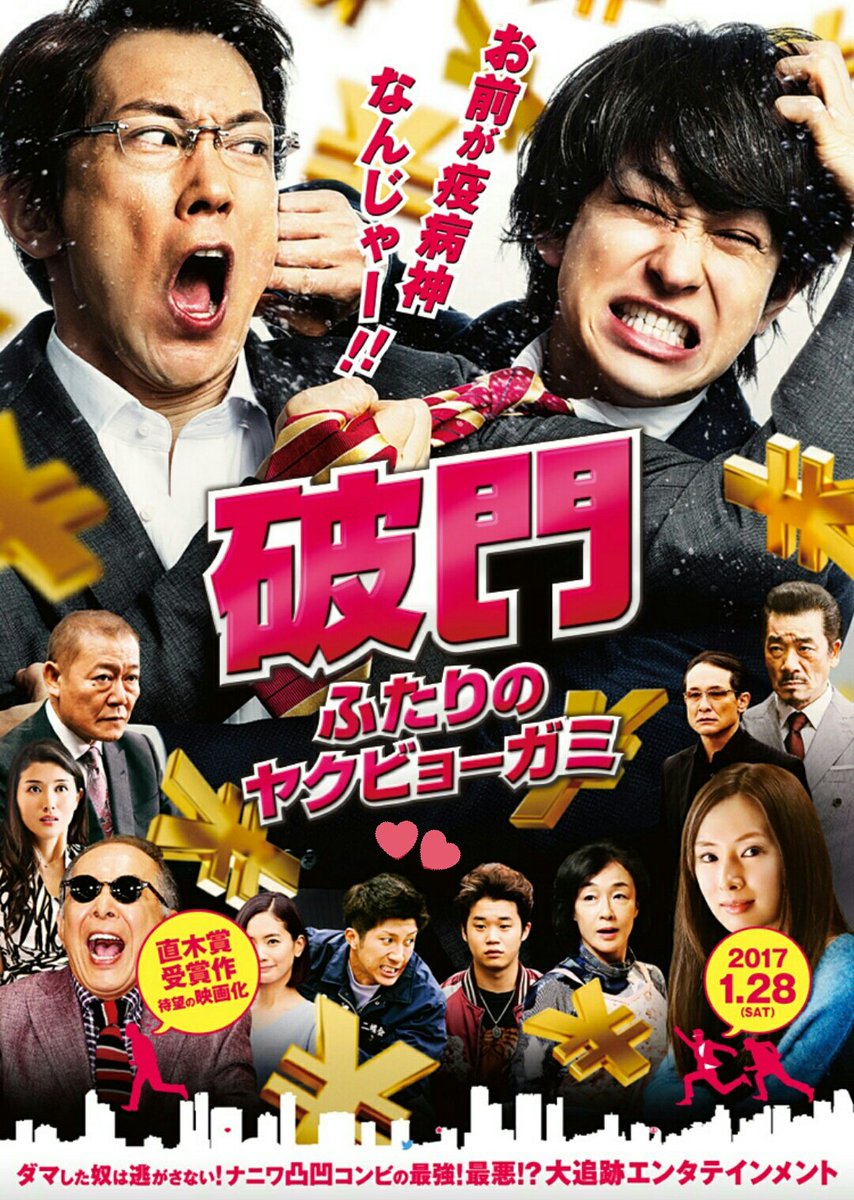
hamon posterConventional wisdom states it’s better not to get involved with the yakuza. According to Hamon: Yakuza Boogie (破門 ふたりのヤクビョーガミ Hamon: Futari no Yakubyogami), the same goes for sleazy film execs who can prove surprisingly slippery when the occasion calls. Based on Hiroyuki Kurokawa’s Naoki Prize winning novel and directed by Shotaro Kobayashi who also adapted the same author’s Gold Rush into a successful WOWWOW TV Series, Hamon: Yakuza Boogie is a classic buddy movie in which a down at heels slacker forms an unlikely, grudging yet mutually dependent relationship with a low-level gangster.

Ninomiya (Yu Yokoyama), a classic slacker, makes ends meet by acting as a kind of liaison officer between the normal world and the yakuza one. His contact, Kuwahara (Kuranosuke Sasaki), is a scary looking guy but as yakuza go not so bad to work with. Following the government’s organised crime crackdown, Ninomiya finds himself at more of a loose end and so when an elderly film director, Koshimizu (Isao Hashizume), comes to him and asks to meet a yakuza first hand, Ninomiya sets up a meeting. Yakuza and movies can be a dangerous mix but somehow or other Koshimizu manages to charm the pair and even gets Kuwahara’s boss, Shimada (Jun Kunimura), to invest some of his own money.

Unfortunately, this is when things start to go wrong. Koshimizu’s pretty “daughter” is really his mistress (as Kuwahara suspected) and the wily old bugger has taken off for the casino paradise of Macao with both the beautiful woman and suitcase full of yakuza dough. Kuwahara is now in a lot of trouble and ropes in Ninomiya to help him sort it out but in their pursuit of Koshimizu they eventually find themselves caught up in a series of turf wars.

Yakuza comedies have a tendency towards unexpected darkness but Hamon’s key feature is its almost childish innocence as Ninomiya and Kuwahara go about their business with relatively few genuinely life threatening incidents. Though the pair bicker and argue with Ninomiya always secretly afraid of his big gangster buddy and Kuwahara fed up with his nerdy friend’s lack of know how, the relationship they’ve developed is an intensely co-dependent one which fully supports the slightly ironic “no me without you” message. Eventually growing into each other, Ninomiya and Kuwahara move increasingly into the other’s territory before finally re-encountering each other on more equal footing.

These are less rabid killers than a bunch of guys caught up in a silly game. Shady film director Koshimizu turns out to be some sort of cartoon hero, perpetually making a sprightly and unexpected escape despite his advanced age while the toughened gangsters hired to keep him locked up find themselves one hostage short time after time. Ninomiya’s worried cousin Yuki (Keiko Kitagawa) keeps trying to talk him into a more ordered way of life which doesn’t involve so much hanging round with scary looking guys in suits, but Ninomiya is reluctant to leave the fringes of the underworld even if he seems afraid for much of the time. Kuwahara is a yakuza through and through, or so he thinks. This latest saga has left him in an embarrassing position with his bosses, not to mention the diplomatic incident with a rival gang, all of which threatens his underworld status and thereby essential identity.

Still, all we’re talking about here is having a little more time for solo karaoke, not being bundled into the boot of a car and driven to a remote location. Filled with movie references and slapstick humour this is a yakuza tale inspired by classic cinematic gangsters rather than their real world counterparts but it still has a few things to say about human nature in general outside of the fictional. An odd couple, Ninomiya and Kuwahara couldn’t be more different but besides the fact they don’t quite get along, they make a good team. No me without you indeed, solo stakeouts are boring, even if you do bicker and fuss the whole time it’s good to know there’s someone who’ll always come back for you (especially if you tell them not to) ready to take the wheel.


Hamon: Yakuza Boogie was screened at the 19th Udine Far East Film Festival.

Original trailer (no subtitles)