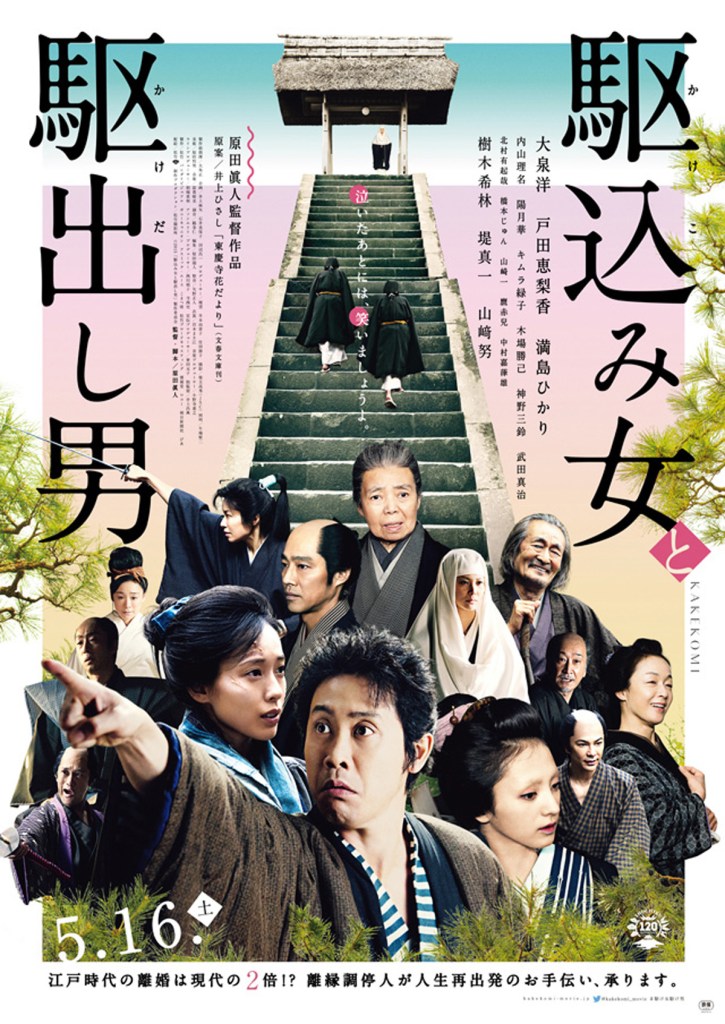
Kakekomi (駆込み女と駆出し男, Masato Harada, 2015)

166028_02The world of the classical “jidaigeki” or period film often paints an idealised portrait of Japan’s historical Edo era with its brave samurai who live for nothing outside of their lord and their code. Even when examining something as traumatic as forbidden love and double suicide, the jidaigeki generally presents them in terms of theatrical tragedy rather than naturalistic drama. Whatever the cinematic case may be, life in Edo era Japan could be harsh – especially if you’re a woman. Enjoying relatively few individual rights, a woman was legally the property of her husband or his clan and could not petition for divorce on her own behalf (though a man could simply divorce his wife with little more than words). The Tokeiji Temple exists for just this reason, as a refuge for women who need to escape a dangerous situation and have nowhere else to go.

Kakekomi (駆込み女と駆出し男, Kakekomi Onna to Kakedashi Otoko) places this important institution at its centre as it focuses on the stories of a number of women who’ve each ended up at the temple after a series of difficult circumstances. Jogo (Erika Toda) is married to a womanising drunkard who forces her to run his iron smelting business from the front lines (hence the painful looking blisters on her face) while he enjoys his life of debauchery. When the staff complains about his attitude and their subsequent fears for their jobs and Jogo raises their concerns with him he simply beats her before returning to his mistress. She then faces a decision – Tokeiji, death, or endurance. During her flight, she runs into O-Gin (Hikari Mitsushima), a mysterious wealthy woman who’s sprained her ankle after fighting off bandits in the woods. The pair bond on their quest to reach Tokeiji where they hope to find refuge from their turbulent home lives.

Before you can enter Tokeiji you’re held at one of the receiving inns where they hear your story, assess the possibility of being able to reconcile with a husband and, if deemed necessary, allowed to travel to the temple where you’ll live as a Buddhist nun for two years at which time your husband must legally sign the divorce papers. The inn adheres to strict Buddhist principles – no men are allowed near the temple (even the outside helpers wear bells so the ladies can hear them coming), you eat only temple cuisine (no meat or stimulants like garlic and onions), and have to abide by the word of the head nun. There are also three different classes of resident starting with the most expensive court lady lifestyle, then one of sewing and making repairs, and finally the lowest class which does all the day to day cooking, cleaning and other menial tasks.

The other pivot around which the film turns is the one time medical student Shinjiro (Yo Oizumi) who has literary dreams but has had to beat a quick retreat from Edo after defiantly breaking its ridiculous “no singing in the streets” law (amongst other things). At this period Edo and the surrounding area is undergoing its own mini cultural revolution as the current authorities advocate a period of austerity which sees things like literature, music and even sushi outlawed. Perceiving threats everywhere, the powers at be are also looking for a way to close down Tokeiji by any underhanded means necessary.

Shinjiro is a fast talking wise guy who can generally talk his way out of anything though he is also a keen student and a promising young doctor. As a relative of the Tokeiji inn owners, he’s seeking refuge too but also hoping to make use of their extensive archives for his writing career. As a doctor he’s immediately fascinated by the burns on Jogo’s face which he believes he can treat though in her frightened state she’s alarmed by his direct manner and refuses. After hearing his more reasoned arguments she finally submits and in turn becomes interested in his medical knowledge assisting him to gather herbs in the forest before starting her own herb garden in the temple.

Of course, the two develop a growing romantic attachment though frustrated by Jogo’s position as a married woman and the temple’s prohibition against male contact. Their romance is never played for melodrama, more as a simple and natural course of events though it’s well played by both Toda and Oizumi. At heart, Kakekomi is an ensemble drama which encompasses the often sad stories of its female cast who are each at the mercy of the cruel and rigid Edo era social system. O-Gin’s reasons for fleeing to Tokeiji turn out to be a little different from everyone else’s though she too is still suffering for love.

A humorous look at this untold story, Kakekomi proves an engaging ensemble drama anchored by the committed performances of its cast. Toda takes Jogo from a frightened and abused woman to a confident and learned scholar who is perfectly capable of taking charge of things on her own and her transformation is the true heart of the film. Apparently, director Masato Harada shot nearly four hours of footage before cutting the film down to the more manageable two and a half which may explain why it sometimes feels a little abrupt but nevertheless Kakekomi proves one of the most enjoyable mainstream Japanese movies of recent times.


The Japanese blu-ray/DVD of Kakekomi includes English subtitles.
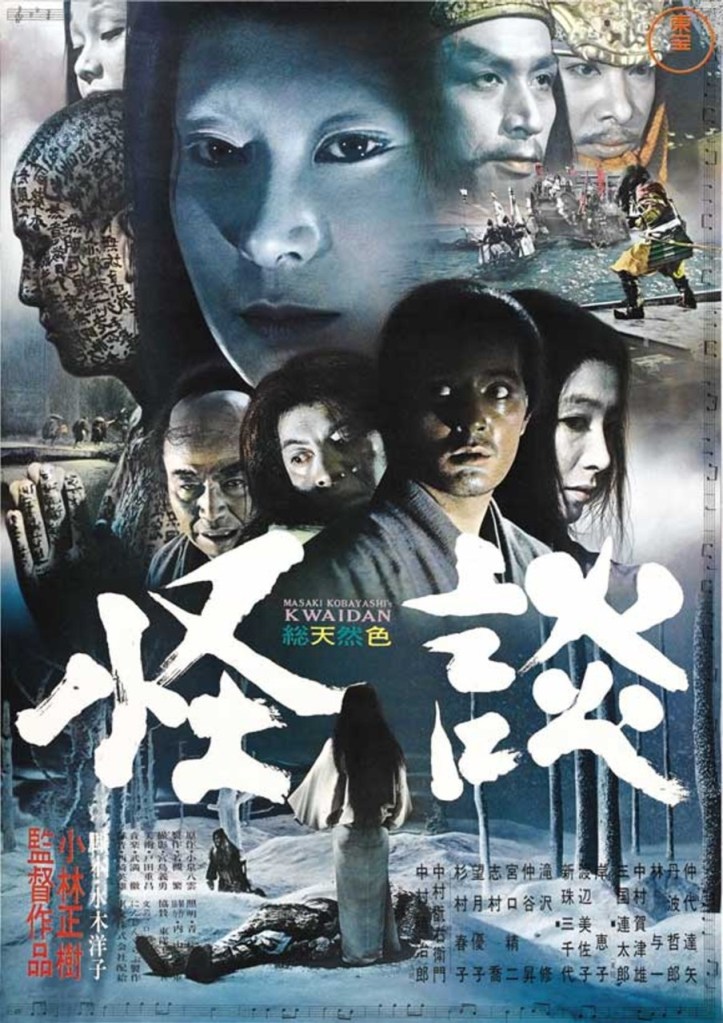
Kwaidan (怪談, Masaki Kobayashi, 1964)

tumblr_ly5zbgdNH61rn3yrmo1_1280Kwaidan (怪談) is something of an anomaly in the career of the humanist director Masaki Kobayashi, best known for his wartime trilogy The Human Condition. Moving away from the naturalistic concerns that had formed the basis of his earlier career, Kwaidan takes a series of ghost stories collected by the foreigner Lafcadio Hearn and gives them a surreal, painterly approach that’s somewhere between theatre and folktale.

The first tale, Black Hair, is the story of an ambitious young samurai (Rentaro Mikuni) who abandons his one true love to marry a wealthy woman and advance his career. However, his second marriage is far from happy and he begins to appreciate just what it is he’s cast aside. Eventually returning home he meets his former wife again and harbours the desire to start afresh. However, when the sun comes up all is not as it seems.

Tale two, The Woman of the Snow, begins when two woodsmen are caught in a blizzard and a mysterious woman appears to suck one of them dry of blood. She spares the other, Minokichi (Tatsuya Nakadai), because she’s moved by his youth but she instructs him never to reveal the events of that evening or she will return to finish what she started. Minokichi returns home and meets another mysterious woman who later becomes his wife and bears him three children but will he remember to keep his secret even from the love of his life?

The third tale is perhaps the most famous, Hoichi the Earless, and features the sad tale of a blind biwa player (Katsuo Nakamura) whose storytelling ability is so great that the dead themselves petition him nightly to recount their story. Eventually the head monk finds out and disapproves of Hoichi’s dealings with the supernatural so the monks paint sutras all over his body to protect him from the malevolent spirits. However, like achilles and his vulnerable heel, they forget to paint Hoichi’s ears…

The fourth tale, A Cup of Tea, is a little more whimsical and opens with a framing sequence lamenting the fact that some ancient tales were never finished for one reason or another. The tale within the tale features a samurai who keeps seeing a face appear in his tea. Obviously this is quite disturbing, but eventually he just decides to drink it anyway only for the owner of the face to suddenly appear and complain about soul having been stolen.

Like all good fables the stories each have a moral to offer but also, crucially, paint the protagonists as victims of circumstance more than rash or unwise people. The samurai feared poverty so he abandoned his love in search of riches only to discover he’d been chasing the wrong kind of dreams. Minokichi momentarily forgot himself, perhaps entrapped by the Snow Woman’s final trick, Hoichi just wanted to play his biwa but his desires were frustrated by the powers at be who further mess things up for him by botching the sutra application. The protagonist of A Cup of Tea does choose to drink the tea himself but the resultant madness is not something that could ever have been reasonably expected. These are worlds of spirits where the doorway to the supernatural is always ajar, waiting for some ordinary person to tumble through accidentally.

Though employing slightly different styles for each of the four segments, Kobayashi sets his stage with a deliberately theatrical, almost hyperreal set design. Obviously shot on a soundstage, the tales take on the feeling of stories which have been told and retold, replayed countless times across the great theatre of life. Black Hair steers closest to a traditional kabuki play, an effect aided by Toru Takemitsu’s more traditional score but The Woman of the Snow gives way to intense color play full of cold blue ice vistas mixed with impressionistic, passionate red skies. Hoichi’s tale begins with an overlay of a scroll painting recounting the famous The of the Heike of which Hoichi sings his song. Full of epic battle scenes, ghostly apparitions and a whole load of biwa music, this segment is the lengthiest but also the meatiest when it comes to subtext. The final tale by contrast is much more straightforward and brings a little chanbara exuberance to the otherwise heavy atmosphere though it does leave us with one of the most haunting images in the entire film.

Kwaidan may look like an exercise in style for Kobayashi – it was also his first colour picture and he makes full use of that aspect of the film. However, that isn’t to say he’s abandoned his recurrent concerns. The people in the stories are all ordinary, they’re flawed but they aren’t evil. The samurai comes closest to bringing his fate on himself when he makes the selfish decision to abandon his loving wife for money and status though he pays a heavy price when he finally realises his foolishness. Minokichi’s crime is a loss of faith of perhaps of having doubted the truth of his tale in itself. In the end, he simply forgot his promise rather than making a conscious decision break it like the samurai. Hoichi is something of a passive player here as his blindness renders him unable to understand his plight – he is unable to keep his promise to the fallen samurai firstly because of the physical toll it’s taking on him and secondly as he’s prevented by his superiors. The protagonist of the final tale simply gives in to temptation and then to madness perfectly symbolising human weakness. Kobayashi maybe more artful here than acerbic but his bleak view of human nature still wins out. However, what Kobayashi crafted in Kwaidan is a beautiful, dreamlike canvas of supernatural visions which continue to dazzle in their artistry long after the screen has gone dark.


Kwaidan is available on blu-ray in the US from Citerion and on DVD in the UK from Eureka Masters of Cinema.


Kagero-za 陽炎座 (Heat Haze Theatre – Seijun Suzuki 1981)

SuzukiKageroza1Zigeunerweisen was an unexpected commercial and critical hit in Japan netting both an improbably good box office return and more than a few awards. The next instalment in what would become Suzuki’s Taisho Roman Trilogy (though it would be another ten years before the final part, Yumeji, would arrive) therefore benefitted from a slighter bigger budget, bigger stars and even greater ambition. Like the others in the trilogy and as implied by its title, Kagero-za is once again based on a book set in the Taisho era though this time by Kyoka Izumi. Izumi was a novelist and kabuki playwright most closely associated with supernatural tales influenced by Edo era traditions and Kagero-za even features a playwright as its protagonist. With even less clarity than Zigeunerweisen, Kagero-za is not altogether as successful but nevertheless boasts Suzuki’s bizarre imagery and surreal world view.

Like Zigeunerweisen Kagero-za also throws dreams and reality into a giant melting pot with a non-linear narrative that floats and wefts like a strange nightmare. It begins with the central character, Matsuzaki (played by Yusaku Matsuda), meeting a lone woman near a shrine who asks him to accompany her to visit a friend in the hospital. She doesn’t want to go alone because she’s afraid of the old woman who sells charms and medicines there including bladder cherries which are said to contain the souls of women. Originally reluctant Matsuzaki agrees only to have her change her mind shortly after. Matsuzaki is pre-occupied over having dropped a love letter and worrying it’s been found by an ‘evil’ person – something which upsets his new friend as she’s convinced the letter was from a married woman.

This mysterious woman, it turns out, may be (or have been?) the wife of Matsuzaki’s wealthy patron Tamawaki. To make matters even more confusing, Tamawaki may have had two wives – the first a German woman he married while abroad and brought back with him to Japan who died her hair black and wore contact lenses to look more Japanese but regained her original blonde & blue eyed foreignness in the bright moonlight. The second is, apparently, dying in hospital – not that Tamawaki is terribly upset about it. Matsuzaki becomes increasingly obsessed with the mysterious woman, following her across the country only to discover Tamawaki waiting for him – apparently intent on witnessing a double suicide.

The film takes an even more surrealist dive towards the end as Matsuzaki finds himself the only adult audience member at a kabuki show entirely performed and witnessed by children. Not only that, this bizarre kabuki play appears to re-enact the exact same events from the first half of the film. A fitting trap for a playwright, this last, nightmarish section echoes the film’s ghost story origins complete with the creepy bladder cherry seller from the beginning as some kind of villainous demoness and Tamawaki as a tempting devil. Who talks of realism here? Says Tamawaki making an exit through an alleyway with a rifle on his shoulder. Who indeed? Not us, that’s for sure.

Even less coherent than Zigeunerweisen, Kagero-za is a veritable fever dream of a film. There’s barely any linear plot, Matsuzaki’s perceptions are recounted in fractured dream narrative where the true nature of events is always unclear. We can’t trust Matsuzaki to guide us here, nor can we trust Suzuki who employs fewer absurdist tricks than with the previous film but injects a heavy dose of kabuki inspired theatrics. Everything feels inevitable, like the action in a play it’s all been scripted and performed many times before. Yet for all that we don’t ever come to feel very much for Matsuzaki and his presumably tragic fate even though we realise fairly early on what sort of story this is. It’s hellish, and gruelling and honestly tries the patience at times but never achieves that sense of over arching dread that characterised Zigeunerweisen.

That said, if Kagero-za’s largest weakness is playing second fiddle to Zigeunerweisen that’s not so much of a problem. Once again filled with bizarre and trippy imagery, Kagero-za has many startling moments but fails to marry its visual virtuosity with the more individualistic focus of its script. Undeniably without the power of Zigeunerweisen, Kagero-za ultimately feels a little too clever (and perhaps too cold) for its own good but nevertheless does offer Suzuki’s visual flair and an entertaining (if baffling) narrative.