Bayside Shakedown the Final: The New Hope (踊る大捜査線: THE FINAL 新たなる希望, Katsuyuki Motohiro, 2012)

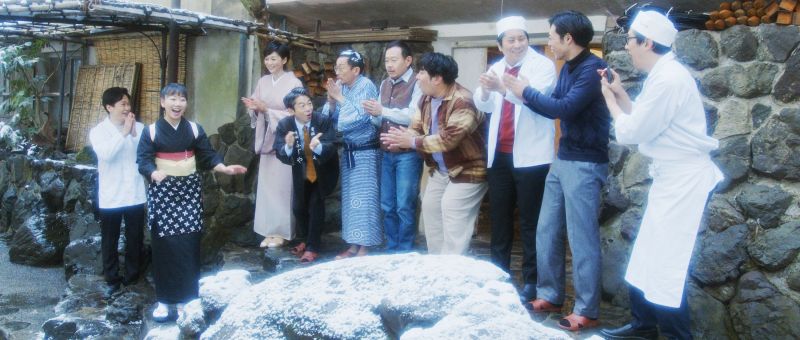
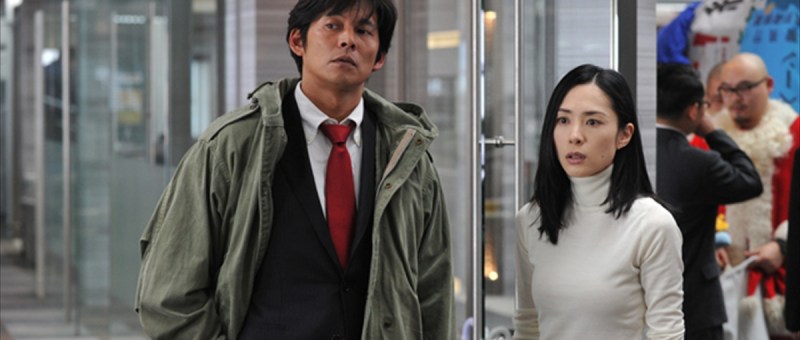
Is it really the end? Billed as the “final” instalment in the Bayside Shakedown series which began with a TV drama in 1997, Bayside Shakedown the Final: The New Hope (踊る大捜査線: THE FINAL 新たなる希望, Odoru Daisousasen the Final: Aratanaru Kibou) once again finds the gang contending with annoying red tape but also with a police force which is intrinsically corrupt and self-serving while questioning if they should remain in an occupation in which they are treated with such disdain. Continuing the familiar pattern from throughout the series, the gang find themselves coming up against a serial killer who may be a crazed vigilante only to discover that the whole thing may have been an extreme inside job designed with the intention of drawing attention to inadequacies in the justice system. 

The problem is that the body they’ve found appears to have been shot with a gun which was removed from the police evidence locker and is linked to a kidnapping case six years previously which just happens to have been handled by Mashita (Yusuke Santamaria) when he was a hostage negotiator. Mashita had ordered an end to the negotiations because of pressure from above to play by the rules with the consequence that the child later died while the prime suspect in the case was recently acquitted of the crime at trial (a staggeringly rare occurrence in Japan). When Mashita’s young son is kidnapped, all eyes are on a rogue policeman, Kuze (Shingo Katori), but it is obvious he is not acting alone. 

Toragai (Shun Oguri), the authoritarian detective from the previous film, has continued along a dark path which only intensifies when his paper on police reforms is rejected out of hand. He too thinks the police force needs structural reform but leans hard into the idea that too many people are getting away with crime rather than concentrating on removing the barriers which prevent police from doing their jobs as Muroi (Toshiro Yanagiba) and Aoshima (Yuji Oda) would probably suggest. Muroi’s lasting dream is of building a police force which trusts policemen to do the right thing and he frequently tells his subordinates that they should feel free to exercise their own judgment. 

Meanwhile, the local cops continue to suffer under the command of the elitist officers from HQ who not only look down on them but assign menial tasks, as does Mashita in finding himself short staffed while most are busy providing security for a local energy summit. While Aoshima had experienced a health crisis that turned out to be a false alarm in the previous film, so this time Sumire (Eri Fukatsu) finds herself struggling with ongoing effects from her shooting in Bayside Shakedown 2 eventually deciding that it might be better to leave the police force entirely while lamenting her unfinished business with Aoshima which remains unresolved even in this “final” instalment while he somewhat unsympathetically can only ask her not to leave rather than express his true feelings. 

Ironically enough, by the time of the final showdown neither of them are actually in possession of a police badge, Aoshima scapegoated by Toragai who still holds a grudge against him while inconvenienced by interference in his scheme to frame a local petty thief for the killings, presenting him with an invitation to resign following serious misconduct accusing him of beating up suspects and planting evidence. One again, the police chiefs sit around a large circular table issuing orders from afar but are mainly concerned how to bury the “scandal” of having a police officer steal a gun from evidence and then use it to commit a murder. In a bizarre twist of fate, it later turns out that the whole thing may be an elaborate, not to mention entirely amoral, plan to expose police shortcomings with a side dose of revenge against Mashita for contributing to the child’s death by insisting on following protocol while receiving heat from above. 

As such the apparently “final” instalment skews a little darker than the series norm while as the subtitle implies offering a new ray of hope in the reversal of Muroi’s fortunes allowing him to embark on the police reforms which have been his and Aoshima’s goal throughout the series. Meanwhile, the film pays tribute to its previous instalments with frequent words of wisdom from the late Waku read from his notebook by his nephew and the ironic return of the previous chiefs reinstated as volunteer mentors as part of a reinforcement programme while familiar faces such as the Captain Kirk cosplayer also make their customary appearances. What’s clear is that there will never really be a “final” outing for Aoshima who reaffirms himself as the last line of defence protecting the local population as he once again runs toward sunset and the next case waiting just behind. 


Trailer (no subtitles)
Bayside Shakedown 3: Set the Guys Loose (踊る大捜査線 THE MOVIE 3 ヤツらを解放せよ!, Katsuyuki Motohiro, 2010)

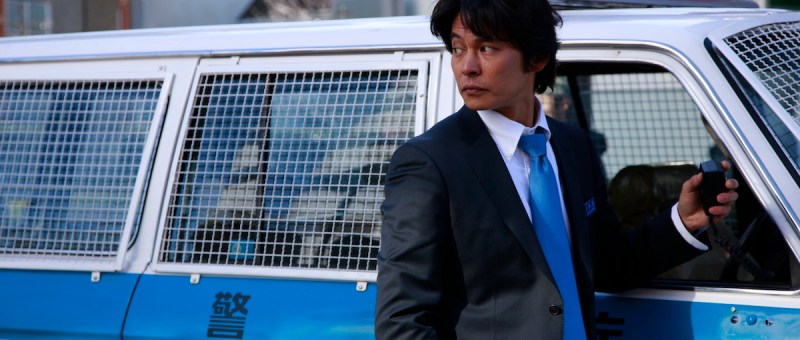
It’s all change at Wangan police station in the third instalment in the Bayside Shakedown series, Let the Guys Loose (踊る大捜査線 THE MOVIE 3 ヤツらを解放せよ!Doru Daisousasen the Movie 3: Yatsura wo Kaihou seyo!). Seven years on from the previous film, many things have changed. Aoshima (Yuji Oda) is now in charge of his team and the precinct is set to move to new purpose-built premises boasting the latest high-tech security systems which will aid them in combating potential terrorism and safeguarding local dignitaries. Even so, the gang will have to deal with some unfinished business from the past before they can fully move on as the circular tale takes us right back to the original film’s villain. 

Following the familiar formula, Motohiro opens with a gag sequence in which Aoshima prepares to give a briefing only it’s not about a case it’s about the logistics of moving offices of which he is in charge and characteristically vowing to do the best job possible. Hindering his progress, however, are two bizarre crimes, the first a bank robbery investigated by his colleague/long-term love interest Sumire (Eri Fukatsu) in which no money is stolen, and a bus hijacking he investigates himself in which the hijackers simply left the scene again without stealing anything. Ironically enough a theft does take place during the move involving three pistols which happen to belong to Aoshima, Sumire, and a new recruit from China, Wang (Kenichi Takito). Soon enough a body turns up on a boat along with Aoshima’s gun sending the gang on the chase for the mysterious thieves. 

The thing we’re constantly told about the new building is how secure it’s going to be, which makes the theft even more ironic, but the truth is that in true franchise style pretty much anyone and everyone is walking in and out carrying moving boxes so nothing is ever really “secure” even in the police station, harking back to the minor villain in the first film who was able to sneak in because he was wearing a fake cosplay police uniform and no one noticed him. Inevitably, this invisible vulnerability eventually comes back to haunt them when the criminals are simply able to steal the manual for the security system and replace it with one of their own to render it unusable to the police later trapped inside the building. Meanwhile approaches to public safety become a matter for debate when it arises that the criminals’ demand is that all of the villains we’ve seen Aoshima arrest so far including psychopathic serial killer Manami (Kyoko Koizumi) who still has a sizeable following online should be released. Counter-intuitively, the police bigwigs are in favour of acquiescing with only Muroi (Toshiro Yanagiba), who has now been promoted to sit at the table himself, objecting on the grounds that it simply isn’t safe to release such dangerous criminals back into society. 

Rather than simply bureaucracy and funding concerns, Bayside Shakedown’s third instalment is more directly critical of the interplay between politics and justice as it becomes clear that the majority of police chiefs care more about public opinion than the law while also mindful of the upcoming general election. Meanwhile the same problem arises with the local police being sidelined by the elites from HQ, a smooth liaison officer Torikai (Shun Oguri) arriving to solve any disputes insisting that the locals be fully respected and allowed to turn their jobs only to turn dark and authoritarian after suffering a catastrophic injury on the job. Once again, Aoshima is forced to consider if his work has real value not only because of the way he’s treated by the cops from HQ but subjected to a healthcare crisis which leads him and many others to assume he’s not long to live. It’s later discovered that he’s been misdiagnosed during his annual checkup, but his boss unethically decides to keep that from him noticing he’s become depressed and lost his mojo, hoping that he’ll be easier to manager but quite the reverse turns out to be true. Again mimicking their previous heart-to-hearts throughout the series, Aoshima perks up after some encouraging words from Sumire in addition to some words of wisdom from the late Waku presented by his rookie nephew and decides to live as if there’s no tomorrow going flat out for justice while caring nothing for his safety. 

Even more than ten years on from the TV series and first big-screen outing, the romance between Aoshima and Sumire still hasn’t quite blossomed despite their respective brushes with death. Many things seem set to change for the Wangan police, the new building acting as a kind of reset while Muroi prepares to move into a more political role and a new, somewhat surprising, local police chief is selected to lead them into a new future just as dedicated to compassionate local policing defined by fairness and justice as they have ever been. 

Trailer (no subtitles)

River (リバー、流れないでよ, Junta Yamaguchi, 2023) [Fantasia 2023]

Some might say time stands still in the “peaceful” hot springs town of Kibune, but on this particular day it’s more than usually true in Junta Yamaguchi’s followup to the cult hit Beyond the Infinite Two Minutes, River (リバー、流れないでよ, River, Nagarenai de yo). This time around, the staff of a hotel along with its guests find themselves trapped in an infinite two minute loop in which they retain all their memories but are constantly returned to where they were two minutes previously no matter what they do. 

Depending on the situation, two minutes can be an eternity or an instant (or perhaps it’s always both) and in this case there isn’t much you can do in such a short time. The hotel staff find themselves constantly running up stairs and through corridors trying to coordinate their actions while accepting that nothing is permanent and any changes they try to make to their situation will be wiped out in the next loop. A chef who is also apparently a science enthusiast cautions them against taking any rash actions seeing as they can’t know when time will start flowing normally again, though for some the opportunity to embrace guilty pleasures such as poking a hole in the shoji is too good to pass up. 

As for what’s causing it, no one really knows but as it turns out everyone has a reason they might want to stop time. For maid Mikoto (Riko Fujitani) it’s that she fears her boyfriend plans to move abroad to study French cooking while another pair of guests secretly wanted to ask each other favours but are having trouble plucking up the courage and a blocked writer consumed with guilt for having killed off a key character is glad he can finally take some time out only to be slowly bored out of his mind when faced with an eternity of nothingness. The irony is that people come to places like these precisely because they’re “boring”, free from the chaos and stress of their ordinary lives. Mikoto says as much while wondering if that’s why her boyfriend wants to leave, that he feels as if he’s stagnating in a place where nothing changes and time doesn’t flow and that while he could be “happy” here with her living an ordinary life there’d always be a part of him wanting more.

Still, having this additional time helps each of them find clarity and begin to resolve some of their worries and anxieties. Even if they had “more time” in the more conventional sense, they may never have been able to speak plainly but given the enforced constraints of the time loop in which they quickly run out of other things to do and are more or less forced to talk to each other, they are all able to come to some kind of accommodation with what’s been bothering them. The two male guests are able to clear the air after an argument, the writer comes to a new appreciation of his characters thanks to his own sense of despair being trapped in the loop, and Mikoto realises she’ll have to let her boyfriend go in the hope that he’ll circle back around to her in time. 

The complexities involved are unlike those in Beyond the Infinite Two Minutes given that time constantly resets so the only point of consistency is the initial position of each person though the infinite quality of the looping provokes an additional layer of existential questioning as each of the various protagonists is forced to ask if they’re really moving on with their lives or even notice that time is indeed flowing. The clue that something is continuing to move lies in the differing levels of snowfall in each of the loops hinting at the increasing depths of their despair as they realise that not even death might free them from the maddening cycle of repetition while accepting they’ll have to work together to figure out what’s going on and how to escape the loop. The farcical humour soon gives way to a more poignant sense of reflection but also to a renewed joy and excitement that the future might actually be fun too and maybe it’s less scary to go there than be quite literally stuck in the present for all of eternity.


River screened as part of this year’s Fantasia International Film Festival.

Original trailer (English subtitles)

Go Find a Psychic! (曲がれ!スプーン, Katsuyuki Motohiro, 2009)

go find a psychic posterHow old is too old to still believe in Santa? Yone Sakurai (Masami Nagasawa), the heroine of Katsuyuki Motohiro’s Go Find a Psychic! (曲がれ!スプーン, Magare! Spoon) longs to believe the truth is out there even if everyone else thinks she must be a bit touched in the head. If there really are people with psychic powers, however, they might not feel very comfortable coming forward. After all, who wants to be the go to sofa moving guy when everyone finds out you have telekinesis? That’s not even factoring in the fear of being abducted by the government and experimented on!

In any case, Yone has her work cut out for her when the TV variety show she works for which has a special focus on paranormal abilities sends her out out in search of “true” psychics after a series of on air disasters has their viewer credibility ratings plummeting. Ideally speaking, Yone needs to find some quality superhero action in time for the big Christmas Eve special, but her lengthy quest up and down Japan brings her only the disappointment of fake yetis and charlatan monks. That is until she unwittingly ends up at Cafe Kinesis which holds its very own psychics anonymous meeting every Christmas Eve so the paranormal community can come together in solidarity without fearing the consequences of revealing their abilities.

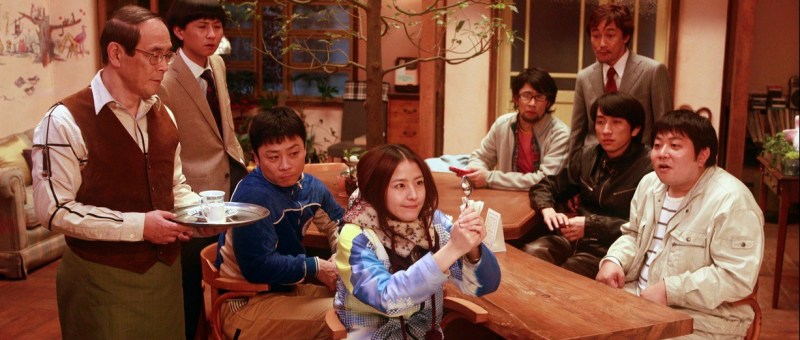
Based on a comic stage play, Go Find a Psychic! roots its humour in the everyday. The psychics of Cafe Kinesis are a bunch of ordinary middle-aged men of the kind you might find in any small town watering hole anywhere in Japan. The only difference is, they have a collection of almost useless superhuman abilities including the manipulation of electronic waves (useful for getting an extra item out of a vending machine), telekinesis (“useful” for throwing your annoying boss halfway across the room), X-ray vision (which has a number of obvious applications), and mind reading (or more like image transmission). The bar owner is not a psychic himself but was once helped by one which is why he set up the bar, hoping to meet and thank the person who frightened off an angry dog that was trying to bite him. Seeing as all the guests are psychic, no one is afraid to show off their talents but when a newcomer, Mr. Kanda (Hideto Iwai), suddenly shows up it creates a problem when the gang realise his “ability” of being “thin” is just the normal kind of skinniness. Seeing as he’s not a proper psychic, can they really let him leave and risk exposing the secrets of Cafe Kinesis?

Meanwhile, Yone’s quest continues – bringing her into contact with a strange man who claims he can withstand the bite of a poisonous African spider. Needless to say, the spider will be back later when the psychics become convinced Yone’s brought it with her presenting them with a conflict. They don’t want her to find out about their psychic powers and risk getting put on TV, but they can’t very well let her walk off with a poisonous spider trapped about her person. Despite small qualms about letting Kanda leave in one piece, the psychics aren’t bad guys and it is Christmas after all. Realising Yone just really loves all sort of psychic stuff and is becoming depressed after getting her illusions repeatedly shattered, the gang decide to put on a real Christmas show to rekindle her faith in the supernatural.

Just because you invite a UFO to your party and it doesn’t turn up it doesn’t mean it doesn’t exist. Some things can’t be explained by science. Maybe those old guys from the bar really can make miracles if only someone points them in the right direction. Like a good magic trick, perhaps it’s better to keep a few secrets and not ask too many questions about how things really work. For Yone the world is better with a little magic in it, even if you have to admit that people who want to go on TV aren’t usually going to be very “genuine”. That doesn’t mean that “genuine” isn’t out there, but if you find it you might be better to keep it to yourself or risk losing it entirely.


Original trailer (no subtitles)