
You Are the Film (君は映画, Makoto Ueda, 2026) [Fantasia 2026]

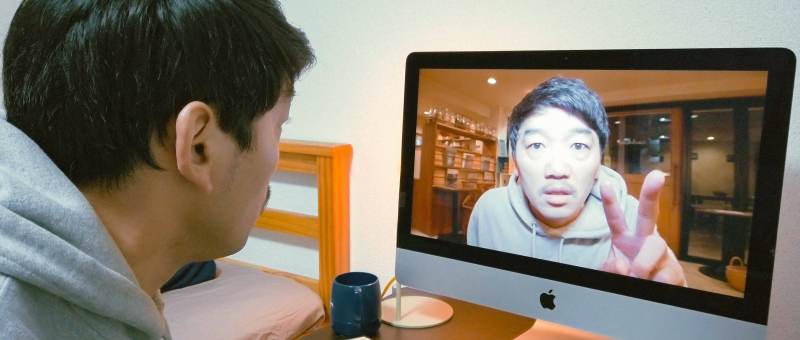
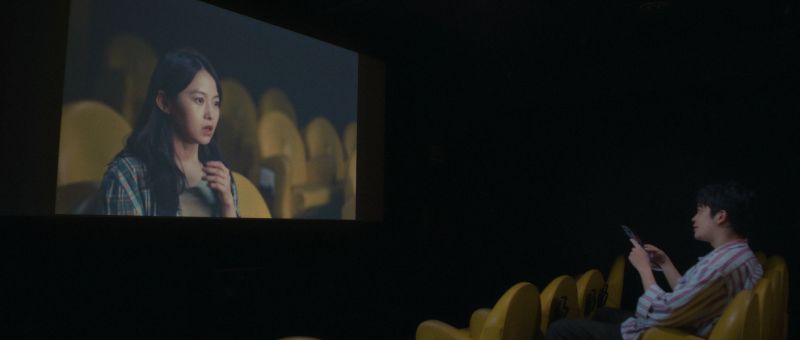
What if you went to see a film, but it was actually just a Zoom meeting with another person who thought they were there to see a film about you? That isn’t quite what happens in Makoto Ueda’s directorial debut You Are the Film (君は映画, Kimi wa Eiga), but it does take the protagonists longer than one would expect to stop suspending their disbelief, convinced that “a film” is conversing with them, and consider that they’re actually just watching a live feed of another person who is also watching them. 

But then again, the image reflected back at them from the screen is also a kind of wilful fantasy designed as both an escapist flight from an unsatisfying “reality” and a means of reframing their current dilemmas so that they can think about them more clearly. Effectively, it’s a way of realising what you might advise someone else to do in this situation, but wouldn’t actually consider doing yourself until you’re given this external vision of your own life. Ueda hints at this subtlety in the film’s opening sequence as he has playwright Madoka (Marika Ito) walk past a forked road representing a bifurcated reality, just as the film she’s going to see takes place directly adjacent to where she’s currently watching it, which is also the environment in which she spends the majority of her life. 

Both she and struggling musician Kazuma (Kai Inowaki) have enough in common to see themselves in the protagonist of the other film, and not just because Kazuma also inhabits this physical space too just on the other side of Madoka. He has a strained relationship with a band member and is so far failing to sell enough tickets for their upcoming concert. Madoka, meanwhile, has been offered the opportunity to put on a play at a larger, more prestigious venue but is feeling the pressure and struggling to complete her script. Despite what originally seems to be a very weird and uncanny situation, they eventually realise that they are able to help each other in a more direct way such as feeding back information about their respective “films” from the pamphlets they sell at the cinema.

But at the same time, the film seems to be in a way satirising these kinds of indie dramas or at least the sci-plot that develops on Madoka’s side is not that far away from the kind zany fringe theatre that troupes like hers often perform. In fact it’s even foreshadowed in the opening sequence as her co-stars seemingly play princess and retainer from another world mystified by the existence of a thermal tumbler, an apparent symbol of corporate oppression. Kazuma’s meanwhile spirals into an unlikely crime drama when his bandmate steals some money from a pair of counterfeiters which eventually exposes that the rock cafe he frequents is a front for an illegal gambling den run by an undercover gangster.

Despite these seemingly apocalyptic scenarios, what they learn is that they are able to change the script and eventually escape their own movie by transcending it, leading to the creation of a third movie starring those they left behind. It turns out that their friends are also yearning for escape in one way or another as Madoka’s friend Shiho has been offered a promising opportunity and secretly wants to move on, while the other actress sort of longs to escape by staying with the troupe but says she wants to leave as her parents have finally found out that she hasn’t been studying for the civil service exam after all. While watching these dramas play out Kazuma comes to his own realisations about his relationships with his bandmates, just Madoka begins to realise that all these desires must also be respected. If she wants to escape her movie, so does everyone else, and in order to be free she will have to let them go.

Nevertheless, each of them learn to embrace their status as the protagonist of their own lives with full authorial power to change the script, rejecting the meddling interference of some kind of engineer sent to rectify the “entanglement in filmspace” and get everyone back inside the right movie again. It turns out that you really are the film, and so is everyone else, but our realities aren’t as separate as they first seemed and we can still help each other out as we go along rather than remaining passive spectators within our own lives and those of others.


You Are the Film screened as part of this year’s Fantasia International Film Festival.

Trailer (English subtitles)
River (リバー、流れないでよ, Junta Yamaguchi, 2023) [Fantasia 2023]

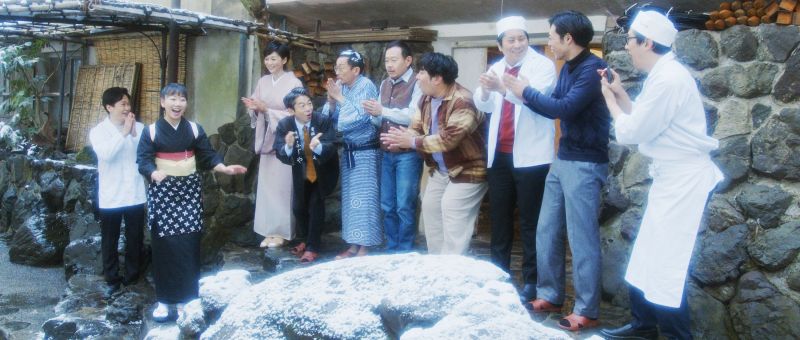
Some might say time stands still in the “peaceful” hot springs town of Kibune, but on this particular day it’s more than usually true in Junta Yamaguchi’s followup to the cult hit Beyond the Infinite Two Minutes, River (リバー、流れないでよ, River, Nagarenai de yo). This time around, the staff of a hotel along with its guests find themselves trapped in an infinite two minute loop in which they retain all their memories but are constantly returned to where they were two minutes previously no matter what they do. 

Depending on the situation, two minutes can be an eternity or an instant (or perhaps it’s always both) and in this case there isn’t much you can do in such a short time. The hotel staff find themselves constantly running up stairs and through corridors trying to coordinate their actions while accepting that nothing is permanent and any changes they try to make to their situation will be wiped out in the next loop. A chef who is also apparently a science enthusiast cautions them against taking any rash actions seeing as they can’t know when time will start flowing normally again, though for some the opportunity to embrace guilty pleasures such as poking a hole in the shoji is too good to pass up. 

As for what’s causing it, no one really knows but as it turns out everyone has a reason they might want to stop time. For maid Mikoto (Riko Fujitani) it’s that she fears her boyfriend plans to move abroad to study French cooking while another pair of guests secretly wanted to ask each other favours but are having trouble plucking up the courage and a blocked writer consumed with guilt for having killed off a key character is glad he can finally take some time out only to be slowly bored out of his mind when faced with an eternity of nothingness. The irony is that people come to places like these precisely because they’re “boring”, free from the chaos and stress of their ordinary lives. Mikoto says as much while wondering if that’s why her boyfriend wants to leave, that he feels as if he’s stagnating in a place where nothing changes and time doesn’t flow and that while he could be “happy” here with her living an ordinary life there’d always be a part of him wanting more.

Still, having this additional time helps each of them find clarity and begin to resolve some of their worries and anxieties. Even if they had “more time” in the more conventional sense, they may never have been able to speak plainly but given the enforced constraints of the time loop in which they quickly run out of other things to do and are more or less forced to talk to each other, they are all able to come to some kind of accommodation with what’s been bothering them. The two male guests are able to clear the air after an argument, the writer comes to a new appreciation of his characters thanks to his own sense of despair being trapped in the loop, and Mikoto realises she’ll have to let her boyfriend go in the hope that he’ll circle back around to her in time. 

The complexities involved are unlike those in Beyond the Infinite Two Minutes given that time constantly resets so the only point of consistency is the initial position of each person though the infinite quality of the looping provokes an additional layer of existential questioning as each of the various protagonists is forced to ask if they’re really moving on with their lives or even notice that time is indeed flowing. The clue that something is continuing to move lies in the differing levels of snowfall in each of the loops hinting at the increasing depths of their despair as they realise that not even death might free them from the maddening cycle of repetition while accepting they’ll have to work together to figure out what’s going on and how to escape the loop. The farcical humour soon gives way to a more poignant sense of reflection but also to a renewed joy and excitement that the future might actually be fun too and maybe it’s less scary to go there than be quite literally stuck in the present for all of eternity.


River screened as part of this year’s Fantasia International Film Festival.

Original trailer (English subtitles)

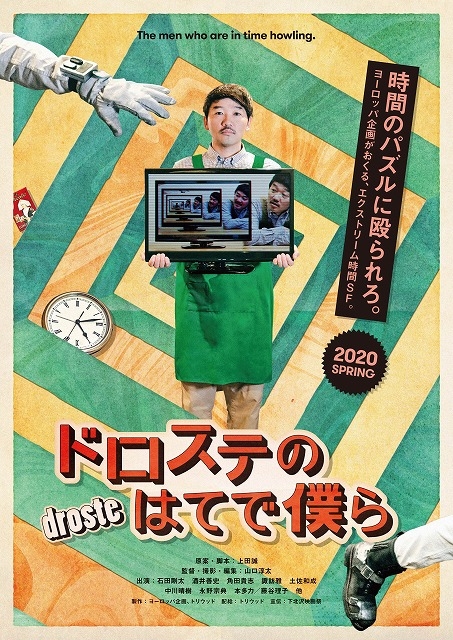
Beyond the Infinite Two Minutes (ドロステのはてで僕ら, Junta Yamaguchi, 2020)

If you had the opportunity to talk to your future or past self, what would you want to say to them? There are many advantages to having some knowledge of things still to come, finding out next week’s winning lottery numbers for example or who’s going to win the Grand National, but on the other hand mightn’t you start to feel as if your life has no freedom or purpose if you find yourself compelled to do exactly as your future self advised? That’s something the future-hating hero of Junta Yamaguchi’s farcical time travel comedy Beyond the Infinite Two Minutes (ドロステのはてで僕ら, Droste no Hate de Bokura) can’t help feeling as he finds himself trapped in an infinite loop of communication with the him from two minutes previously. 

Granted, getting knowledge of what’s going to happen in two minutes is not actually that useful. Cafe assistant Aya (Riko Fujitani) makes a point of asking her future self what the next era is going to be after Reiwa ends forgetting that it is almost certainly still Reiwa in two minutes’ time. Then again, it could help with very short term decisions such as whether or not to confess your feelings to a crush or which spots to scratch on your scratch card to win the best prizes, but maybe knowing only the immediate consequences of your actions isn’t very helpful either. Let’s say your future self finds a bunch of money and tells you to go get it, only the money belonged to gangsters and now you have a big problem with a two-minute head start. And then, can you really trust your future self? Maybe they aren’t being completely honest with you for reasons you may well understand in two minutes’ time. In any case, maybe you have better things to do than be struck in an infinite dialogue loop parroting back what you’ve just been told by your future self to your past self. Maybe you should learn to live in the moment. 

That’s something cafe owner Kato (Kazunari Tosa) has had trouble doing, later confessing that he hates the idea of knowing what lies ahead largely because he over invested in conspiracy theories and prophesies about the end of the world and therefore failed to plan very much for his future. His friends, however, are childishly excited by the discovery that his upstairs TV is linked to the downstairs with a two-minute delay, realising they can extend its range through the “Droste” effect to send themselves messages from further into the future, but then again how long do they really want to keep all this up slavishly reenacting the same conversations afraid of deviating from the original path lest they create a time paradox or provoke some other kind of disaster. They find themselves trapped in the middle as if the present no longer existed and had become merely a conduit between an extremely near future and very recent past. 

Yamaguchi captures their farcical dilemma with an ironic immediacy, filming with an elaborate one shot conceit that adds to the sense of wonder as the gang find themselves continually running upstairs and down to talk to themselves from either side of the time divide. The uncanny absurdity is the film’s greatest asset, placing this extremely bizarre scientific anomaly in the centre of an ordinary hipster cafe run by a guy who really wants to be a musician and is too shy to ask out the girl who works in the hairdresser’s next-door (Aki Asakura). By the time a pair of strange-looking gentlemen turn up claiming to be from the time travel police insisting that the guys stop all this nonsense before they cause a serious problem in the space time continuum you might come to sympathise with Kato’s resentment in feeling as if the future is controlling him but then there are always unexpected ways to rebel against fate and who knows, maybe your romantic destiny will work out after all with a little old-fashioned conversation only tangentially assisted by sci-fi hijinks. A charmingly whimsical take on time travel shenanigans and their existential dilemmas, Yamaguchi’s meticulously plotted farce is an indie gem.  


Beyond the Infinite Two Minutes streams in Germany 1st to 6th June as part of this year’s Nippon Connection.

Original trailer (English subtitles)