A Wanderer’s Notebook (放浪記, Mikio Naruse, 1962)

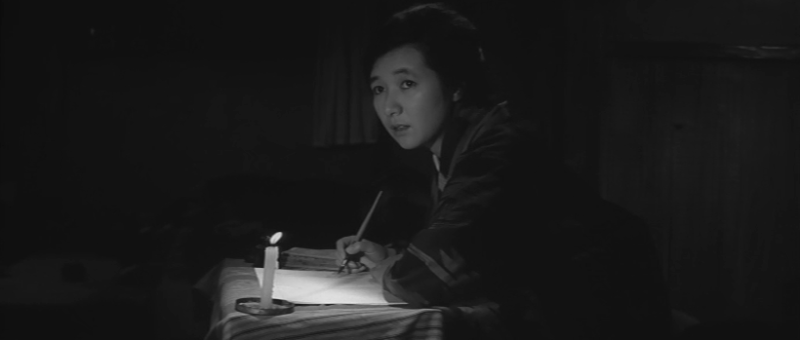
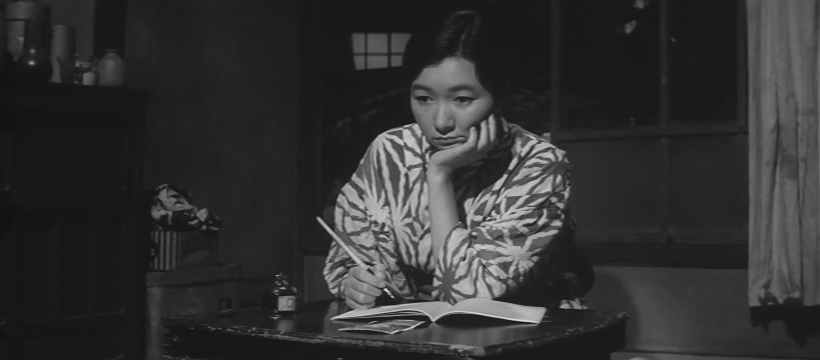
Many of Mikio Naruse’s most famous films are adapted from the work of Fumiko Hayashi, a pioneering female author who chronicled the life of a working class woman with startling frankness. Yet his dramatisation of her life, A Wanderer’s Notebook (放浪記, Horo-ki), is both a little more reactionary than one might have expected and surprisingly unflattering even in the heroine’s eventual triumph in escaping her poverty through artistry. Even so if perhaps sentimentalising the economically difficult society of the 1920s in emphasising the suffering which gave rise to Hayashi’s art, the film does lay bare the divisions of class and gender that she did to some extent transgress in pursuit of her literary destiny. 

Naruse and his screenwriters Toshiro Ide and Sumie Tanaka bookend the the film with a literal “lonely lane” which the young Fumiko walks with her itinerant salespeople parents. As a small child, she sees her father arrested for a snake oil scam peddling some kind of wondrous lotion, setting up both her disdain for men in general and her determination not to be deceived by them at least unwittingly. She has no formal education but is a voracious reader well versed in the literary culture of the time and intensely resentful of if resigned to her poverty. In the frequent sections of text which litter the screen taken directly from her novels, she details her purchases, wages, and longing for the small luxuries she can in no way afford. 

As an uneducated woman in the 1920s her working opportunities are few. She exasperatedly relates standing in a queue with hundreds of other women waiting for an interview for a company job only to be told they’ll let her know, while her other opportunity involves meeting a theatre director at a station who later takes her to his hotel/office and makes it plain he’s not really interested in her CV. She gets a job at the office of a stockbroker, but lies about being able to do accounts and is flummoxed by double entry bookkeeping getting herself fired on day one. After a brief stint in factory painting toys, she leaves with a friend to become a hostess but is also fired on her first day for getting drunk and being unwilling to ingratiate herself with the boorish men who frequent such establishments. 

Despite her animosity, she is drawn towards men who are callous and self-involved, firstly taking up with a poet and actor who praises her work but turns out to have several “wives” on the go, and then begins living with a broody writer, Fukuchi, who is insecure and violent, resentful at her success in wake of his failure. Perhaps because of her experiences, she seems to resent any hint of kindness though sometimes kind herself, lending money to her friend whose mother is in need and often ready to stand up for others whom she feels are being mistreated. A kindly widower in the boarding house where she lives with her mother, Yasuoka, falls in love with her but she repeatedly rejects him partly as someone suggests because he is not handsome, but mainly because of his goodness and kindness towards her. Nevertheless, he continues to support always ready in her time of need though having accepted that she will never return his feelings or accept his proposal. 

Perhaps her might have liked to have been kinder, but was too wounded by her experiences to permit herself. In any case at the film’s conclusion in which she has achieved success and in fact become wealthy it appears to have made her cold and judgemental. She instructs her maid to send a man away believing he is from a charity set up to help the poor, insisting that the poor must work for industry is the only path out of poverty implying that as she managed it herself those who cannot are simply not applying themselves when she of all people should know how fallacious the sentiment is. As if to bear out the chip on her shoulder, she forces her mother to wear a ridiculous kimono from a bygone era that is heavy for an old woman and makes her feel foolish because of her own mental image of the finery she dreamed of providing her on escaping the persistent hardship of their lives. 

As she says, she’s no interest in the socialist politics espoused by the literary circles in which she later comes to move, pointing out that the poor have no time for waving flags. One of her greatest supporters is himself from a noble family despite his progressive politics and in truth can never really understand the lives of women like Fumiko. He describes her work as like upending a rubbish bin and poking through it with a stick, at once fascinated and repulsed by a frankness he may see as vulgar. At one point he accuses her of writing poverty porn, playing on her humble origins for copy and becoming something of a one note writer. 

In truth, the film is not really based on the novel from which it takes its title but on the play that was adapted from it, while the novel itself was apparently reworked and republished several times in response to reader taste giving rise to a series of questions both about its essential authenticity and what it was that it was attempting to convey. In the film at least, moments after her literary success, Fumiko is challenged by a fellow female writer, Kyoko, who was once her love rival, that she cheated in a contest by failing to submit Kyoko’s entry until after the deadline had passed, though as it seems she would have won anyway. She is occasionally underhanded, perhaps because she feels she has no other choice, but then as we can see there is no particular solidarity between women save the kindly landladies who often let her delay her rent payments. Fumiko feels herself to be alone and her quest is not really for literary success but simply for her next meal, though she feels the slights of the bitchy women and arrogant men who mock her commonness while simultaneously exploiting it as entertainment. 

On the one hand, her success seems to signal a triumph of independence having freed herself from the need to depend on terrible men though she also she seems to have met and married a warmhearted painter who cares for her and supports her work while she has also been able to give her mother the level of comfort they both once dreamed of. Even so, the unavoidable fact that she dies at such a young age implies she’s worked herself into an early grave in a sense punishing her for her rejection of contemporary social norms undercutting her achievements with some regressive moralising while the one thing she still desires, rest, is given to her only in death. In Takamine’s highly stylised performance, as some have implied perhaps intended to mimic the silent screen, Fumiko is at once a carefree young woman who dances and sings and a melancholy fatalist with a self-destructive talent for choosing insecure and self-involved men, but above all else a woman walking a lonely road towards her own fulfilment while searching for a way out of poverty that need not transgress her particular sense of righteousness. 


Original trailer (no subtitles)

The Silent Duel (静かなる決闘, Akira Kurosawa, 1949)

Amid the labour strikes crippling Toho in the late ‘40s, Akira Kurosawa formed an association with other directors and film professionals and began working with different studios, the first being Daiei on a loose adaptation of a popular play in which an idealistic doctor struggles with his repressed desires while watching others wilfully embrace post-war selfishness and cynicism. Like many of Kurosawa’s films from this period, The Silent Duel (静かなる決闘, Shizukanaru Ketto) is essentially a meditation on post-war moral decline and what’s needed to correct it but also if somewhat accidentally the destructive effects of secret keeping and miscommunication. 

Kurosawa opens the film in 1944 with exhausted field medic Kyoji (Toshiro Mifune) operating on a badly wounded solider, Nakata (Kenjiro Uemura). Distracted by the constant dripping of a leaky roof, the adverse weather conditions outside, and the general stressfulness of the situation, Kyoji makes the fateful decision to remove his gloves to better accomplish the fiddly operation he is performing only to drop a scalpel and cut himself. He continues with the surgery, but realises that Nakata is likely infected with syphilis which he may have contracted through the wound on his finger. Kyoji tells Nakata, otherwise recovering well, that he should make sure to seek treatment but overhears him boasting that his injuries may soon save him from the battlefield. Kyoji continues to serve but is unable to treat the infection effectively with the limited resources available to him as a frontline medic allowing the disease to continue its progression largely unmitigated.

Taking a job at his father’s obstetrics clinic on his return to Japan, Kyoji breaks off his longstanding engagement to pre-war girlfriend Misao (Miki Sanjo) who has been waiting for him the last six years but refuses to explain to her why he cannot go through with their marriage. She assumes it must in some way be related to his war trauma, and in a way it is. The syphilis is an obvious metaphor for the corruptions of militarism. He declines to explain, he claims, because he is certain that Misao would vow to go on waiting for him until the disease is cured which would take at least three to five years assuming it can be cured at all. As she is already 27, he would be taking away Misao’s opportunity to make a happy marriage and have children with another man. In any case, he makes her decision for her which ironically conflicts with his later statement that she should be free to seek happiness on her own, not least because it seems she has been pressured into an arranged marriage by her financially troubled father. The act of childbirth is symbolically relevant though he does not seem to consider the idea of a platonic marriage perhaps uncertain that he could go on repressing his desires as a married man. So morally upright is he, that he also refuses to lie, saying nothing rather than allowing Misao to believe that he has fallen out of love with her, met someone else, or has another war-related issue that prevents his marrying her. Nor does he seem to consider telling her that he has syphilis and allowing her to come to the same conclusion as everyone else, that he contracted it through sleeping with sex workers during his military service which is most likely how Nakata became infected. 

The stigma associated with the disease adds a further dimension to Kyoji’s frustration given that he describes himself as having wilfully sublimated his physical desires in order to be able to return to a “peaceful marriage” with Misao whereas as Nakata who satisfied himself without a second thought returned home symptomless, married, and is soon to be a father. Re-encountering him by chance, Nakata who seems to have become wealthy doing something that is likely immoral if not illegal, tells Kyoji that his sickness is cured but does eventually bring his wife in for a free checkup to discover that he has passed the disease to her and to their unborn child. Yet even confronted with the truth, Nakata lies again and suggests that Kyoji has made all this up as revenge for something that happened in the war keeping the fact that he infected him from his wife. He blames Kyoji for destroying his family rather than accept his own responsibility and sees nothing wrong in his actions until directly confronted with the body of his stillborn child apparently so deformed and monstrous that they wouldn’t let the mother see it. 

The two men have clearly taken different paths, Kyoji certain that he must put others before himself and suppressing his own desires to ensure he cannot pass the disease on while Nakata buries his head in the sand and ignores it. It is a kind of metaphor for the post-war future, those like Kyoji acknowledging that the legacy of wartime trauma is something that must be acknowledged and actively healed before happiness is possible while those like Nakata simply plow on like nothing ever happened with no thought or consideration for those around them. Yet it is also Kyoji who lies by omission even in his selflessness just Nakata lied to his wife while the truth is only discovered by accident, firstly by reluctant nurse Minegishi (Noriko Sengoku) who walks in on him injecting the remedy for syphilis, she in turn then overheard by Kyoji’s father (Takashi Shimura) while Minegishi then overhears the explanation Kyoji gives him. She in a sense completes the cycle when she asks Misao to apologise to Kyoji on her behalf as she is too embarrassed to do so herself after realising that she got him wrong having resolved to turn her life around after learning of the depths of his selflessness. 

Minegishi had been a nightclub dancer who tried to take her own life after becoming pregnant by a man who abandoned her but was saved by Kyoji who gave her a job at the clinic and convinced her to raise the child. It’s this child, at first unwanted but later loved and embraced by all despite the stigma of his being born out of wedlock, that offers the clearest path towards a healthier future suggesting that the solution lies in accepting the past with a willingness to make something new out of it rather than in wilful denial and resentful self-interest. Yet Kyoji is also human and privately resentful. “If I’d known it would happen to me I would’ve done things differently” he sneers petulantly suggesting that his properness may be an affectation rather than deeply felt conviction but equally frustrated in feeling his fate is unjust and that he’s suffering for someone else’s sin. 

“Because of the blood of a shameless guy, my body became dirty without knowing any pleasure” he complains, hinting at a metaphor for his wartime contamination dragged into a conflict by forces outside of his control. The roles he plays are ironic, firstly a healer in a place of death and destruction and then as a deliverer of life at his father’s obstetrics clinic though he fears he will never have children of his own. He is in a sense trapped by his past as shown in the repeated visual metaphor of the closed gates outside the clinic on which the flowers that represent his relationship with Misao and hope for the future gradually wither. Minegishi tells him she’s in love with him and is willing to accept the risk of his disease to alleviate his desire, but he once again chooses to say nothing, immediately returning to business. As his father points out, he has (for the most part) resolved to channel his resentment into helping those less happy than himself but if he had been happy he may have become a snob, indifferent to the suffering of others. In some ways his problem is the familiar giri/ninjo conflict as he fights a silent duel within himself between his natural desires and his better nature but it’s also a battle against the slow poison of the wartime legacy through compassion and selflessness that may, like his inescapable illness, eventually drive him into madness.


The Silent Duel screens at the BFI Southbank, London on 2nd & 11th February 2023 as part of the Kurosawa season.