The Insect Woman (にっぽん昆虫記, Shohei Imamura, 1963)

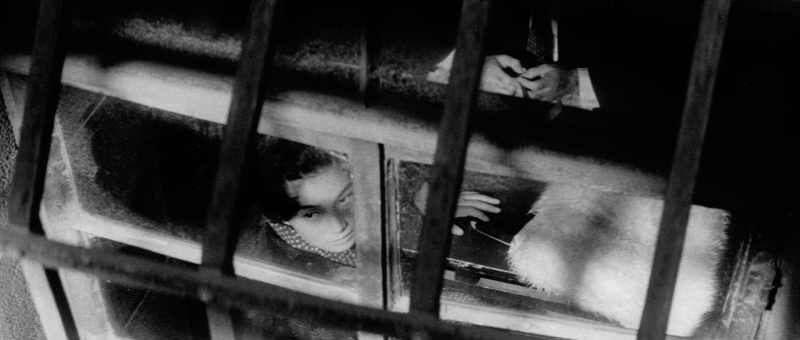
“What other way is there?” a young woman says to her mother, little understanding that what she so casually tells her quietly crushes her mother’s view of herself as if her long years of suffering had all been for nothing while exposing her justification that everything she had done was to save her daughter from her own fate as not strictly true. The opening scenes of Shohei Imamura’s The Insect Woman (にっぽん昆虫記, Nippon Konchuki) follow a bug stubbornly traversing rough terrain, slipping, pushing onward, overcoming obstacles, yet not really getting anywhere.

The bug’s journey is echoed in Tome’s (Sachiko Hidari) return to the village at the end of the film, now an ageing woman struggling with mountain roads after long years spent in the city and finally snapping her geta leaving her barefoot on rocky ground. Like that of the bug, Tome’s life seems to be a flat circle in which history repeats itself inexorably. The film opens in 1918 as Tome is born out of wedlock to a promiscuous woman who has entered a common law union with a man who appears to have learning difficulties. Chuji (Kazuo Kitamura) may or may not be her biological father, but has an attachment to Tome. As a child, she had asked him whether they are “married” seeing as they sleep together, and he had said that they were. There is definitely more than humouring a little girl’s silly question in his reply, while he flies into jealous rages when there is talk of marrying off the older Tome to the local landlord’s son. 

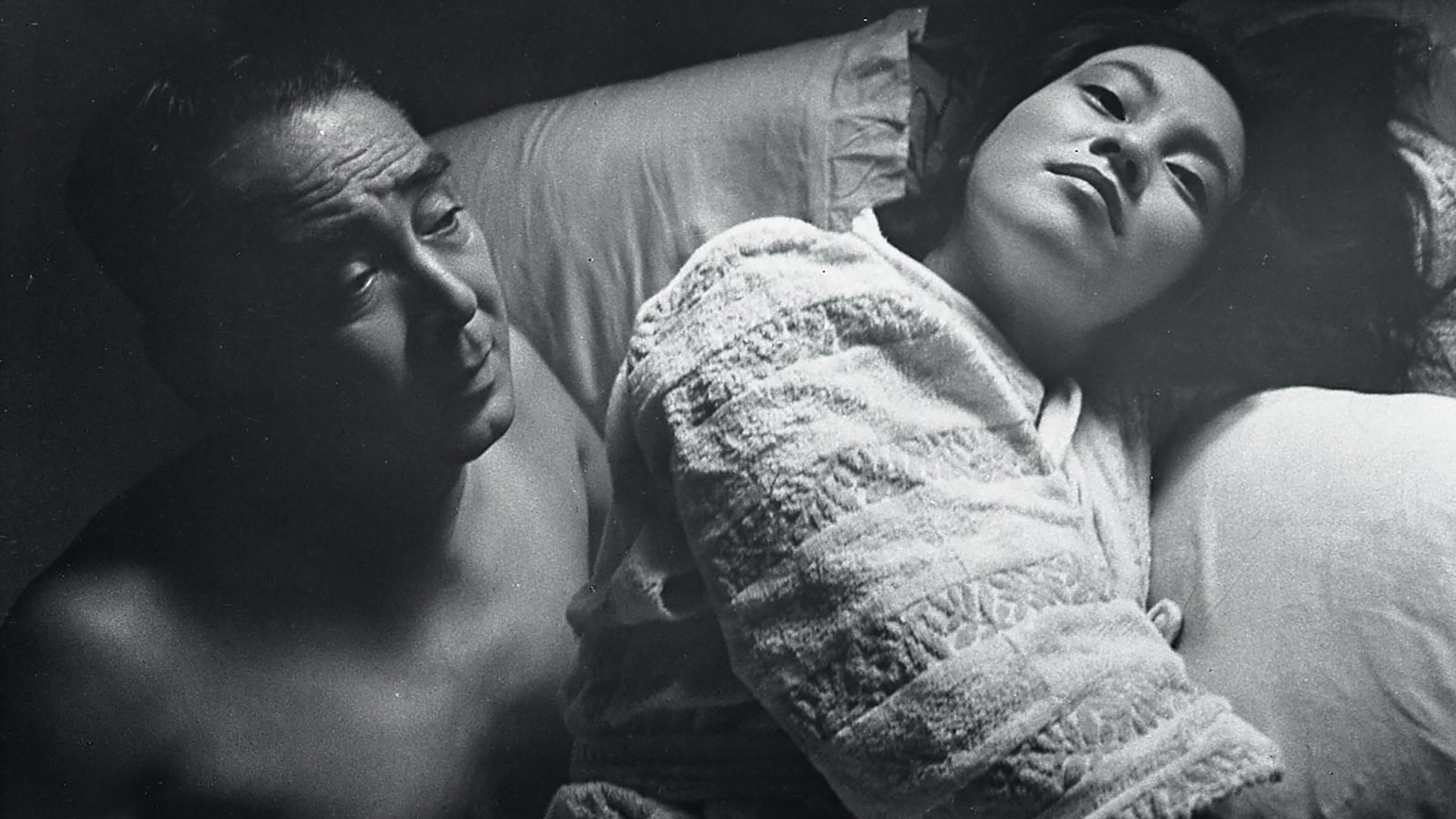
Just as her mother had, Tome also has a child out of wedlock, though the father can only be Shuzo, the man her family intended her to marry in part in settlement of a longstanding debt. Tome’s early life is defined by the lingering feudalism of the rural society in which her family are serfs beholden to the whims of the landlord. The older women in the village call her away from her factory job which she says she is doing for the war effort to help on the landlord’s farm. Though she is assured she is only required to do farm work, she is raped by Shuzo who urges her to submit to him and serve her country in another way by letting him have his way with her as he will soon be going off to die for the emperor. Tome then becomes his woman, but not actually his legal wife while this justification wears a little thin when it is revealed that Shuzo has another woman and child already and thus will likely not marry her. When she becomes pregnant and Chuji beats Shuzo up, Tome is sent back to her family to have the baby. It turns out to be a girl and the older women have a brief conversation about whether to let it die as female babies are worthless and resources are scarce. This seems to run contrary to rural wisdom seen in other films such as Imamura’s later The Ballad of Narayama in which, grim as it is, male children are often exposed as girls at least can be sold, though possibly not any longer in the new democratic society.

Nevertheless, Tome insists on keeping her baby though feels out of place among her family and returns to the factory where he she has an affair with the married foreman who gets her into trade unionism and then complains that she’s too militant about the labour movement when he gets promoted to assistant manager. Tome bristles at his hypocrisy, but later abandons her ideals herself and becomes an exploiter of women after moving to the city. After visiting a shady cult to overcome her sense of guilt after a child she was looking after who reminded her of her own faraway daughter died in accident, Tome meets a devotee who complains that all of the contemporary society’s ills are caused by a lack of religious rigour, yet is actually running a brothel staffed by “amateur” sex workers to which she forcibly recruits Tome by locking her in a room with a customer. 

Just as Tome schemes by dobbing her new boss in to the police so she can start up her own business using the women as call girls posing as one half of a regular couple to avoid police detection, so she is later betrayed by her own prodigy. Tome’s travel from her rural hometown to Tokyo mimics the nation’s transition from an agrarian to an urban society mired in post-war corruption as seen in the cynical and exploitive conditions at the brothel in which the madam takes almost all the money for herself, deducting large amounts for things like kimonos and room and board, while the “amateur” sex workers prepare blood vials to convince the customers they are virgins. Tome always states that her goal is to earn enough money so that she, Chuji, and her daughter Nobuko who have been shunned by the family, could live together but though she becomes quite wealthy and sends large amounts of money home she makes no real attempt to bring them with her or to go back to the village. 

A grown-up Nobuko (Jitsuko Yoshimura) later comes to her and asks for money because some of the local youngsters are trying to start a collective farm in the wake of land reforms that redistributed landlords’ lands and ended serfdom. Tome is distressed to know that Nobuko has dropped out of school though Tome has been sending her money for the fees, realising that Nobuko will not escape the village through education nor through marrying a nice professional husband and moving to the city. In fact, Nobuko follows in the footsteps of her mother and grandmother by conceiving a child of uncertain lineage out of wedlock after being coaxed into a sexual relationship with her mother’s former lover, Karasawa (Seizaburo Kawazu), a once-prominent businessman who has fallen on hard times. He agrees to lend her the money for the farm on the condition that she make herself sexually available to him twice a week. He eventually asks her to stay and run a shop he owns instead. Nobuko agrees, but actually runs off with the money for the farm and returns to her boyfriend Yoshiji. Like Chuji, he also questions the paternity of her child, but seems to have accepted the fact it may not be his while agreeing to raise it. Tome, meanwhile, returns to the village on Karasawa’s behalf planning to tell Yoshiji about Nobuko’s life in the city in an attempt to force her to return to him.

In blowing Karasawa off and taking the money to invest in the farm, Nobuko may have broken the cycle in another way in shaking off male authority and rejecting the consumerism of the urban society, though her farm is also envisioned as a money-making business that will make them rich rather than purely self-sufficient. Another passenger on the train Tome is travelling on remarks that the rice tastes better because they have had good harvests, bearing out Nobuko’s optimism for the future. Yet in other ways, Tome is merely a passive everywoman largely oblivious to the history happening all around her. She misses the emperor’s speech announcing the end of the war while sick from malnutrition and canoodling with her lover. A former union organiser she ironically gets caught up in the Matsukawa train derailment that was blamed on the Communist Party and Japan National Railway Union which the authorities desperately wanted to crush. As an older woman, she runs into the 1960 Anpo protests, but is irritated because they disrupt her cab journey costing her time and money. She may have been corrupted by the urban, amoral capitalism of the post-war society, but is neither good nor bad, just herself and someone doing what they can to survive. 

Imamura had said that he wanted to challenge the image of suffering womanhood seen in golden age cinema. Self-sacrificing heroines such as those in Naruse’s Floating Clouds or Mizoguchi’s Life of Oharu don’t really exist, he explained. His heroines were strong and outlived men, just like Tome who tries to carve out a kind of independence for herself, but eventually finds it taken from her by other women trying to do the same. Imamura had been prevented from making another film for three years after going over budget on Pigs and Battleships, but returns with a bold new stylistic experiment using freeze fames and ironic composition to depict the “messiness” of Tome’s life in all of its moral ambiguities, victories, and defeats.
A Wanderer’s Notebook (放浪記, Mikio Naruse, 1962)

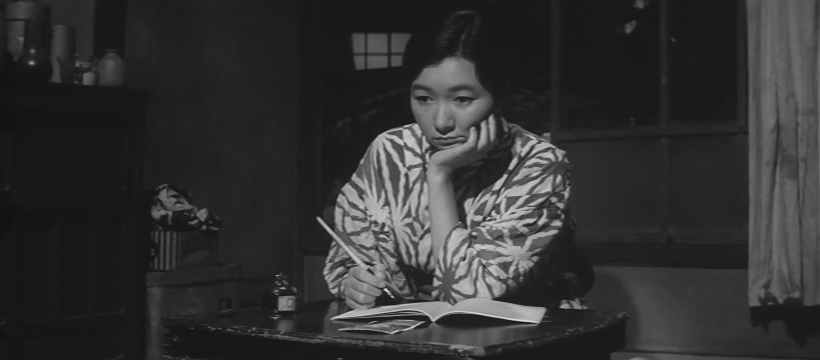
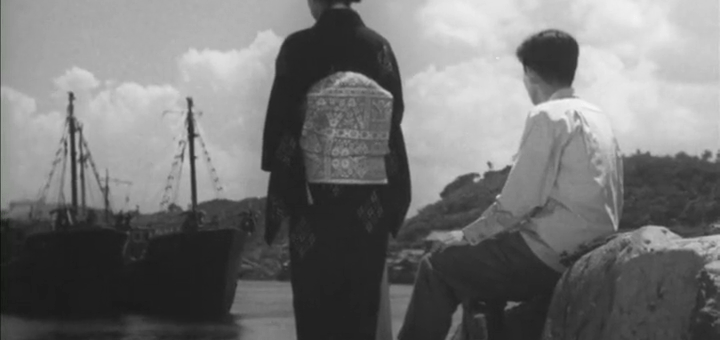
Many of Mikio Naruse’s most famous films are adapted from the work of Fumiko Hayashi, a pioneering female author who chronicled the life of a working class woman with startling frankness. Yet his dramatisation of her life, A Wanderer’s Notebook (放浪記, Horo-ki), is both a little more reactionary than one might have expected and surprisingly unflattering even in the heroine’s eventual triumph in escaping her poverty through artistry. Even so if perhaps sentimentalising the economically difficult society of the 1920s in emphasising the suffering which gave rise to Hayashi’s art, the film does lay bare the divisions of class and gender that she did to some extent transgress in pursuit of her literary destiny. 

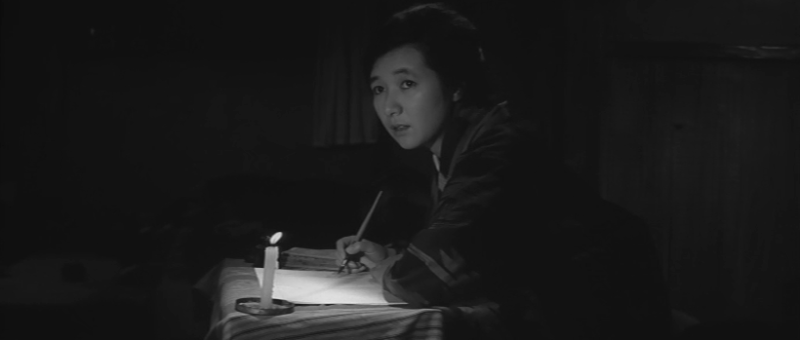
Naruse and his screenwriters Toshiro Ide and Sumie Tanaka bookend the the film with a literal “lonely lane” which the young Fumiko walks with her itinerant salespeople parents. As a small child, she sees her father arrested for a snake oil scam peddling some kind of wondrous lotion, setting up both her disdain for men in general and her determination not to be deceived by them at least unwittingly. She has no formal education but is a voracious reader well versed in the literary culture of the time and intensely resentful of if resigned to her poverty. In the frequent sections of text which litter the screen taken directly from her novels, she details her purchases, wages, and longing for the small luxuries she can in no way afford. 

As an uneducated woman in the 1920s her working opportunities are few. She exasperatedly relates standing in a queue with hundreds of other women waiting for an interview for a company job only to be told they’ll let her know, while her other opportunity involves meeting a theatre director at a station who later takes her to his hotel/office and makes it plain he’s not really interested in her CV. She gets a job at the office of a stockbroker, but lies about being able to do accounts and is flummoxed by double entry bookkeeping getting herself fired on day one. After a brief stint in factory painting toys, she leaves with a friend to become a hostess but is also fired on her first day for getting drunk and being unwilling to ingratiate herself with the boorish men who frequent such establishments. 

Despite her animosity, she is drawn towards men who are callous and self-involved, firstly taking up with a poet and actor who praises her work but turns out to have several “wives” on the go, and then begins living with a broody writer, Fukuchi, who is insecure and violent, resentful at her success in wake of his failure. Perhaps because of her experiences, she seems to resent any hint of kindness though sometimes kind herself, lending money to her friend whose mother is in need and often ready to stand up for others whom she feels are being mistreated. A kindly widower in the boarding house where she lives with her mother, Yasuoka, falls in love with her but she repeatedly rejects him partly as someone suggests because he is not handsome, but mainly because of his goodness and kindness towards her. Nevertheless, he continues to support always ready in her time of need though having accepted that she will never return his feelings or accept his proposal. 

Perhaps her might have liked to have been kinder, but was too wounded by her experiences to permit herself. In any case at the film’s conclusion in which she has achieved success and in fact become wealthy it appears to have made her cold and judgemental. She instructs her maid to send a man away believing he is from a charity set up to help the poor, insisting that the poor must work for industry is the only path out of poverty implying that as she managed it herself those who cannot are simply not applying themselves when she of all people should know how fallacious the sentiment is. As if to bear out the chip on her shoulder, she forces her mother to wear a ridiculous kimono from a bygone era that is heavy for an old woman and makes her feel foolish because of her own mental image of the finery she dreamed of providing her on escaping the persistent hardship of their lives. 

As she says, she’s no interest in the socialist politics espoused by the literary circles in which she later comes to move, pointing out that the poor have no time for waving flags. One of her greatest supporters is himself from a noble family despite his progressive politics and in truth can never really understand the lives of women like Fumiko. He describes her work as like upending a rubbish bin and poking through it with a stick, at once fascinated and repulsed by a frankness he may see as vulgar. At one point he accuses her of writing poverty porn, playing on her humble origins for copy and becoming something of a one note writer. 

In truth, the film is not really based on the novel from which it takes its title but on the play that was adapted from it, while the novel itself was apparently reworked and republished several times in response to reader taste giving rise to a series of questions both about its essential authenticity and what it was that it was attempting to convey. In the film at least, moments after her literary success, Fumiko is challenged by a fellow female writer, Kyoko, who was once her love rival, that she cheated in a contest by failing to submit Kyoko’s entry until after the deadline had passed, though as it seems she would have won anyway. She is occasionally underhanded, perhaps because she feels she has no other choice, but then as we can see there is no particular solidarity between women save the kindly landladies who often let her delay her rent payments. Fumiko feels herself to be alone and her quest is not really for literary success but simply for her next meal, though she feels the slights of the bitchy women and arrogant men who mock her commonness while simultaneously exploiting it as entertainment. 

On the one hand, her success seems to signal a triumph of independence having freed herself from the need to depend on terrible men though she also she seems to have met and married a warmhearted painter who cares for her and supports her work while she has also been able to give her mother the level of comfort they both once dreamed of. Even so, the unavoidable fact that she dies at such a young age implies she’s worked herself into an early grave in a sense punishing her for her rejection of contemporary social norms undercutting her achievements with some regressive moralising while the one thing she still desires, rest, is given to her only in death. In Takamine’s highly stylised performance, as some have implied perhaps intended to mimic the silent screen, Fumiko is at once a carefree young woman who dances and sings and a melancholy fatalist with a self-destructive talent for choosing insecure and self-involved men, but above all else a woman walking a lonely road towards her own fulfilment while searching for a way out of poverty that need not transgress her particular sense of righteousness. 


Original trailer (no subtitles)

Fireworks Over the Sea (海の花火, Keisuke Kinoshita, 1951)

In the films of Keisuke Kinoshita, it can (generally) be assumed that the good will triumph, that those who remain true to themselves and refuse to give in to cynicism and selfishness will eventually be rewarded. This is more or less true of the convoluted Fireworks Over the Sea (海の花火, Umi no Hanabi) which takes a once successful family who have made an ill-advised entry into the fishing industry and puts them through the post-war ringer with everything from duplicitous business associates and overbearing relatives to difficult romances and unwanted arranged marriages to contend with.

The action begins in 1949 in the small harbour town of Yobuko in Southern Japan. Tarobei (Chishu Ryu) and his brother Aikawa (Takeshi Sakamoto) run a small fishing concern with two boats under the aegis of the local fishing association. The business is in big trouble and they’re convinced the captain of one of the boats has been secretly stealing part of the catch and selling it on the black market. Attempts to confront him have stalled and the brothers are at a loss, unsure how to proceed given that it will be difficult to find another captain at short notice even if they are already getting serious heat from their investors and the association.

Luckily things begin to look up when a familiar face from the past arrives in the form of Shogo (Takashi Miki) – a soldier who was briefly stationed in the town at the very end of the war during which time he fell in love with Tarobei’s eldest daughter, Mie (Michiyo Kogure). Shogo has a friend who would be perfect for taking over the boat and everything seems to be going well but the Kamiyas just can’t seem to catch a break and their attempt to construct a different economic future for themselves in the post-war world seems doomed to failure.

The Kamiyas are indeed somewhat persecuted. They have lost out precisely because of their essential goodness in which they prefer to conduct business honestly and fairly rather than give in to the selfish ways of the new society. Thus they vacillate over how to deal with the treacherous captain who has already figured out that he holds all the cards and can most likely walk all over them. They encounter the same level of oppressive intimidation when they eventually decide to fight unfair treatment from the association all the way to Tokyo only to be left sitting on a bench outside the clerk’s office for three whole days at the end of which Tarobei is taken seriously ill.

However, unlike Kinoshita’s usual heroes, Tarobei’s faith begins to waver. He is told he can get a loan from another family on the condition that their son marry his youngest daughter Miwa (Yoko Katsuragi). To begin with he laughs it off but as the situation declines he finds himself tempted even if he hates himself for the thought. He never wanted to be one of those fathers who treats his daughters like capital, but here he is. Both Miwa, who has fallen in love with the younger brother of the new captain, and her sister are in a sense at the mercy of their families, torn between personal desire familial duty. Mie, having discovered that her husband died in the war, is still trapped in post-war confusion and unsure if she returns Shogo’s feelings but in any case is afraid to pursue them when she knows the depths of despair her father finds himself in because of their precarious economic situation. Shogo is keen to help, but he is also fighting a war on two fronts seeing as his extremely strange (and somewhat overfamiliar) sister-in-law (Isuzu Yamada) is desperate to marry him off to her niece (Keiko Tsushima) in order to keep him around but also palm off her mother-in-law.

Meanwhile, a lonely geisha (Toshiko Kobayashi) who has fallen into the clutches of the corrupt captain is determined to find out what happened to someone she used to know who might be connected to Shogo and the Kamiyas and falling in desperate unrequited love with replacement captain Yabuki (Rentaro Mikuni) who is inconveniently in love with Mie. Kinoshita apparently cut production on Fireworks short in order to jet off to France which might be why his characteristically large number of interconnected subplots never coalesce. Running the gamut from melancholy existential drama to rowdy fights on boats and shootouts in the street, Kinoshita knows how to mix things up but leaves his final messages unclear as the Kamiyas willingly wave their traumatic pasts out to sea with a few extra passengers in tow still looking for new directions.


Titles and opening (no subtitles)

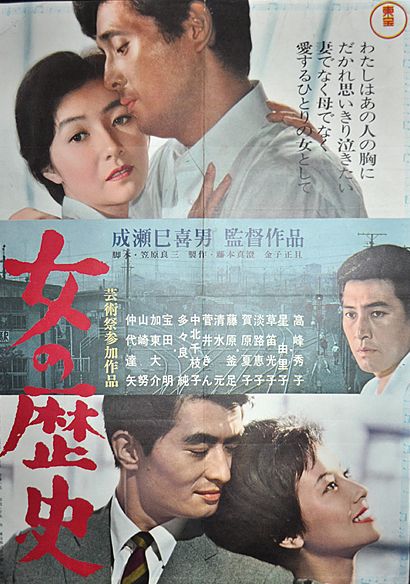
A Woman’s Story (女の歴史, Mikio Naruse, 1963)

woman's storyMikio Naruse made the lives of everyday women the central focus of his entire body of work but his 1963 film, A Woman’s Story (女の歴史, Onna no Rekishi), proves one of his less subtle attempts to chart the trials and tribulations of post-war generation. Told largely through extended flashbacks and voice over from Naruse’s frequent leading actress, Hideko Takamine, the film paints a bleak vision of the endless suffering inherent in being a woman at this point in history but does at least offer a glimmer of hope and understanding as the curtains falls.
We meet Nobuko Shimizu (Hideko Takamine) in the contemporary era where she is a successful proprietor of a beauty salon in bustling ‘60s Tokyo. She has a grown up son who works as a car salesman though he’s often kept out late entertaining clients and has less and less time for the mother who gave up so much on his behalf. Her life is about to change when Kohei (Tsutomu Yamazaki) suddenly announces that he wants to get married – his lady love is a bar hostess to whom he’s become a knight in shining armour after saving her from a violent and persistent stalker. Needless to say, Nobuko does not approve both for the selfish reason that she isn’t ready to “lose” her son, and because of the social stigma of adding a woman who’s been employed in that line of work to the family.

All of this is about to become (almost) irrelevant as tragedy strikes leaving Nobuko to reflect on all the long years of suffering she’s endured up to this point only to have been struck by such a cruel and unexpected blow. An arranged marriage, her husband’s infidelity, the war which cost her home, possessions and also the entirely of her family, and finally the inescapable pain of lost love as the man who offers her salvation is quickly removed from her life only to resurface years later with the kind of pleasantries one might offer a casual acquaintance made at party some years ago. Life has dealt Nobuko a series of hard knocks and now she’s become hard too, but perhaps if she allows herself to soften there might be something worth living for after all.

Women of a similar age in 1963 would doubtless find a lot to identify with in Nobuko’s all too common set of personal tragedies. They too were expected to consent to an arranged marriage with its awkward wedding night and sudden plunge into an unfamiliar household. Nobuko has been lucky in that her husband is a nice enough man who actually had quite a crush on her though there is discord within the household and Nobuko also has to put up with the unwelcome attentions of her father-in-law. This familial tension later implodes though fails to resolve itself just as Japan’s military endeavours mount up and Nobuko gives birth to her little boy, Kohei. Husband Kouichi becomes increasingly cold towards her before being drafted into the army leaving her all alone with a young child.

All these troubles only get worse when the war ends. Though Kouichi’s former company had been paying his salary while he was at the front, they care little for his widow now. Left with nothing to do but traffic rice, Nobuko comes back into contact with her husband’s old friend, Akimoto (Tatsuya Nakadai), who wants to help her but is himself involved in a series of illegal enterprises. Nobuko is molested twice by a loud and drunken man who accosts her firstly on a crowded train (no one even tries to help her) and then again at a cafe where she is only saved by the intervention of Akimoto, arriving just in the nick of time. Nobuko sacrifices her chances at happiness to care for Kohei, caring about nothing else except his survival and eventual success.

Of course, Kohei isn’t particularly grateful and feels trapped by his mother’s overwhelming love for him. Nobuko’s sacrifices have also made her a little bit selfish and afraid of being eclipsed in the life of her son. It’s easy to understand the way that she later behaves towards Kohei’s new bride, but if she wants to maintain any kind of connection to the son that’s become her entire world, she will need to learn to allow another woman to share it with her.

Naruse is a master at capturing the deep seated, hidden longings that women of his era were often incapable of realising but A Woman’s Story flirts with melodrama whilst refusing to engage. The awkward flashback structure lends the film a degree of incoherence which frustrates any attempt to build investment in Nobuko’s mounting sorrows, and the voiceover also adds an additional layer of bitterness which makes it doubly hard to swallow. This is in no way helped by the frequently melodramatic music which conspires to ruin any attempts at subtlety in favour of maudlin sentimentality. The endless suffering of mid-twentieth century women is all too well drawn as grief gives way to heartbreak and self sacrifice, though Naruse does at least offer the chance to begin again with the hope of a brighter and warmer future of three women and a baby building the world of tomorrow free of bombs and war and sorrow.


If You Were Young: Rage (君が若者なら, Kinji Fukasaku, 1970)

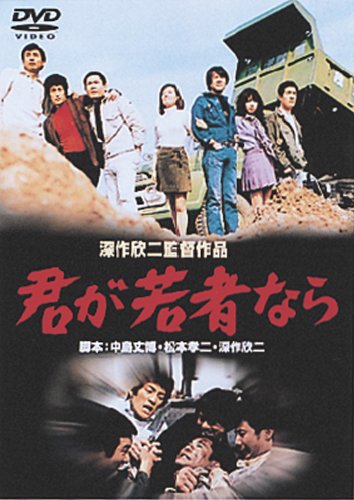
51AM0Z0Z2cLFor 1970’s If You We’re Young: Rage (君が若者なら, Kimi ga Wakamono Nara), Fukasaku returns to his most prominent theme – disaffected youth and the lack of opportunities afforded to disadvantaged youngsters during the otherwise booming post-war era. Like the more realistic gangster epics that were to come, Fukasaku laments the generation who’ve been sold an unattainable dream – come to the city, work hard, make a decent life for yourself. Only what the young men find here is overwork, exploitation and a considerably decreased likelihood of being able to achieve all they’ve been promised.

Our story revolves around five young men who meet whilst working at a factory which later goes bust. The central pair, Kikuo and Asao have been friends since childhood. Both of their fathers were killed in mining accidents and the boys are part of the “golden egg” movement bringing in workers from the rural towns to increase prosperity in the capital. The other three are a fisherman’s son, Kiyoshi, a boxing enthusiast Ryuji and fifth wheel Ichiro. After a short spell in gaol, the guys hatch on the idea of clubbing together to buy a dumper truck and start a business of their own. However, by the time they’ve actually got the truck one of them’s in prison, one pulls out because of a shotgun marriage and the other is killed in a labour dispute. Asao and Kikuo get on with living the dream and are doing pretty well with the truck until their imprisoned friend decides to escape and ruins all of their lives in the process.

Almost proto-punk in tone, If You Were Young: Rage takes a long hard look at the put upon masses who rebuilt Japan but were left with little in return. These five guys left their small towns for the big city promised high wages, access to education and a path to a better life but largely what they found was cold rooms and overwork. There are frequent strike motions in the film as the construction and factory workers attempt to insist on better pay and conditions but are constantly defeated by the white collar bosses who can just bus in even more desperate young men who will agree to cross the picket line because they have no other choice. Our central five now have a dream and something to work towards, their truck isn’t just “a truck” – it’s a hundred trucks somewhere down the line and a symbol of the path to prosperity.

However, at the end of the film all of their dreams have been shattered. Some of this is not their fault, merely the vicissitudes of fate and changing times, some of it is down to poor choices but largely the odds were always stacked against them because the world is unfair. Kiyoshi lies all the time because he’s scared of pretty much everything, possibly because of an abusive (though perhaps not uncommon) upbringing. His selfishness and, ultimately, cowardice is about to mess things up for everyone else and there are somethings you just can’t come back from. Like many of Fukasaku’s heroes, what Asao dreams of is the friendship he found when the five guys were all together and working as a team. He wants to go back to that time of perpetual hope and friendship rather than live in this lonely prosperity.

Fukasaku veers between quirky new wave style optimism and the extreme pessimism of his general world view. The film is bright and colourful for the majority of its running time with memory and fantasy often relegated to black and white. He uses his usual freeze frames, often in times of violence, hand held cameras and dynamic framing to achieve his youthful, freewheeling atmosphere but as usual there’s a kind of desperation lurking in the background. As might be expected, the ending is all flames and ashes – youth lies ruined, dreams shattered, and the possibility of moving on seems woefully far off. Another characteristically caustic look at modern youth from Fukasaku, this more indie effort is one of his most searing and bears out his rather bleak prognosis for the future of his nation.


If You Were Young: Rage is available with English subtitles on R1 US DVD from Homevision and was previously released as part of the Fukasaku Trilogy (alongside Blackmail is My Life and Black Rose Mansion) by Tartan in the UK.