The Kamikaze Guy (カミカゼ野郎 真昼の決斗, Kinji Fukasaku, 1966)

The hero of Kinji Fukasaku’s Kamikaze Guy (カミカゼ野郎 真昼の決斗, Kamikaze Yaro: Mahiru no Ketto) is described as cheerful and with a spirited personality though unfortunately not very bright. A vehicle for rising star Chiba, the film was intended as the first in a series starring its bumbling hero, Ken Mitarai, though no other instalments were ever produced. In any case, it seems to echo the lighter side of Nikkatsu’s borderless action line along with Toho’s spy spoofs in its wrong man tale of wartime legacy and corporate duplicity. 

Often called “Mr. Toilet” because of the way his name is pronounced, Ken (Sonny Chiba) is a slightly sleazy private plane pilot who has pinups on the roof of the cockpit. According to the voiceover, there is no bottom to the depths of his crassness which is a sentiment later borne out by his attempt to pick up a woman on a ski slope by uttering the immortal lines “please don’t think I’m a creep, just hear me out.” However, events take a turn for the strange when the pair of them are witness to a murder. Ken valiantly tries to help, but is later brought in as a suspect himself, partly as the police are annoyed by his smugness. The woman, Koran (Bai Lan), turns out to be from Taiwan which is where Ken ends up flying only to discover that his cargo is the body of an old man he also encountered at the slopes. 

In keeping wth the growing internationalism of mid-1960s Japanese cinema, the film travels to Taiwan but does so in a rather complicated way as Ken is drawn into a plot concerning three men responsible for the death of a Japanese official shortly after the war killed because he wanted to return 200 billion yen’s worth of diamonds stolen from the local population. While on his travels, Ken runs into a woman who was trafficked to the island at the age of 15 and later cheated out of the money she’s saved to return. The film almost flirts with the awkward relationship between the two nations and Japan’s imperialist past but in the end does not quite engage with it save for the brief appearance of the indigenous community which seems to stand in for layers of historical and contemporary colonialism.

In any case, the murdered man was Japanese as were the two of the three currently being targeted in the assassination plot Ken is being framed for. Ken’s defining characteristic is his bumbling earnestness in which his determination to get to the bottom of the mystery only lands him in further trouble. At one point he even tries to stop the villain escaping by standing in front of the plane with his arms wide open as if it hadn’t really occurred to him that a man who has already killed a number of people is unlikely to be deterred by the thought of killing one more. Nevertheless, it provides the film with one of its more memorable and quite incredible sequences as Ken grabs on to the wing support as the plane is taking off and eventually climbs his way inside.

Chiba reportedly designed the action sequences himself and his martial arts skills are very definitely on display in the unusually well accomplished fight scenes while the film also contains a lengthy and expertly choreographed car chase albeit one occasionally interrupted by random bison and an indigenous parade. Perhaps because of this manly tone, there is an unfortunate strain of semi-ironic misogyny that runs through the film with frequent exclamations that women are too quick to jump to conclusions while Ken later seems slightly put out that Koran is “using her feminine wiles” to combat the bad guys. 

By the same token, there is something a little ironic and subversive in the film’s use of the term kamikaze, self-adopted by Ken to emblematise his devil may care nature while otherwise setting the action in a nation once colonised by Japan that holds a celebratory gala in Ken’s honour for his assistance in retrieving the gold and returning it to the Taiwanese people. Perhaps in another sense, it echoes a new willingness to make restitution with the past even if Ken bumbles his way into it and does so by accident taking on both the new and destructive capitalism of the post-war society and the toxic wartime legacy and freeing himself from them, literally a body flying in midair with no direction but his own.

Original trailer (no subtitles)
The Golden Bat (黄金バット, Hajime Sato, 1966)

Named after Japan’s oldest brand of cigarettes, Golden Bat is regarded by some as the nation’s first superhero created as a character for Kamishibai in 1931 by Takeo Nagamatsu and Suzuki Ichiro. Drawing inspiration from mythological illustrations, Nagamatsu and Ichiro had however intended Golden Bat to be rooted in science rather than legend which might seem ironic on viewing Hajime Sato’s 1966 piece of Toei tokusatsu titled simply The Golden Bat (黄金バット, Ogon Bat). 

Though Toho might be more closely associated with big screen tokusatsu adventures, Toei also had a small sideline in special effects movies as well as a series of hugely popular television franchises. Back in the 1960s, however, Golden Bat was something of an outlier in that it shifts away from the predominant messages that underlined many post-war tokusatsu in the importance of responsible science favouring instead a kind of throwback to the 1930s serial origins of the title character. As the film opens a factory worker with an obsessive though amateur interest in astronomy, Kazahaya (Wataru Yamakawa), tries to convince a professor that the planet Icarus has left its regular orbit and is on an imminent collision course with the Earth. The professor, however dismisses him, stating that his story might appeal to the tabloids but “it is essential that scientists examine any situation carefully” (which he doesn’t seem interested in doing). An assistant then arrives to back him up, adding that as they live in a world in which mankind has been to the moon “the universe no longer poses any terror for us” which sounds like quite an irresponsible statement for a scientist to make. 

In any case, according to Kazahaya Icarus is going to collide with the Earth in under 10 days so there isn’t much time for careful investigation anyway. On his way out of the building he’s accosted by two scary looking guys, but contrary to expectation they aren’t from some shady government organisation carting him off because he knows too much but from the super secretive Pearl Research Institute which has apparently been following him closely and wants to offer him a job because he’s right about Icarus. In another break with the usual tokusatsu anti-nuclear messages, Pearl has developed the “Hyper Annihilator Beam Cannon” which, using a special lens they haven’t developed yet, can turn a ray of atomic light into a heat beam with the power of a thousand H-bombs. They plan use this to blow up Icarus before it hits the Earth (no mention is ever made about whether or not Icarus is also inhabited). It’s about this time that their expeditionary force begins sending distress signals and then drops out of contact, the gang then discovering Icarus is part of a master plan operated by the evil inter galactic villain Nazo who thinks that only he deserves to exist so wants the Earth destroyed. 

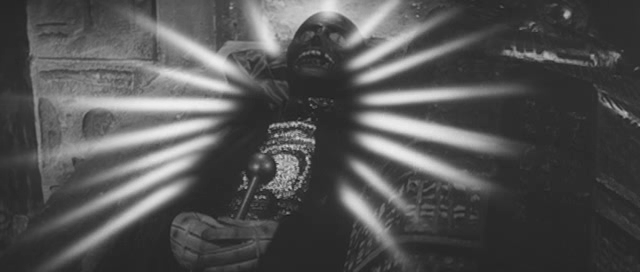
Nazo is Golden Bat’s arch enemy, here a man in a rat costume with four eyes and a large metal wrench for a hand. Travelling to find their fallen comrades, the gang discover Golden Bat in his sarcophagus hidden in what looks like an ancient temple with instructions to wake him up with a single drop of water should humanity be in crisis which he predicts will happen 10,000 years after he went into storage in Atlantis. Professor Pearl’s adorable 12-year-old granddaughter Emily (Emily Hatoyama) does just this and then becomes his point of contact, but in true tokusatsu fashion after simply gifting them the special lens and fighting off Nazo’s goons Golden Bat flies off into the sunset with important superhero business to attend to. Meanwhile, Captain Yamatone (Sonny Chiba) and the others attempt to save the Earth while battling Nazo’s three most dangerous henchmen: wolfman Jackal (Keiichi Kitagawa), fish woman Piranha (Keiko Kuni), and Keloid (Yoichi Numata) who has a large skin lesion on his face which honestly seems in poor taste. 

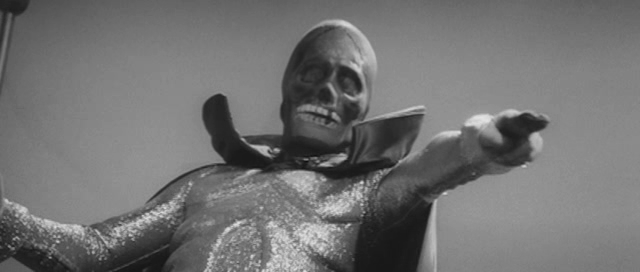
As in his other films, Sato appears to have his tongue very much in his cheek given that the performances of his cast are decidedly broad with a tendency towards evil glares and reaction shots, his camera often zooming in directly on villainy. Golden Bat meanwhile is often seen striking theatrical poses while uttering phrases such as “for justice alone do I fight!” and hitting people with his baton to make them behave. You might think children would find a skeleton man with an eyeless gold skull a little frightening, but Golden Bat seems to make it work while offering his own non-evil laugh as he cheerfully returns to save the day until finally forced to tap the sign he’s helpfully put up reading “those who attempt to subjugate the world through force by their own force shall perish”. Nazo meanwhile has a definite nautical theme, travelling by shark submarine/aeroplane and giant squid-shaped earth borer with laser eyes but is finally undone in surprisingly violent fashion by Golden Bat’s Baton of Justice. Defiantly irreverent and flying in the face of tokusatsu’s general responsible science stance, Golden Bat is exceptionally silly and makes little literal sense but is undeniably fantastic fun as the skeletal superhero does his best to ward off galactic imperialism. 


Original trailer (no subtitles)

Love New and Old (三味線とオートバイ , AKA Shamisen and Motorcyle, Masahiro Shinoda, 1961)

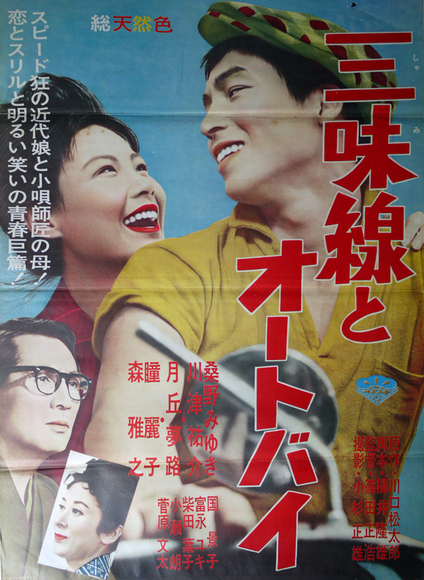
shamisen and motorcycleMasahiro Shinoda’s first film for Shochiku, One-Way Ticket to Love, over which he’d been given a fairly free rein did not exactly set the box office alight. Accordingly, he then found himself relegated to studio mandated projects with set scripts designed with the studio’s house style in mind. Love New and Old (三味線とオートバイ, Shamisen to Otobai, also known as Shamisen and Motorcycle) is just one of these studio pictures, taking him away from the beginnings of a promising collaboration with avant-garde poet and playwright Shuji Terayama begun in Dry Lake (Youth in Fury) and Killers on Parade. Despite the banality of its melodramic tale of mother and daughter strife caused by changing times, secrets and social mores, Love New and Old plays into several of Shinoda’s recurrent themes and allows him to further indulge his tendency for visual flamboyance with a widescreen colour canvas.

Regular teenager Hatsuko (Miyuki Kuwano) hangs around with the “nice” kind of biker gang, clinging onto her upper class boyfriend Fusao (Yusuke Kawazu) as they ride around the city making use of all the new freedoms available to the young people of the day. Hatsuko lives alone with widowed mother Toyoeda (Yumeji Tsukioka), a minor celebrity known for giving lessons in traditional “kouta” singing on local television. Despite Hatsuko’s rather headstrong nature, she and her mother are very close and have a broadly happy life together in the small house they share which doubles as her mother’s studio.

Things change when Hatsuko and Fusao get into an accident on the bike which leaves them both in hospital. It just so happens that the doctor who ends up treating Hatsuko, Kuroyanagi (Masayuki Mori), is an old friend of her mother’s from before the war. During Hatsuko’s extended convalescence the pair rekindle their long abandoned romance but tension soon arises when the still youthful Hatsuko begins to resent this change in her familial relations. Having come to think of her mother as a kind of pure, saintly figure the idea of her as woman with a woman’s needs and desires profoundly disturbs her.

Shinoda frames this twin tale of women in love as series of embedded conflicts – between generations, between eras, and between a mother and a daughter whose relationship must necessarily change as one comes of age. There is also an additional burden placed on the relationship by means of a long buried secret regarding Hatusko’s birth, the man she had regarded as her father, and the newly resurfaced figure of the doctor who, it seems, has always been in Toyoeda’s heart. Despite the fact that one might assume all of the resentment towards a new relationship would come from the maternal side, Toyoeda is generally supportive of her daughter’s right to choose a boyfriend only warning her that the boy’s parents had acted with hostility following the accident and there may be class based trouble ahead given the fact that her mother is “only a kouta teacher”.

The doctor, a melancholy and perceptive figure, is the first to notice the effect his unexpected return is having on the previously happy mother daughter relationship. Correctly remarking that young people of Hatsuko’s age have much more clearly defined ideas about “morality”, especially as it relates to the older generation, Kuroyanagi can see why Hatsuko may have reservations about her mother remarrying. In this he is very much correct. Even setting aside the slight cultural squeamishness concerning second marriages, Hatsuko’s reaction to her mother’s new romance is one of deep disgust and confusion. Though she recognises that her feelings are unfair and will only cause her mother additional suffering, she cannot bring herself to accept the idea of her mother taking a lover and eventually bringing this new element into their extremely close relationship.

Eventually Hatsuko moves out to live with a friend while Fusao, who had been absent from the picture thanks to his parental machinations, finally reappears and seems to want to resume their relationship whatever the final cost to his own familial relations. Ending on a bittersweet note after which secrets are revealed, confessions are made, and hearts are bared, the film seems to want to remind us that life is short and unpredictable – there is no time for the kind of petty discomforts which lead Hatsuko to force her mother to choose between the man she loved and her daughter. After beginning with an innovative title sequence, Shinoda’s approach is more straightforward than in some of his more visually adventurous work of the period but makes good use of dissolves and interesting compositions to bring a little more substance to this otherwise generic Shochiku programme picture.


Female Prisoner #701: Scorpion (女囚701号/さそり, Shunya Ito, 1972)

scorpion-701

Meiko Kaji had already become a familiar face in Nikkatsu’s genre output when she took on the role that would come to define her career at only 25 years of age. Toei’s Female Prisoner #701: Scorpion (女囚701号/さそり, Joshu Nana-maru-ichi Go / Sasori) would launch a series of similarly themed films and create a national pop culture icon in its central character. Based on a manga by Toru Shinohara, Female Prisoner #701 Scorpion is, at heart, a women in prison film and a cornerstone of the pinky violence genre but first time director Shunya Ito has more on his mind than salacious thrills and offers up a noticeably nuanced approach to his material filled with impressive art house flourishes.

701 is the number printed on the back of the prison uniform worn by inmate Nami Matsushima (Meiko Kaji). She makes a valiant escape attempt with a fellow prisoner, Yuki (Yayoi Watanabe), but the pair are caught and put into solitary confinement where they experience torturous treatment both at the hands of the guards and their fellow prisoners. Mostly known as Matsu but also given the nickname of “Scorpion”, Prisoner #701 is not exactly popular with the other ladies in the joint who seem to resent her escape attempts and quiet dignity, annoyed by her above it all demeanour.

Matsu has just one mission in life – vengeance, on the man who wronged her, on the society that allowed her to be wronged, and on the prison system with its sadistic guards and turncoat inmates. Once an ordinary, law abiding woman, Matsu had the misfortune to fall in love with a vice cop who convinced her to go undercover in a yakuza club to get some vital info he needs to bust it. However, Sugima (Isao Natsuyagi) turns out to be the biggest crook of them all and was merely using her to try and take out the local yakuza to get in with a bigger yakuza boss and key into a slice of the drugs trade. Matsu is brutally gang raped after her cover is blown and ends up being sent to prison after making an attempt to ice her former lover with the desire to get out and complete her mission the only thing that’s keeping her going.

Ito begins with an ironic scene in which one of the prison guards is receiving a commendation for his honourable service, Japanese flag flying proudly behind above, until the occasion is interrupted by the escaped prisoner alarm. Later Ito puts the yakuza boss in a building bearing the large banner “Beautiful Soul and Harmony of Japan” and he even adds in an expressive moment as Matsu surrenders her virginity to Sugima, staining her white sheets with a large red circle. Society is corrupt everywhere from Sugima’s bent copper to gang raping yakuza and the prison system itself.

The guards are effectively running their own little empire, cut off from mainstream law enforcement and left to their own “corrective” impulses. Ito gives us salacious shower scenes and women being marched around in the nude but he places us in the place of a voyeur, making it plain that the prison guards are sating their lust for power through humiliating their charges in sexual dominance and violence. Divide and rule is the name of the game as a top tier of prisoners are “employed” in various prison tasks earning them a different colour uniform and a status bump. These ladies are even worse than some of the male guards and are responsible for much of the cruelty inflicted on Matsu and Yuki during their time in solitary.

Inter-prisoner conflict is not the central theme of the film as Matsu continues to plan for her eventual escape and revenge on the man who has ruined her life. A slight spanner is thrown in the works when an inside woman is recruited to take Matsu out, but Matsu is painted as a the ultimate vengeful warrior. Barely speaking (the bulk of her dialogue is actually voice over for her flashback scene), Matsu waits silently, observing and plotting. Biding her time she manages to take an extremely skilful and poetic revenge against her solitary abuser despite her hands and feet being bound, and when a police mole is placed in a cell with her Matsu sees through the ruse straight away. Seducing her new cellmate, Matsu neutralises the threat with ease maintaining her trademark intense elegance all the way through.

Though the synopsis smacks of cheap and nasty exploitation Ito doesn’t see it that way and films with an art house aesthetic rather than a salacious eye. Matsu’s flashback takes a very theatrical form with a rotating set and Matsu remaining present in the corner as she narrates. Her rape scene is grotesque and nightmarish, shot through a see-through floor as her attackers grin and gurn away at her like fairytale monsters. Likewise, when Matsu traps another prisoner in her own scheme, the woman turns into a classic ghost creature, face white and staring, broken glass firmly gripped manically in front. The acting style is broad and absurd. Policeman laugh loudly and for too long, blood is an artificial kind of red, gloopy like paint, and pantomimeish grotesquery is everywhere. Ito’s backgrounds are expressionist rather than realist but always perfectly pitched.

You can tell a lot about a place from the way it treats its prisoners and when its as bad as this, you start to wonder which side of the bars you’re really on. The guards are only a representation of a consistently exploitative society, but they can at least be outsmarted. “To be deceived is a woman’s crime”, says Matsu, but it’s one she fully intends to atone for – in blood, settling not just her own score but those of all her fellow prisoners caught in the patriarchal trap of hollow promises and abused honour.


Original trailer (English subtitles)