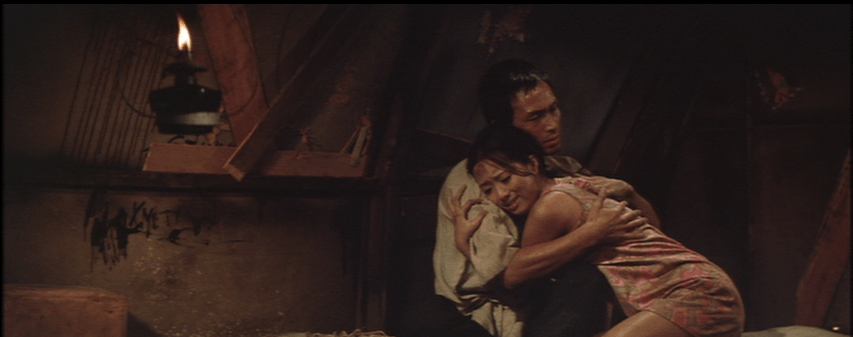
Genocide (昆虫大戦争, Kazui Nihonmatsu, 1968)

In the early 1960s, tokusatsu movies had begun to slide towards something which was much less serious than the early days of the genre, but as the decade went on others edged in the direction of the ‘70s paranoia thriller expressing a nihilistic view of contemporary Cold War geopoliticking. Given the rather provocative English title Genocide (昆虫大戦争, Konchu daisenso), as opposed to the more recognisably genre-inflected “great insect war”, Kazui Nihonmatsu’s wasp-themed disaster film is part anti-nuclear eco-treatise and part anti-US spy movie.

Then again, the film’s secondary hero, Joji (Yusuke Kawazu), a Japanese man obsessed with collecting rare insects he sends alternately to a researcher in Tokyo and a foreign woman living locally, cannot exactly claim the moral high ground. When he spots a US bomber falling out of the sky and runs to investigate the descending parachutes, he’s in the middle of tryst with Annabelle (Kathy Horan) while his wife waits for him patiently at home. Not only that, he picks up an expensive watch dropped by one of the airmen and attempts to sell it, he later claims to buy something nice for his wife, Yukari (Emi Shindo). Meanwhile, the voice of reason Dr. Nagumo (Keisuke Sonoi) is also seen conducting experiments on animals, injecting insect venom into a squirming guinea pig while explaining that the toxin affects the nervous system and causes madness and death. 

For all his own moralising, it’s this callous and selfish disregard for life which caused so many problems. The insects have apparently become fed up with human volatility and have decided that they don’t care what humans do to each other but they won’t go down with us in a nuclear war so the only solution is total eradication. The film’s true moral centre, the innocent Yukari, had tried to stop Joji capturing insects, reminding him that “insects have babies too,” while unbeknownst to him the insects he’d been capturing for Annabelle had been used for her sinister experiments to “breed vast numbers of insects that drive people mad and scatter them across the world.”

Annabelle’s quest is one of revenge, claiming that she doesn’t trust humans and likes insects because they don’t lie. She’s currently working with Communist spies supposedly researching deadly nerve toxins but with no loyalty to the regime, only the desire for the eradication of humanity in revenge for the murder of her parents in the holocaust. The Americans, meanwhile, only care about getting the H-bomb that the downed bomber had been carrying, eventually admitting that they’re considering simply detonating it to wipe out the insect threat in total indifference to the lives of those who live on the islands. When Nagumo challenges him, the American officer pulls a gun. One of the soldiers refuses the command to detonate, but is then killed. 

The Americans reject the idea that it was “insects” that brought the plane down, but tell on themselves on insisting that the airman onboard was hallucinating having become addicted to drugs to help him overcome his fear of combat situations. The insects do indeed cause him to hallucinate but with flashbacks back to his time in Vietnam, loudly exclaiming that he won’t go back there before asking for more drugs and being injected by a medic. The American officers claim they’re fighting for “freedom and independence,” but it rings somewhat hollow and is immediately challenged by Nagumo. “Sacrifices must be made in war,” they retort when he points out that detonating the bomb will not only kill everyone on the islands but irradiate the rest of Japan, wiping out the Japanese as if they too were merely insects. 

Even so, Nagumo too wants to wipe out the insects rather than consider the implications of their concern or find a way to live with them. Annabelle might have had a point when she said that human beings only knew hate despite her entirely twisted and exploitative plan to use the insects to complete her mission of eradicating humanity. In any case, in contrast to other similarly themed films, Nihonmatsu keeps things fairly realistic despite the outlandishness of the narrative, frequently cutting back to closeup footage of an insect biting into human flesh with its pincers before ending on an image of a nihilistic and internecine destruction that suggests there may be no real hope for us after all.

The Shape of Night (夜の片鱗, Noboru Nakamura, 1964)

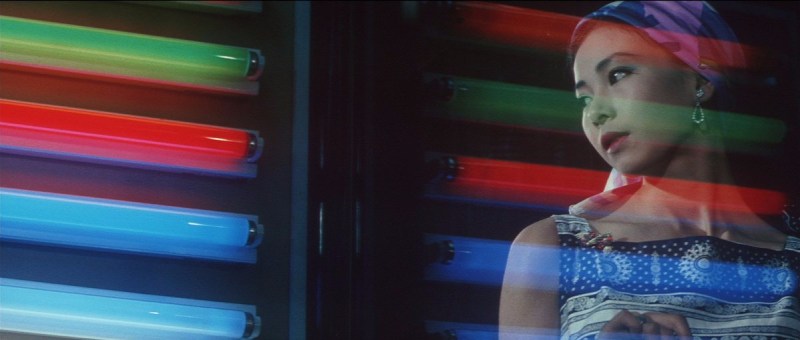
(C) Shochiku 1964Despite having two films nominated for a best foreign language Oscar and a handful of foreign festival hits under his belt, Noboru Nakamura has been largely forgotten by Western film criticism though a centennial retrospective of three of his most well regarded films at Tokyo Filmex in 2013 has helped to revive interest. The Shape of Night (夜の片鱗, Yoru no Henrin), Nakamura’s 1964 Shochiku melodrama focussing on the suffocating life of a young woman pulled into the Tokyo red light district, was one of the three newly restored films featured and was also screened in Berlin and Venice to great acclaim. Making full use of its vibrant colour palate, The Shape of Night paints its city as a constant tormentor filled with artificial light and false promises.

As we meet her, melancholy street walker Yoshie (Miyuki Kuwano) has been trapped in her dead end existence for six years and has lost all hope of living a “normal” life filled with love and happiness. A chance encounter with a supercilious client, Fujii (Keisuke Sonoi), prompts her into a series of recollections in an effort to explain exactly how it was she ended up in such a sorry state. As the eldest daughter of a poor family Yoshie left school early to work in a factory (making those neon tubes you see everywhere) while supplementing her income by working as a barmaid (not a hostess, just a girl behind the bar). Just shy of her 20th birthday, she meets a handsome “salaryman”, Eiji (Mikijiro Hira), who starts coming to the bar regularly to see her. The pair became a couple, and then lovers, and then cohabiters, but Eiji isn’t a “salaryman” so much as a low level gangster with a gambling problem whose street name is “princess”. Continual losses put Eiji in a tight spot with his crew and he begins borrowing money from Yoshie before asking her to prostitute herself to get him out of a hole. Thinking it will just be a one time thing, Yoshie resolves to make a sacrifice for her man but, of course, it wasn’t a one time thing.

Yoshie’s story is a sadly familiar one – an innocent woman duped by a duplicitous man whose empty promises aim to mask his continued fecklessness. Eiji, despite his smart suits and coolly confident attitude, is unlikely to make much of himself in the yakuza world yet is as tied into its hellish system of loyalty and reciprocity as Yoshie is in her non-marriage to the man she thinks she loves. Seeking constant approval, Eiji thinks nothing of living off a woman and his childishly excited smile on re-entering the apartment after Yoshie has sacrificed herself to save his face is a grim reminder of his priorities. When pleading doesn’t work Eiji turns violent, prompting Yoshie to finally consider leaving him but she’s too late – the yakuza world has already got its hooks into her and any attempt to escape will be met with terrifying resistance.

Fujii may seem as if he presents another option for Yoshie, a chance for a better, kinder existence but he too is merely another man trying to tell her how she should live her life. Hypocritical at best (as he freely admits), Fujii pays Yoshie to “ease his sexual urges” but expresses disgust and disapproval of her lifestyle and seeks to “save” her from her life of humiliating immorality, “purifying” her just like the dam he is building is supposed to do to the Sumida river. Fujii’s obvious saviour complex is worrying enough in itself though there is also the additional worry of what his “salvation” may entail if Yoshie decides to make a break from her yakuza chains and run off to the comparative safety of provincial Hokkaido. Fujii may claim to have fallen in love with her, but so did Eiji and who’s to say Fujii’s idea of wedded bliss will be any better than Eiji’s brutal reign as a common law spouse.

The situation is further complicated by Eiji’s gradual shift from a violent, overbearing, abusive boyfriend to a genial figure of gentle domesticity and what that shift later provokes in Yoshie. Rendered physically impotent by an incident during a gang fight, Eiji is literally and figuratively emasculated. Though his sudden inability to satisfy Yoshie originally provokes his jealously, it soon robs him of his violent impulses and turns Eiji into a willing housewife who dutifully does the couple’s washing and prepares the meals much to Yoshie’s consternation. This transformation is what finally kills her love for him, but still Yoshie cannot find it in herself to sever her connection with the man who has been the cause of all her suffering. Not quite hate or loathing, Yoshie’s burned out love has become a burden of care as she finds herself duty bound to look after a man she now believes incapable of looking after himself.

While Yoshie and Eiji sit in a bar one night after “work”, the television plays a report featuring the sad news of the death of a female student at the ANPO demonstrations. Prompting Yoshie to exclaim “what is ANPO anyway?”, the news report lays bare just how isolated her life as become – as all of Tokyo is aflame with with righteous indignation and the streets are filled with the largest protest in living memory, Yoshie is trapped in her tiny neon world which promises so much and delivers so little.

Nakamura makes fantastic use of sound design to capture Yoshie’s interior world – the background music rising over the droning voice of a boring client who hasn’t quite made up his mind, the radio cutting out at intense moments of violence, the terrible clanging of Eiji’s geta on the iron staircase which leads to his flat. Fading into blue dissolves of memory, Nakamura makes a hellish wonderland of nighttime Tokyo whose flashing neon lights, crowded bars and oddly darkened streets turn it into a prison of dubious delights. Finally making a drastic decision, Yoshie attempts to free herself from her burdens and sever the chains which bind her to her misery but in cutting the cord she finds the knots tightening, realising she will never be released from the source of all her suffering.


Screened at BFI as part of the Women in Japanese Melodrama season.