Osaka Elegy (浪華悲歌, Kenji Mizoguchi, 1936)

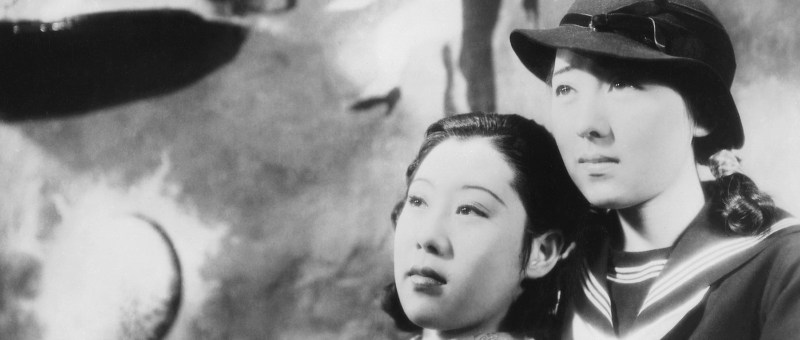
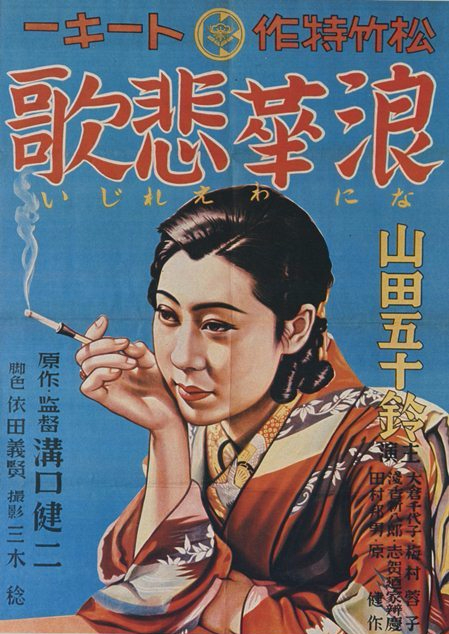
osaka elegy posterKenji Mizoguchi felt he was hitting his artistic stride with Osaka Elegy (浪華悲歌, Naniwa Elegy). Released in 1936 amid the tide of rising militarism, Mizoguchi’s tale of sacrifice and betrayal is strikingly modern in its depiction of female agency and the impossibility of escape from the confines of familial power and social oppression. Sexual harassment was not so much a problem as an accepted part of life in 1936, but as always it’s never the men who suffer. In depicting life as he saw it, Mizoguchi’s vision is bleak, leaving his forward striding heroine adrift in a changing, volatile world.

Beginning not with the protagonist, Mizoguchi first introduces the quasi-antagonist, lecherous boss Asai (Benkai Shiganoya), who feels trapped in an unhappy marriage to a bossy, shrewish woman. For Asai, the head of a family pharmaceuticals firm, work is an escape from family life and the same is also true for telephone switchboard operator Ayako (Isuzu Yamada) who lives with her feckless father whose gambling problem has left them all with serious debts. Asai, encouraged by Fujino (Eitaro Shindo), a colleague well known to be a womaniser, has developed a crush on the meek and innocent Ayako and continues to harass her at work, invading her personal space and pleading with her to have dinner with him. She declines and leaves distressed but when her father is discovered to have embezzled a large sum of money from his company which they will let go if he pays it back, Ayako is faced with a terrible dilemma.

In essence, Osaka Elegy is a hahamono which shifts focus to the self-sacrificing daughter of motherless family rather than a betrayed mother who gives all for her children and receives little in return. Ayako flits between resentment of her useless father’s poor parenting which has left her the sole figure of responsibility for a younger sister and older brother who already seem to hate her even before her present predicament. Yet however much she loathes her father for his weaknesses, she still feels a responsibility to help him and to avoid the social stigma should he fail to repay the money he stole and is arrested. Once she makes the difficult decision to become Asai’s mistress, her fate is sealed. She loses her future, her right to be happy, and the possibility of marriage to her equally meek boyfriend Nishimura (Kensaku Hara).

Being Asai’s mistress is perhaps not as bad as it sounds. Ayako is at least provided for – Asai pays her father’s debt and sets her up in an apartment they can use to conduct their affair but her status will always be uncertain. Asai’s wife (Yoko Umemura), ironically enough, is fond of Nishimura who may be something of a gigolo but their situation is unlikely to entail further consequences for either of them. In her relationship with Asai, Ayako begins meekly, playing the part-time wife which is exactly the figure Asai desires – someone to lovingly help with his coat and throw a scarf around his neck. When the affair is discovered by Mrs. Asai, Ayako’s character undergoes a shift. No longer meek and passive, she declares she will not see Asai again. Her physical presence and manner of speaking reverts to the repressed resentment previously seen only when dealing with her father.

If the failed affair allows a certain steel to rise within her, her neat kimono swapped for the latest flapper fashions, Ayako remains ill equipped to operate within the world she has just entered. About to renounce her “delinquent” life, Ayako fixes her hopes on reuniting with Nishimura and the normal, peaceful marriage to a kind and honest man that should have been hers if it were not for her father’s lack of care. Just when it looks as if she may triumph, a second familial crisis sends her right back into the world she was trying to escape but Ayako overplays her hand and suffers gravely for it.

Having sacrificed so much for her family, Ayako is rejected once again. Her feckless father and cruel siblings do not want to be associated with her “immoral” lifestyle which has made her a media sensation and continues to cause them embarrassment. She has lost everything – career, love, family, reputation and all possibility for a successful future. Yet rather than ending on the figure of a broken, desolate woman, Mizoguchi allows his heroine her pride. Ayako, far from collapsing, straightens her hat and walks towards the camera, facing an uncertain fate with resolute determination, defiantly walking away from the patriarchal forces which have done nothing other than conspired to ruin her.


Screened at BFI as part of the Women in Japanese Melodrama season. Screening again on 21st October, 17.10.

Also available on blu-ray as part of Artificial Eye’s Mizoguchi box set.

Opening scene (English subtitles)
Victory Song (必勝歌, Masahiro Makino, Kenji Mizoguchi, Hiroshi Shimizu, Tomotaka Tasaka, Tatsuo Osone, Koichi Takagi, Tetsuo Ichikawa, 1945)

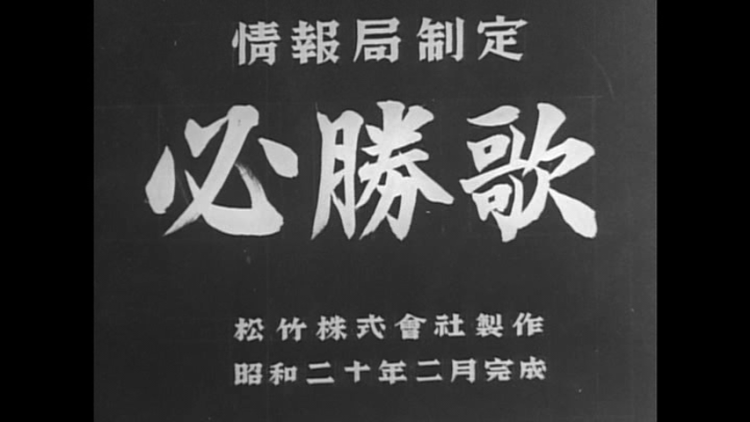
vlcsnap-2017-08-01-00h21m20s082Completed in 1945, Victory Song (必勝歌, Hisshoka) is a strangely optimistic title for this full on propaganda effort intended to show how ordinary people were still working hard for the Emperor and refusing to read the writing on the wall. Like all propaganda films it is supposed to reinforce the views of the ruling regime, encourage conformity, and raise morale yet there are also tiny background hints of ongoing suffering which must be endured. Composed of 13 parts, Victory Song pictures the lives of ordinary people from all walks of life though all, of course, in some way connected with the military or the war effort more generally. Seven directors worked on the film – Masahiro Makino, Kenji Mizoguchi, Hiroshi Shimizu, Tomotaka Tasaka, Tatsuo Osone, Koichi Takagi, and Tetsuo Ichikawa, and it appears to have been a speedy production, made for little money though starring some of the studio’s biggest stars in smallish roles.

The first scenes make plain the propagandistic intentions by starting in 660BC with a pledge of protection for the descendants of Amaterasu – ancestral mother goddess of Japan. Flash forward to 1941 and her sons are doing their best. Stock footage gives way to soldiers in the Asian jungle, taking a brief respite from the fighting to console each other with thoughts of home which is presumably where most of these small stories of resilience come from.

The soldiers appear to come from all backgrounds, the youngest of them seeming to be just a young boy whose strongest memory of home is his mother’s face. They chat cheerfully about their hometowns, never betraying any sense of fear, boredom or fatigue but the commander suddenly announces that they’re all “going home” until the next attack – taking a brief voyage of memory back to the motherland.

Within this framing sequence, the ordinary people of Japan go about their ordinary lives with cheerful forbearance. A young man cares for his parents after his older brother has given his life for the Emperor, serving on the home front by working himself so hard there’s a danger of going overboard and rendering himself out of action. His father argues that as long as everyone in Japan works as hard as they can, they can never be defeated. Community comes to the rescue again when a train gets stuck in the snow and the entire village gets out of bed to free it.

While the adults are giving it their all, the children are preparing to become fine subjects of the Emperor, training their minds and bodies to be of the most use whilst singing patriotic songs and performing military drills. Another segment finds the children praising their parents for their bravery, playing and roughhousing like any children would, but a hint of darkness emerges when a group of boys plays at war with their toy aeroplane. One little boy, Yuichi, has applied for the young pilots school without talking it over with his parents because he didn’t want them to be sad about him going away. His father, at least, is proud of him but upset at not being consulted. Practically measuring him up for the uniform, Yuichi’s father marvels at all the “young pilots” in the village – a chilling note seeing as none of these boys can be more than ten years old.

While the men go to war the women are at home waiting. Another persistent question relates to the fate of unmarried women – a positive motion for an arranged engagement is disrupted by the receipt of a draft card, prompting the male side to suggest they call the whole thing off. The woman, however, points out that every young man is in this position and she doesn’t see the point in expecting the worst. Life must go on, women must get married, and men must go to war. All of these things must be accepted without thinking too hard about it or there will be nothing for these gallant men to come home to.

The difficulties of wartime life extend to the fear and destruction of air raids, though a news report of the fire bombing of Tokyo reminds us that it could all have been much worse if it weren’t for the valiant efforts of the pilots and ground based defence forces keeping the threat from the skies at a minimum. Other reports detail dive bombing of hospital convoys while the wounded die happily knowing they’ve done their duty. Likewise the “special attack squad” prepare to meet their fates with stoicism and determination while their relatives are treated with especial esteem.

Interspersed with the vignettes and stock footage there are songs and dances bringing both entertainment and inspiration. The final message is one of resilience and unity, that Japan stands together to defend its ancient homeland in devotion to its Emperor, but then such a message would hardly be necessarily if the situation were brighter. Brief allusions are made to rationing, to the destruction and constant loss of life but these are all things which must be born for the glorious future. There is, however, much more stock put in remaining positive than there is in trying to deny the ongoing desperation. As propaganda films go, this one may backfire but does perhaps shine a light on the unspoken anxieties of ordinary people facing an extraordinary situation.


Final scenes including the “Victory Song” itself

https://www.youtube.com/watch?v=MmJAaU8sJuo

The Crucified Lovers (近松物語, Chikamatsu Monogatari, Kenji Mizoguchi, 1954)

E8BF91E69DBEE789A9E8AA9EB2Bunraku playwright Chikamatsu Monzaemon had a bit of a thing about double suicides which feature in a number of his plays. Though these legends of lovers driven into the arms of death by a cruel and unforgiving society are common across the world, they seem to have taken a particularly romantic route in Japanese drama. Brought to the screen by the great (if sometimes conflicted) champion of women’s cinema Kenji Mizoguchi, The Crucified Lovers (近松物語, Chikamatsu Monogatari) takes its queue from  one such bunraku play and tells the sorry tale of Osan and Mohei who find themselves thrown together by a set of huge misunderstandings and subsequently falling headlong into a forbidden romance.

Set in 17th century Kyoto, the story begins with a reminder that adultery is currently illegal and that the penalty is crucifixion of both parties. A samurai woman and a man servant are being paraded through the streets for having committed the double transgression of an extra-martial affair which also crosses class borders. We set our tale at the top printing house in the city where the most promising employee, Mohei, is being pulled from his sickbed to complete a particularly important order. At the same time, mistress of the house Osan receives an unwelcome visit from her brother who is once again in pecuniary difficulty. He wants her to ask her wealthy husband, Ishun, to lend him some more money to meet the latest mortgage payment on their family home. However, Ishun is a stingy old man and outright refuses. Mohei overhears the brother’s visit and offers to help but his idea to temporarily embezzle some of the money backfires when he’s caught.

To make matters worse, Ishun now has it in for Mohei as Ishun has been after the servant girl Otama who has been refusing his advances and finally lied to him by claiming that she and Mohei are secretly engaged. After Otama reveals Ishun’s true nature to Osan, they hatch a plan to confront him by swapping rooms so that when Ishun makes his nightly visit to Otama he’ll find his wife waiting for him instead and have to backdown for awhile. This backfires too when Mohei decides to escape and stops by Otama’s room to say goodbye only for another servant to find Mohei and Osan together there. Mohei flees but a rumour starts about his friendship with Osan and it’s not long before she’s stormed out too. Accidentally running in to each other the pair find themselves on the run and eventually falling in love, but this isn’t the sort of place where two people can just move to another town and disappear. The police and Ishun’s men are hot on their tail determined to try and prevent the impending scandal…

Life was pretty harsh in feudal Japan. In some ways Osan might be thought lucky – married off at a young age to a well connected and prosperous husband. Indeed, at the beginning of the film she doesn’t seem too unhappy though is obviously nervous to talk to her husband about her brother’s predicament. Ishun is not a good man though he is perhaps sadly typical of his petty samurai merchant class. He swaggers around complaining about having to pay for everything and won’t even lend any of his vast wealth to his own sister let alone his wife’s family. Though outwardly miserly he’s no problem promising fancy kimonos and even a house to Otama if she’d only consent to becoming his mistress. Something of a double standard then when his wife is accused of having affair with a servant merely by having been found in a compromising position alone in a room with another man.

Mohei, by contrast, is the archetypal loyal retainer. When ever a problem comes up he reminds himself that one needs to be a “good servant” – a sentiment he utters to Otama when she asks for his help to fend off Ishun. He doesn’t approve of the idea of her simply giving in, but thinks she ought to grin and bear it. Similarly when some of the female members of staff are sympathising with the samurai lady about to be crucified for love, Mohei agrees that he feels sorry for her but also that she’s broken a law and what is happening is simply a natural consequence. He’s the last sort of person you would expect this sort of thing to happen to, and yet, it does.

The irony is that nothing existed between the pair other than the loose friendship and loyalty of a mistress and a member of staff before this whole thing started. Their union is quite literally unthinkable, not only a relationship between a married woman and another man, but love across the class divides. Even if Osan were free, a marriage with Mohei would be considered a disgrace. When the pair face the hopelessness of their situation and decide on suicide, Mohei confesses his love which immediately changes Osan’s mind about dying. She’s fallen in love with him too, and now she wants to live. For her now there can be no life without Mohei. Though Mohei entertains the noble idea of handing himself in to the police and sending Osan back to Ishun who would doubtless be glad to cover up the affair and avoid a bigger scandal, he later finds himself unable to give her up. The pair cannot, and will not, deny their love even if it costs their lives. In this unforgiving world of harsh social justice, the only freedom left to Osan and Mohei is to ride proudly to their agonising deaths hand in hand and with beatific smiles on their faces.

In the end, two grand houses fall because of a series of coincidental misunderstandings and lapses of protocol. Envious of his position, another petty samurai is perfectly happy to manipulate the situation to take down Ishun fully knowing that it will mean the deaths of two people. In ordinary circumstances this passionate, romantic love would never be permitted to exist (or at least among this social class). Its blossoming is an impossible miracle that threatens the very foundation of the extraordinarily regimented society of the two people at its centre. Parents betray their children to protect these archaic laws and preserve their family “honour” but what honour could their possibly be in the denial of love and society that places standing above basic compassion?

Though not perhaps Mizoguchi’s most impressive effort, The Crucified Lovers is an impassioned attack on needlessly repressive social systems and the self centred shenanigans which perpetuate them. Unashamedly melodramatic and filled with a melancholy though passionate resilience, The Crucified Lovers is a tragic tale of true love torn asunder by a cruel and unforgiving world. It would be so easy to say this would never happen today, and yet…


The Crucified Lovers is available on blu-ray in the UK as part of Eureka’s Late Mizoguchi box set.

No trailer but here is a particularly beautiful scene from the film

http://www.youtube.com/watch?v=rG59RIaz3VM

And an introduction from Tony Rayns

Sansho the Bailiff

Kenji Mizoguchi’s Sansho the Bailiff is one of those films that has many times been cited as among the greatest ever made. Based on an ancient folktale, Mizoguchi places the action during the Heian era where a feudal lord is being stripped of his position for daring to speak out about brutal treatment of the peasants. The lord will be exiled but his wife and children will travel to stay with relatives until sent for. Parting from his children he entrusts to them a statue of the goddess Kanon (goddess of Mercy) and instructs them to remember to show mercy, be kind even if it causes you personal pain.

Some time later the mother and her two children set out to join the father with only one servant and no resources to help them get there. Having failed to find lodging in the town (taking in travelers has been banned because of the bandit/slaver problem) they prepare to make camp in the woods. An old lady priestess offers them food and lodging for the night and apparently knows a quicker way to their destination if they’re prepared to travel by sea. Of course, it turns out that the old lady’s motives were far from altruistic and the family are quickly separated, the mother and female servant in one boat and the children dragged away elsewhere. The slavers have great difficulty finding a buyer for these wealthy children, being so small they won’t be as productive, especially considering their background makes them unused to physical labour. Eventually the children are sold to the notorious Sansho, who shows no mercy or consideration for the children’s youth and is determined to get his money’s worth.

As time moves on the children struggle to adapt to their new conditions, the girl clinging to memories of the past and the boy wishing to forget. He casts aside his father’s teachings and seeks to become closer to Sansho until the illness of another prisoner, coupled with the echo of his mother’s voice, reminds him of his better nature and sets him off on his path to redemption.

Sansho the Bailiff is a morality tale about the importance of compassion and of standing up for what is right over what is expected. Cruel men like Sansho, who can regard people as objects and are without the ability to understand the point of view of those who might raise questions, are much in favour with the feudal lords who see nothing except their profits. The profit of the lords must be maintained, those who make suggestions that might interfere with those are removed. Sansho is valued because his turnover is so high, more humane procedures would necessarily reduce this and so are out of the question. Who cares about a bunch of lowborn ‘cattle’? they aren’t like us, they are not us, so we need not concern ourselves with their lives, their feelings or their souls.

When Zushio has committed himself to the path of mercy, vowing to bring down this economy of exploitation, he again finds himself effectively powerless. Although he has achieved the necessary status, the will of the other lords will always win out. Taking drastic action wins him a small victory in the immediate area, but it’s not clear how long this will last or if any permanent change will occur. He’s no better off as a lord than he was with Sansho, he’s still a slave just in a nicer cage. So abandoning his position he sets off in search of his mother.

Finally mother and son are reunited, but the reunion is bittersweet. Zushio exclaims that he could have come here as a fine, important man and taken her away back to the life she once knew, but instead he kept to his father’s teachings and has nothing. She replies that she’s sure that if he had not obeyed they would never have met again. In the end their only victory is to have survived and found each other, but it’s the victory of the pure soul.