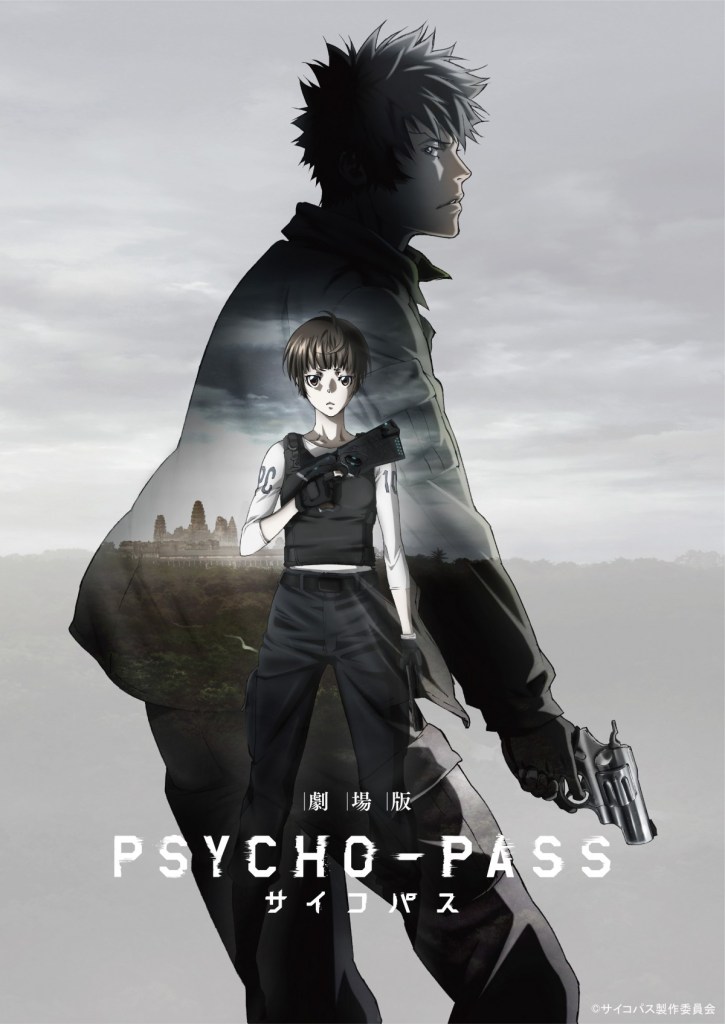
 The Japan of 2116 is a peaceful place. Crime is at an all time low thanks to the Sybil system which monitors the nation’s citizens issuing them a “Crime Coefficient” rating assessing how likely they are to commit a crime. When a potential criminal’s Psycho-Pass reaches an unacceptable level, the Public Safety Bureau are called in to hopefully put a stop to any criminal activity before it has the chance to occur.
However, the world outside of Japan is not quite so ordered and so its Sybil system has become an important political export. Things are about to get murky as the nearby SEAUn (South East Asia Union) is currently in a state of civil war and its de-facto leader has struck a deal with Japan for additional support in return for trialling the system in a new reclaimed land development. Not everyone is happy with sacrificing personal liberty for social safety and so an active resistance unit working against both the deployment of Sybil and the leader they see as a dictator is continuing to prove a destabilising force.
This all comes to a head when a group of so called “terrorists” manage to sneak in Japan hoping to take the fight to Sybil itself. After a brief but intense shootout with the PSB, the gang is neutralised save for one which famed Inspector Akane Tsunemori manages to capture and take in for questioning. However, whilst Akane is waiting for the captive to come round from the sedative she gave him, her bosses have taken drastic action which amounts to lethal torture. Akane is horrified, but when the recovered information flags up the familiar face of her former colleague Kogami, she quickly finds herself at the centre of covert, international political machinations which cast her own nation in far from a positive light.
Psycho-Pass: The Movie (劇場版 PSYCHO-PASS サイコパス, Gekijo-ban Psycho-Pass) is the big screen outing for the hit TV anime which has so far spanned two series each with their own distinct narrative arcs. Series creator Gen Urobuchi handled the first season but sat out the second (handing the reign’s over to Murdock Scramble’s Tow Ubukata) in order to work on this film which takes place after season two but was actually developed at the same time so avoids direct reference to its events. For the most part, Psycho-Pass: The Movie works as a stand alone enterprise though it does make reference to plot elements from season one, or more exactly its villain, without further explanation which may leave newcomers feeling lost. Fans of the franchise already familiar with the characters and their relationships will undoubtedly get the most out of the set-up, but in depth knowledge of the series is never a prerequisite for understanding the action.
“Action” is an apt place to start when it comes to the themes of Psycho-Pass: The Movie as it acts more as an exciting side story to the main series than the grand conclusion that might be expected. Broadly speaking, the central concern is the increasing interference of powerful nations in the “domestic affairs” of smaller ones. Akane is as idealistic as they come despite everything she has already seen and is unprepared for the extent her own nation’s complicity in this very dirty, possibly proxy, war. In this country, those with flagged Crime Coefficients are forced to wear a standard issue collar which is designed to explode Battle Royale style and are treated as an underclass not permitted to board the same public transport or occupy the same “public” space as the general population. Once again this sits uncomfortably with Akane, but there isn’t a lot she can do about it.
Kogami, now a drifting mercenary since going on the run from the PSB, has become a rebel revolutionary trying to help the oppressed citizens fight for democracy in this war torn land. To some, he’s a terrorist (though the rebels are never shown targeting civilians or carrying out “terrorist action” so much as acting as a resistance group) but his sights are firmly set on hypocritical, oppressive regimes and especially those acting as puppet states for a third party. Akane and Kogami’s relationship status continues in the “it’s complicated” direction which has progressed throughout the series and they aren’t given very much time to build on that here though their mutual respect for each other adds to the tension as each comes to terms with being on opposing sides yet somehow still “together” in spite of external obligations.
Even if Psycho-Pass: the Movie proves disappointing in terms of its character development (betraying its side story origins), it excels in the action stakes with several impressive, high octane battle scenes not to mention the strange ballooning effect of the explosive Dominator weapons. Though it sets up a complicated, geo-political conspiracy of superpowers exploiting civil unrest to steal puppet states and install dictatorial stooges who oppress the local population into a sublime obedience with the promise of long desired peace, it wisely avoids expository dialogue preferring to keep things moving in a more urgent fashion. A minor entry into the Psycho-Pass world, Psycho-Pass: The Movie is nevertheless an exciting return to its increasingly dystopian universe and even if it adds little in terms of themes or characters, does at least point towards a promising continuation of the series.
Reviewed as part of the “biennial” Anime Weekend at BFI Southbank. Psycho-Pass: The Movie has also been licensed for UK distribution by All the Anime (and Funimation in the US).
English Subtitled trailer:
 Masamune Shirow’s cyberpunk manga Ghost in the Shell burst onto the scene in 1989 and instantly became a genre classic. Mamoru Oshii then adapted the manga into a much lauded anime movie in 1995 which almost came to define cyberpunk animation even if it emerged towards the end of the genre’s heyday. A sequel, Ghost in the Shell: Innocence followed in 2004 as well as a TV anime spin-off Ghost in the Shell: Stand Alone Complex. Now with the 20th anniversary of the original animated movie, the series has yet again been adapted into a series of entirely new anime OVAs under the name of Ghost in the Shell: Arise. Ghost in the Shell: The New Movie (攻殻機動隊 新劇場版, Kokaku Kidotai – Shin Gekijoban) is the big screen outing of this latest incarnation scripted by Tow Ubukata who also produced the very GITS influenced Mardock Scramble.
 Windows on Worlds