Hong Kong Paradise (香港パラダイス, Shusuke Kaneko, 1990)

A tour guide on her maiden voyage finds herself swept into intrigue in Shusuke Kaneko’s madcap caper, Hong Kong Paradise (香港パラダイス). Effectively a Japanese take on mo lei tau nonsense comedy, it’s also a commentary on Japan at the tail end of the Bubble era as the heroine dreams of an exciting world of travel only to find herself shepherding a collection of mostly elderly retirees whose most pressing concern is finding the duty free shop.

Mamiko (Yuki Saito) wanted to go Paris, but according to her boss she’s not really the type, so he’s sending her to Hong Kong instead. Everyone keeps remarking on the fact that she looks just like a fugitive princess, Yoko Kitashirakawa, who eloped with the man she loved to escape from an arranged marriage with a member of the imperial family. Mamiko has also, apparently, recently broken up with a boyfriend which might explain her desire for travel, as the film flirts with the idea she might really be Yoko enjoying a kind of Roman Holiday and not wanting to return to her constrained life as an aristocrat. But on the plane over, she ends up running into Ando (Tsuyoshi Ihara), a man who’s on the run after committing a heist in which he stole a pair of golden chess pieces as part of an insurance scam.

The golden king and the queen who end up getting separated are a representation of frustrated romance as various parties try to get them back together for different reasons. Mamiko evidently took a liking to Ando, but sadly he is soon killed, leaving her to be rescued by Oishi (Kaoru Kobayashi), a man of dubious motivations. Having lost her memory after being press-ganged into being the subject at a hypnotism show, Mamiko must once and for all re-establish her identity by finding her way through the conspiracy while slowly falling for Oishi despite his irritating qualities. In order to find the treasure, Oishi lies to her, telling Mamiko that she’s Yoko while she’s also chased by a man claiming to be a police officer and Hong’s goons who are convinced that she knows where the chess pieces are.

For the criminals, and perhaps for us too, the missing king and queen are a kind of MacGuffin, but they link back to another tragic love story. Believing that Mamiko is Yoko, Mrs Yang (Keiko Awaji) sympathises with her predicament acknowledging that love across the class divide is never easy. The love of her life was an English prince called Charles, incongruously played by an American in the opening and closing voice over, whom she met thanks to her father’s work as a diplomat. Times being what they were (and perhaps are), she knew they could never marry. Oishi tries to trick Mamiko by playing on her sympathy, claiming that the chess pieces were a gift for Mrs Yang from the man she loved in an effort to get Mamiko to help him find them without realising that he has actually stumbled on the truth.

Hong Kong then becomes a place of romance not unlike the Paris of Mamiko’s imagination in being the paradise of a tragic love story even if in reality the chess pieces were “stolen” as part of an insurance fraud scam which is about as unromantic as it’s possible to get. Nevertheless, princess Yoko apparently got a happy ending, marrying an ordinary person even if there are many people who think she’s crazy for turning down the opportunity to become a member of the imperial household. Mamiko’s occupation as tour guide, or tour conductor as she keeps reminding the participants, is largely unromantic too, mostly consisting of shuttling disinterested guests from one tourist spot to another which is to say it’s not so much broadening her horizons as narrowing them.

But in any case through her zany adventure she does perhaps get to experience the romance of life in being pulled into unlikely intrigue and fighting to reunite the separated king and queen on a symbolic and spiritual level beyond the simply physical. “It doesn’t matter who I am,” she eventually reflects on embracing her liberated anonymity and enjoying the thrill of the chase, while paradoxically rediscovering her identity in the process. Critics at the time objected to the nonsensical plot and frequent tonal shifts, but they are, of course, a key element of mo lei tau and what gives the film its zany, madcap charm as the heroine careers from one ridiculous situation to another all while falling in love.
The Wind in Your Heart (心に吹く風, Yoon Seok-ho, 2017)

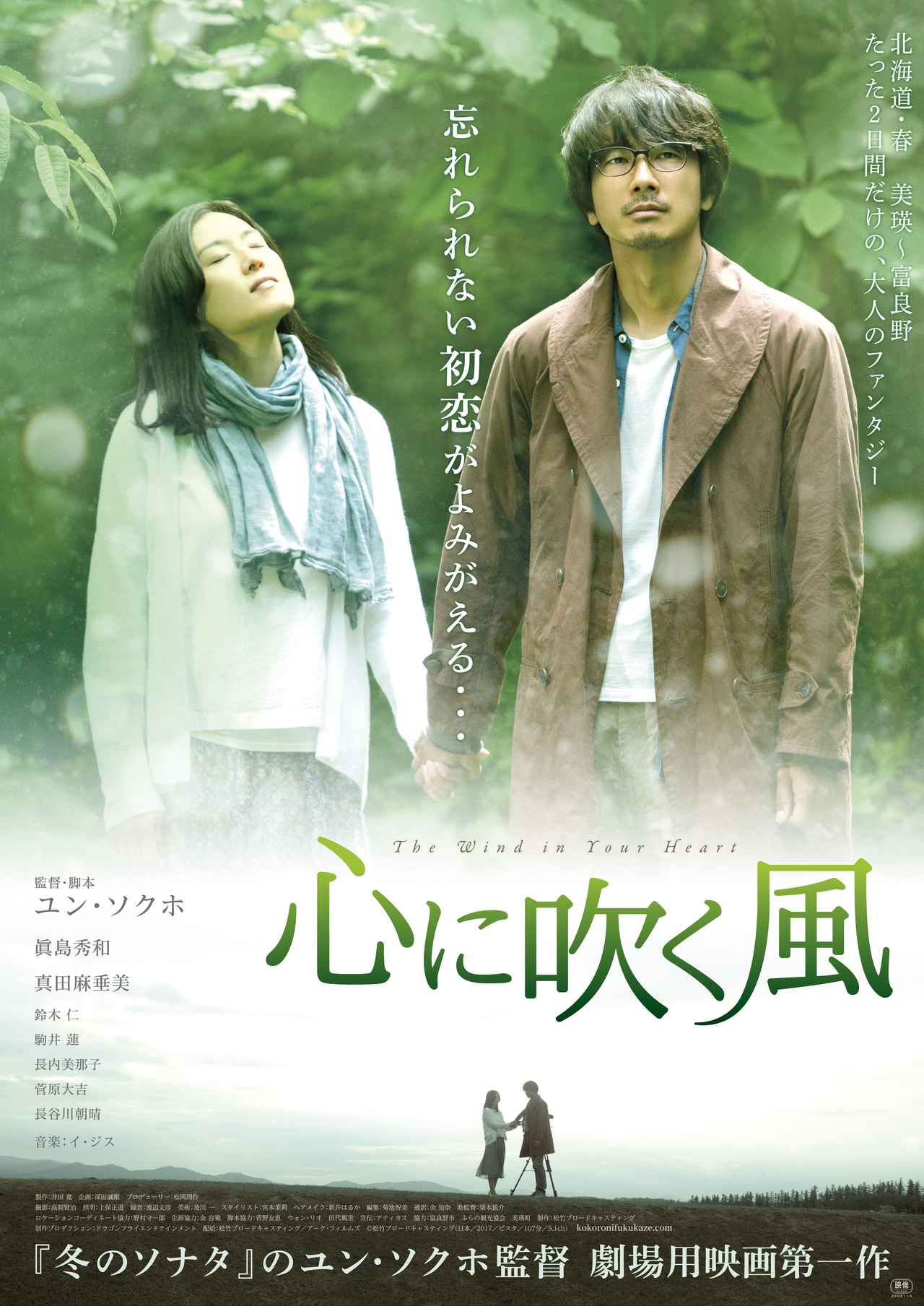
the wind in your heart posterYoon Seok-ho is best known for his work in Korean television drama which included several of the series thought of as kickstarting the “Hallyu” wave. Chief among these is Winter Sonata which proved extremely popular in Japan and is also cited as a major inspiration for the short-lived boom of “junai” or “pure love” movies in the early 2000s. The Wind in Your Heart (心に吹く風, Kokoro ni Fuku Kaze) brings things full circle – making his feature debut, Yoon brings his brand of romantic melodrama to Hokkaido for a re-evaluation of first love, middle-aged regrets, and an escape from real world cynicism to a world of beauty and innocence.

Video artist Ryosuke (Hidekazu Mashima) has been in living in London for many years but is currently staying with a friend in Hokkaido on a working holiday. When his pick up truck breaks down in the middle of nowhere he chances in to a nearby cottage in the hope of using the phone, only to find a ghost from the past standing in the doorway – Haruka (Masumi Sanada), his high school sweetheart whom he has not seen in 23 years. Obviously a lot has happened – Haruka is married with a grown-up daughter, but seems sad and lonely. Ryosuke is only in town for a couple more days, but the pair make the most of their time to reconnect and think about what might have been and why it wasn’t, as well as what might still be if someone finds the courage to boldly pursue their desires.

Well, that might be a little strong – this is a story of innocent, chaste love, rather than a hot and passionate affair. The Wind in Your Heart does indeed share much in common with the classic “junai” in its nostalgic look back to innocent teenage romance and yearning to return to a time when everything seemed so simple and love was all that mattered. It is, however, sadder – we’re not told exactly what made Haruka decide to forget Ryosuke after he left for university in Tokyo, only that she went through some tough times. Likewise we don’t really know why Ryosuke didn’t try harder to find out, save that perhaps he thought that was what she wanted and respected her decision. Nevertheless, Ryosuke has remained unmarried and apparently still carries a torch 23 years later. All the pair have are mutual regrets and a shared sense of nostalgia for a future they feel they lost because of things that happened to them in their youths.

Now, things might be different. Haruka is obviously miserable in her marriage. Her daughter has left for university, her husband is working away in Taiwan, and she’s left at home all alone with her horrible mother-in-law. Ryosuke asks her if she’s happy and she can’t answer. She doesn’t want to talk about her husband whom she doesn’t seem to like very much. When we eventually meet him he is drunk, bossy, and insensitive. It’s no wonder Haruka might dream of running off with her idealised first love but when all is said and done she lacks the conviction to do it. She is simply too conventional, too bound by social obligation, to consider throwing caution to the wind and embracing her own happiness.

It might be patronising to suggest that Haruka is a stand-in for the expected audience – unhappy, under appreciated middle-aged women who perhaps feel trapped by a conservative society and long for escape from their humdrum lives through an innocent romance, but then that does very much seem to be the screenwriter’s intention. Haruka hesitates – her hand always hovering over door handles as if they were triggers, unsure which door to open and which direction to choose, ultimately making her decisions far too late. Unlike the more positive resolutions of a junai romance which allow the left behind to come to terms with their loss and resolve to live on with happy memories rather than sorrow, Haruka is left only with the crushing realisation that it really might be too late and she’s made a lifetime’s worth of poor choices though she does at least begin to find a degree of fulfilment in re-embracing her youthful dreams previously crushed by the unforgiving attitudes of her family.

Filming in Hokkaido, Yoon maintains a notably Korean sensibility in his static camera and straightforward composition which prioritises simple conversation between two people, only occasionally wandering off into poetic reveries in which the sun embraces the wind in a bracing Hokkaido spring. Reaching for something deeper than it manages to grasp, The Wind in Your Heart lands in standard melodrama territory, never quite managing to lend its central romance the weight it seems to want, but nevertheless doing its best to strain the heart with a tale of inescapable middle-aged misery in lives lived through the power of what might have been.


Original trailer (no subtitles)