Divine Bow (神弓 / 신궁, Im Kwon-taek, 1979)

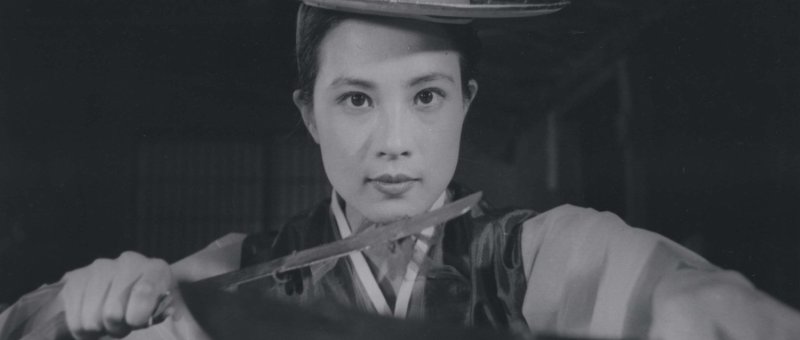
“From now on we need think only of our children. We can’t pass on shamanism to them. Our children at least should have a bright future” insists a man whose horizons have in one sense been broadened but perhaps in another narrowed following forced immersion in the modern world. A classic “island” film, Im Kwon-taek’s Divine Bow (神弓 / 신궁, Singung) finds a conflicted modern day shamaness reassessing her place in a community which has systemically betrayed her while trying to find a path through the intensity of her grief and sorrow. 

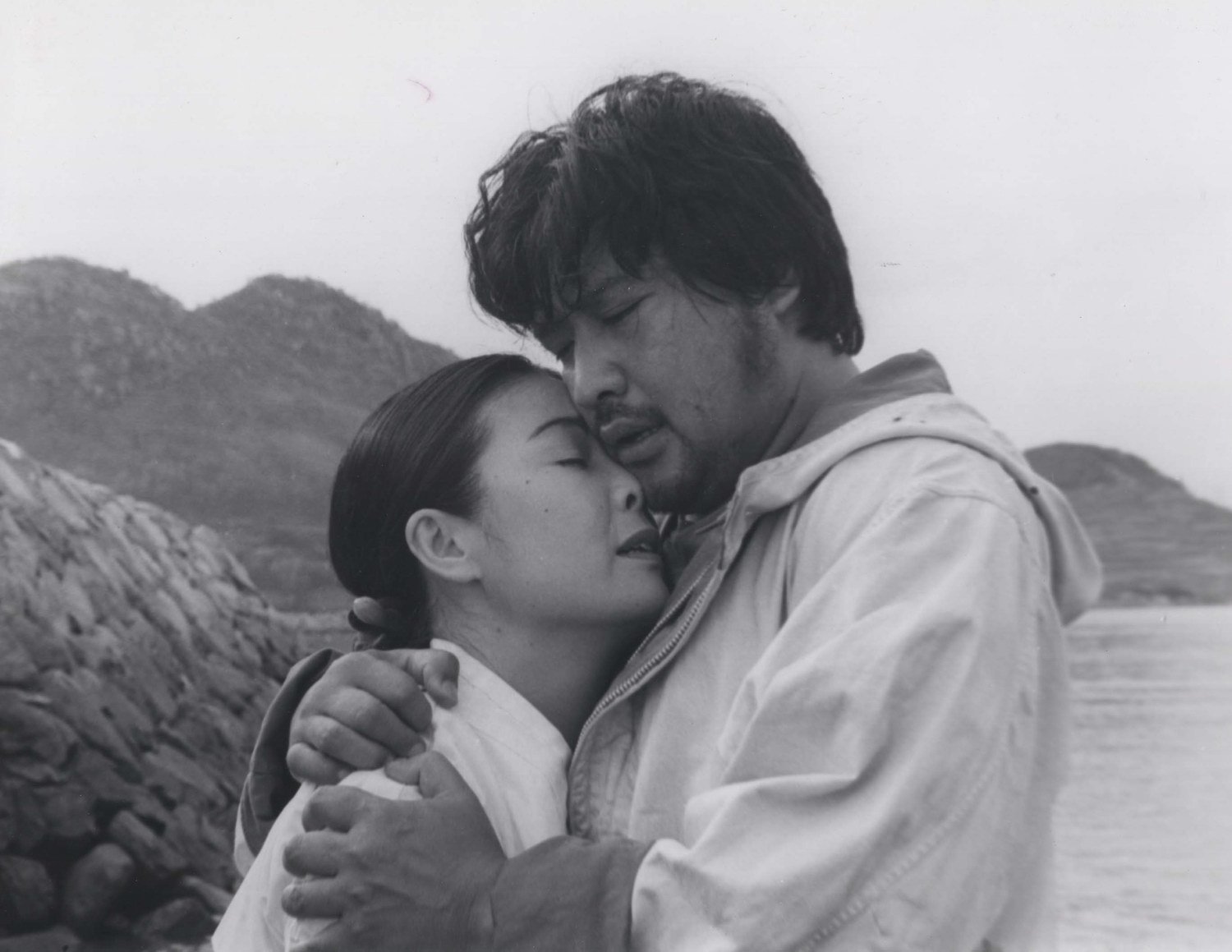
Set almost entirely on the small fishing island of Naro, the film opens with a series of short, static shots of the rainy harbour where an old man sits and strokes his beard wearing traditional Korean dress while a group of seemingly unemployed young men look on listlessly from the boats. It seems the community is in crisis for a number of reasons, the most pressing being a non-existent harvest of fish which they are choosing to attribute to the local shamaness’ refusal to perform the customary rituals. Unmoved by their petitioning, Wangnyeon (Yoon Jeong-hee) advises them to hire her daughter-in-law instead, but for unexplained reasons they only want her, threatening to hire a shaman from a neighbouring island if she continues her policy of non-cooperation. As we will discover, Wangnyeon has her reasons beyond a simple desire for retirement from what is a fairly strenuous job for an ageing woman, but the return of her long absent son Yongban prompts her into a reconsideration of her past and future as well as her place in this community. 

Though the tale is set in the present day, the fishermen are convinced that Wangnyeon’s refusal to conduct the ritual is the reason their harvest has failed, apparently for the first time in 30 years ever since she “retired”. But then they also tell us themselves of more rational reasons they may no longer be able to fish including an oil leak in the surrounding seas and the corrupting influence of larger corporations for which many of them are now reluctantly working. It is precisely this incursion of modernity that has led to all the trouble. Taken off the island, presumably to fulfil his military service, Wangnyeon’s husband Oksu (Kim Hee-ra) observes the modern world during his time in the army and comes to the conclusion that his home culture is backward and superstitious. Hired to perform an important ritual on a neighbouring island for the first time, Wangneyon repeatedly delays the contract to align with her husband’s discharge so he can play drums for her as he always had before. His newfound sophisistication, however, has robbed him of the ability to play. He no longer believes in shamanism and eventually leaves once again to work on a ship in order to one day own a fishing boat of his own. 

“What does a shaman do if not rituals?” Wangnyeon irritatedly asks her husband, in her case the answer apparently being a defiant nothing. Her refusal is part of her resistance to a world that has repeatedly betrayed her. Yet suffering economically temporarily loses her her son who, perhaps unlike his father, returns after a year of travelling more convinced than ever by shamanism if resentful that his mother has not yet relented and resumed her ritual duties. What we realise is that Wangnyeon has grown weary of her complicated place in the island hierarchy, existing to one side of the rest of the community who view her both with mild disdain and fearful awe. A victim of petty island politics, she takes literal aim at the corruption in her society and purifies it with her “divine bow”, mindful of Yongban’s pleas that her rituals are not just for her but for the many people who need to see them performed. 

“Everything, everything, everything is a dream” Wangyeon sings, living perhaps in her own ethereal purgatory, her jagged life story revealed to us in a series of fragmentary flashbacks as she reflects on her present predicament while finally understanding what it is she must do, determining to pick up the divine bow once again and reassume her rightful role as the shamanness. Marking Im’s first collaboration with cinematographer Jung Il-sung, Divine Bow is rich with ethnographic detail exploring this small rock pool of traditional culture on an otherwise moribund island subject to the same petty authoritarian corruptions and ravages of an increasingly capitalistic society as anywhere else. 


Divine Bow streams in the UK until 11th November as part of this year’s London Korean Film Festival.

Jagko (짝코, AKA Pursuit of Death, Im Kwon-taek, 1980)

Jagko poster

During the dark days of the dictatorships, the “anti-communist film” was a mainstay of the Korean film industry. Though it wasn’t exactly possible to make a pro-communist film and that therefore any and all films were at least implicitly anti-communist, the authorities had been especially keen on films which took a hardline on anything remotely leftwing. By the late ‘70s however times were changing and a more nuanced view of recent history began to become possible. Im Kwon-taek is thought to be among the first directors whose work precipitated a shift from the “anti-communist” to the “division” film in which the tragedy of the division itself takes precedence over the demonisation of the North (though such views were perhaps not as uncommon as might be assumed in films from the late ‘50s and early ‘60s before the passing of the Motion Picture Law). Jagko’s (짝코) two haunted protagonists are both flawed men betrayed by their country and changing times realising they have wasted their youth on a cat and mouse game over an outdated ideological disagreement when the conflict that defined their lives was merely a proxy war fought by two super powers on Korean soil.

Song (Choi Yoon-seok), a former policeman, is picked up by a vagrancy patrol and taken to a “rehabilitation centre”. Despite the name the centre is more like a debtors’ prison and Song is now a prisoner of poverty who will not be allowed to leave unless redeemed by a family member (of which he has none or he might not be here). Nevertheless, the men are treated well, fed three meals a day, and only asked for a couple of hours of non-strenuous work with the rest of the time marked “free”. Once Song has begun to calm down, he makes a shocking discovery. He is convinced that a man lying ill a few beds over is none other than Jagko (Kim Hee-ra) – a former North Korean partisan and the man he holds responsible for ruining his life.

Im lets us in on the stories of both men via a series of flashbacks. Though he pretends not to know him, the other man, calling himself Kim, is indeed “Jagko” though his life has been just as miserable as Song’s. Back on Mount Jiri at the end of the Korean war, Song was a respected policeman – he left school at 12 and made a name for himself catching partisans. When he catches the legendary Jagko, wanted for a series of atrocities and terrorist acts, all Song can do is boast and talk of his imminent promotion after which he will enjoy a life of comfort. Unsurprisingly, Jagko is not exactly happy for him but allows his captor to prattle on in order to buy time for his escape. It is Song’s own arrogance which permits him to do so. Claiming to need the bathroom, Jagko offers Song a gold ring hidden in his shoe which Song scoffs at, but he does loosen his cuffs to facilitate Jagko’s relief at which point he manages to headbutt him and run away. Song is accused of taking bribes and dismissed. He is humiliated and loses his status, job, and family all in one go. Fixated on Jagko, Song gives up everything to chase him in order to turn him in to his former commander and have him clear his name by confirming that he was not bribed and did not sell out his country for gold.

Almost thirty years later both men are older than their years, broken and defeated. As one of the rehabilitation centre residents puts it, they’re all about to die – what does it matter now if someone was a communist or a partisan, what good could it possibly do to drag the past up all these years later? For Song it’s almost as if there is no “past”, the last few decades have been spent in a relentless pursuit of the man who holds the key to his good name. He wants to undo the folly of his hubris by overwriting it, but time has passed and what he’s lost cannot be reclaimed. Meanwhile, Jagko is not an ideologically crazed leftist, but a lonely old man who is now in poor health and has nothing but regrets. The two men bond in their mutual suffering and work together to escape, but the world they emerge into is not that of their youth. Song was disempowered when he entered the facility – they took his arrest rope away from him, but when he tackles the weakened Jagko to the ground and tries to call two policemen on patrol over to arrest him as an “escaped communist guerrilla” the young officers of the law have no idea what he’s talking about. Those words no longer mean anything. The bemused policemen conclude the old men must be escaped mental patients before spotting the rehabilitation centre uniform and jogging off to phone someone to come and take them back.

The old men’s quarrel is exposed as ridiculous. Jagko, less angry more soulful, remarks that men like he and Song are the most pitiful souls on Earth as he watches America sit down with Russia on the TV and realises he is merely a victim of ongoing global geopolitical manoeuvring. It’s no longer a question of left and right, both men are victims of their times, neither “good” nor “bad” but flawed and human. We do not know if Jagko did the things Song says he did but he has paid a heavy price all the same. Song, by contrast, has shifted all the blame for his fate onto Jagko, believing that if he can catch him he can somehow make it all right, but of course he can’t and is trapped in a spiral of denial in refusing to accept his own responsibility for the tragedies of his life. What is to blame is the folly of war and particularly of an internecine fraternal conflict which remains unresolved and may well be unresolvable unless an attempt is made to address the past with empathy and understanding in place of enmity and rancour.


Jagko is available on blu-ray courtesy of the Korean Film Archive. The set includes subtitles in English, Japanese, and Korean with the audio commentary by Kim Dae-seung and editor of Cine21 Ju Sung-chul also subtitled in English. The audio commentaries from the DVD edition included with the Im Kwon-taek boxset, one by director Im Kwon-taek and film critic Huh Moon-yung, and the other by screenwriter Song Gil-han and film critic and director Kim Hong-joon, unfortunately do not carry over the English subtitles. The set also comes with a bi-lingual Korean/English booklet featuring an essay by film critic and professor Park Yuhee. Not currently available to stream via the Korean Film Archive’s YouTube channel.