
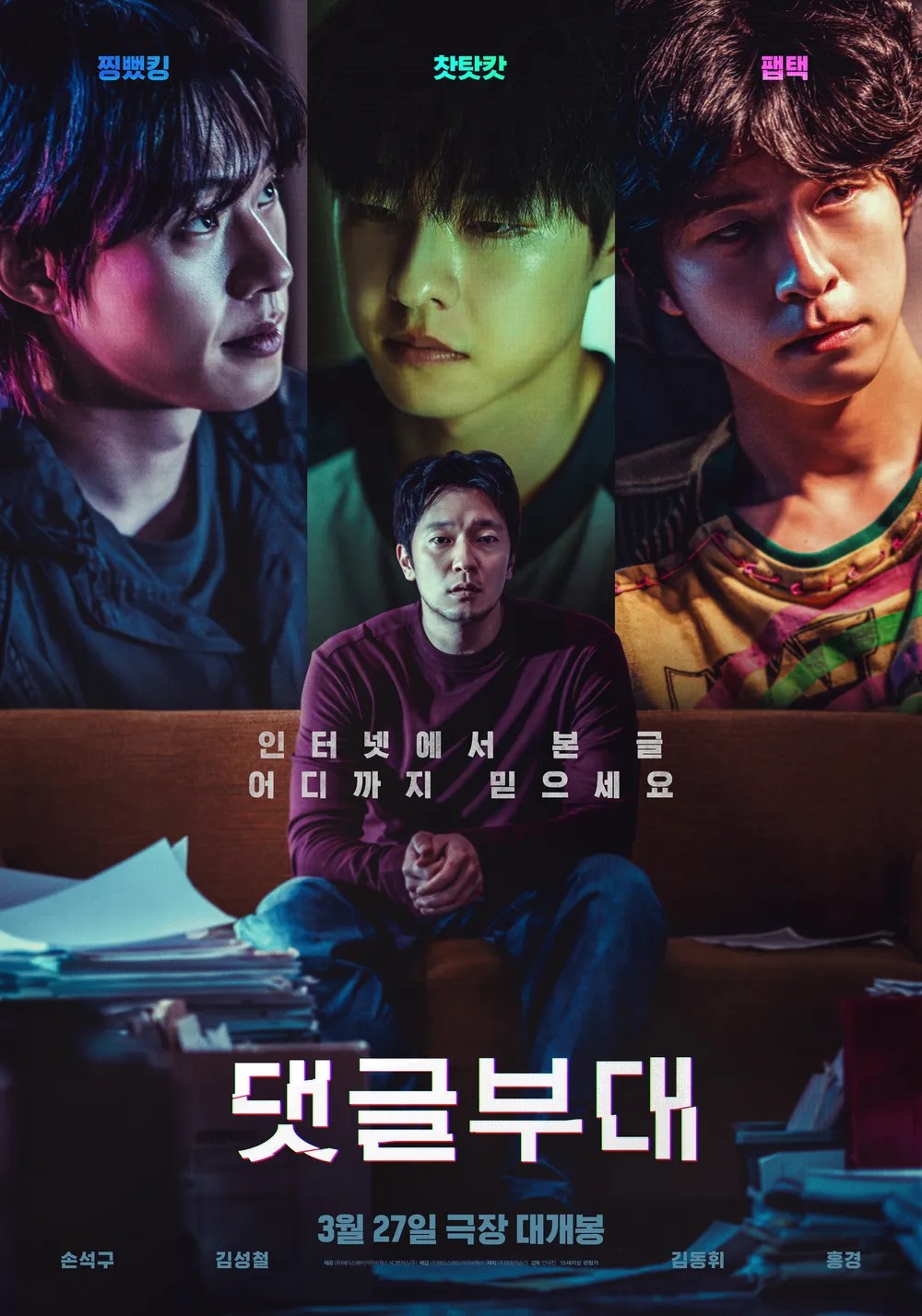
Troll Factory (댓글부대, Ahn Gooc-jin, 2024)

The modern world is so confusing that it’s become almost impossible to discern what is objectively “real” from what is merely currently held public opinion. Sometimes what is actually true sounds like a conspiracy theory, or maybe that’s just what they want you to think. In any case, most of us are already aware of the danger lurking behind cynically employed terms such as “fake news,” and that our perspectives are increasingly manipulated by dubious sources with their own agendas we are continually unaware of. 

Yet is Sang-jin (Son Suk-ku) the journalistic hero of Ahn Gooc-jin’s Troll Factory (댓글부대, Daetguelbudae) already too far down the rabbit hole to be able to see the light? He’s fond of saying that “the path of a journalist is dark and lonely, but his courage changes the world,” while simultaneously admitting the “thrill” of leaking a secret that no one else knows. It’s possible he’s over romanticised his role in events and is reading more into things than is really there because at the end of the day he wants to believe which obviously leaves him dangerously open to manipulation.

In some ways, he starts his story with a more positive framing explaining that the first candlelight protests took place in the early days of the internet so they weren’t able to get the information out there fast enough to attract large enough crowds to make a difference while approximately a third of the entire population turned out in 2017 and got President Park Geun-hye impeached. Of course, that’s only good news if you’re on the same side as the protestors, and Sang-jin increasingly hints that the internet has been bought up by big business which obviously wouldn’t be. Sang-jin has a particular bugbear with a company named Manjun that was forced to offer a public apology for its corrupt business practices which were exposed thanks to the protests against the government scandal. He’s suckered into writing an article exposing them to help a small IT company that says Manjun scuppered its attempts to win a government contract then poached its employees and stole its technology.

Though Sang-jin is able to publish the piece, Manjun refute it and cast doubt on the CEO’s evidence. Sang-jin is relentlessly trolled online and the CEO takes his own life with many blaming Sang-jin for allowing him to face this kind of harassment because of his own petty vendetta against Manjun and desire for journalistic glory. Yet the young man who comes to him with another story that he was employed by Manjun to run extreme PR and harassing campaigns online may not be so different in that one of their targets also took her own life after being humiliated on the internet. They were hired to get her father to stop his one man protest against the defamation laws by pushing her into suing the people trolling her. Sadly she made a much more final decision, but her father did stop protesting so technically they still achieved their goal. 

As he later says, truth mixed with lies feels more real than the actual truth. It doesn’t seem implausible that a large corporation would be doing this sort of thing. It’s not unheard of that people are paid to write product reviews for products they’ve never used or to write negative reviews of a rival business to cause them reputational damage. It stands to reason that they’d be briefing against their enemies online and trying to mitigate any negative energy by manipulating public opinion. We’ve seen this done demonstrably with bots during elections. But Sang-jin still can’t seem to critically inspect his sources and never really stops to wonder if the young man opposite him in an otherwise empty coffee shop is making all this up just to troll him personally, or in fact from the conspiracy theorist’s perspective, to permanently discredit him so that his criticisms of Manjun will never be given any credence. 

In the end, it’s him that seems like a crank resorting to posting lengthy rants on the internet because the respectable papers won’t trust him anymore now that all his scoops have been discredited. Is he right that Manjun and possibly others are running large scale “Public Opinion Task Forces” or Troll Factories online, or did he just get trolled himself and can’t let it go? In the opinion of some, he is now the troll peddling his conspiracy theories online and craving the attention of going viral with another sensationalist story. But even if not all of it’s true, that doesn’t mean it’s all lies and Sang-jin maybe onto something even if it’s just that the internet make trolls of us all as we become lost in the infinitely confusing labyrinth of what is objectively “true” and what merely a convenient lie to serve those who are in “reality” already in power or simply would wish to be. 


Trailer (Korean subtitles only)

In Our Prime (이상한 나라의 수학자, Park Dong-hun, 2022)

Education is supposed to be the great leveller, a true meritocracy in which a combination of hard work and innate ability can enable anyone to follow their chosen path as far as it will go. The reality is however far less idealistic. Park Dong-hun’s In Our Prime (이상한 나라의 수학자, Isanghan Naraeui Suhakja) is the latest in a series of Korean films taking aim at corruption within the educational system along with a persistent classism that ensures only the “right” kind of people are allowed to prosper. 

Han Ji-woo (Kim Dong-hwi) knows he’s not the “right” kind of person and feels out of place at the elite boarding school where he is bullied by teachers and students alike for being a scholarship boy amid the children of mostly wealthy families. Though he won the place though being a top student at his previous school, now his grades are merely average and he’s bottom of the class in maths. Ji-woo’s odious, elitist teacher coldly tells him that his case is hopeless and he’ll never get into a top league university with these kinds of grades at this kind of school. He pressures Ji-woo into applying to transfer out which he is reluctant to do because he knows how much his attending such a prestigious school means to his widowed single mother. In any case as we later discover, the teacher merely has it in for him openly complaining with other members of staff about having to fuss with paperwork for kids on scholarships and bursaries who in his opinion don’t really belong in a place like this which is clearly geared towards perpetuating the privilege of the children of the elite at the expense of those like Ji-woo. 

When Ji-woo is caught smuggling in pork and soju at the behest of his exploitative roommates he refuses to dob them in, making the unlikely claim that he intended to consume all four meals himself. The teacher first praises his idealistic stance but then calls him an idiot because the other boys wouldn’t do the same for him nor are they coming forward themselves to take responsibility. Perfectly happy to let the scholarship boy take the blame one of them even crassly slips Ji-woo some money afterwards, genuinely confused when Ji-woo tries to turn it down claiming such things are unnecessary between friends. Nevertheless, the incident brings him the attention of the “commie officer”, a North Korean defector (Choi Min-sik) working as the nightwatchman who easily solves Ji-woo’s impossible maths problems. The officer eventually agrees to teach him maths but only on the premise that he doesn’t care about tests or grades but solely on the art of learning. 

What he teaches Ji-woo is a valuable lesson that cuts straight to the quick of the issues within the educational system in which children are being taught to blindly answer standardised questions without developing critical thinking skills. The first problem he shows him has a deliberate error in it, but Ji-woo is so focussed on giving the correct answer he doesn’t stop to consider the question itself may be wrong and as the officer is fond of saying there can be no correct answer to an incorrect question. Yet this new philosophy of maths in particular being a purely rational science in which there is only one true answer brings Ji-woo back into conflict with his teacher who complacently teaches to test and humiliates him when he points out one of the test questions is badly formulated. The teacher tells them the correctness of their answer is irrelevant for they must answer in accordance with the textbook and willingly say that black is white if the textbook says it’s so. Meanwhile it also becomes apparent that he has been taking kickbacks from parents getting wealthy students into an elite tutoring group where he leaks the questions on upcoming exams.

This discovery prompts a minor rebellion by rich kid Bo-ram (Jo Yun-seo) who becomes disgusted with her elitist mother after being unwittingly enrolled in the cheating cabal while already resenting her for having made her give up playing the piano. For the officer, music is a mathematical language and merely an expression of the beauty of numbers which can used to explain everything there is in the world, yet as we discover he left North Korea after finding out that his research was used in weapons production only to become disillusioned with the South on realising that here people merely use it as a tool for advancement towards dull and conventional lives in the service of capitalism. When Ji-woo admits that he supposes he wants good grades to get into a good uni and then get a good job to be set for life, the officer decides to broaden his horizons encouraging the better instincts the elites at the school had rejected and showing him how to think for himself rather than blindly follow what he’s being taught. 

All that might seem quite ironic for a man from North Korea pointing out the unhelpful brainwashing of a rote learning system along with the unpleasant complacency of Ji-woo’s teacher not to mention his unethical hypocrisy. Nevertheless, the officer has his own tragic past which suddenly rears its head just as the two begin to form a paternal bond and Ji-woo finds himself at a moment of crisis once again pushed towards a transfer. Though the system is stacked against them, Ji-woo and Bo-ram eventually find their way through it in their shared resistance bolstered by the officer’s teaching as they gain the strength to fight back with honesty and integrity. It may be a slightly rosy conclusion implying the system has been corrected as if Ji-woo’s teacher were the only problem rather than the product of its corruption but does at least make the case that integrity is the one thing that pays but can’t be bought.


International trailer (English subtitles)