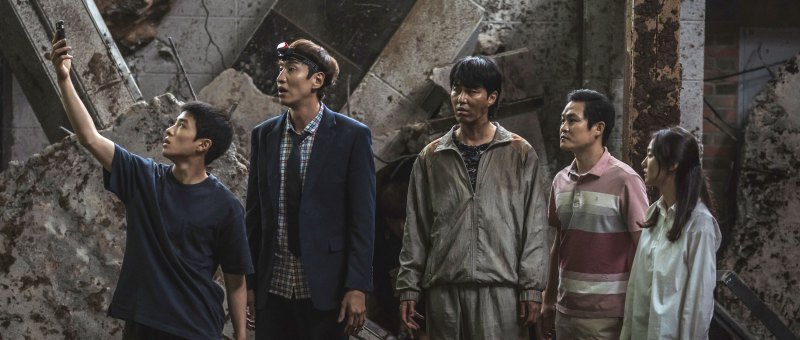

Sinkhole (싱크홀, Kim Ji-hoon, 2021)

Financial security is built on shaky ground in Kim Ji-hoon’s harrowing disaster dramedy Sinkhole (싱크홀) in which one man’s home-owning triumph quite literally crumbles beneath his feet. The latest in a recent series of movies lamenting the sometimes lax safety culture of the Korean construction industry, Sinkhole is also a crushing indictment of a society ruled by house prices in which social status is largely defined by the owning of property while the young in particular struggle to climb out of a deep well of societal despair. 

As the film opens, the Park family is about to move in to their new flat, the first they’ve ever owned albeit with a frighteningly large mortgage, in the middle of a seasonal downpour. Only when they arrive, they discover the movers haven’t even started unloading because their apparently irresponsible neighbour Man-su (Cha Seung-won) has inconsiderately parked his car in front of the entrance and isn’t answering his phone. Patriarch Dong-won (Kim Sung-kyun) ends up in an awkward confrontation with the abrasive apartment dweller which is inconvenient because Man-su apparently works in just about every business in the area which means he continues to run into him just about everywhere he goes. 

Anyway, that’s the the least of his problems because, having made this giant investment, Dong-won can’t help thinking there’s something wrong with his new dream home especially when his adorably polite young son Su-chan points out that his marbles roll across the floor of their own accord. Worried they may have a subsidence problem, Dong-won checks his windows open properly and records evidence of ominous cracks in the pavement outside but struggles to get the other residents to agree to maintenance checks in fear that not getting the answer they want will bring down the value of their property. 

Property prices are apparently everything. Homeownership is an unobtainable dream for many, yet Dong-won already feels insecure in his purchase especially as his colleagues seem relatively unimpressed by the fact his flat is in a recently gentrified area and comparatively modest. Bamboozled into hosting a housewarming, he’s mildly embarrassed to realise the view from his balcony is of nicer, much more expensive luxury flats just across the river which are likely to remain far out of his reach. Nevertheless, his colleague, Seung-hyun (Lee Kwang-soo) declares himself jealous in part because he’s still renting a studio flat and feels that dating let alone marriage is impossible without being in a position to get a multi-room apartment. His colleague Eun-ju (Kim Hye-jun) is in the same predicament but prefers to see it as simply being at a certain stage on the ladder.  

This dream of future security is however quite literally built on shaky ground. There are definitely problems with Dong-won’s new apartment which become increasingly severe from the tilting floors to cracked glass and interruptions with the water supply presumably caused by cost-cutting and shoddy construction practices. When the building collapses into a sinkhole, Dong-won is trapped inside with work colleagues Seung-hyun and Eun-ju along with Man-su and his teenage son Seung-tae (Nam Da-reum). Despite the inherent horror of the situation, Kim keeps the atmosphere light as the small band of survivors attempts to manage as best they can, finding an awkward solidarity while trying to attract the attention of the emergency services and eventually making a daring escape using whatever tools are available to them. 

Even so, as much as the small band of almost strangers bond thanks to their desperate circumstances, there is an uncomfortable conservatism at play especially in the film’s treatment of a working class single mother and her son living in an apartment on the floor below Dong-won’s. That aside, Sinkhole offers a fierce criticism of an increasingly consumerist society in which house prices are all anyone talks about and homeownership is the only badge of social success. 11 years of patient sacrifice is swallowed in an instant, sucked into an abyss of corporate malfeasance, while Dong-won is left to climb out of the hole he’s in on his own. It’s small wonder that some of the survivors decide to drop out of the system altogether, ditching the idea of rooted homeownership for nomadic freedom in buying a small caravan rather than participate in the property market or climb the corporate ladder. “Don’t be happy in 10 years, be happy today!” they enthusiastically chant. The entire society is, it seems, sitting on a sinkhole which might give any minute, what’s the point in investing in a future which could disappear from beneath your feet without reason or warning? 


Sinkhole screened as part of this year’s New York Asian Film Festival.

International trailer (English subtitles)
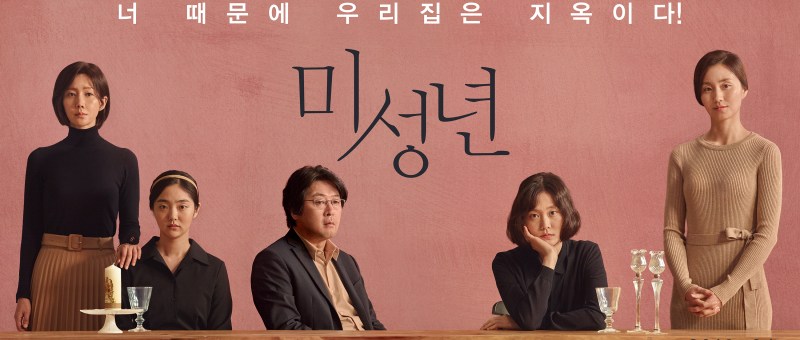
Another Child (미성년, Kim Yoon-seok, 2019)

Another Child Poster 1Learning to be generous in the face of disappointment is perhaps a defining characteristic of adulthood. It’s a lesson the teenage heroines of Another Child (미성년m Miseongnyeon) must learn the hard way as they find an unexpected bond in realising that their parents aren’t bad people, just flawed and human. The debut directorial feature from actor Kim Yoon-seok who also stars in a minor role as the feckless patriarch, Another Child finds four women across two generations caught in very trying circumstances but acting with generosity and compassion as they endeavour not to make any of this harder than it needs to be.

The drama begins when 15-year-old Joo-ri (Kim Hye-jun) spots a compromising photo of her father and another woman on his phone. Following him around, she realises that he’s been having an affair with a woman who runs a duck restaurant a little way out of town and is actually the mother of one of her schoolmates, Yoon-ha (Park Se-jin), though they barely know each other seeing as they’ve never shared any classes. In any case, they do not really get on and eventually get into a fight over Joo-ri’s phone which she dropped at the restaurant while snooping, prompting Yoon-ha to blurt out the truth to Joo-ri’s already depressed and suspicious mother.

Despite Joo-ri’s outrage, her father Dae-won (Kim Yoon-seok) and mother Young-joo (Yum Jung-ah) have been sleeping in separate bedrooms for the last two years and appear to be married in name only. Nevertheless, Joo-ri hoped she could sort all of this out before her mother knew anything about it but the situation has been further complicated by the fact that Yoon-ha’s mother Mi-hee (Kim So-jin) is apparently several months pregnant – news which comes as a shock to Joo-ri who begins to accept that perhaps she can’t simply put an end to her father’s philandering and that nothing will ever be the same ever again.

This becomes doubly true once the baby is born in an early labour brought on by Young-joo’s impromptu visit to the restaurant. Guilt-stricken, Young-joo tries to do what she can for Mi-hee as another woman in a difficult situation while trying to encourage her rather snooty daughter to make friends with her almost step-sister. Despite themselves and the many differences between them, Joo-ri and the headstrong Yoon-ha do eventually start to bond but find their newfound friendship tested by their shared affection for their new little brother with Yoon-ha immediately adopting him and vowing to raise the baby herself in place of her irresponsible mother, even stopping to ensure his birth certificate is properly registered, while Joo-ri coldly suggests he be put up for adoption in the hope he gets a better education. Yoon-ha, practically minded in many other respects, would never abandon a family member, while Joo-ri makes what she thinks is the “sensible” if austere choice which prioritises Yoon-ha’s right to conventional success over familial duty.

Meanwhile, the four women are left to sort everything out amongst themselves. Dae-won is perhaps not a bad man, but weak and feckless. Unwilling to face what it is that he’s done, he runs away – avoiding seeing the baby while refusing to engage with the pain he’s caused his wife and daughter through his infidelity, still in denial that he’s destroyed his family home but never really intending to make a new one with Mi-hee who really was, it seems, just a mid-life crisis fling. Across town, Yoon-ha tries asking her own feckless father for money to pay some of her mother’s hospital fees as well as other expenses but finds him an irresponsible gambler who’d forgotten how old she was even if he eventually managed to recall her name.

Thanks to some gentle prodding from each other’s mothers, with whom both Yoon-ha and Joo-ri begin to find common ground, the girls eventually grow more accepting of their situation, looking for understanding rather than trying to apportion blame. No one here is really “bad”, just flawed and unhappy, caught up in an emotionally difficult situation that is either everyone’s fault or no one’s. None of them have anything to gain by making this harder than it needs to be and thankfully decide to take the moral high ground, not exactly forgiving but compassionate. “It’s not easy to live in this world”, Yoon-ha tells her new brother not quite knowing how right she is. A beautifully pitched exploration of magnanimous female solidarity and unexpected friendship, Another child is a finely drawn feature debut from the veteran actor which holds only sympathy for its flawed heroines trying to find grace in trying times.


Another Child screens on 11th July as part of the 2019 New York Asian Film Festival. It will also be screening as part of the 2019 Fantasia Film Festival on 14th/20th July.

International trailer (English subtitles)