Hot in Day, Cold at Night (낮에는 덥고 밤에는 춥고, Park Song-yeol, 2021)

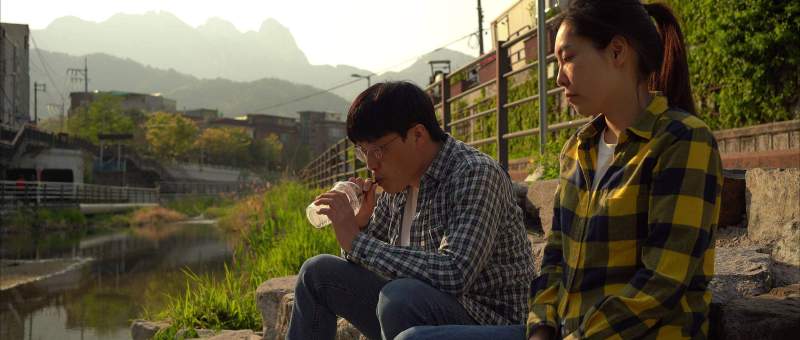
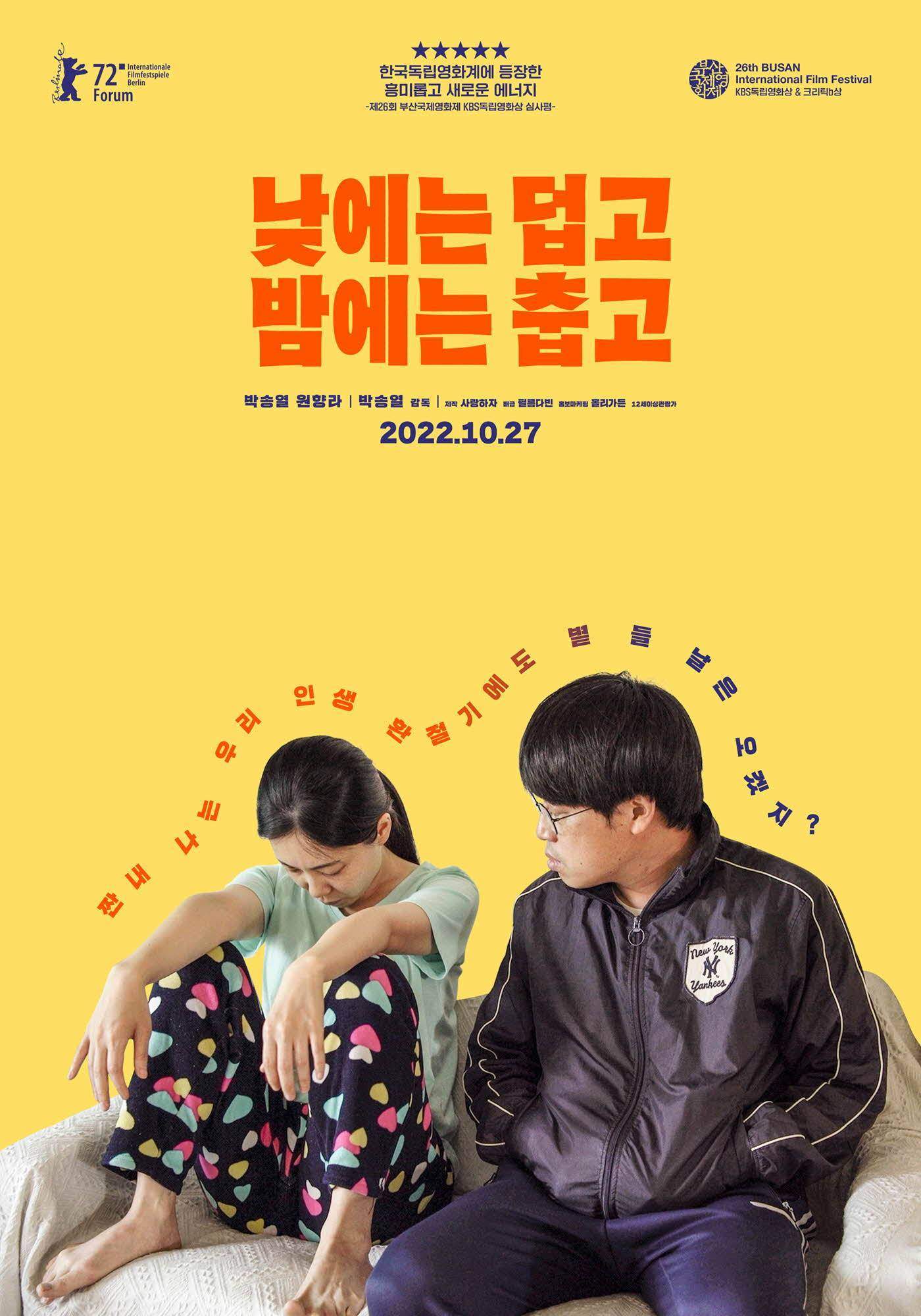
Anyone can have a run of bad luck, but when it’s happening to everyone at the same time perhaps it’s time to admit that something isn’t working. The latest film to tackle life on the margins of an increasingly unequal society, Park Song-yeol’s scrappy indie drama Hot in Day, Cold at Night (낮에는 덥고 밤에는 춥고, Naj-eneun deobgo bam-eneun chubgo) follows one ordinary couple who’ve found themselves jobless and are just trying to keep their heads above the water without losing either their dignity or humanity. 

Young-tae (Park Song-yeol) was working as a delivery driver until an accident with his bike left out him out of work and now he can’t seem to find anything else. His wife Jeong-hee (Won Hyangra), formerly a teacher, is also unemployed and in the process of applying for new positions which seem to be thin on the ground. They aren’t proud and are willing to do whatever is available, each of them reeling off a list of all the casual jobs they’ve done including those that are dangerous or exploitative, but they just can’t seem to catch a break. Mainly, they’re on the same page though differ slightly in their approaches to life, Jeong-hee feeling that her softhearted husband is too much of a pushover and shouldn’t always be so understanding when comes to getting what’s he’s owed. 

A case in point being his decision to lend their professional camera to a friend, Myung-su, who pays them a token rental fee and swears to return it in two weeks when he’s made enough money to buy his own but soon stops returning Young-tae’s calls. Unreturned calls become a repeated motif emphasising how money and the shame associated with not having it can disrupt even close and longstanding relationships. Jeong-hee experiences something similar with school friend Mi-sun who calls in a loan but abruptly stops talking to her after what appears to be a slightly dodgy arrangement getting Jeong-hee to sub for her at a school which goes south over a misunderstanding with the address causing Jeong-hee to ruin a good opportunity (and possibly Mi-sun’s reputation) by arriving late. 

Young-tae has his own series of interview disappointments, Myung-su getting him an opportunity through the “relative of an acquaintance’s friend” which takes a turn for the strange when the interviewer starts asking awkward questions such as whether Young-tae has any sick relatives at home because people apparently take too much time off claiming they have to take care of someone who’s ill. Another possibility sees a friend call out of the blue after 20 years which predictably turns out to be linked to a pyramid scheme.  “My identity just vanishes” Young-tae exclaims of all his soulless causal jobs, “your self-esteem just gets destroyed”. He takes a job as a proxy driver but is faced either with the tedious talk of much wealthier customers throwing their money around in the back or else harangued by drunken fares who don’t agree with this driving practice or the route he’s chosen. 

There is only so much anyone can take though Young-tae’s threshold is higher than most, keeping his cool and trying to get on with his work in the hope that happier days are coming. “There’s no such thing as easy money” he concedes, even as Jeong-hee goes behind his back to take out an ill-advised loan from loansharks who send passive aggressive messages wishing her “peace and wellbeing” while breathing down her neck for the repayments before going so far as to turn up at her mother’s door looking for money. The fact that Jeong-hee didn’t just ask her mother for help in the first place hints the secondary effects of their poverty in their intense embarrassment which further isolates them from wider society even if they hadn’t fallen out with most of their friends over money. A primary motivator for Jeong-hee getting the loan is seeing all her siblings, who each have several children, preparing gifts and money for her mother’s birthday which is something they as a couple were unable to do though it’s Young-tae who appears to feel the most awkward, guilty to be eating food at the party while bringing no gift even if that shouldn’t really be the way it works. 

Young-tae is the sort of person who likes to do things properly and sees the best in people but even he starts to feel like a mug on realising that Myung-su sold his camera ages ago, insisting he pay him back fairly and a little more for the betrayal only to feel guilty and give him back some of the money. Myung-su just accepts it without even offering an apology for acting in such a reprehensible manner but is later seen to have bought a new car which doesn’t tally with his claims of absolute desperation. It’s enough to drive anybody crazy, but really what can you do? Young-tae meditates on petty revenge, but eventually thinks better of it. It wouldn’t make any difference anyway. Quite obviously made for a shoestring and imperfect in execution, the film’s scrappiness perfectly matches that of its heroes who find themselves just muddling along trying live comfortable lives in one the world’s richest cities but discovering little more than loneliness and disappointment. 


Hot in Day, Cold at Night screened as part of this year’s London Korean Film Festival.

Original trailer (English subtitles)

Burning Mountain (山불 / 산불, Kim Soo-yong, 1967)

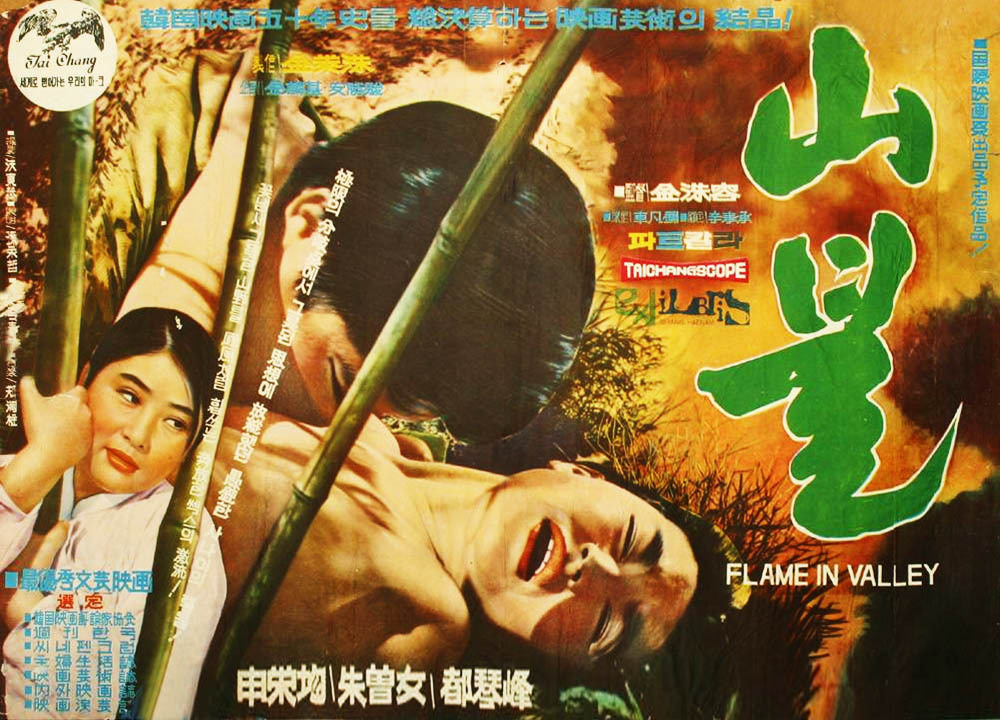
Burning Mountain still 1In his 1965 film The Seashore Village, Kim Soo-yong had presented a broadly positive vision of a community of women who had learned to survive without men by supporting each other. 1967’s Burning Mountain (山불 / 산불, Sanbul, AKA Flame in the Valley) revisits a similar theme but with much less positivity. This time around, the women have been deprived of their men not because of nature’s cruelty, but because of man-made corruption. Set during the Korean War, Burning Mountain finds a collection of wounded, lonely women condemned by patriarchal social codes and hemmed in by political strife not of their making struggling against their baser instincts as they determine to survive in an often hostile environment.

A small village near Jirisan has lost all of its men. Pressed by communist guerrillas for food, the lone women are hungry and afraid. Consequently, they are often at each other’s throats and united only in a shared futility of waiting for men they are almost certain will never return, either because the war has taken them or they have taken the opportunity to seek a better kind of life. The drama begins when Jum-rye (Ju Jeung-ryu) discovers a communist deserter, Kyu-bok (Shin Young-kyun), hiding in the bamboo grove and is seduced by him, satisfying her long repressed desire and escaping her loneliness through a transient bond with a captive man.

Unlike the fishwives of The Seashore Village, the women of Burning Mountain are a more conservative bunch though they too are largely unafraid to talk plainly of their unanswered desire in the absence of men. Rather than embracing each other as the fishwives had, the mountain women allow their sexual frustrations to make them bitter and irritable, forever at each other’s throats and unable to let go of past grievances. They dwell on the possibility of escape, but do not believe it to be real. One of the younger, unmarried women, talks of going to the city to find work as a maid but is confronted by a world of checkpoints and soldiers which restricts both her movement and her freedom in ways she is ill-equipped to understand.

The village stands as a tiny enclave, caught between North and South, part of both and neither as if lost in some eternal netherland. The bamboo grove represents the innocent natural freedoms which have been taken from the villagers by civilisation and by later by the folly of men and war. It’s in the bamboo grove that Jum-rye first encounters Kyu-bok in a meeting which begins as rape but ends in seduction as Jum-rye surrenders herself to a rough stranger in desperation and loneliness. The affair continues and relations between herself and the other women improve until Sawol (Do Kum-bong), a woman with whom she’d been on bad terms because their absent husbands had been on different sides, discovers Kyu-bok’s existence and blackmails the pair into allowing her to make sexual use of him in order to ease her own frustration.

Roles interestingly reversed, Kyu-bok takes exception to his new status as a kept man, resenting the feeling that he is nothing more than a pet, breeding stock kept to scratch an itch. Nevertheless, he stays while the women, increasingly conflicted, urge him to turn himself in to the authorities sure that if he explains himself they will not treat him harshly. Already emasculated in having been forced into the mountains against his will, Kyu-bok remains impotent in all ways other than the sexual, pleading with Jum-rye that she let him stay in the bamboo grove “until the world gets better”.

Sadly, the world shows little sign of doing that, though thanks to their shared transgression a strange kind of camaraderie arises between former enemies Jum-rye and Sawol, now disposed towards female solidarity having eased their own frustrations. They want to trap Kyu-bok and keep him for themselves, but at the same time they dwell on the idea of the unseen woman waiting somewhere for him just as they are waiting for their menfolk and know they cannot have him for long. Where the constant refrains of “we are all the same” had rung somewhat hollow, they ring true now in the two women’s commitment to a woman they don’t know who is, in some senses, their rival.

Yet, the liminal space of the bamboo grove cannot be allowed to stand in the increasingly straitened future. Already subversive in his frank depiction of female desire, Kim subtly undercuts the austerity of the times in making accidental villains of the South Korean army who arrive to burn the bamboo grove down to smoke out the guerrilla fighters, taking from these women the symbol of their freedom in the natural pleasure of the forest. The cowardly communist, while fulfilling the demands of the censors’ board, is both passive victim of his times and a representative of the frustrated masculinity which has caused them in the first place. The corruption of the war has come to the bamboo grove and set light to the last vestiges of hope in taking from these already impoverished women their very source of life. A sorry tale of despair and futility, Burning Mountain spins a tale of weak men and resilient women whose solidarity is bought through a mutual satisfaction cruelly ended by an austere and unforgiving regime.


Burning Mountain is available to stream online via the Korean Film Archive’s YouTube Channel.

Ashamed (창피해, AKA Life is Peachy, Kim Soo-hyun, 2011)

ashamedOne of the very earliest films to address female same sex love in Korea, Ashamed (yes, really, but not quite – we’ll get to this later, 창피해, Changpihae, retitled Life is Peachy for US release) had a lot riding on it. Perhaps too much, but does at least manage to outline a convincing, refreshingly ordinary failed love romance even if hampered by a heavy handed structuring device and a lack of chemistry between its leading ladies.

Beginning in the film’s “present”, embittered art professor Jung Ji-woo (Kim Sang-hyeon) is auditioning models for an art project, whereupon she bonds with two students currently undergoing some kind of unresolved drama of their own. Hee-jin (Seo Hyun-jin), Jung’s pupil, has roped in her friend also coincidentally named (Youn) Ji-woo (Kim Hyo-jin) who, as she recounts in a lengthy flashback, she met in odd circumstances whilst drinking with layabouts in an alley. Eventually, Youn Ji-woo confessed to her that she’s attracted to people of the same sex, which has left Hee-jin feeling kind of awkward.

Trying to console her student, Jung encourages the younger woman to recount the story of her own great yet failed romance with a pickpocket named, yes, again (Kang) Ji-woo (Kim Kkobbi). Youn had been leading a dull and unfulfilling life as a shopgirl in a department store, baby sitting middle aged housewives. Disillusioned with her disappointing boyfriends, Yoon has entered a dark place where the thing she’s most sorry about in life is that she won’t be able to witness her own suicide. Accordingly she dresses up one of the department store mannequins in her clothes and pushes it off a roof, only it hits a car below and causes an accident.

Not exactly a traditional “meet-cute”, Youn and Kang first encounter each other surrounded by broken glass and are then handcuffed together by the investigating policeman (Choi Min-Yong) who was also just stabbed by one of Kang’s gang members after he spotted her pickpocketing on the metro. The policeman then randomly takes them to his friend’s Chinese restaurant which affords them an opportunity to escape even if they’re still chained at the wrists.

Though this very improbable situation points to a cute and quirky romance, Ashamed takes a non committal stance as regards to tone, throwing in odd details like strange priests living in the woods and Kang’s constantly unreliable self narratives but then retreating to something more straightforwardly melancholy. Love falls slowly as Youn recounts her lack of satisfaction with men only to find herself strangely attracted to her new handcuffs buddy while she, somewhat rudely, has sex with an ex-boyfriend she invited over for help with Youn lying mortified beside them. Suddenly realising why none of her boyfriends ever worked out, Youn feels, understandably, awkward alone with Kang and her ex and but is encouraged by Kang’s tentative but ultimately decisive grasping of her hand during the taxi journey onwards.

Kim’s attempt to avoid prurience whilst also pushing boundaries for sexual content unavoidably feels tame, hampered by the lack of chemistry between the leading actresses and lingering sense of embarrassment in his choice of camera angles. Though painted as a grand and heartbreaking love affair of a lifetime in the opening sequences, Youn and Kang’s romance never takes on the weight of tragedy or moves much beyond the very ordinary tale of two people who couldn’t make it work. This indeed may be the point, but given the melancholy atmosphere of the the three women discussing lost love on a lonely beach, Youn and Kang’s missed opportunity can’t help but feel slighting underwhelming.

Rather than the strongly negative “ashamed” the meaning of the original Korean might be more generously translated as “shy” or “embarrassed”, at any rate the film does not imply any of its characters have reason to feel shame. The title word surfaces a handful of times, most notably when the loosened up professor declares she has no need for it anymore, and in the final showdown with Kang as Youn attempts to challenge her on her problems with intimacy and commitment but fails to push her into a more honest space. Kang’s sense of “shame”, if that would be the right word, seems to be unconnected to sexuality but has deeper roots in the past which she remains unwilling to reveal. This sense of personal inadequacy fuels Kang’s drifting life as she feels the need to move on each time someone gets too close, afraid or perhaps on some level “ashamed” to commit herself fully.

Kim’s multi layered flashback structure mixed with imagined sequences and expressionist scenes inspired by Jung’s artwork proves an unwieldy concept which often detracts more than it gives. With a running time of over two hours and a romance which doesn’t start until many indie films have already ended, Ashamed bites off much more than it can chew but at the same time never fully engages with the most interesting elements of its subject matter. Flawed, if interesting, Ashamed is a bold and worthy effort yet one which falls far short of its target despite the committed performances of its central trio.


Original trailer (English subtitles)