YMCA Baseball Team (YMCA 야구단, Kim Hyun-seok, 2002)

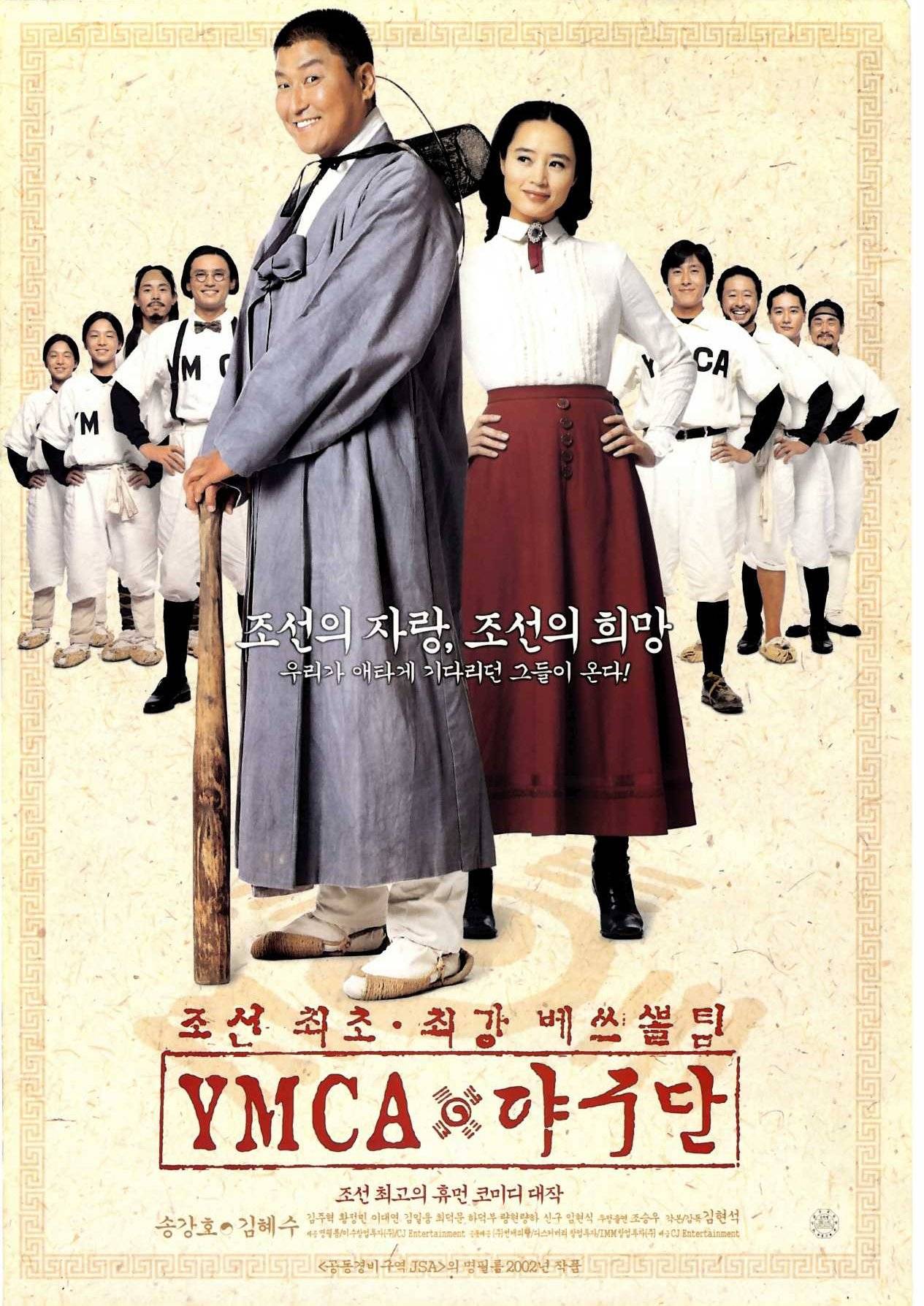
Kim Hyun-seok’s sporting comedy YMCA Baseball Team (YMCA 야구단, YMCA Yagudan) opens with sepia-tinted scenes of Korea in 1905 in which most people still wear hanbok and live little differently than their distant ancestors. Modernity is, however, coming as evidenced by the streetcar that runs through the centre of town even if it’s surrounded on both sides by unpaved ground. Reluctant scholar Hochang’s (Song Kang-ho) father (Shin Goo) complains that the cranes no longer stop in Seoul. Too many scholars have picked the wrong side, he says, but Hochcang counters him that these days you can get to Incheon in hour by train. Maybe the cranes are saying there’s no need to emulate them anymore. 

Hochang doesn’t want to be a scholar or take over his father’s school. His father wanted his brother to do that anyway, but he’s run off and joined the resistance to the Japanese. Just as Hochang discovers the new sport of baseball thanks to a pair of American missionaries and the pretty daughter of a diplomat, the Japanese further increase their dominance over Korea by forcing it to sign the Eulsa Treaty in which they effetively ceded their sovereignty and gave additional provisions for Japanese troops to remain in their nation.

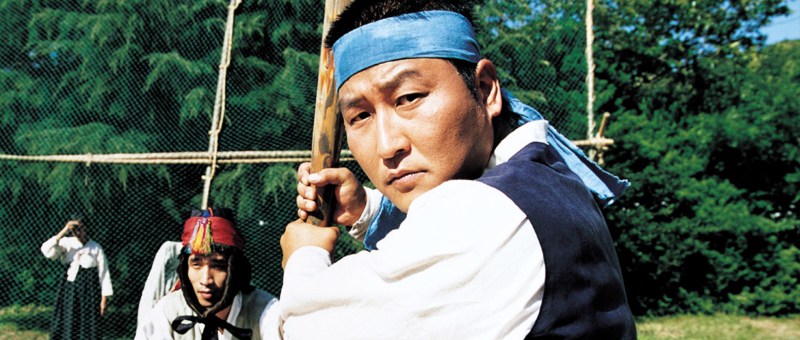
Hochang had been playing football alone as his friend practised reading English before he kicked a ball into Jungrim’s (Kim Hye-soo) garden and found a baseball instead. The early scenes see the local population adopting this Western game in makeshift fashion, using paddles and tools as bats while putting festival masks on their faces in weaponising their culture to make this sport their own. In baseball, Hochung finds the vocation he hasn’t found in scholarship or anywhere else. As a child, he wanted to be a King’s Emissary, but the Korean Empire is drawing to a close and the position no longer exists. His battle is in part to be able to live the life he chooses rather than simply continue these ancestral traditions and be a teacher like his father. In a cute public event unveiling the team, children sing a song in which little boys sing about how they don’t want to be an admiral as their fathers wanted them to be but want be something else, while the girls don’t want to marry a powerful man as their mother’s advised, but would rather marry someone else. The joke is that they both want to be or be with the YMCA Baseball Team, which has, in its way come, to represent a new modernising Korea that is keeping itself alive by embracing the new.

To that extent, Jongrim herself comes to represent “Korea” in that Hochang uses his scholarly skills to write her a love scroll in beautiful calligraphy, but it somehow gets mistaken for her father’s will and read out at his funeral after he takes his own life to protest the Eulsa Treaty. Hochang’s heart felt and rather florid poem is then reinterpreted to reflect her father’s “love” for Korea which has been stolen from him by the Japanese. Jungrim and her Japanese-educated friend Daehyun (Kim Joo-hyuk) are secretly in the Resistance and later forced into hiding when Hochung’s friend Kwangtae (Hwang Jung-min) figures out that it was Daehyun who attacked his politician father for betraying the nation by letting the Eulsa treaty pass. 

The baseball team becomes another resistance activity, with Jongrim admitting that the people “became one and felt proud” every time the team won. When they discover that their training ground has been commandeered by Japanese troops, they end up agreeing to play them to reclaim their lost territory. But the Japanese still have superiority over an underdeveloped Korea as seen in the opening footage as they started playing baseball 30 years earlier. Just as Hochang didn’t want to be a scholar, general’s son Hideo (Kazuma Suzuki) didn’t want to be a soldier either, but in a world of rising militarism he had little choice. His father thinks baseball’s a silly waste of time too, and like Hochang’s father is secretly proud of his son when he’s doing well, but is very clear that this game cannot be lost because the great Japanese Empire cannot be seen to lose to the nation it is currently in the process of subjugating. The day is saved, ironically, by Hochang’s royal seal, given to him by Jongrim, who seems to have returned his affections even if she had a greater cause. The baseball team even allows a snooty former nobleman to accept that class divisions no longer exist and he can in fact be friends with a peasant, especially when they’re uniting in a common goal like kicking out the Japanese. Sadly, the Japanese turned out to be not such good sportsmen after all, and predictably sore losers, but Hochang has at least found a way to resist and fight for a Korea that is free of both onerous tradition and colonial oppression.


YMCA Baseball Team screened as part of this year’s London Korean Film Festival.
I Can Speak (아이 캔 스피크, Kim Hyun-seok, 2017)

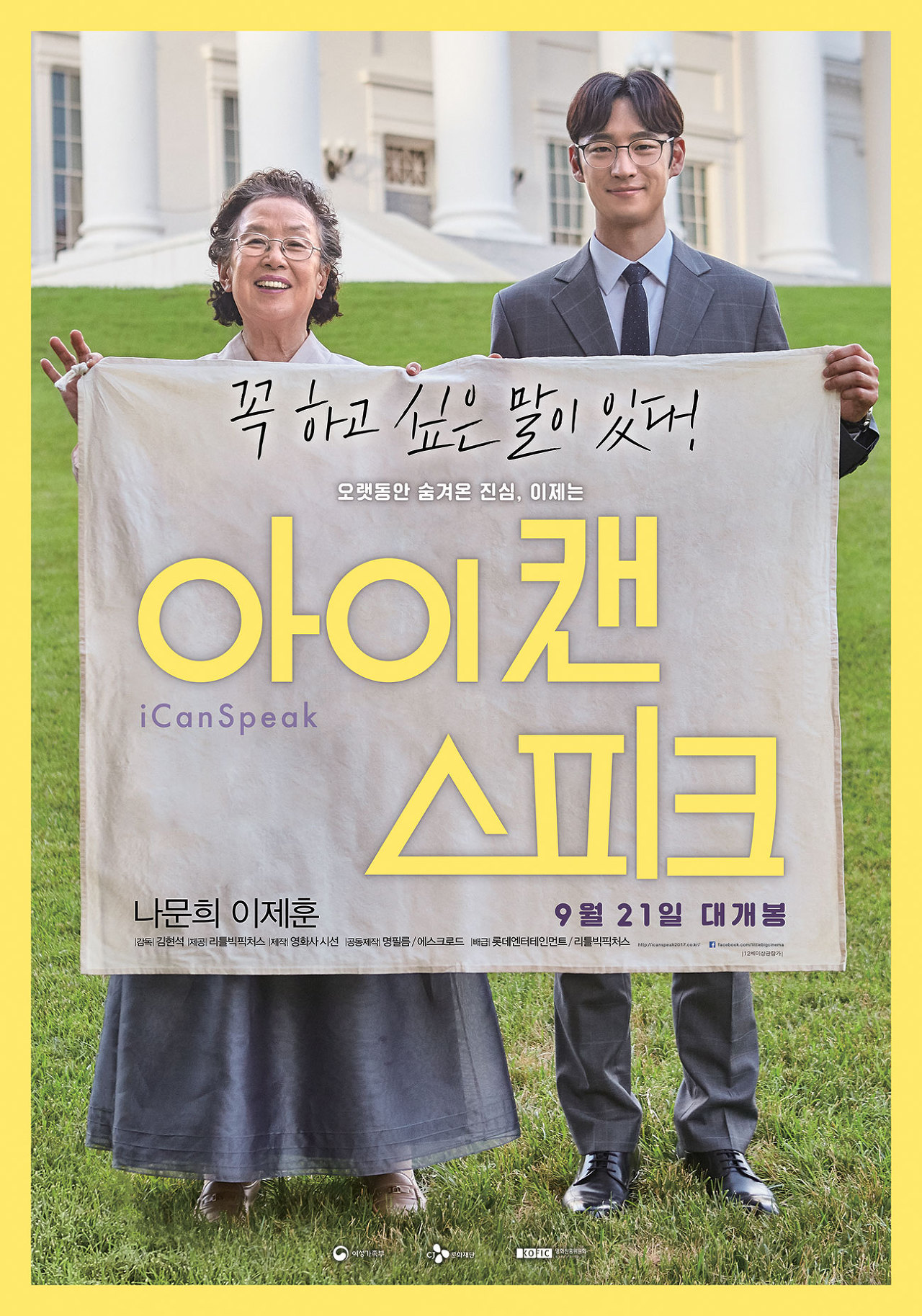
I Can Speak posterGenre in Korean cinema has always been a more fluid affair than it might be elsewhere, but careering from zany generational comedy to affecting historical drama is perhaps a bold choice. I Can Speak (아이 캔 스피크) is, in many ways, the story of an old woman’s personal revolution as she finds herself repurposing her “Goblin Granny” credentials to pursue justice for a great evil she spent a lifetime hiding from, but it’s also an unabashedly political attack on a legacy of unresolved national trauma. Nevertheless, despite its slightly awkward straddling of cheeky comedy and heartrending melodrama, I Can Speak does at least manage to lay bare a series of entrenched social problems affecting all areas of modern Korean society while also making a fairly uncontroversial (at home at least) political point.

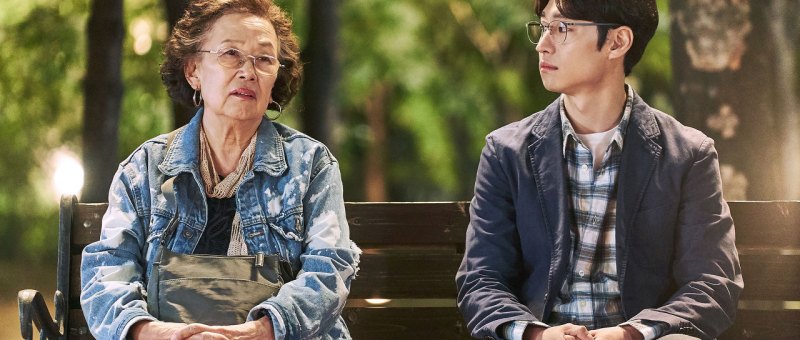
Park Min-jae (Lee Je-hoon) has just transferred to the local council offices in a rundown area of Seoul. Seeing as he’s new and very by the book, he doesn’t know that everyone in the office is terrified of “Goblin Granny” (Na Moon-hee)  – an old woman who turns up every single day with a list of complaints and things around the neighbourhood that could do with being fixed. Min-jae, unaware of Goblin Granny’s fortitude, attempts to deal with her complaints in a bureaucratic manner. He is no match for Ok-boon’s bloodymindedness, but his straightforward approach eventually earns her respect.

Ok-boon is the sort of old woman familiar to many municipal offices in that she is essentially lonely and comes in to complain about things just to make her presence felt. She does have a few friends, however – one being the lady who runs the local convenience store, and the other a woman of around her own age who can speak fluent English. Ok-boon decides she ought to learn English too and enrols in an expensive cram school but is abruptly kicked out of the class which is almost entirely filled with youngsters because of her old lady ways. On the way out, however, she runs into Min-jae who was there to check that his extremely high TOEIC scores were still valid. Ok-boon manages to talk Min-jae into giving her English lessons in return for decreasing the burden on the municipal offices by making fewer complaints.

I Can Speak begins firmly in the realms of bureaucratic comedy as the council workers find themselves cowering in front of Goblin Granny while simultaneously enjoying their cushy jobs for life which require almost no effort in their daily activities. Some in the community assume Ok-boon is a horrible old busybody who likes making trouble and pulling other people up on their various social failings but her community patrols come from a good place. The woman who runs a small stall in the market assumes Ok-boon reported her to the police for selling alcohol to a minor but that’s not the sort of thing that Ok-boon would think worth reporting, which is why she doesn’t think much of breaking city regulations to enjoy a drink outside her friend’s shop. Everything she reports is because she genuinely worries someone may get hurt and her main area of concern is with the strange goings on around the market which is earmarked for “regeneration”. Her concerns are not unfounded as she discovers when she overhears some of the council workers talking about taking backhanders to push the redevelopment through while making use of “external labour” in the form of shady gangsters tasked with clearing the area so the ordinary people who live in the old fashioned neighbourhood will consent to quietly move away. Perhaps because no one ever stood up for her, or because she’s sick of being pushed around, Ok-boon is not going to go quietly nor is she going to allow any of her friends to be taken away without a fight.

Ok-boon is perhaps attempting to fight something else, something she has been afraid to revisit for most of her life. The fact is that Ok-boon was one of many Korean women forcibly abducted by the Japanese army at the end of the Second World War and subjected to heinous, inhuman treatment as sex slave in one of the many “comfort woman stations” which existed throughout Japanese occupied territory. After the war, she was disowned by her family who saw only shame in her suffering and insisted she tell no one what had happened in fear of damaging her family’s reputation. One of the reasons Ok-boon wants to learn English is to be able to talk to her little brother again who she has not seen since they were children and has apparently forgotten how to speak Korean after spending a lifetime in the US.

English does however give her back something that she’d lost in the form of a familial relationship with the otherwise closed off Min-jae who is also raising a teenage brother (Sung Yoo-bin) following the death of their parents. It is true enough that it is sometimes easier to talk about painful things in a second language – something Min-jae demonstrates when he shifts into English to talk about his mother’s death. Abandoning Korean allows Ok-boon to begin dismantling the internalised shaming which has kept her a prisoner all these years, too afraid to talk about what happened in the war in case she be rejected all over again. Her worst fears seem to have come true when her old friends learn about her past, but what they feel for her is empathy rather than shame, hurt that Ok-boon was never able to confide in them and unsure what it is they should say to her now.

Ok-boon learns that she “can speak” – not only English but that she has the right to talk about all the things that happened to her and the long-lasting effect they have had on her life, that she has nothing to be ashamed of and has a responsibility to ensure nothing like this ever happens again. English becomes a bridge not only between her past and future, but across cultures and eras as she finds herself bonding with a Dutch woman giving a testimony much similar to her own and receiving the same kind of ignorant, offensive questions from the American law makers as well as cruel taunts from a very undiplomatic Japanese delegation. Undoubtedly, the final sequence is a very pointed, almost propagandistic attack on persistent Japanese intransigence but then its central tenet is hard to argue with. Tonally uneven, and perhaps guilty of exploiting such a sensitive issue for what is otherwise a standard old lady regains her mojo comedy, I Can Speak is an affecting, if strange affair, which nevertheless makes a virtue of learning to find the strength to stand up for others even if it causes personal pain.


I Can Speak screens at the New York Asian Film Festival on 12th July, 6.30pm.

Original trailer (English subtitles/captions)