
The World of Love (세계의 주인, Yoon Ga-eun, 2025)

Lee Jooin (Seo Su-bin) is a cheerful young woman, always laughing and joking. She tells people she’s okay, though some of them think she shouldn’t be, as if she can’t be telling the truth or what happened to her can’t be all that bad if she’s otherwise unaffected by it now. It’s like they’re telling her that she has no right to be happy, but must continue to live in suffering to conform to their idea of what a traumatised person looks like, otherwise she must be making it up for attention. 

Put like that, it seems very unfair. But it’s true enough that director Yoon Ga-eun plays with our prejudices deliberately withholding whatever it is that happened in Jooin’s life until the truth of it gently unfolds and we witness the radiating effects it’s had on her family and those around her. We at first wonder if she might have done something bad she’s expected to atone for, especially with the talk of lawyers and court cases, the fact her friends and teachers seem to regard her as a compulsive liar, and her sometimes aggressive physicality that sees her rough house with the boys and repeatedly end up in altercations with classmate Su-ho (Kim Jeong-sik) whose sister Noori attends her mother’s daycare.

Later, we might wonder if Su-ho is carrying something difficult to bear too. His mother doesn’t seem to be around, and he’s stepped into a maternal role caring for his sister to a degree that may seem obsessive. He’s started a petition against a convicted child abuser being released back into their community and is fixated on getting the entire school to sign it, even though it’s not really anything to do with him and simply saying they don’t want him back here is not particularly helpful seeing as he’ll have to go somewhere. Su-ho thinks he’s doing a good thing, but Jooin refuses to sign because she doesn’t like it that he’s written that being a victim of sexual assault ruins people’s lives. She tries to explain to him why it’s offensive, that he’s robbing those who’ve experienced sexual violence of the right to assume agency and suggesting they must forever be defined by their victimhood. She resents his patriarchal attitude and insistence that someone’s life could be “ruined” beyond repair because of a traumatic event that occurred to them personally outside of the problematic framing Su-ho’s way of thinking lends it. Su-ho, however, does not really listen but merely forces her to sign the petition anyway to fit in with everyone else so he’ll get his unanimous numbers, not that it really matters. 

We might also start seeing some of Jooin’s behaviour as a trauma response. Her love of Taekwondo a means of self-protection, her prankster persona a way of rebelling against her sadness with aggressive cheerfulness, but in that we may not be much better than Su-ho. Perhaps she just likes Taekwondo and is a natural comedienne. Maybe she just doesn’t care for apples. Not everything in her life radiates from her trauma. Meanwhile, we catch sight of things in others that suggest they may be suffering too. When Jooin grabs her friend Yura’s arm, she pulls away as if it were injured, tugging at her sleeve as if trying to hide it. Someone keeps writing nasty notes questioning Jooin’s behaviour, which they find confusing, and her authenticity as if she might simply be playacting something which to them is real.

Not being believed is another aspect of Jooin’s trauma. Even when she tells the truth, others accuse her of lying. Other women around her experience something similar, asked why they accepted money from or did not cut of contact with a man they say abused them even if that man was a close family member. Jooin’s father has abandoned the family and does not reply to her messages, rejecting her because of his own sense of guilt, while her mother is doing the best she can but has taken to drink. She also has a younger brother, Hae-in, with a burgeoning career as a stage magician, who may at times get forgotten amid everyone else’s needs. As part of his act, he has a section where he asks the audience to write their fears and worries on a card so he can magic them all away. But as much as he’s been secretly protecting his sister, there’s no spell you can cast to make all of this disappear. Jooin, meanwhile, writes her vocation as “love” and is indeed surrounded by it. “You’ll never know who I am, but I’ll never forget you,” the note writer later signs off, thanking her for speaking out and making them feel a little less alone while simultaneously liberating Jooin from her sense of fear and isolation. “Lying makes it hurt more,” little Noori advises Jooin’s mother, while Jooin has at least unburdened herself and assumed control of the world around her.


The World of Love screens as part of this year’s BFI London Film Festival.

Trailer (English subtitles)
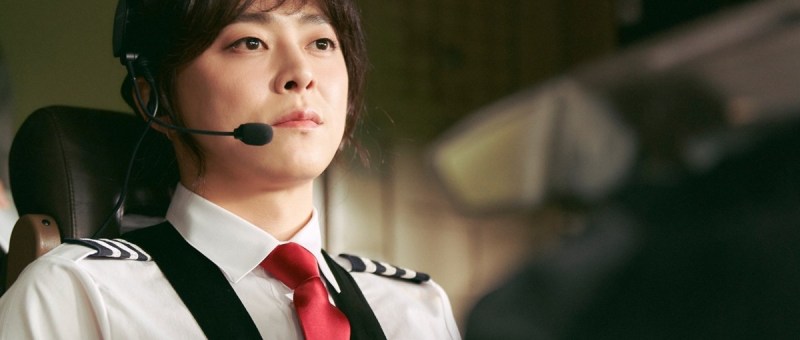
Pilot (파일럿, Kim Han-gyul, 2024)

“You can’t say things like that anymore,” the men of Pilot (파일럿) are fond of chuckling but still they think them and on a baseline level are unable to understand what’s wrong with what they see as merely offering a compliment. Adapted from the 2012 Swedish film Cockpit, Kim Han-gyul’s non-romcom takes its cues from films like Tootsie and Mrs Doubtfire to explore the inherent sexism and misogyny at the heart of contemporary Korean society if perhaps problematically doing so through the means of a male redemption story.

In any case, Han Jung-woo (Jo Jung-suk) is mindless more than anything else later claiming that sometimes it’s better “to say yes and go with the flow” than risk creating unpleasantness. Seemingly excelling at everything, he graduated top his class at the Korean Air Force Academy and was fought over by several large airlines becoming a minor celebrity and apparent pilot influencer. But behind the scenes, he’s somewhat false and self-involved as evidenced by his attempt to show off a video of himself tearfully paying tribute to his mother for raising him and his sister alone but refusing to answer a telephone call from her at the same time. His celebrity fame comes back to bite him when a video of team dinner in which he rejected his boss’ comment about the new intake of stewardesses not being pretty enough by referring to them as a beautiful bouquet is leaked online. The clip goes viral with his boss getting the brunt of the abuse and while he is not visible many are able to identify him by his voice. The airline soon goes bust and unsurprisingly no one else is willing to hire him. 

The issue is that neither his boss nor Jung-woo understand what was wrong with what they said. They just parrot back that what they said was nice so they can’t see the problem with it but fail to understand that their comments are demeaning because they belittle women’s talents and reduce them to objects for male appreciation. Hyun-seok (Shin Seung-ho), who attended the Air Force Academy with Jung-woo, gets him an interview at his airline but it’s run by a female CEO (Seo Jae-hee) who happens to be the sister of his old boss and is apparently on a mission to make her company more egalitarian by having at least 50% female pilots so she’s only hiring women. Nevertheless, she also asks sexist questions at the interview looking closely at a female candidate’s age and asking her if she is married or in a relationship, whether she intends to have children and when. The female candidate fires back a pre-prepared speech that she’s uninterested in marriage and is not planning to have her eggs frozen or anything like that so she can devote herself fully to the job. 

Hyun-seok expresses sympathy, echoing Jung-woo’s earlier comment that all that matters in flying is skill and people should be hired for their merits not their gender. But it’s impossible not to read into his words that he thinks women are inherently not as capable as men and wouldn’t be getting the job at all if it weren’t for this affirmative action, which is to say it’s all about gender after all and only men are suited to the job. He says as much later on when the plane he’s piloting runs into trouble while he’s unwittingly co-piloted by Jung-woo in his female persona Jung-mi, having posed as a woman in order to pass the interview. “Men should step up during times of emergency, not women,” he screams while losing the plot as the plane plunges and refusing to hand over the controls to his female co-pilot until Jung-woo takes them by force. 

Despite being slightly younger and believing himself to be a modern man, Hyun-seok is still incredibly sexist and openly flirts with Jung-mi to the point of sexual harassment even while she bluntly tells him that she isn’t interested. Jung-woo had been flattered and overjoyed the first time someone called him “miss” on the street and alluded to his unconventional, broad-shouldered beauty but quickly discovers that that gets old and becomes aware of how “annoying” or even scary some men can be in their entitled treatment of women, and by extension the various ways in which his own treatment of women may not have been appropriate. Becoming Jung-mi allows him to become himself, rediscovering his love of flying no longer so hung up on the external validation of internet fame and more interested in and considerate of those around him in the absence of the kind of toxic masculinity that infects men like Hyun-seok.

Though his wife divorces him when he loses his job if more because of his persistent emotional neglect than disappointment or financial worry, he becomes more aware of and sympathetic towards his son who, just as he had says yes and goes with the flow by saying a toy aeroplane was fine despite having been engrossed in the Barbie aisle seconds before but presumably afraid of disappointing his father if he told him he’d rather have a doll instead. Nevertheless, the film strangely refuses to engage with ideas of gender and sexuality and becoming Jung-mi does not really unlock Jung-woo’s femininity even if it evidently makes him a better and more considerate person, while his sometime love interest Seul-gi (Lee Ju-myoung) is more or less queer coded and her attempts to stand up for herself as a woman and an equal are not always well respected by the film. Even so the betrayal of CEO Noh who is revealed to be a ruthless businesswomen perfectly willing to exploit other women and throw them under the bus if necessary highlights the ways in which entrenched patriarchy pits women against each other. 

Thus the underlying misogyny of the present society is fully exposed, if ironically by a man experiencing what it is really like to live as a woman which is to be ignored and disrespected, judged by appealingness to men and obedient temperament while skills go undervalued or worse are viewed as a threat to often fragile masculinity. Though the film largely avoids making Jung-woo’s cross-dressing a joke in itself, it does find humour in the absurdity of the demands of performative femininity in a rigid and conformist society in which a woman is rarely permitted to sit in the cockpit of her own life.


International trailer (Simplified Chinese & English subtitles)

The Running Actress (여배우는 오늘도, Moon So-ri, 2017)

running actress posterIn international eyes at least, Moon So-ri is one of Korea’s most prominent actresses. She has worked with such highly esteemed directors as Lee Chang-dong, Hong Sang-soo, and Park Chan-wook, yet she continues to face the same kinds of issues as many women in the film industry despite her immense critical success and popularity at the box office. The Running Actress (여배우는 오늘도, Yeobaewooneun Oneuldo) is her first feature as a director and brings together three of her short films which neatly form a tryptic depicting the trials and tribulations of the contemporary actress.

Moon also stars in the films, playing a character called Moon So-ri, apparently inspired by her “real” life. Kicking off with the first segment titled The Actress, Moon introduces the fears and anxieties which recur throughout most notably in her preoccupation with gaining good roles and worrying that she is losing out on them though not being “pretty” enough. Her friends, attempting to be supportive, only add to her discomfort by assuring her that she is pretty “in her own way” and reminding her that in any case she is a wonderful actress. Confidence at rock bottom, Moon laments that her industry prefers airheaded beauty to technical skill and is unwilling to accept that women continue to exist past the age of 25 without suddenly morphing into spiky aunties and salty grandmas. Unexpectedly running into a producer whilst hiking, she gets a temporary boost when it seems he has her in mind for a dream project with a director she’s long wanted to work with but is dismayed when she realises the character has a college age child meaning she’ll be making a possibly irreversible step into playing suffering mothers rather than interesting women with nuanced character arcs.

Meanwhile, she runs into the producer and his friends at an inn on the way down and is forced to endure a drinking session with two starstruck fans whose increasingly drunken conversation turns to the rude and loutish in which they too begin picking apart Moon’s looks while mocking her acting skills, one of them even offering a slightly offensive caricature of her award winning performance as a disabled woman in Lee Chang-dong’s Oasis (the title of which he seems to have forgotten).

Moon’s fears and insecurities follow her into her family life in the second chapter, The Running Actress, which finds her attempting to juggle the demands of being a wife and mother with her acting career. In a running joke, everyone seems to assume that mega famous actress Moon So-ri must be filthy rich but like everyone else she has trouble making ends meet, especially as she is constantly worrying over where the next job is coming from. As if that wasn’t enough she also has to put up with her mother continuing to treat her like a petulant teenager (which to be fair her behaviour sometimes mimics) and trading photo opportunities for free dental work, while her adorable little daughter is sharp as a tack. 

The social and the professional come together in the final segment which sees Moon attend the funeral for a director she once worked with years ago and to tell the truth did not particularly like. Planning to show her face but not stay very long, Moon is dismayed to realise she is one of an extremely small number of mourners which include a drunken actor she doesn’t really get on with either, and an aspiring young actress who may have been involved in an improper relationship with the late director in the hope of furthering her career. In a lovely human touch, Moon breaks away from the rapidly declining situation at the wake to spend some time with the director’s young son who has been left all alone watching a few home videos his father shot by means of a handheld projector.

The film takes its title from a humorous moment in the second chapter in which Moon suddenly orders her driver to stop the car and jumps out to run away screaming, making a bid for frustrated freedom from her often exasperating life and career. Moon is obviously not afraid to poke fun at herself or her industry, taking her (presumably very real) fears and insecurities and exposing them for all to see. Taking a cue from Hong Sang-soo, Moon’s deadpan style only adds to the comic effect of her razor sharp dialogue which is filled with small moments of everyday humour somehow assuming wider dimensions thanks to the well crafted nature of the script. Addressing real problems faced by women today in all walks of life, The Running Actress is a warm and funny effort from the veteran performer turned first time director and will hopefully pave the way for an interesting second career.


Screened at the 20th Udine Far East Film Festival.

Original trailer (Korean subtitles only)