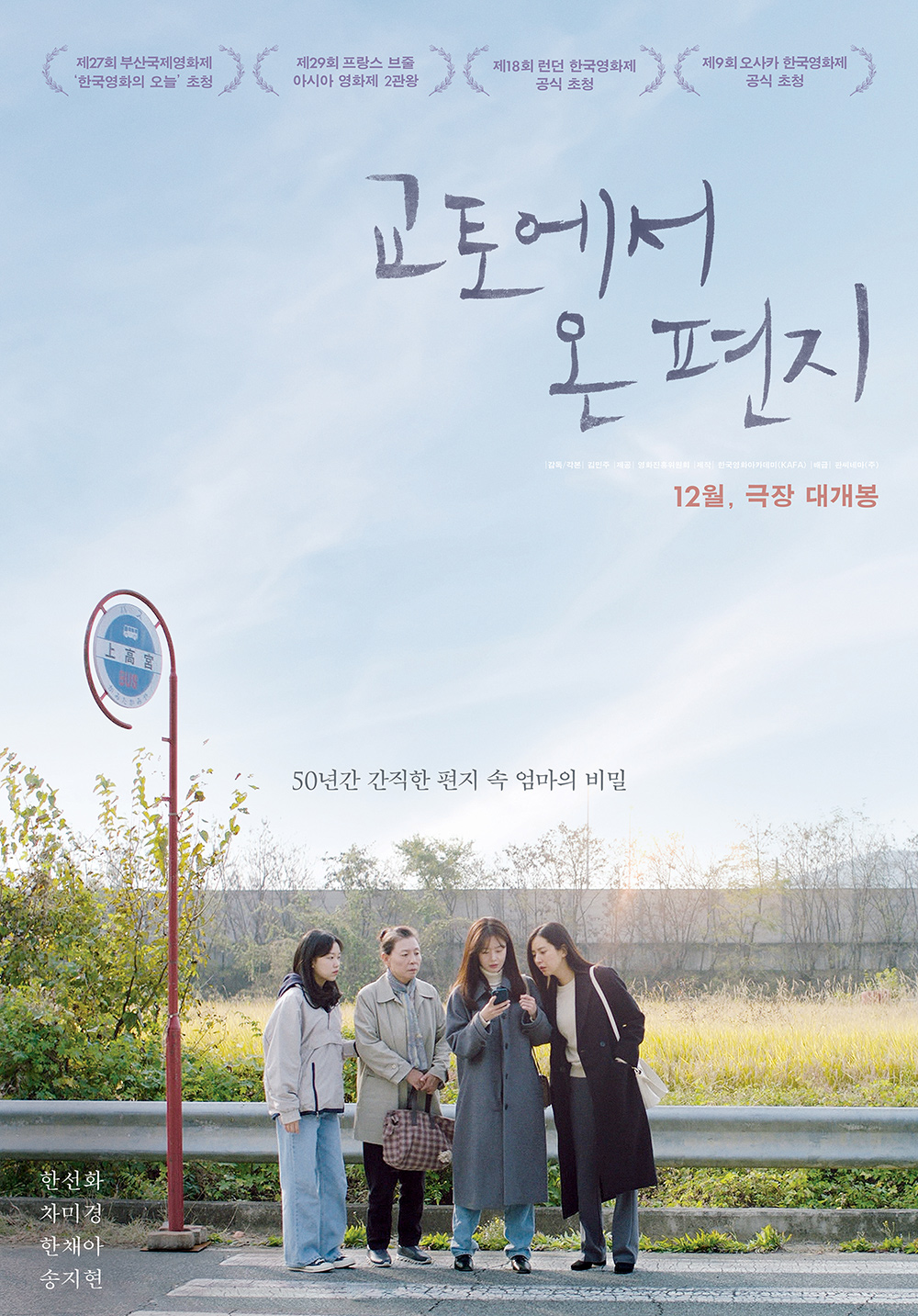
A Letter from Kyoto (교토에서 온 편지, Kim Min-ju, 2022)

A disillusioned young woman returns to her hometown in search of healing but finds it in a state of disrepair in the fracturing relationship between her two sisters, one approaching middle age and the other yet to graduate high school, and her ageing mother entering the first stages of dementia in Kim Min-ju’s poignant debut feature A Letter From Kyoto (교토에서 온 편지, Gyoto-eseo on Pyeonji). As the title implies partly a story of dislocation, seeking both an escape from and return to the safety and comfort of a hometown, the film explores the destructive effects of secrecy and miscommunication between those who ought to share a greater intimacy.

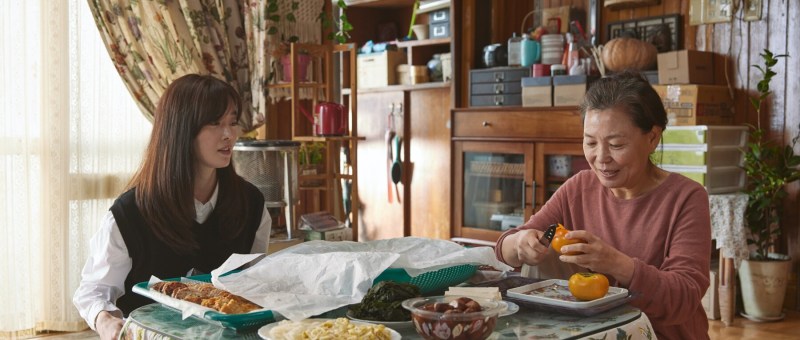
Hye-young (Han Sun-hwa) couldn’t wait to get out of Yeongdo and has been living in Seoul for the past several years with the aspiration of becoming a writer but has been earning her living working for a TV station making educational programmes. It’s clear that something has gone wrong for her in her sudden and unannounced visit home, though she only explains that she’s taking break. Meanwhile, she begins to notice that her mother, Hwa-ja (Cha Mi-kyung), has become forgetful and easily confused. Not only is she overstocking her fridge with multiple purchases of persimmons but habitually picking up the leftover kimchi from the kitchen where she works despite reminders from her otherwise sympathetic boss not to. 

The ages of the three sisters, like those of the Chekhov play marooned in the provinces, seem to be representative of the passage of a life. The youngest, Hye-joo (Song Ji-hyun), is boisterous and full of dreams keeping her hopes of becoming a hip hop dancer a secret on remembering all the fuss surrounding Hye-young’s announcement that she wanted to become a writer. Oldest sister Hye-jin (Han Chae-ah) by contrast is cynical and worldweary. She supports the family with her job in a mid-range handbag shop where she once dated the manager only he decided to break up with her because she didn’t want to leave Busan and had no interest in money. 

Hye-jin later tells unexpected love interest Polish sailor Piotr that she has never been abroad perhaps because she’s in a sense afraid to leave while constrained by her sense of duty owing to being the older sister, mildly resentful of Hye-young for abandoning them and shifting all of the burden onto her. A sense of displacement floats around the family home in part because of Hwa-ja’s childhood past, born in Japan and then brought to Korea by her Korean father without her Japanese mother’s knowledge. The film’s title comes from a series of letters the daughters find that are written in Japanese, a language that Hwa-ja claims to have forgotten though is perhaps slowly returned to her as they begin to translate in an attempt to retrace and reclaim the past that been hidden from them.

Though she recounts a fear of discrimination because of her Japanese ancestry, Hwa-ja had never particularly hidden her past answering Hye-young’s questions as to why she never mentioned it with the reasonable reply that she never asked. A sense of secrecy and miscommunication continues to divide the sisters with Hye-young reluctant to discuss the reasons behind her desire to return home, Hye-joo keeping her dancing dreams a secret, and Hye-jin not saying much at all in her disappointment and resentment. It frustrated Hye-young that her mother never throws anything away, but to her it would be like throwing away a part of her past self and another act of forgetting aside from that she no longer has any control over.

Yet the film seems to suggest that Hwa-ja need not remember everything when her daughters can remember it for her, adopting her orphaned memories into their own stories while she too is able to make a kind of peace with the past on reclaiming the memories of her own mother that were otherwise lost to her through linguistic and geographical displacement. Exposing the secrets and repairing the fracturing past frees each of the sisters to follow a path that more suits them, accepting that there’s a time to leave your hometown, and a time to return, whether or not or one eventually decides to stay. Poignant and somewhat elegiac, the film eventually celebrates maternal and sisterly connections extending beyond the immediate family in the presence of Hwa-ja’s staunchly loyal childhood friend along with a sense of serenity in rootedness to a particular place that represents a home.


A Letter from Kyoto screened as part of this year’s London Korean Film Festival.

Trailer (no subtitles)
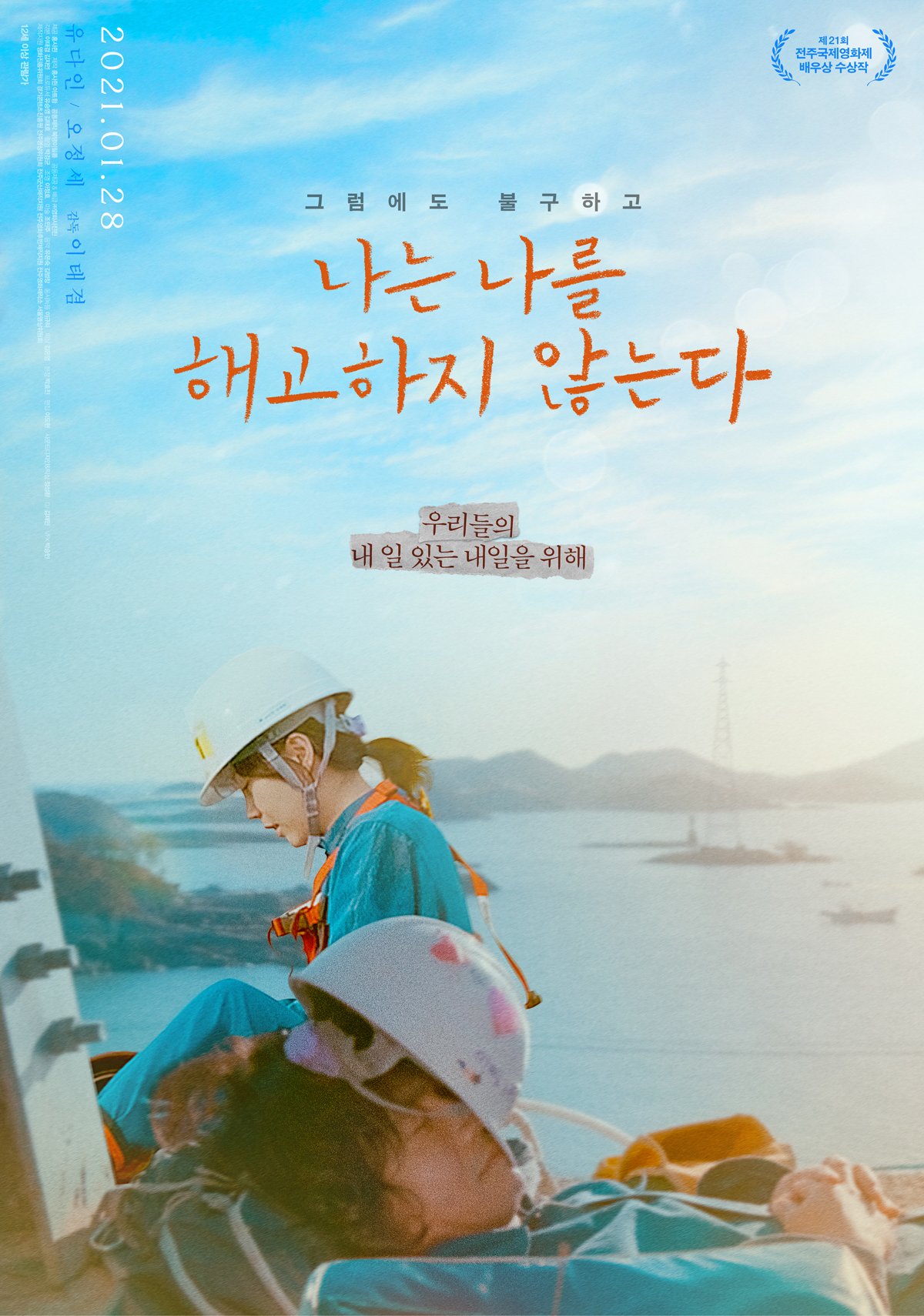
I Don’t Fire Myself (나는 나를 해고하지 않는다, Lee Tae-gyeom, 2020)

“All we asked for is not to die” a disgruntled employee reasonably explains, finally finding her voice on being confronted with the consequences of her complicity. Lee Tae-gyeom’s impassioned workplace drama I Don’t Fire Myself (나는 나를 해고하지 않는다, Naneun Nareul Haegohaji Anneunda) is the story of one woman’s path towards reclaiming agency over her life, but it’s also a subtle condemnation of rampant capitalism and the various ways entrenched social mores can set the oppressed against each other, hiding from the very ways they are each victims of the same social order. 

30-ish Jeong-eun (Yoo Da-in) is a talented employee working at an electrical company but her capability only makes her a threat to her male bosses. Insisting that “it’s not about whether a woman can do the job”, her superior forces her to accept a one-year transfer to a rural electrical engineering subcontractor promising that if she works out the contract she can come back to HQ. Resolving to make the best of a bad situation Jeong-eun soon realises her new boss is not keen to have her. Her presence is an obvious inconvenience to the other three male employees who must now put a curtain up so they can change into their work clothes while resenting the unexpected intrusion into their working life. What soon becomes clear to Jeong-eun is that her new assignment is in reality just an elaborate form of “banishment room”-style constructive dismissal. Her old boss is trying to make her working life so miserable that she’ll quit on all her own. 

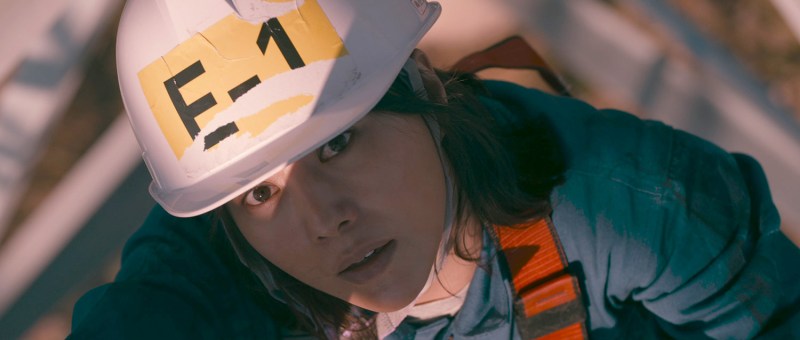
Only, as a friend of Jeong-eun’s points out, neither of them can afford to quit because it’s so unlikely they’ll be able to find alternative employment. Jeong-eun was good at her job, but as a woman she has very little chance of career advancement and had to work twice as hard as the men just to be employed. Perhaps for these reasons, she refuses to quit resolving to stick out the year in the sticks to see what happens, but her new manager refuses to give her any work and is himself pressured by the higher ups to either push Jeong-eun towards resignation or engineer a reason to fire her. Her male colleagues only come to resent her more when it’s revealed that the substation is expected to cover her salary out of their budget which is also being reduced meaning someone will likely be out of a job. Hoping to win their trust and respect, she studies electrical engineering manuals in her off hours and offers to accompany them into the field but is quickly undone by anxiety as she looks up at the tall towers of the electricity pylons unsure how she could ever scale them. 

There is something of a potent metaphor in Jeong-eun’s attempts to climb these infinite structures while the men around her laugh and try to pull her down. Latterly sympathetic colleague Seo (Oh Jung-se) snaps at her that for men like him getting fired is worse than dying and the reason she can’t climb is that for her it never will be. But Seo has in a sense miscalculated. Jeong-eun may be educated and middle class, but as she claps back to her getting fired and dying are synonyms. They are each victims of the same system, but blind to the ways they are similarly misused. Jeong-eun knows only too well the costs of getting fired, her grief over a close friend who took her own life after being forced out of her job possibly contributing to her self-destructive drinking problem. Seo meanwhile is constantly being reprimanded for falling asleep on the job, largely because he also works a series of part-time gigs to make ends meet such as manning the till in a convenience store and working as an Uber driver. As Jeong-eun discovers this dangerous, highly skilled work which is essential both for public safety and economic support pays almost nothing while the workers are also expected to provide their own protective safety gear including electric resistant overalls which run to $1000. 

The inspectors sent to undermine Jeong-eun and pressure the manager harp on about how the company has already been privatised and can no longer afford “inefficiency” while continuing to exploit their employees and ride rough shod over both employment law and people’s basic rights. Jeong-eun has three months to decide if she wants to try suing them for constructive dismissal but is warned that if she does the company will retaliate and even if she wins the quality of her working life may not improve. Yet if everyone goes on thinking only of themselves the company will continue to get away with their nefarious practices 

Pushed to breaking point, Jeong-eun’s epiphany comes only after a colleague is killed after being asked to fix a transmission tower in unsafe conditions while her slimy boss shows up to pressure his young daughter who can’t be more than 10 to sign away her right to proper compensation. She realises that she’s been “fired” by everyone in her life from her parents to her company, but has also been wilfully complicit in her reluctance to rock the boat believing that if you work hard and follow the rules you’ll eventually succeed even while intellectually knowing that that way of thinking is merely another tool used by the powerful to maintain their grip on power. She realises that she doesn’t need to fire herself too, seizing her own agency to mount a resistance towards the amoral venality of her ultra capitalist bosses by refusing to play by their rules anymore. A subtle yet pointed attack on the radiating effects of Korea’s notoriously poor labour law, I Don’t Fire Myself allows its educated middle-class heroine to find unexpected solidarity with a working-class labourer while ending on a note of positivity as Jeong-eun finds the courage to climb alone in the hope of bringing the light to others much like herself. 


I Don’t Fire Myself streams in the US Aug. 18 to 23 as part of this year’s New York Asian Film Festival.

Original teaser trailer (English subtitles)